


The $37 Billion Cleanup
On February 20, 2026, the Supreme Court ruled 6-3 that the International Emergency Economic Powers Act never gave the president authority to impose tariffs. Chief Justice Roberts wrote the majority opinion. Every dollar collected under that authority, including the reciprocal tariffs, the baseline tariffs, and the fentanyl tariffs, became money the government had taken without the power to take it.
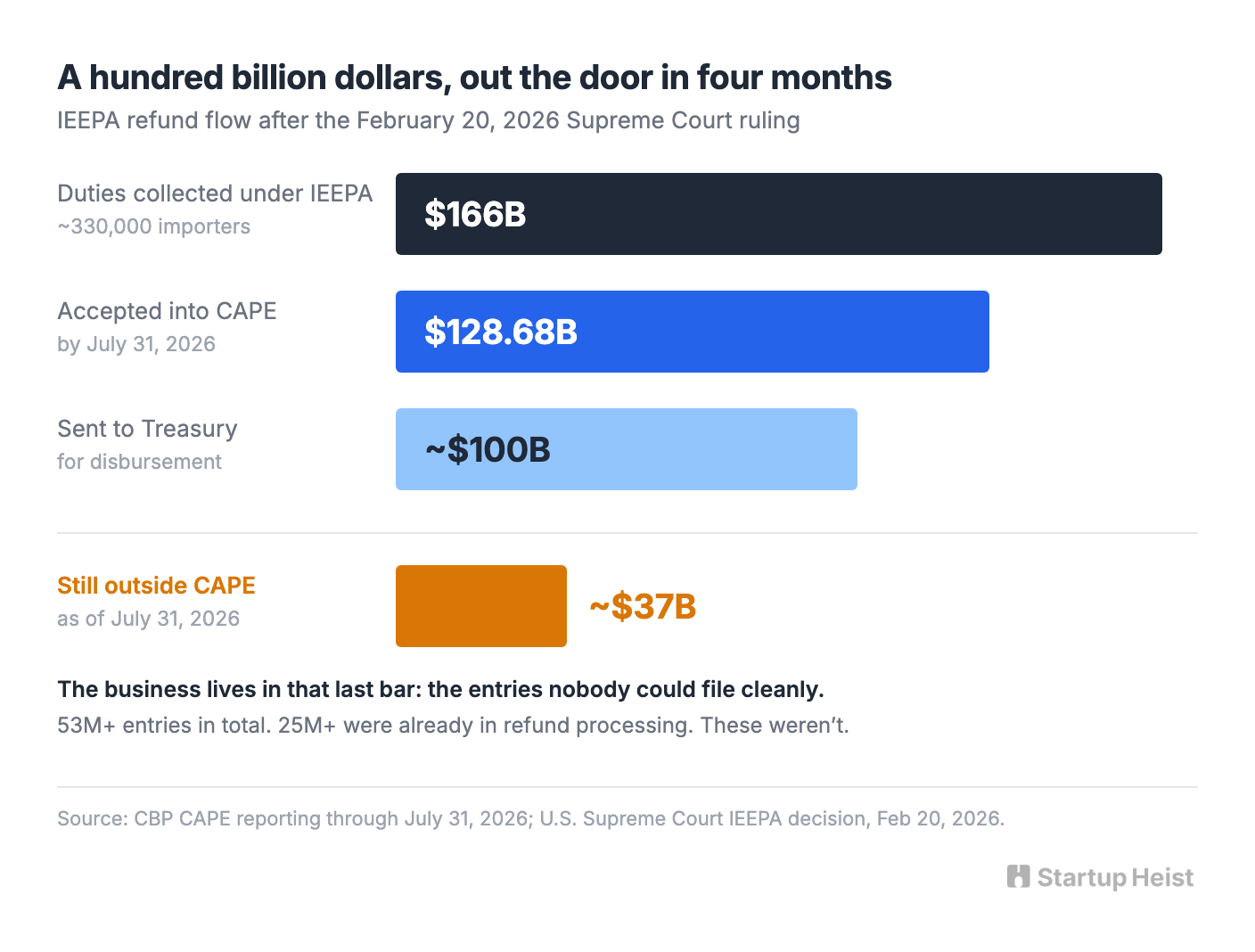
Roughly 330,000 importers had paid about $166 billion across more than 53 million import entries.
Then the federal government did something nobody had priced in. It started paying, fast.
Customs and Border Protection built a refund tool called CAPE, for Consolidated Administration and Processing of Entries, inside the existing ACE portal, and opened Phase 1 on April 20, 2026. By July 31, CBP had accepted roughly $128.68 billion into CAPE and sent about $100 billion to Treasury for disbursement. More than 25 million entries were in refund processing.
A hundred billion dollars out of a federal agency in four months. That pace killed the obvious startup before anyone finished building it.
The play everyone pitched in March was the TurboTax of tariff refunds. Upload your entries, we find your money, we take fifteen percent. That window has effectively closed. The cleanest claims are being processed at industrial scale, CBP charges importers nothing to process a refund, and at least half a dozen vendors already sell a CAPE filing package. One of them, ClaimYourTariffs, publishes flat pricing at $297, $1,497, and $4,997. Another, RefundArrow, is run by a customs law firm. The simple end of this market got commoditized in about ninety days.
What CAPE didn't solve is the mess. Fragmented records across several brokers, dormant ACE accounts, entries that fail validation for reasons nobody at the company understands, importer-of-record entities that no longer match the operating company, reconciliation flags. And roughly $37 billion that hadn't entered CAPE at all as of July 31.
Here's the opportunity:
The money: 800 customers at $1,250 average is $1 million. There are more than 200,000 small business importers, and roughly $37 billion still hasn't entered CAPE.
Inside:
• Broker Chase, the feature that wins the deal
• Flat-fee pricing ladder: $750 to $2,500
• Broker and CFO channels that own the customer
• The 2027 deadline map that creates urgency
That gap sits one layer above filing. Call it the refund-readiness layer: software and operations for sub-$20 million importers that reconstructs the entry ledger, identifies likely eligible IEEPA duties, sorts every entry into an operational path, and hands a finished package to whoever is legally permitted to submit it. Build it right and the same ledger keeps working after IEEPA, on duty drawback and every other pile of customs money nobody claims.
The opportunity is perishable and the problem underneath it isn't, which is what makes this worth stealing.
The government built the payment rail, not the recovery desk
CAPE is free. CBP doesn't charge importers a cent to process an IEEPA tariff refund, which means there's no selling access to government money. What you sell is certainty.
Take a small manufacturer that imported $3 million of components in 2025 through a freight forwarder and two brokers. The owner knows tariffs crushed her margins. What she doesn't have is a database that answers which entries actually carried refundable IEEPA duties, which charges were IEEPA versus Section 232 or Section 301 or antidumping duties that aren't coming back, which legal entity was importer of record on each entry, which broker filed it, which entries are still unliquidated, which are finally liquidated and therefore legally complicated, and whether her company is even set up to receive the money.
The ACE portal doesn't answer those questions. It expects her to arrive with the answers already in a correctly formatted CSV.
The U.S. Chamber of Commerce counts more than 200,000 small business importers in the country and warns members plainly that identifying which duties qualify is complex, recommending they consult a customs broker or counsel. That advice is correct and mostly unaffordable at this size.
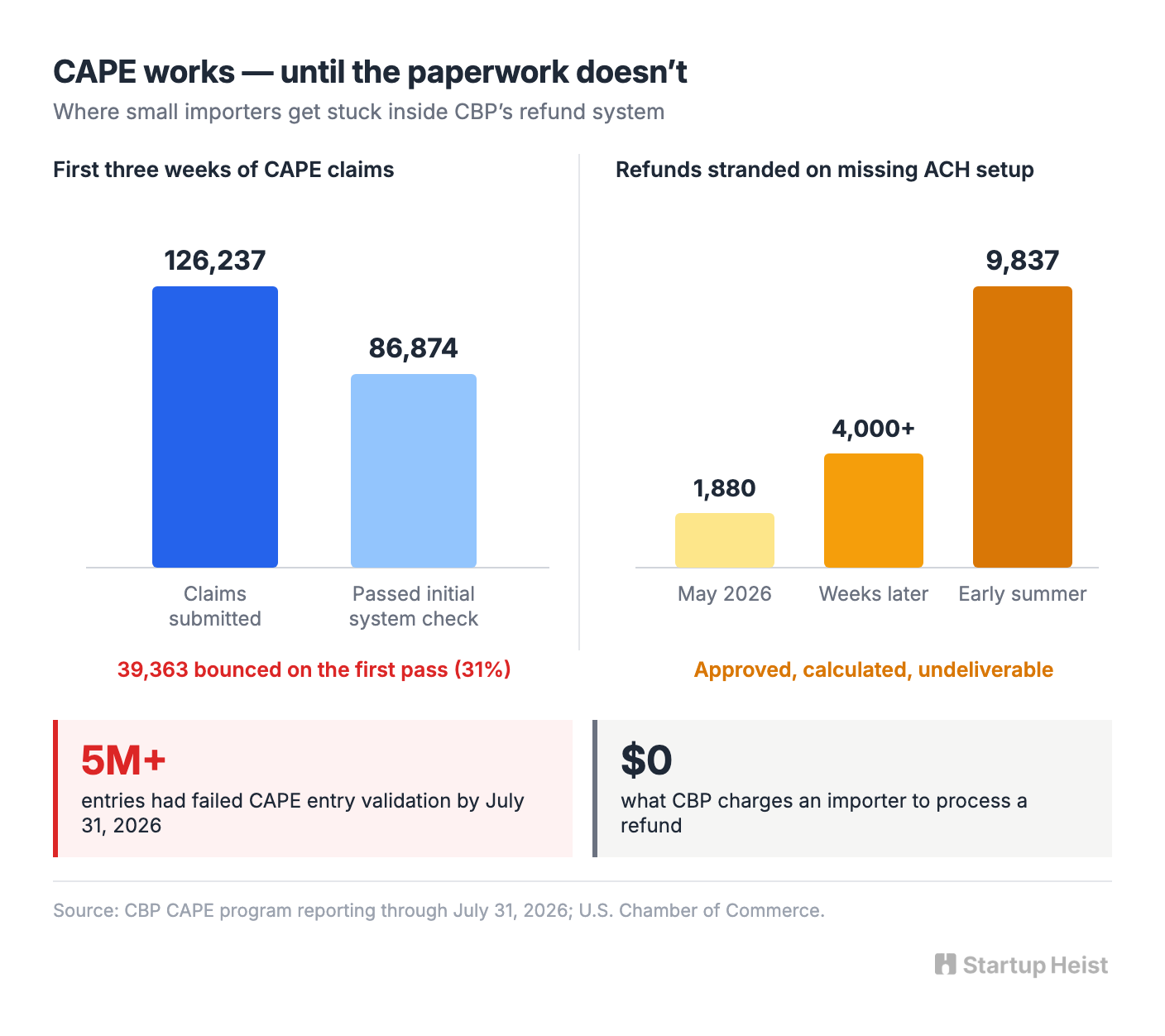
The failures are documented. In the first three weeks, 126,237 CAPE claims were submitted and only 86,874 passed the initial system check. By July 31, more than 5 million entries had failed entry validation. The most telling number in the program is the banking one. CBP reported 1,880 consolidated refunds stuck in May because the importer had never set up ACH banking with the agency, a figure that climbed past 4,000 and reached 9,837 by early summer 2026. Those refunds were calculated, approved, and undeliverable. The money sat there with nowhere to go because a small company never completed a bank enrollment it didn't know existed.
Your customer isn't Apple. It's the founder whose controller says, "I think we paid $180,000 in those tariffs, but our forwarder handled everything."
What's actually left, and what shape it's in
A lazy pitch would say $166 billion is up for grabs. It isn't. Subtract the $128.68 billion already accepted into CAPE by July 31, then cut further for sophisticated importers running the process in-house, entries tied up in litigation, and money that will land without anyone's help. The remaining dollar total tells you less than the shape of what's left.
CBP worked the easy cases first. Phase 1 took unliquidated entries and entries CBP could still voluntarily reliquidate, which the Chamber pegged at about 63% of eligible entries. Phase 2 opened June 29, 2026 for entries flagged for reconciliation where no reconciliation entry had been filed. Warehouse entries were pulled out of eligibility on July 7.
Everything after that is exception work. Five million failed validations. Entries stranded on missing bank enrollments. And Phase 3, covering finally liquidated entries, which the Court of International Trade addressed in a July 15, 2026 order that made the stakes brutally clear: importers who filed their own suits get court orders directing CBP to refund those entries. Importers who didn't are depending on a class certification fight and a government appeal that may not resolve before 2027.
This is what always happens to large administrative programs. Automation eats the happy path, and value migrates to the exceptions.
You can't be the filer, and that's good news
CBP restricts CAPE filing to the importer of record that paid the duties, or to the customs broker that filed the underlying entries. It has to be the broker that filed those specific entries, so an importer who used three brokers across 2025 may need all three to participate.
Which means "connect your account, we file everything, we take fifteen percent" isn't available to you. Stop looking for the version where it is.
Position yourself one step before filing. You reconstruct, normalize, identify, package, chase, and track. The importer or the permitted broker executes.
That reads like a weakness until you look at the customer. A company with three forwarders, two brokers, and several importer entities doesn't need a fourth broker. It needs someone to make three years of customs spaghetti legible enough that the right broker can act on it in an afternoon. The value sits in knowing what should be submitted, by whom, and what's still missing.
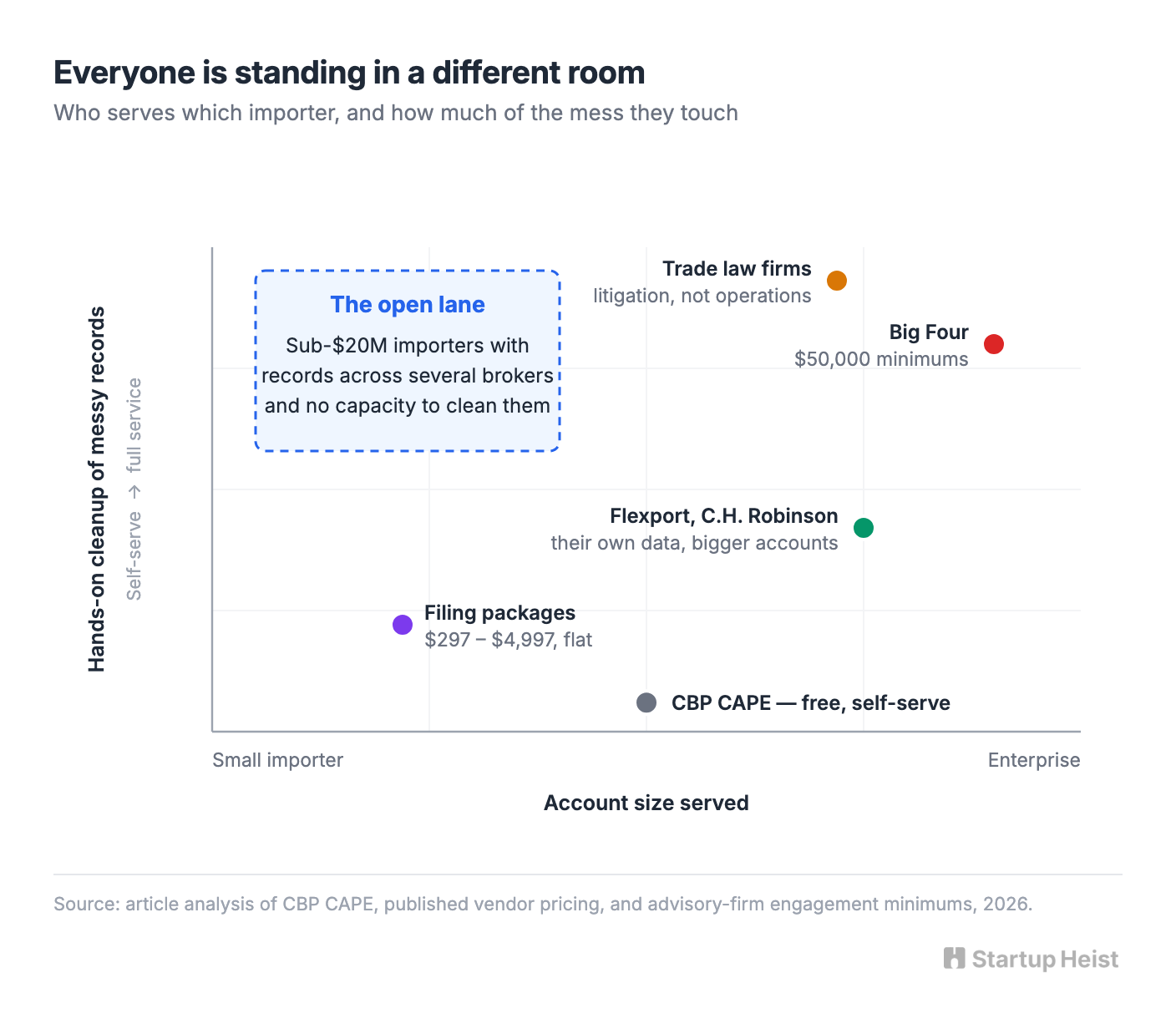
Every incumbent is standing in a different room. Flexport and C.H. Robinson hold enormous shipment data and serve larger accounts. Big Four firms have deeper compliance expertise and $50,000 minimums. Trade law firms own the litigation. CBP owns the rail and charges nothing. The account you want is too small for PwC, too fragmented for one forwarder, too operational for the lawyer, and too messy for self-service CAPE. Nobody is racing you to fill that gap. They're all declining it on purpose.
What to build: a customs recovery workspace
The home screen is a reconciliation ledger, because a ledger is the thing the customer doesn't have. It shouldn't look like tax software.
Unlock the Vault.
Join founders who spot opportunities ahead of the crowd. Actionable insights. Zero fluff.
“Intelligent, bold, minus the pretense.”
“Like discovering the cheat codes of the startup world.”
“SH is off-Broadway for founders — weird, sharp, and ahead of the curve.”


