


The Creator Lift Audit: A $3K–$10K Measurement Business for Tourism Boards
A tourism board pays a travel creator to spend four days in the country. The creator posts a cinematic Reel. It does 2.4 million views, 80,000 likes, and a comment section full of people asking where to stay.
Four months later, somebody at a board meeting asks the question nobody prepared for.
Did any of this put a person on a plane?
The marketing team doesn't have a good answer. It has impressions.

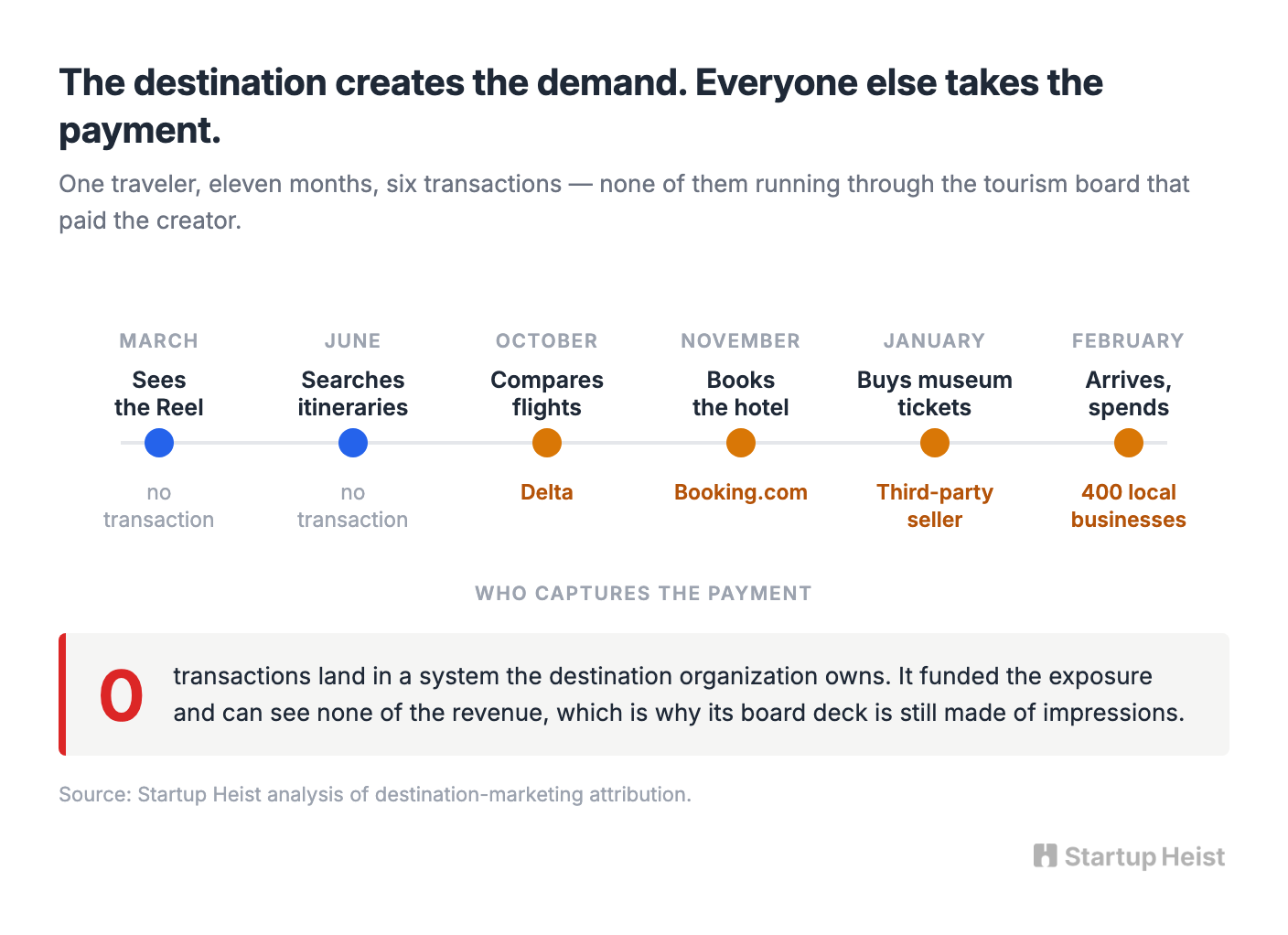
Nobody in that room is bad at their job. The problem is structural. Influencer attribution works well enough when the advertiser owns the checkout. A skincare brand hands a creator a link, watches the orders land, and has a cost per acquisition by Friday. A tourism board owns nothing downstream. Someone watches a video about Finland in March, searches winter itineraries in June, compares flights in October, books a hotel through Booking.com in November, buys a museum ticket from a third party, and arrives the following February. The destination marketing organization that generated the demand sees none of those transactions. Delta, Marriott, Airbnb, Expedia, and four hundred local businesses captured them.
So the DMO is left holding metrics that describe attention rather than travel: views, reach, saves, follower demographics, link clicks, maybe a few UTM sessions. Those numbers are real. They're also not incremental demand, and everyone in the room knows it.
The gap between attention and arrivals is where the business is.
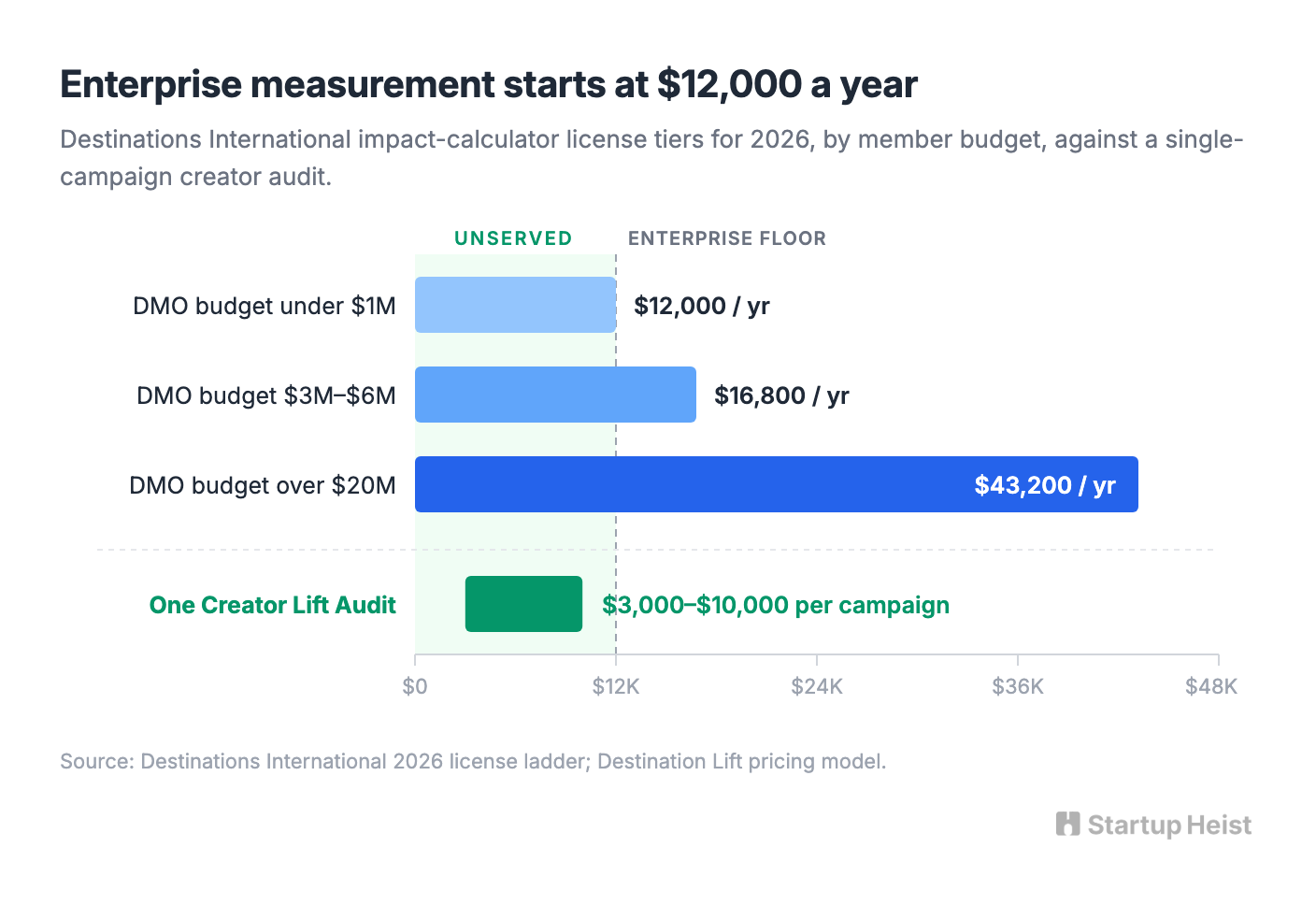
The money: Two audits a month at a $5,000 average is $10,000 monthly for a solo operator. Enterprise measurement tools start at $12,000 a year.
Inside:
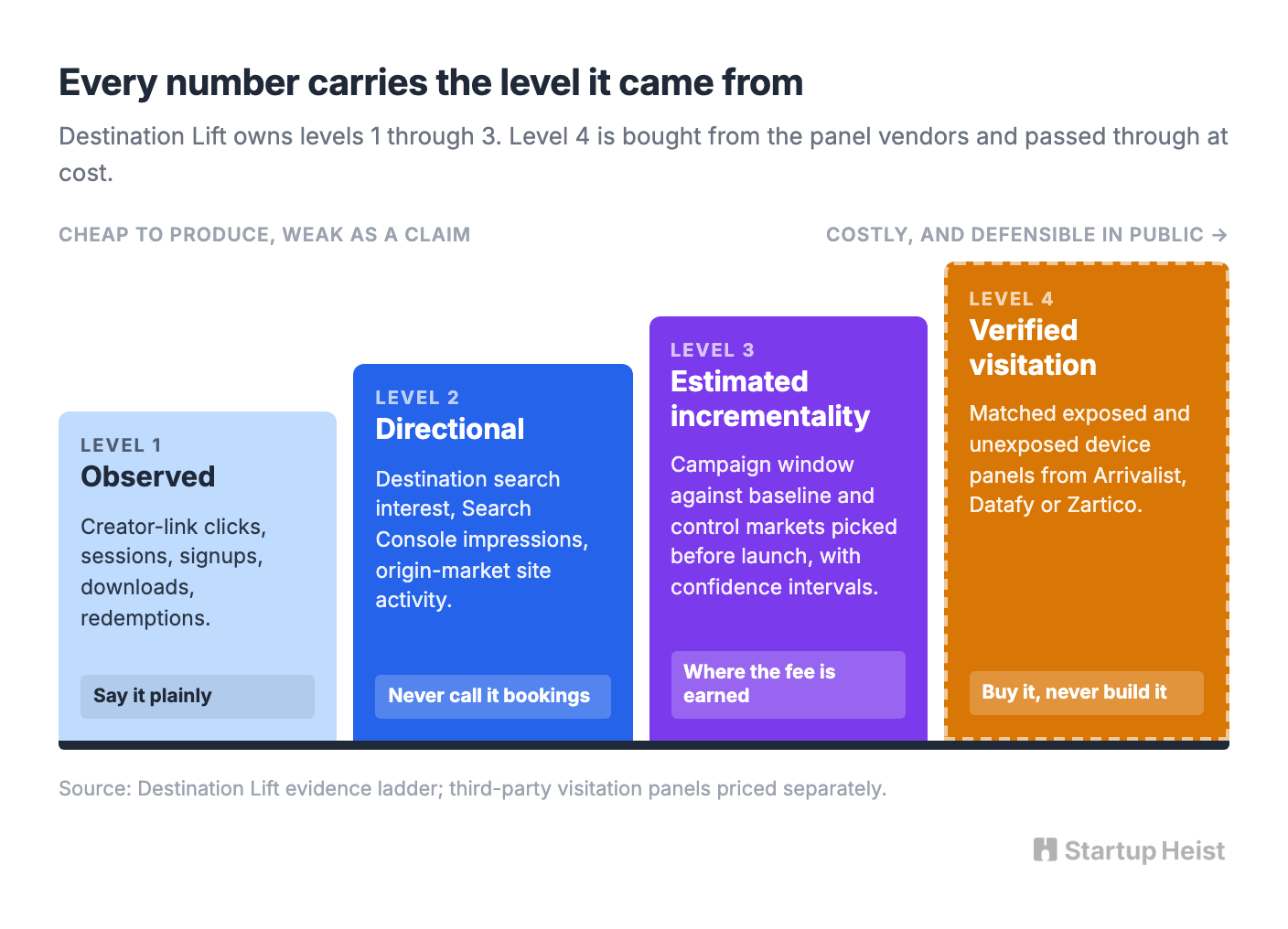
• Four-level evidence ladder for causal claims
• Pre-launch measurement protocol and UTM spec
• Three-tier pricing from $3K to $10K studies
• Agency white-label model and first-five plan
The moment this stopped being an internal annoyance
Tourism New Zealand spent NZ$6.1 million on social media influencers in the 2024/25 financial year, and more than NZ$9.4 million since 2023/24. Against that, it reported NZ$389 million in equivalent advertising value for the 2024/25 campaigns.
The Taxpayers' Union went after the gap, and its complaint was aimed at the arithmetic: an equivalent-advertising-value number can't tell you whether the creators moved anyone, or whether they were along for the ride on campaigns that would have run anyway.
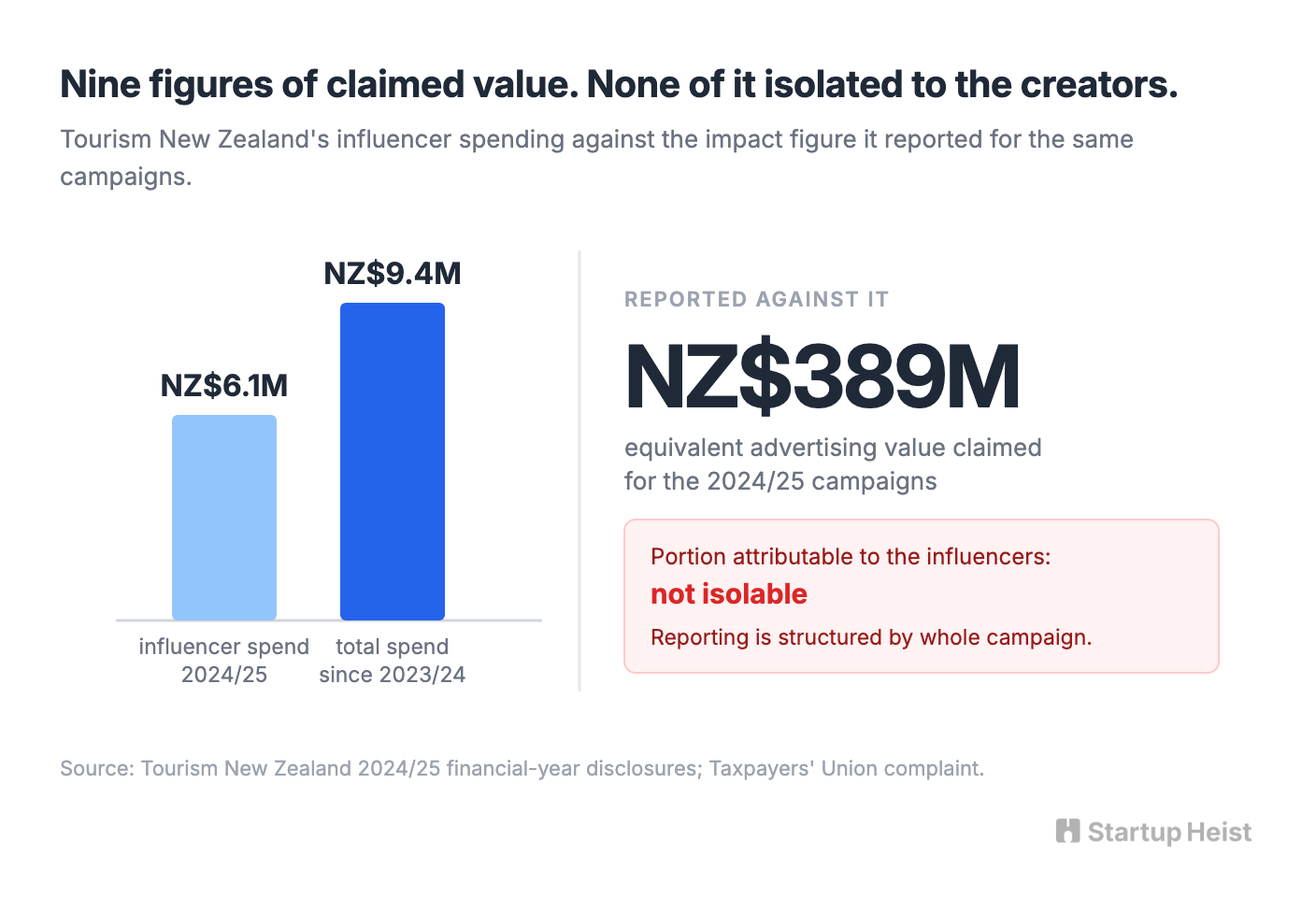
Then Tourism New Zealand said the thing that turns a political spat into a business. Its internal reporting is structured around whole campaigns rather than individual components, so it couldn't attribute any portion of that value to the influencer content specifically.
A national tourism board with a nine-figure impact claim couldn't isolate the effect of the one line item under scrutiny.
Every regional destination organization in America runs a smaller version of that exposure. Hotel-tax funded, board-governed, spending real money on creators, holding a folder of screenshots.
The buyers already pay for evidence
Destination organizations already write checks for evidence, which is how you know this is a market and not just a complaint.
Destinations International, whose membership spans more than 750 destinations, licenses an Event Impact Calculator used by over 300 destination organizations. In 2025 it launched a Website Impact Calculator with Tourism Economics that connects destination-site traffic to influenced visits and economic impact. The 2026 price ladder runs by organizational budget: $12,000 a year for a DMO under $1 million, $16,800 in the $3M–$6M band, and $43,200 for organizations above $20 million.
The private vendors sit above that. Zartico, which combines spending, lodging, and geolocation data for visitor intelligence, raised a $20 million Series A and works with more than 200 DMOs. Arrivalist builds matched exposed and unexposed cohorts from device and connected-car data to estimate incremental visits and spending. Datafy sells the same physical-world attribution logic. Outside travel entirely, a credible geo-lift incrementality program from a vendor like Haus or Measured runs from the tens of thousands into six figures a year in tooling alone.
Enterprise-grade measurement, then, starts around $12,000 a year and climbs fast. Below that, nothing exists for the specific, messy, increasingly expensive unit boards actually ask about. Nobody sells a defensible answer for one creator campaign.
The Heist
Build the independent measurement layer that sits between the creator contract and the board deck.
Call it Destination Lift. The offer is a Creator Lift Audit: a $3,000 to $10,000 productized engagement that instruments a destination influencer campaign before it launches, measures the incremental demand it produced, and turns the result into something a marketing director can defend in public.
The load-bearing word is incremental. Any dashboard can report that a Reel got 900,000 views. This answers the narrower and much harder question: what changed because the campaign ran?
Every deliverable resolves to four answers.
What did the creator directly generate? Clicks, engaged sessions, itinerary downloads, newsletter signups, partner referrals, pass redemptions.
Did destination demand change? Branded search, destination-intent queries, site activity from priority origin markets.
Was that change larger than normal, and how sure can anyone be? Campaign windows measured against historical baselines and pre-selected control markets, reported with confidence intervals, confounding events, and minimum detectable effects stated plainly.
What can the organization safely say out loud? Observed results separated from estimated lift separated from third-party-verified visitation.
That last one is where the money is. Government-adjacent marketing organizations have plenty of analytics. What they lack is analytics that survive a hostile question from a board member.
The evidence ladder
The industry reflex is to collapse everything into one magic ROI number. Do the opposite. Build the entire company around a four-level ladder, and label every figure in every report with the level it came from.
Unlock the Vault.
Join founders who spot opportunities ahead of the crowd. Actionable insights. Zero fluff.
“Intelligent, bold, minus the pretense.”
“Like discovering the cheat codes of the startup world.”
“SH is off-Broadway for founders — weird, sharp, and ahead of the curve.”


