


There is a very specific kind of market that gets large before anyone gives it serious infrastructure. Creator partnerships are there now — and the startup idea hiding inside that gap is one of the better micro SaaS opportunities we've seen so far this year.
U.S. creator ad spend hit $29.5 billion in 2024 and is projected to reach $37 billion in 2025, a 26% year-over-year jump growing roughly four times faster than the overall media industry. Nearly half of all ad spenders now consider creators a "must buy," ranking the channel just behind paid search and social media. The broader creator economy sits around $250 billion today, with Goldman Sachs projecting a path to $480 billion by 2027. North America's slice alone is forecast to grow from roughly $34 billion in 2025 to $277 billion by 2032.

But the operational infrastructure serving creators is still embarrassingly thin. Most brands partner with 10 or fewer creators, yet 59% plan to expand their programs. More inbound, more fragmentation, more ad hoc workflows, and more messages landing in inboxes that were never designed to function as revenue operations systems.
Early tools in this space are already surfacing five-figure recovered revenue per creator per month from buried inbound alone.
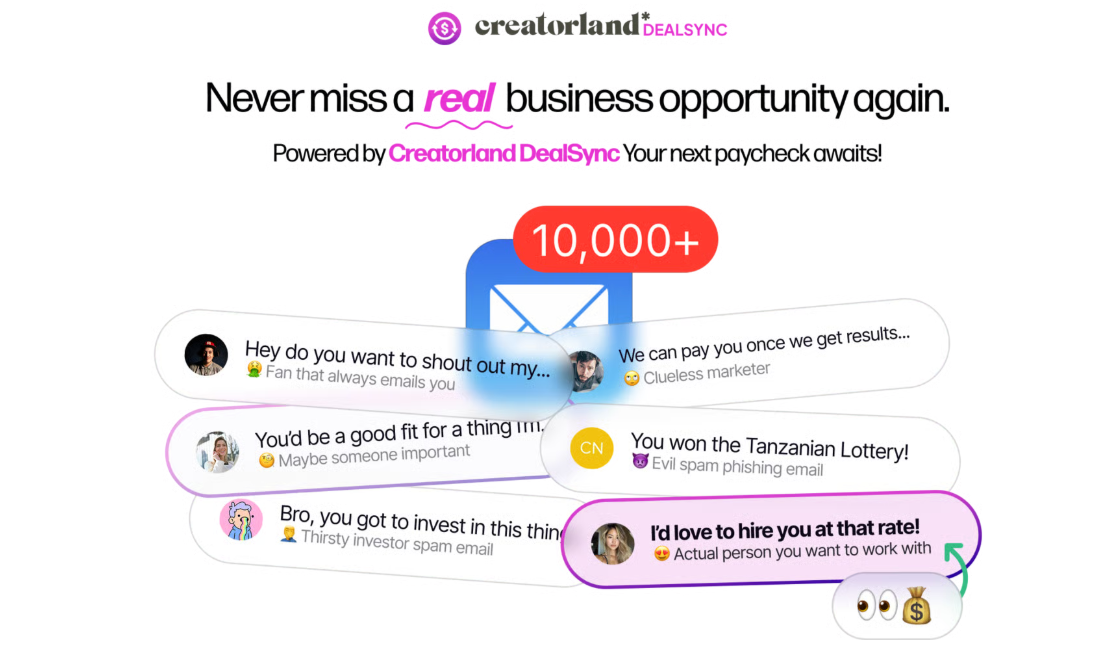
Creatorland's Dealsync tool filtered more than 500,000 junk messages for its first wave of users while surfacing over 11,000 legitimate brand offers. Their surveys found creators routinely spend three to four hours per day managing email. Talent managers reported losing 15 to 20 hours per week per client to inbox volume alone.
Then there's Marlo, an AI-native deal desk for talent management and creator teams backed by Penny Jar Capital and Andreessen Horowitz through its Speedrun program. Founded in January 2025 by Austin Chen — formerly Director of Product for creator monetization at TikTok and co-founder of Asaii, the artist discovery platform Apple acquired in 2018 — Marlo has already processed more than 500,000 inbound opportunities across thousands of brand deals. Chen's thesis came directly from watching how creators and managers actually handle inbound at TikTok: traditional CRMs and generic AI assistants were never built for the realities of creator dealmaking.
These are early movers. They validate the category without closing it. The question for builders is where the remaining white space sits.
What Is Actually Happening Here
The creator market has professionalized faster than its tooling. Creator marketing budgets surged 171% year over year according to CreatorIQ's 2025–2026 report, with nearly two-thirds of the increase pulled directly from paid and digital media budgets. Enterprises are now spending $5.6 to $8.1 million annually on creator programs. Measurement, operational maturity, and brand safety have become central concerns.
When a market becomes operationally important, whoever controls the system of record captures outsized value. In SaaS sales, that was CRM. In finance, it was terminals and data feeds. In creator commerce, the system of record is still email, DMs, and spreadsheets.
The next valuable creator tool probably won't help creators grow at all. It'll help them sort, price, and respond to inbound demand that's already hitting them. That's a far more concrete pain than "audience strategy," because it's tied directly to lost dollars, slow responses, brand risk, fraud, and underpricing.
Why This Wedge Beats "AI for Creators"
"AI email assistant" is a bad category to build in. Horizontal inbox AI will eat generic writing, summarization, and labeling. Gmail, Outlook, Superhuman, and every AI wrapper in the market can offer "draft reply" and "organize inbox." None of that is a durable business, and none of it encodes creator-specific concepts like usage rights, gifted collabs, or multi-platform package pricing.
The real wedge is commercial intent detection paired with creator-specific decision support. The product needs to answer five questions:
- Is this real? Separate legitimate brand outreach from spam, affiliate noise, and phishing.
- Is this worth responding to? Score inbound by sender quality, budget signals, and alignment.
- What is this sender likely worth? Enrich with company data, past deal behavior, and category benchmarks.
- What should I charge? Surface pricing intelligence based on comparable deals, platform, and deliverable type.
- What should I do next? Draft the right response, route to a pipeline stage, or flag for review.
That's inbound commerce middleware, not inbox software. It's a materially different product spec than "make my inbox neater," and it mirrors how successful vertical SaaS systems of record have emerged in other industries.
The strongest positioning is missed-revenue prevention for public-facing businesses. It ties directly to money and expands well beyond creators. The same pain exists for newsletter writers, podcasters, indie consultants, solo agencies, speakers, and experts with public inboxes. Anyone monetizing attention eventually needs triage.
The Best Starting Segment
Don't start with all creators. Start with the under-managed middle.
Large creators already have managers, talent reps, or agency support. Tiny creators don't have enough inbound for this to matter. The sweet spot is the messy middle: roughly 50,000 to 2 million followers, meaningful inbound, no full-time operator, and enough deal flow that missed responses actually cost money.
Marlo has targeted the opposite end, going after large talent management companies overseeing hundreds of creators. Many managers told Chen they'd love to sign more talent but simply lacked the bandwidth to manage additional inbound. At that scale, inbox volume becomes a structural constraint on the business itself.
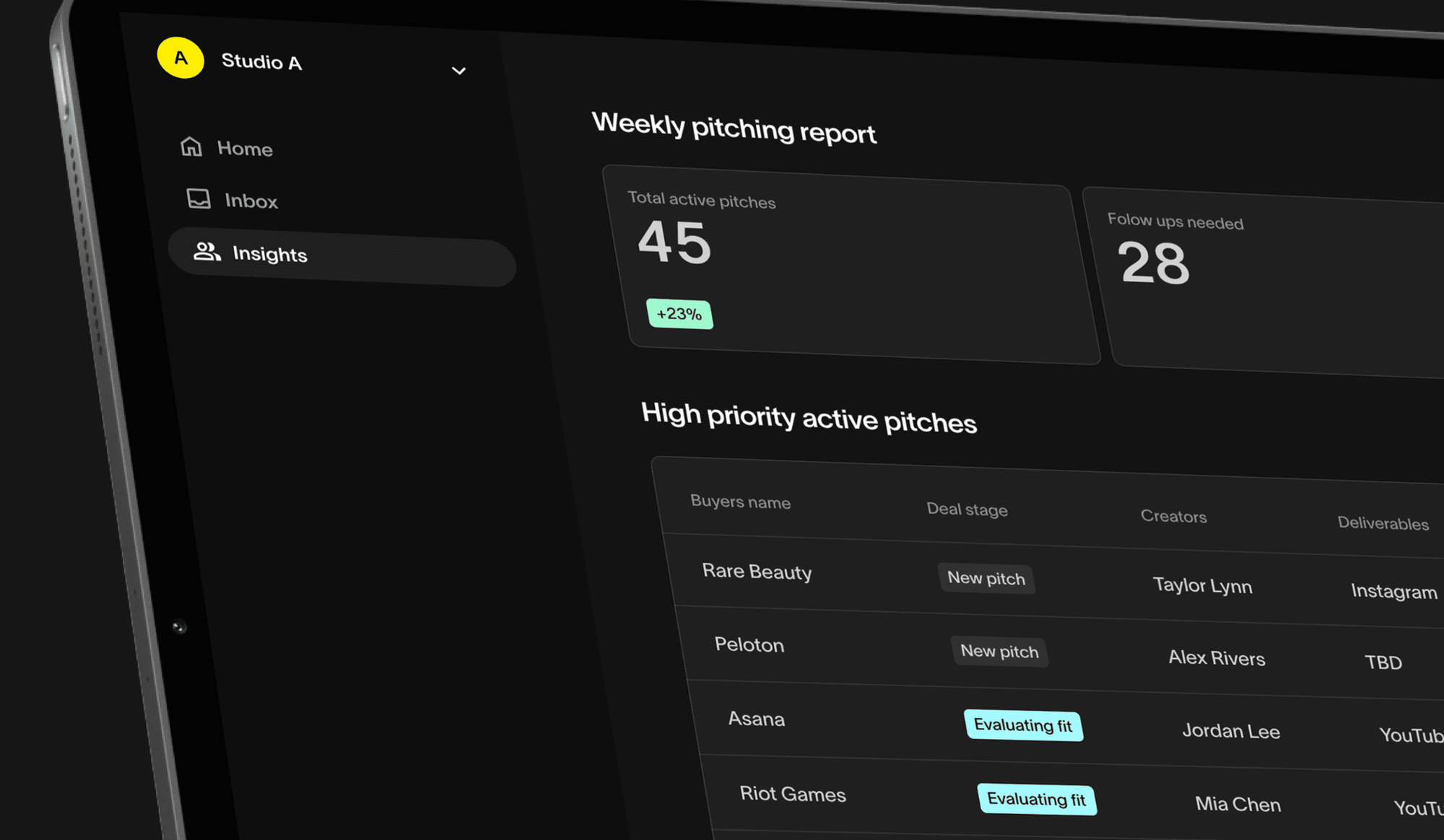
That leaves a massive underserved band. Creators who are too big to ignore inbound, too small to hire an operator, and too busy creating content to spend four hours a day sorting email. You're selling the mid-tier creator a deal desk they don't yet have.
Newsletter operators, business and finance creators, and B2B experts on LinkedIn are especially strong initial micro-segments — their ACV is higher, email is their primary commercial channel, and they already think in terms of revenue per impression.
The Real Product Is Pricing Intelligence
Most founders will stop at classification. That's way too small.
Shift your lens to what the product is and build an actual moat no one else can compete with.
Classify offers. Filter spam. Draft replies: those are wedge features, nice-to-haves.
Pricing and trust intelligence: these are where you find the deeper value.
Unlock the Vault.
Join founders who spot opportunities ahead of the crowd. Actionable insights. Zero fluff.
“Intelligent, bold, minus the pretense.”
“Like discovering the cheat codes of the startup world.”
“SH is off-Broadway for founders — weird, sharp, and ahead of the curve.”


