


Reorder Radar: The Inventory Copilot for Shopify Brands That Still Reorder by Panic
A strange thing happens when a small ecommerce brand starts working.
At first, inventory is easy. The founder knows every SKU by heart. They remember which candle sold out last Mother's Day, which hoodie size always lags, which supplier disappears in December, which product spikes whenever an influencer posts. The system isn't elegant, but it works because the founder is the system.

Then the store hits $10K, $30K, $80K a month, and inventory turns into a quiet tax on growth. The founder is still checking Shopify, staring at a Google Sheet, guessing supplier lead times, trying to decide whether to reorder 200 units or 500 before cash gets tight. They aren't running a supply chain. They're playing blackjack with boxes.
Here's the opportunity:
The money: 500 Shopify merchants at $99/month is roughly $50K MRR with a lean team. 53% of Shopify products stock out, so the pain is daily and the install case writes itself.
Inside:
• 8-feature MVP scope, GraphQL-native
• 8-12 week build plan, week by week
• Three-tier pricing from $49 to $199
• Concierge audit playbook to land beta users
• Four moat layers and a vertical pivot path
Build the explainable reorder copilot for Shopify micro-brands doing roughly $10K to $100K a month. Not an ERP, and not a venture-scale autonomous procurement platform. Something simpler: a tool that watches sales velocity, inventory levels, supplier lead times, upcoming events, and cash constraints, then says:
Order 72 units of Lavender Balm by Tuesday. At the current 14-day pace, you stock out in 11 days. Your supplier lead time is 7 days. Mother's Day search interest is rising. Recommended: 72 units, not 150, because cash coverage is tight this month.
The wedge is explained reordering. Better forecasting is a feature, not a product.
The Pain Is Operational, Not Analytical
Inventory software usually assumes the user wants more information. For a small brand, that assumption misses the job entirely.
A Shopify founder doesn't wake up wanting demand planning analytics. They wake up wanting to know if they need to reorder today, whether they can afford to reorder enough, whether they'll run out before the promo, and why a quiet SKU suddenly started moving.
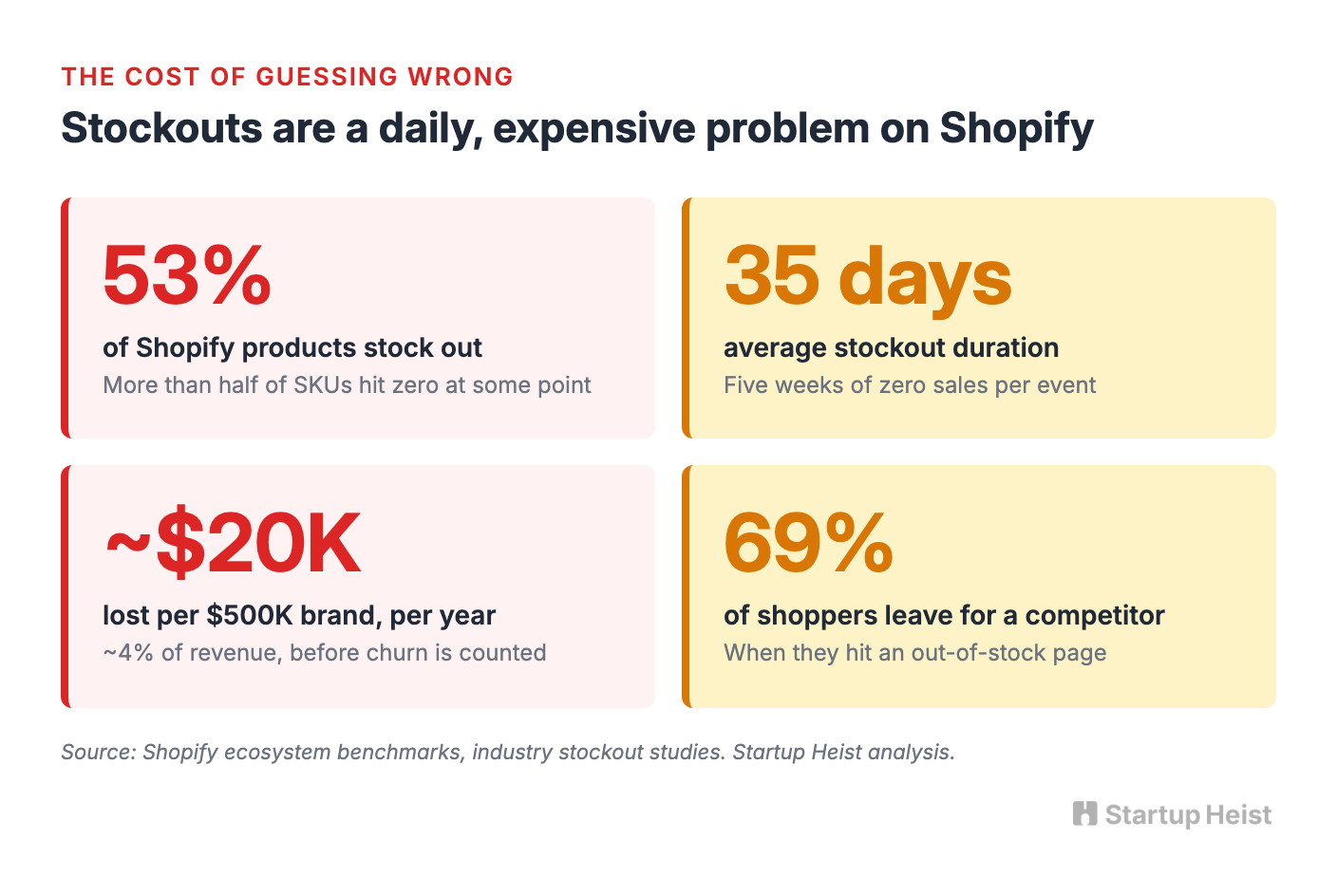
The cost of guessing wrong is brutal. Roughly 53% of products on Shopify stores experience stockouts, with each event lasting an average of 35 days. A typical Shopify brand doing $500K in annual revenue loses around 4% of sales (about $20K) to stockouts before any long-term customer churn is counted. Small handmade sellers at $30 AOV bleed $2,400 to $6,000 a year on lost sales, fees, time, and customer trust. When a shopper hits an out-of-stock page, 69% leave for a competitor immediately. Preventing two or three meaningful stockouts a year easily pays for a $79 to $199 monthly Shopify inventory app. The selling line writes itself: stop losing money because you guessed wrong.
Why Now
Three timing signals make this a 2026 opportunity.
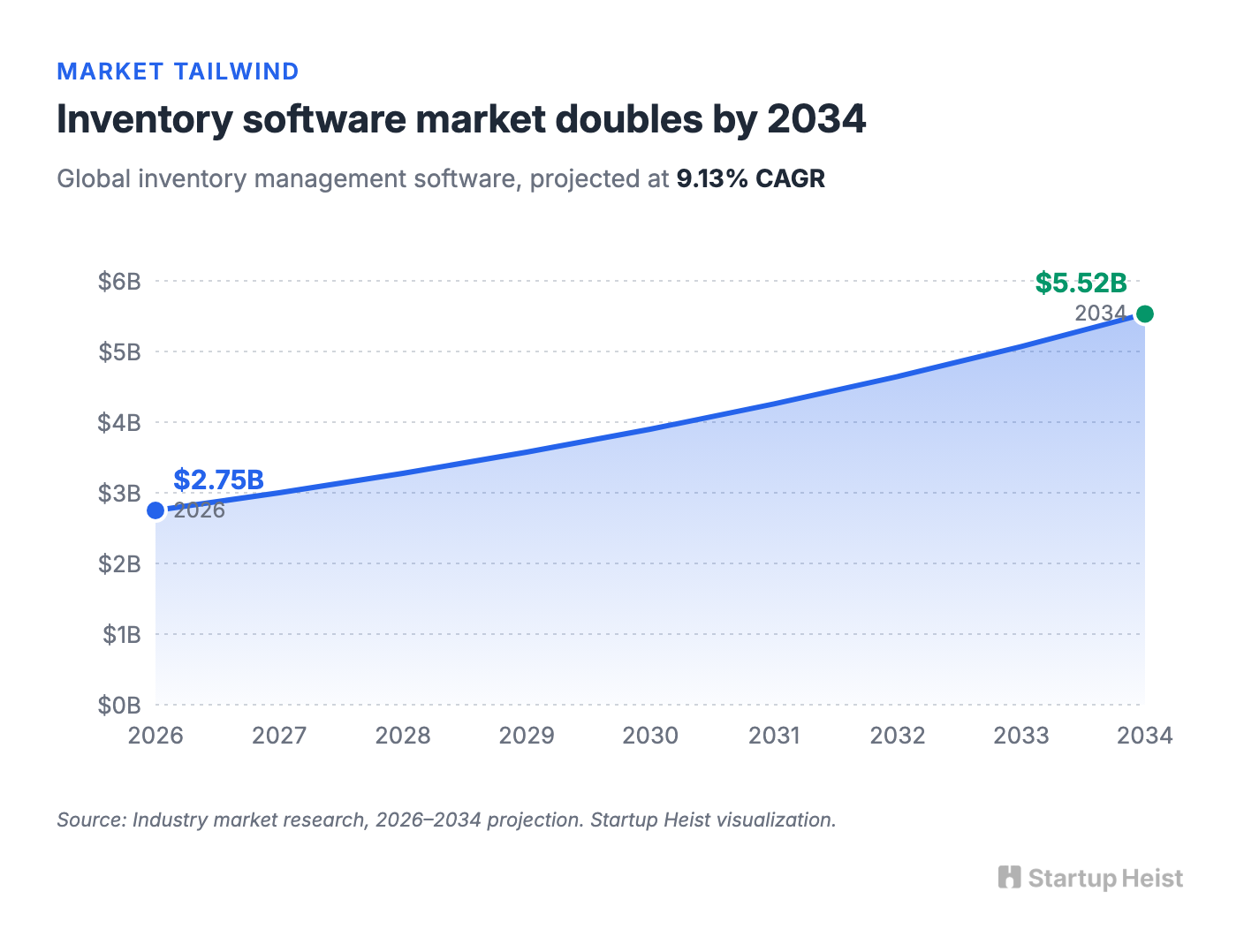
First, the market is real and growing. The global inventory management software market sits at $2.75B in 2026 and is projected to reach $5.52B by 2034 at a 9.13% CAGR. The growth is driven by complexity, not novelty.
Second, the platform shifted underneath every existing app. Shopify marked its REST Admin API as legacy on October 1, 2024, and required all new public apps submitted to the App Store from April 1, 2025 onward to use the GraphQL Admin API. Shopify ships a new API version every quarter with a 12-month minimum support window. Every legacy inventory app has been forced into a rewrite cycle, and rewrite cycles open the door to a clean GraphQL-native entrant with sharper UX and faster onboarding.
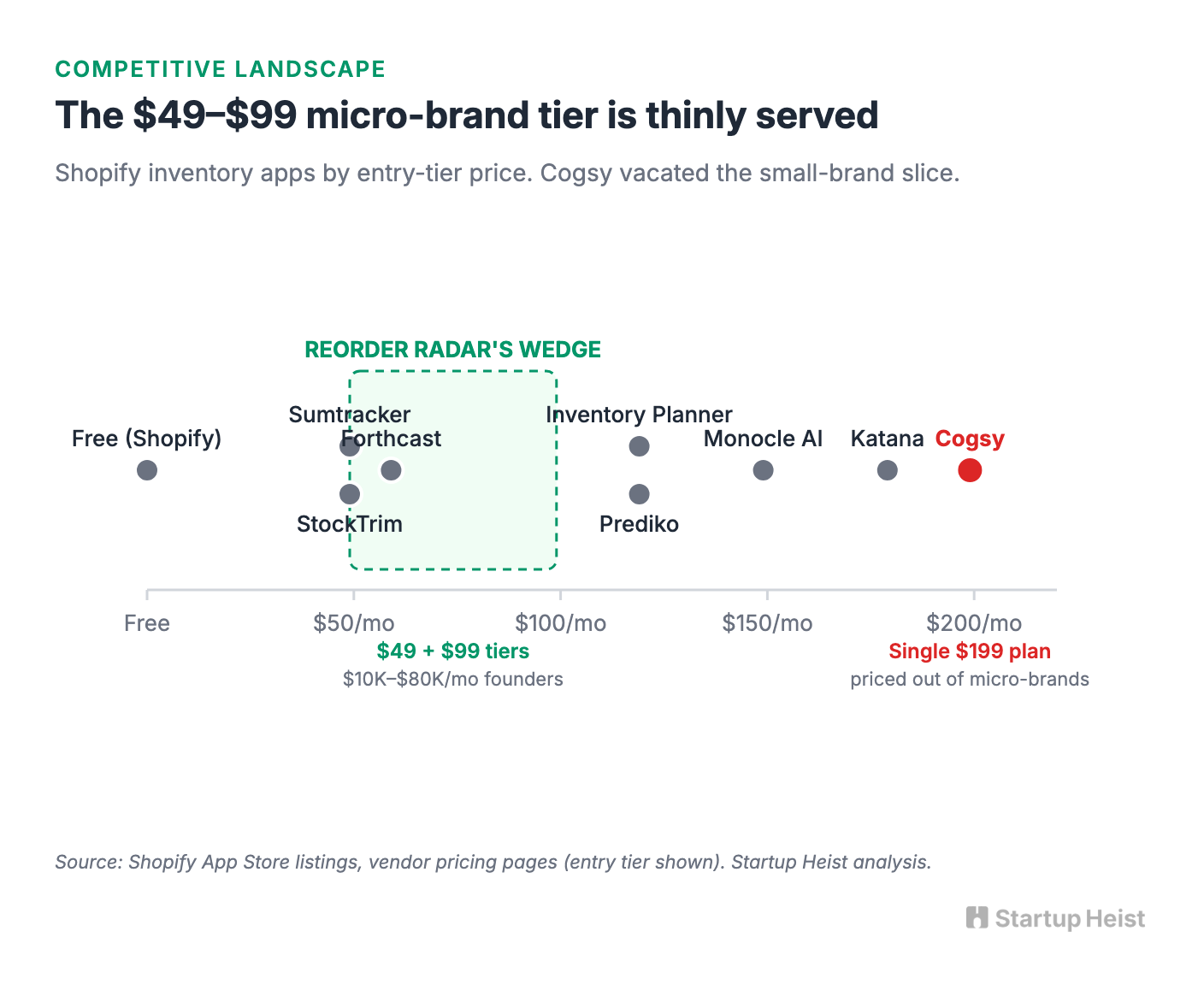
Third, the most credible incumbent has priced itself out of the micro-brand tier. Cogsy, long the category's reference point, has consolidated to a single $199/month plan. That leaves the $49 to $99 small-merchant slice — the founders doing $10K to $80K a month — wide open. Shopify's own behavior confirms platform-level appetite for AI-native tooling: it acquired Vantage Discovery, an AI semantic search startup, for $59M in March 2025. The platform wants intelligence layers built on top of it. The inventory tier just hasn't been claimed at the small-brand price point.
The Product: Decisions, Not Dashboards
Call it Reorder Radar. It does one job. It tells small Shopify merchants what to reorder, when, how much, and why.
The product should feel less like SaaS and more like a weekly operator briefing. Every Monday morning, an email lands:
Urgent Reorders
- Vanilla Body Oil — Order 120 units by Wednesday
Stock: 38 units · Velocity: 6.4/day · Lead time: 8 days · Stockout risk: 87%
Why: Velocity is up 31% over the last 14 days. Inventory runs out in 6 days. Supplier lead time is 8 days. Your last campaign lifted this SKU for 11 days post-launch.
That is the entire product. A specific instruction with the reasoning attached. The mistake would be trying to build an ERP. A second mistake would be trying to out-forecast every incumbent. A third would be pitching "AI inventory intelligence" to people who just want to avoid being humiliated by a sold-out bestseller.
Who Buys This
The first customer is the product-heavy micro-brand doing $10K to $100K a month with 10 to 200 SKUs, recurring suppliers, and enough sales history for forecasting to mean anything.

Best fits: beauty, small apparel, coffee roasters, supplements (no regulated claims), pet products, specialty food, home goods, makers, boutique CPG. Skip dropshippers, sub-$5K stores, NetSuite-class enterprises, complex manufacturers, chaotic high-SKU marketplaces, and stores driven by viral demand.
The sweet spot is the founder who has outgrown memory but won't graduate to an ERP. They have a Shopify store, a Google Sheet, supplier lead times buried in email, a VA or part-time ops person, painful stockout stories, and zero appetite for a six-week onboarding. That founder pays $79 a month because the alternative is another Saturday night with a spreadsheet.
The Crowded-but-Beatable Field
Shopify's inventory category lists more than 1,000 apps. Prediko, Inventory Planner, Stocky, Cogsy, Forthcast, Monocle AI, Sumtracker, Katana, and StockTrim all touch parts of the problem. Pricing clusters between $47 and $199 a month, with Cogsy sitting alone at the top on a single $199/month plan and the most credible micro-brand tier ($49 to $99) thinly served.
That means "AI forecasting for Shopify" is not a position. The position has to be sharper:
For Shopify founders who still reorder manually, Reorder Radar tells you exactly what to buy next, before a stockout costs you the weekend.
Most tools sell forecasting; this one sells decisions. Most assume merchants want to analyze inventory; this one assumes they want to stop thinking about it until a decision is needed. The wedge is real, but it's still a wedge, not a moat. Any competitor can bolt on AI summaries. Defensibility has to come from somewhere else, and that's where the real work begins.
The Real Moat: Workflow Lock-In
Explainability earns the first install. It does not keep the customer.
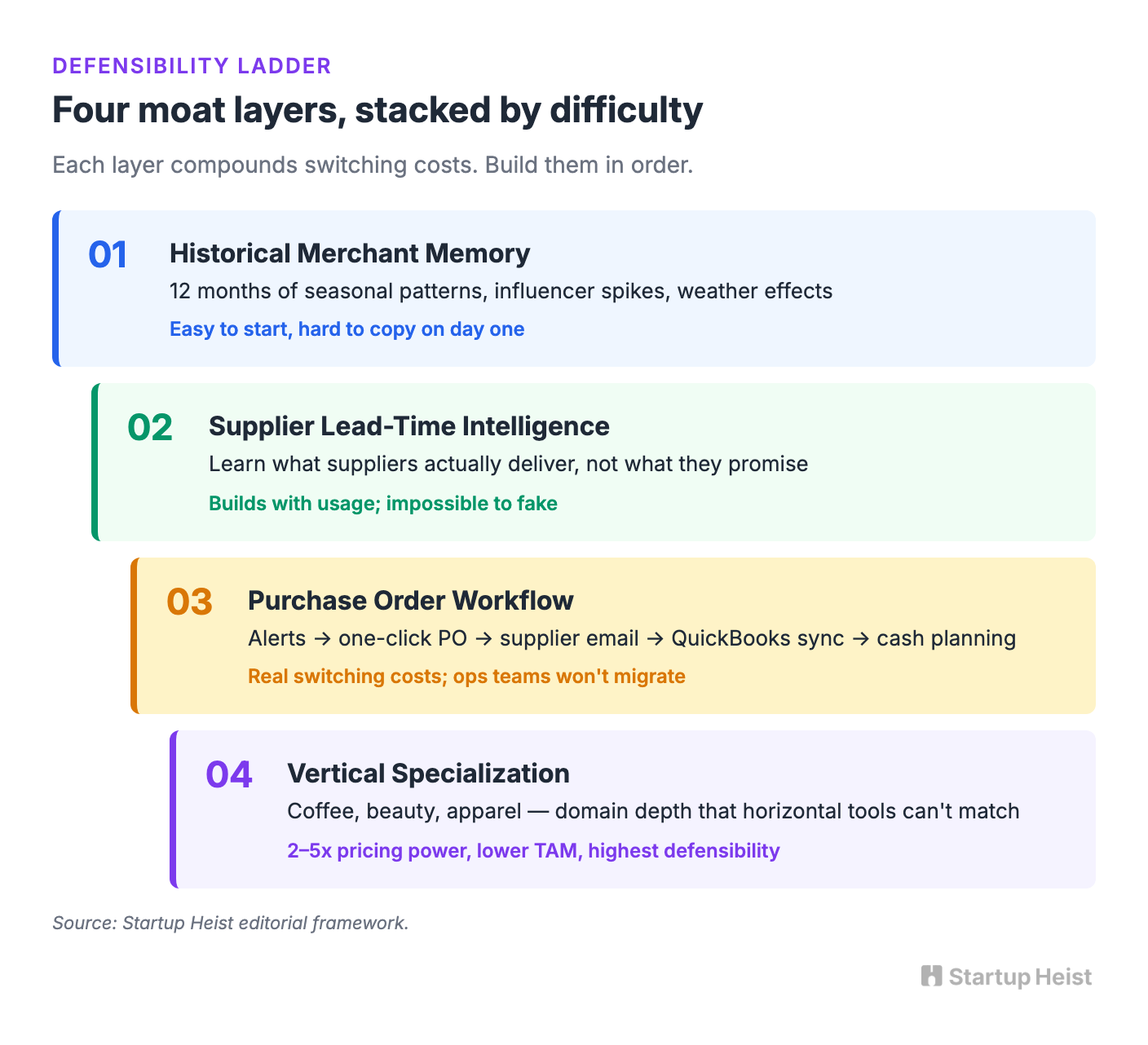
Four moat layers, in order of difficulty:
Unlock the Vault.
Join founders who spot opportunities ahead of the crowd. Actionable insights. Zero fluff.
“Intelligent, bold, minus the pretense.”
“Like discovering the cheat codes of the startup world.”
“SH is off-Broadway for founders — weird, sharp, and ahead of the curve.”


