


The next great software rollup won't look like private equity. It'll look like a talent agency with a distribution engine.
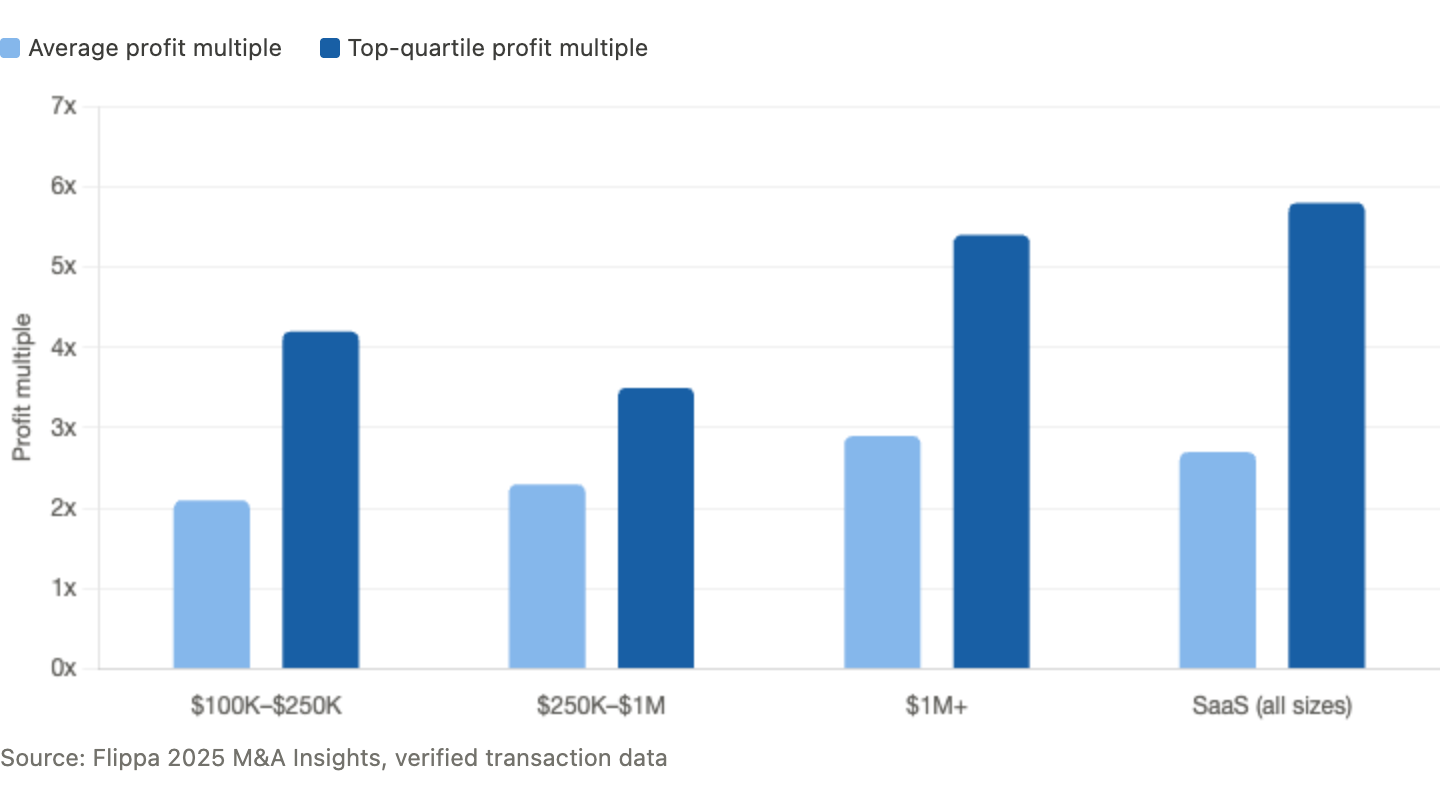
Bootstrapped SaaS under $1M ARR regularly trades at 2–5x profit.
A disciplined operator buying three to five adjacent tools at $3K–$8K MRR each can reach $30K–$60K combined MRR within two years at 40–60% EBITDA margins. At the high end, that's $720K annualized — from assets most buyers ignore.
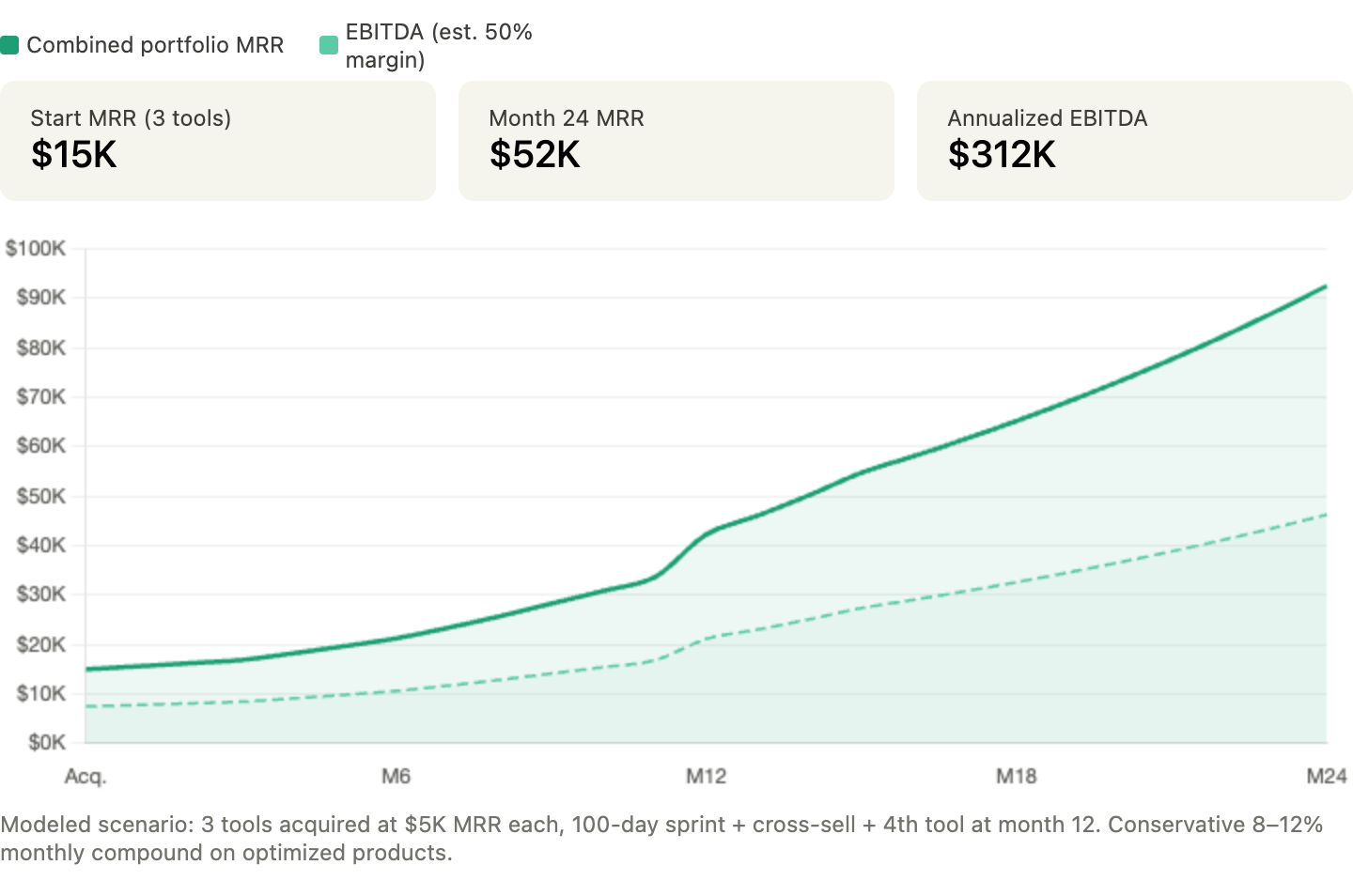
The next interesting software rollup is going to look like a record label.
Pascal Levy-Garboua's Noosa Labs has already run the play in public. Since 2021, the former Checkr executive has acquired five bootstrapped SaaS products generating between $150K and $800K in ARR, targeting a portfolio worth $50 million in ARR at roughly 50% EBITDA margins over time. He buys in the range most funds won't touch.
The operating thesis is what matters: small SaaS assets can be bought, cleaned up, repriced, cross-promoted, and turned into a portfolio where distribution compounds across products. This isn't a micro-SaaS side hustle idea. It's a holdco business model with real precedent — and it's particularly well-timed for operators who understand AI-era distribution, SaaS workflow automation, and niche B2B software economics.
The market underneath it is liquid. Flippa's 2026 data puts private SaaS deals at 3x to 10x ARR, with low-growth businesses clustering between 3x and 5x. Profit multiples for bootstrapped SaaS under $1M ARR sit around a median of 2.85x, with top-quartile deals reaching 6.13x. Over a third of buyers on Flippa's platform in 2025 were portfolio acquirers executing multiple transactions.
So the opportunity isn't "buy a micro-SaaS." Plenty of people are already doing that. The opportunity is to become the buyer who is worth more than the highest bidder — the operator whose existing audience, bundle, and infrastructure make every deal accretive on day one.
The Premise
Most small SaaS founders don't fail because the software is broken. They stall because the founder is the bottleneck. The product works. The niche is clear. There are paying customers. But growth flattens somewhere between "nice side income" and "real company." The founder is tired, maybe undercapitalized, or simply not wired for year four of pricing tests, onboarding rewrites, lifecycle email work, and churn cleanup.

A widely cited Blind survey found that 73% of startup founders experience burnout. At the indie scale — where one person handles product, support, billing, and growth — the exit impulse is even stronger. The "tired but working" SaaS owner is now a well-documented seller persona, and aggregators like saas.group and Noosa Labs have built entire pipelines around it.
Thousands of profitable, subscale software products exist right now. Many are too small for serious funds, too boring for venture, and too operationally annoying for buyers who want one clean asset. For the right operator, these are under-optimized cash-flow machines with real optionality.
A traditional acquirer asks, "What is this app worth on its own?" A label asks, "What is this app worth inside my audience graph, my bundle, my onboarding system, my email engine, and my existing customer relationships?" That second question is where you win deals even when everyone sees the same listing.
Why This Works Now
Four timing advantages are converging.
AI and vibe-coding tools are flooding the market with new software, but cheap creation doesn't eliminate value — it shifts where value sits. Distribution, retention, and trust are the scarce resources now. Anyone can ship an app over a weekend. Products that have already found paying customers and held them for months or years are disproportionately valuable precisely because spinning up a competitor costs almost nothing.

Founder fatigue is peaking. Tim Schumacher, co-founder of saas.group (25 acquired brands, just crossed $100M ARR), put it plainly: talented founders were getting burned out, stuck in their businesses, or unable to scale further despite great products. He's built an entire acquisition pipeline around that pattern. As no-code and AI tools lower the barrier to launch, more solo founders are hitting the ceiling faster — great at building, less interested in the grind of growing.
Deal infrastructure is mature. Flippa, Acquire.com, and Empire Flippers have made small SaaS acquisitions legible. Standardized metrics — churn rates, profit multiples, revenue trends — give first-time buyers a realistic pricing framework that didn't exist five years ago.
Founder-friendly acquirers are still rare. Most small sellers worry about getting lowballed and watching their product die. If you become known as the operator who keeps products alive and gives founders a dignified exit, you create seller-side preference. saas.group built its entire inbound pipeline on reputation. Word of mouth from founders and brokers generates steady deal flow without outbound.
Where the Real Money Is
The beginner version is straightforward: buy a $3K–$8K MRR SaaS, improve onboarding, raise prices carefully, fix churn, harvest cash flow. It works. But the real margin is in shared demand.
The money is in adjacency. Buy three to five tools for the same buyer — not five unrelated tools.
Don't own a form builder, a PDF tool, a scheduling app, an SEO plugin, and a random dev utility. Own a cluster:
Freelancer tools: proposals, invoicing, client portals, reporting, lightweight CRM. One customer, five subscription fees, one integrated experience.
Shopify ecosystem: reviews, upsells, post-purchase offers, analytics, retention widgets. Every merchant running one of your tools is a warm lead for the rest.
Creator tools: sponsorship pipeline, media kit builder, booking forms, affiliate tracking, lead capture. The creator economy is fragmented enough that a coherent stack commands real pricing power.
Agency tools: onboarding, white-label reporting, time tracking, client approvals, knowledge base. Agencies hate stitching together ten different vendors. Solve that and you own the relationship.
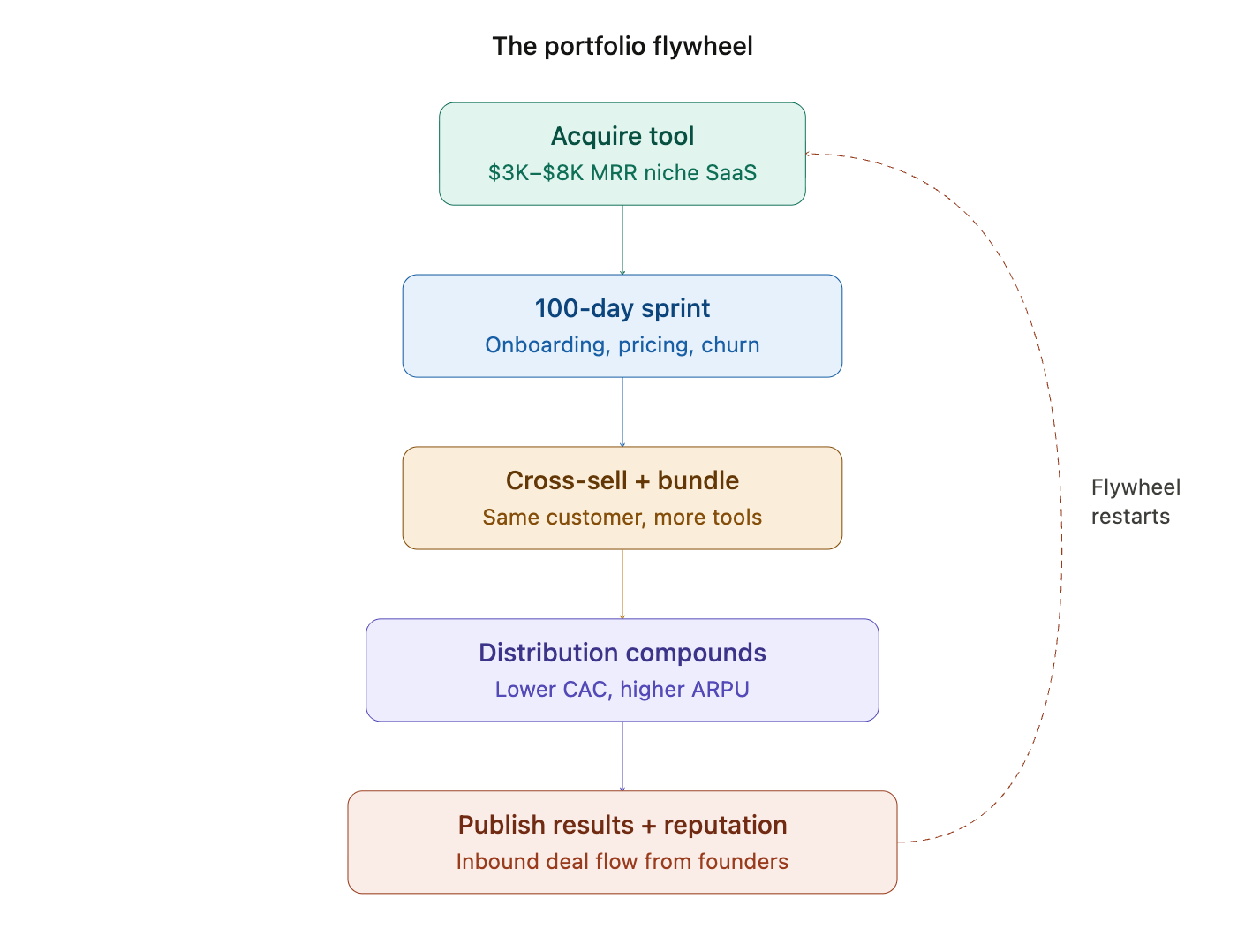
Once products serve the same customer, every acquisition becomes cheaper to grow than the last. Cross-sell works. Bundle pricing works. Shared partnerships work. Churn drops because leaving one app means leaving a stack, not a feature.
That's the leap from holding company to distribution system.
saas.group has proven it at scale: 25 brands, 400 employees across 30 countries, targeting $125 million in revenue and $35 million in EBITDA for 2026. Brands remain independent but benefit from shared marketing, finance, and DevOps. You don't need to be saas.group to apply the principle. You just need a wedge customer and two adjacent tools.
The Insight
Most buyers still underwrite these products as standalone cash flows. They're leaving money on the table.
One app may be mediocre on its own and excellent inside a portfolio. If you already own the newsletter, the affiliates, the audience trust, and the adjacent workflows, a "flat" asset can become accretive immediately. It may be worth 30% more to you than to the next buyer — even before you change the product — because your cost to reactivate growth is structurally lower.
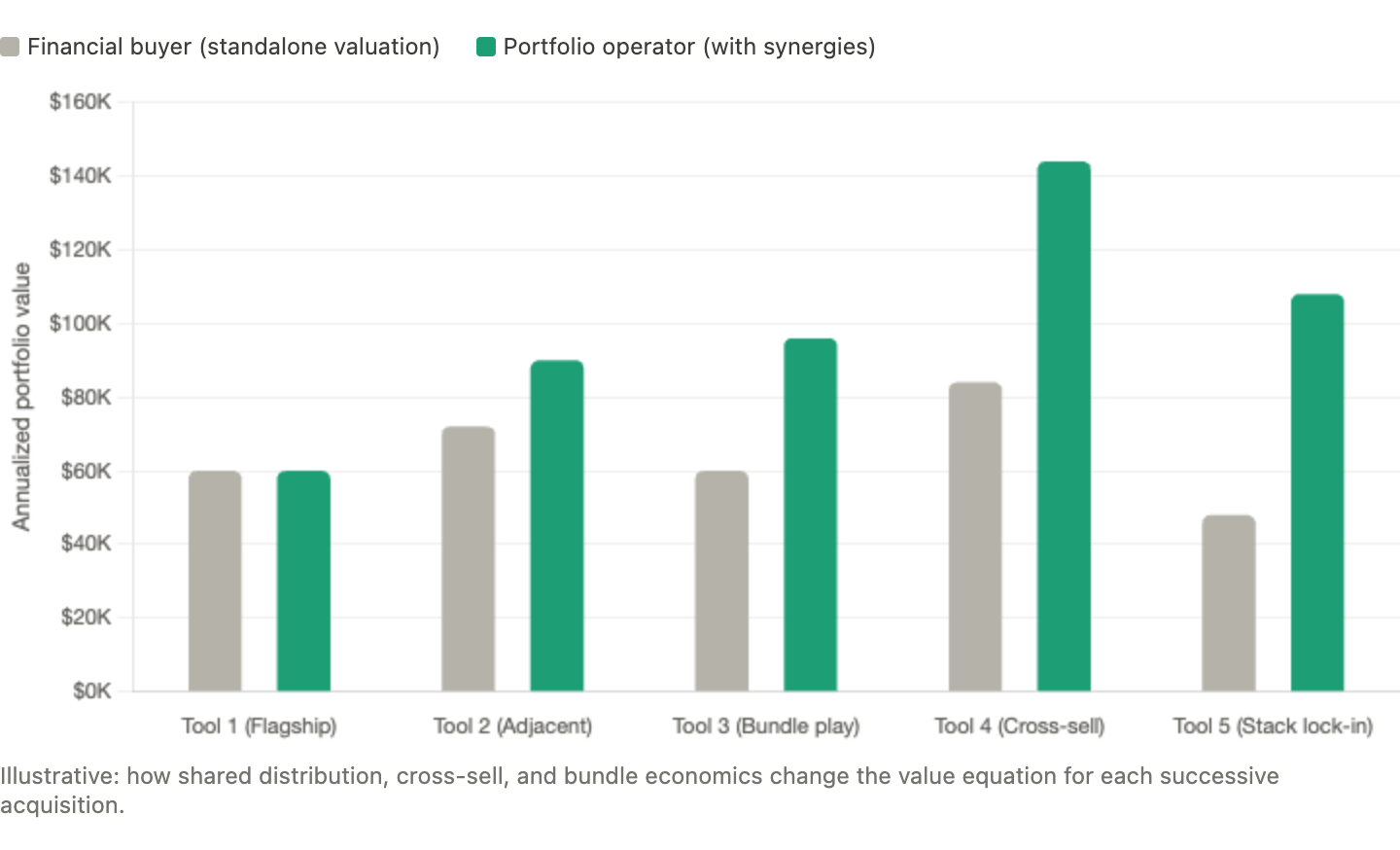
Strategic acquirers consistently pay the highest multiples because they factor in synergies: cross-sell opportunities, shared infrastructure, overlapping functions they can consolidate. A financial buyer sees the spreadsheet. A portfolio operator sees the system.
Two implications follow. First, you can sometimes pay a little more and still win because the deal is worth more to you structurally. Second, the best acquirer in this market won't necessarily be the richest. It'll be the one with the best distribution fit.
A label doesn't need every artist to be a superstar. It needs a roster that makes the whole catalog stronger. One breakout winner subsidizes experiments. One large list feeds multiple products. One founder reputation sources better deals. One operating system raises margins across the board.
The Playbook: From Zero to Portfolio
Phase 1: Choose a Wedge
Unlock the Vault.
Join founders who spot opportunities ahead of the crowd. Actionable insights. Zero fluff.
“Intelligent, bold, minus the pretense.”
“Like discovering the cheat codes of the startup world.”
“SH is off-Broadway for founders — weird, sharp, and ahead of the curve.”


