


The TikTok Shop LTV Heist
Lose money on the first order. Make it back on the refill.
There's an e-commerce trick making the rounds. Launch a high-margin product on TikTok Shop, offer creators an absurd affiliate commission of 50%, 60%, even 75%, and let thousands of hungry creators run your customer acquisition for you.
It sounds broken. A $50 product sells, the creator takes $37.50, TikTok takes its cut, you ship the goods and keep roughly nothing.
Then the customer reorders. This time there's no giant commission attached. If the product is genuinely replenishable, the second, third and fourth orders carry the economics. That's the heist.
Almost everyone running this play is buying revenue rather than losing money intelligently, and the two look identical for about a quarter. The real opportunity is a creator-native replenishment brand where the first order is booked as customer acquisition cost and cohort data proves the refills pay it back.
Here's the shape of it:
The money: A thousand active subscribers refilling every 60 days throws off roughly $12K a month in contribution margin, and the creator commission was already paid.
Inside:
• The $49 unit math at every commission rate
• A four-tier commission ladder, 20% to 75%
• The 100-sample creator seeding playbook
• Per-creator cohort dashboard and kill criteria
In 2026 the infrastructure finally exists to run it properly.
$11.8 billion in six months
TikTok Shop's U.S. GMV hit $11.8 billion in the first half of 2026, up 103% year over year, according to Momentum Works and Tabcut. That's more than three-quarters of what the entire U.S. business did in all of 2025 ($15.1 billion, itself up 68%), delivered in six months. More than 5,700 U.S. stores crossed $1 million in GMV during the half, an eightfold increase.
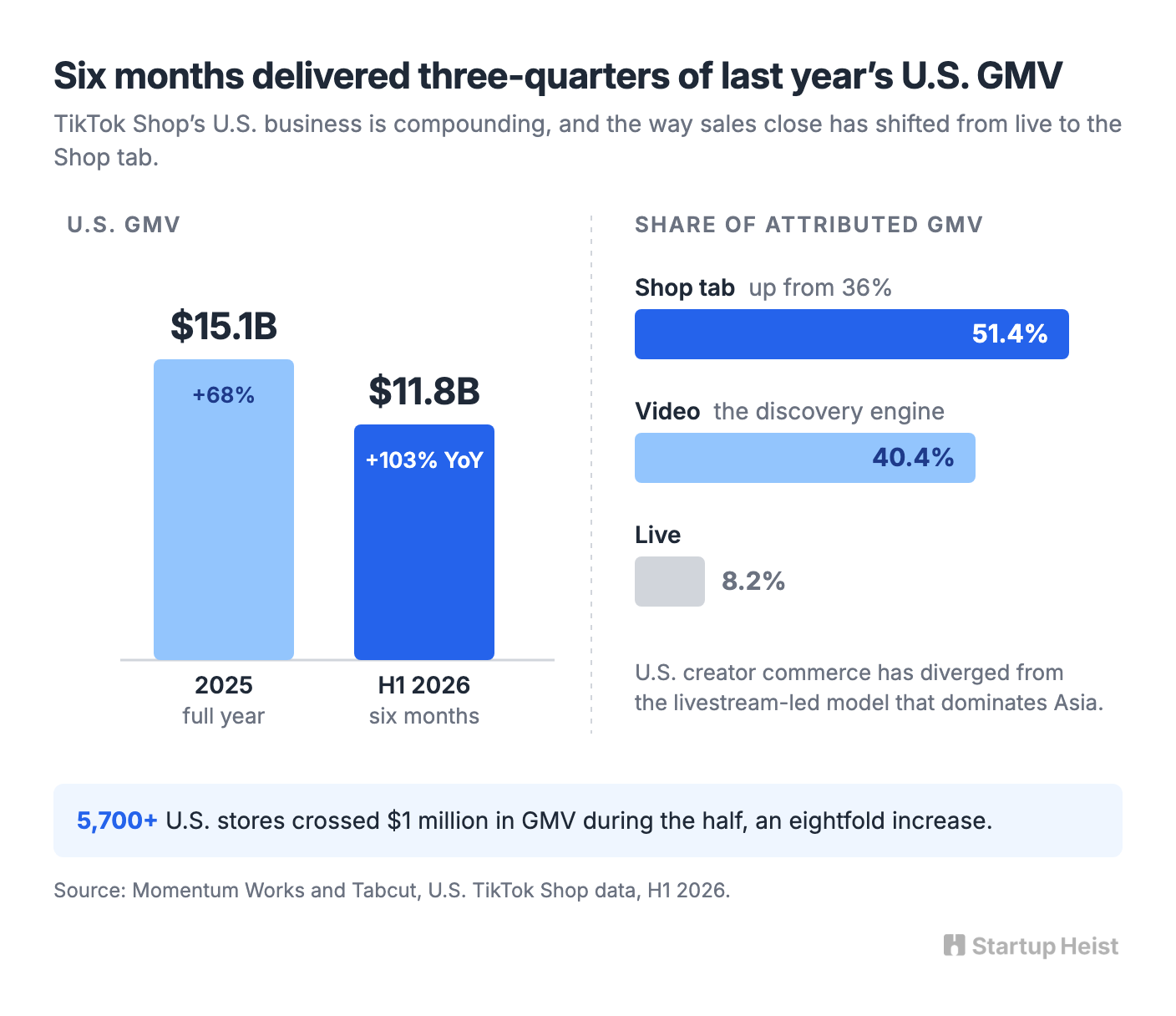
The mechanics of how those sales close also shifted. The Shop tab now drives 51.4% of attributed GMV, up from 36%. Video accounts for 40.4% and remains the discovery engine. Live has narrowed to 8.2%. U.S. creator commerce has quietly diverged from the livestream-led model that dominates TikTok Shop in Asia. Creators generate the demand; the store closes it.
For a replenishment business that matters, because a shopper arriving through the Shop tab has already crossed from browsing into buying. The change that actually unlocks this play is smaller, and it's gotten almost no attention.
Product Subscriptions, and the rule buried in the FAQ
In June 2026, TikTok Shop turned on Product Subscriptions for selected U.S. sellers. Customers can sign up for recurring deliveries at a standing discount of 5%, 10%, 15% or 20%. Eligible categories include Beauty, Health, Personal Care, Food and Beverages, Home Supplies and Pet Supplies, which is to say the replenishment-heavy end of the catalog.
Buried in TikTok's own seller documentation is the line that turns a clever theory into an actual business model:
Affiliate commission is paid out once, on the initial order. Subsequent recurring orders generate no commission at all.
Read that again with a spreadsheet open. The creator gets paid on the transaction that acquires the customer, and never again. Every refill after that arrives with your full contribution margin and no acquisition cost attached.
Nothing about it reads like a loophole. TikTok has described a customer acquisition auction in the flattest possible language and moved on to the next FAQ entry.
Stop calling it commission
A 40% affiliate rate makes experienced e-commerce operators flinch. Gross margin is 70%; handing 40 points to a creator feels like arson.
That's the wrong comparison. A brand spending $40 on Meta ads to land a customer doesn't say Facebook took 80% of the order. It says CAC is $40 and moves on. Creator commission belongs in the same column. The creator is a performance media channel, you pay when commerce happens, and the only oddity is that the bid is denominated as a percentage of the first transaction instead of a flat dollar amount.
Which makes the market rate the number worth calibrating against, and TikTok's documentation is unusually clear about the range. A seller can set any commission from 1% to 80%. There's no published category cap. What varies is where you make the offer.
Open Collaboration is the public marketplace, where any of the 20 million U.S. creators can grab your product without asking you first. Beauty rates there typically run 10 to 15%, and the U.S. average across all categories sits near 13%. Targeted Collaboration is a direct, negotiated deal with a named creator, and that's where the big numbers structurally live: 15 to 25% for proven performers, 25 to 50% for top creators.
So opening at 20 to 30% in Open Collaboration isn't generosity. It's a bid at roughly double the going rate, placed in a marketplace where creators are deciding what to promote today.
Once you see commission as a bid, deliberately losing money on order one stops being crazy. It becomes crazy only when you don't know what happens next.
The $49 test
Say you sell a replenishable skincare product at $49. TikTok's referral fee is a flat 6% for most categories and includes payment processing, so there's no second transaction charge hiding underneath it. New sellers get a temporary break on that, roughly 1.8 to 3% for the first 30 to 90 days, which makes your earliest cohorts cheaper than the model below.
| Line item | |
|---|---|
| Retail price | $49.00 |
| TikTok referral fee (6%) | -$2.94 |
| Product + packaging | -$8.00 |
| Pick, pack and shipping | -$7.00 |
| Refund and support reserve | -$2.00 |
| Contribution before creator | $29.06 |
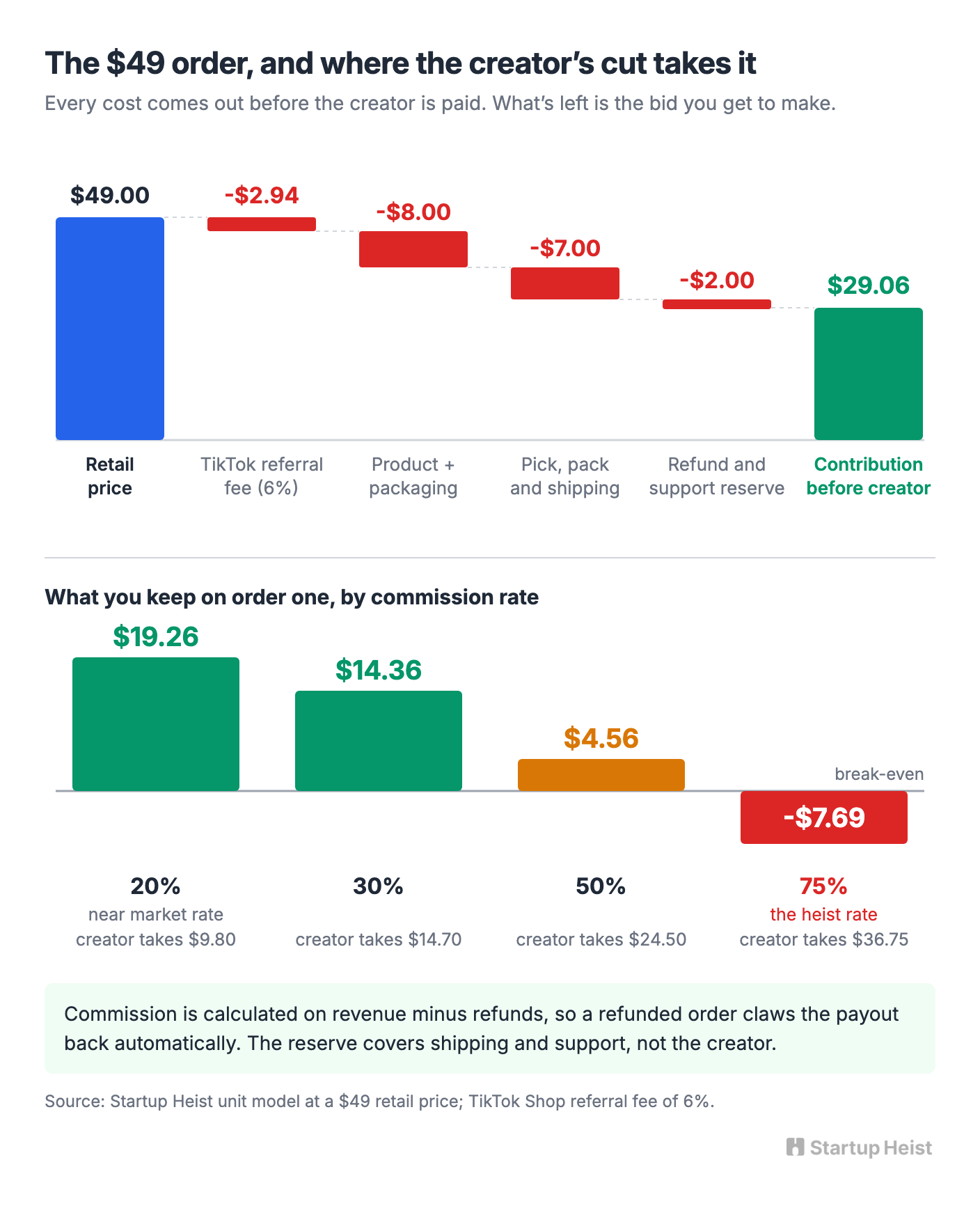
Now add the creator. At 20%, near market rate, the creator takes $9.80 and you keep $19.26. At 30%, the creator takes $14.70 and you keep $14.36.
Push higher and the floor arrives fast. At 50%, the creator takes $24.50 and you keep $4.56. At 75%, the creator takes $36.75 and the first order loses $7.69.
This is the moment where operators screenshot the GMV dashboard and either declare themselves geniuses or spend six months discovering they built a money incinerator. The first transaction tells you almost nothing.
One thing does work in your favor. TikTok calculates creator commission as revenue minus refunds, times the rate. A refunded order claws the commission back automatically. Your reserve covers the shipping and the support ticket, not the payout.
Order two is the entire company
Assume the buyer subscribes at a 10% discount. Recurring price: $44.10.
Same cost structure, minus the creator:
$44.10 revenue, less $2.65 in platform fees, less $8.00 in product, less $7.00 in fulfillment, less $2.00 in reserve. $24.45 of repeat-order contribution.
That $7.69 first-order loss now needs 0.31 future orders per acquired customer to disappear. Add $5 per acquired customer for creator samples and operational overhead and you need about 0.52.
That ratio is the business. Views, GMV and affiliate post counts all sit downstream of future contribution orders per acquired customer.
Where the 75% play actually breaks
Run a cohort of 100 customers acquired at 75% commission. You start $769 down on merchandise and $500 down on samples and operations. Call it -$1,269. Break-even needs 52 repeat orders from those 100 people.
Unlock the Vault.
Join founders who spot opportunities ahead of the crowd. Actionable insights. Zero fluff.
“Intelligent, bold, minus the pretense.”
“Like discovering the cheat codes of the startup world.”
“SH is off-Broadway for founders — weird, sharp, and ahead of the curve.”


