


The next big voice startup will not be another keyboard replacement.
Horizontal dictation is getting too good, too cheap, and too obvious. Wispr Flow now charges roughly $15 per user per month for its Pro plan, with a free tier and enterprise pricing above that. The category is racing toward commodity. Voice input itself is becoming infrastructure, the same way "type into any app" became infrastructure two decades ago.
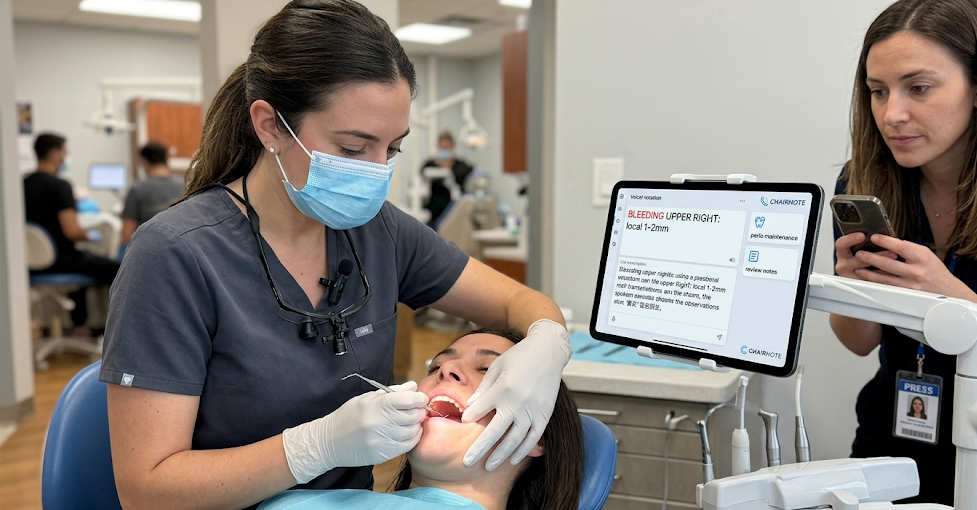
The better heist sits one layer up: a voice-first dental documentation overlay for hygienists and dentists. A product that listens chairside, turns messy spoken observations into structured dental clinical notes, SOAP notes, tooth-specific findings, perio language, treatment-plan language, and suggested CDT codes, then drops that output into the practice's existing PMS workflow.
Nothing about a new dental operating system, a Dentrix replacement, or "AI for dentists" in the abstract. Just a narrow, painful, chairside documentation layer priced for the 178,000 small and independent offices that the enterprise scribe vendors are not really chasing.
The Opportunity
Dental offices have a workflow problem hiding in plain sight.
The most important work happens with gloved hands, masks, suction noise, patients in the chair, and clinicians trying to capture details while maintaining flow. Hygienists and dentists need accurate notes, periodontal charting, treatment observations, patient instructions, medical-history changes, procedure details, follow-up plans, and billing-supporting documentation. The software they use was mostly designed for someone sitting at a desk.
That mismatch is the wedge. A hygienist does not want to stop, remove gloves, tap through a legacy interface, remember exactly what was said, and reconstruct the note later. A dentist does not want to finish a procedure and spend extra time typing clinical details into a system built around forms, codes, and tabs. An assistant can help, but staffing is already one of the biggest constraints in dentistry.
Voice becomes more than convenience here. It becomes workflow compression. The pitch fits on one line: talk naturally during or after the visit, get clean dental documentation that fits your existing system. Dictation is a feature. Hygienist documentation throughput is the business.
Why Now
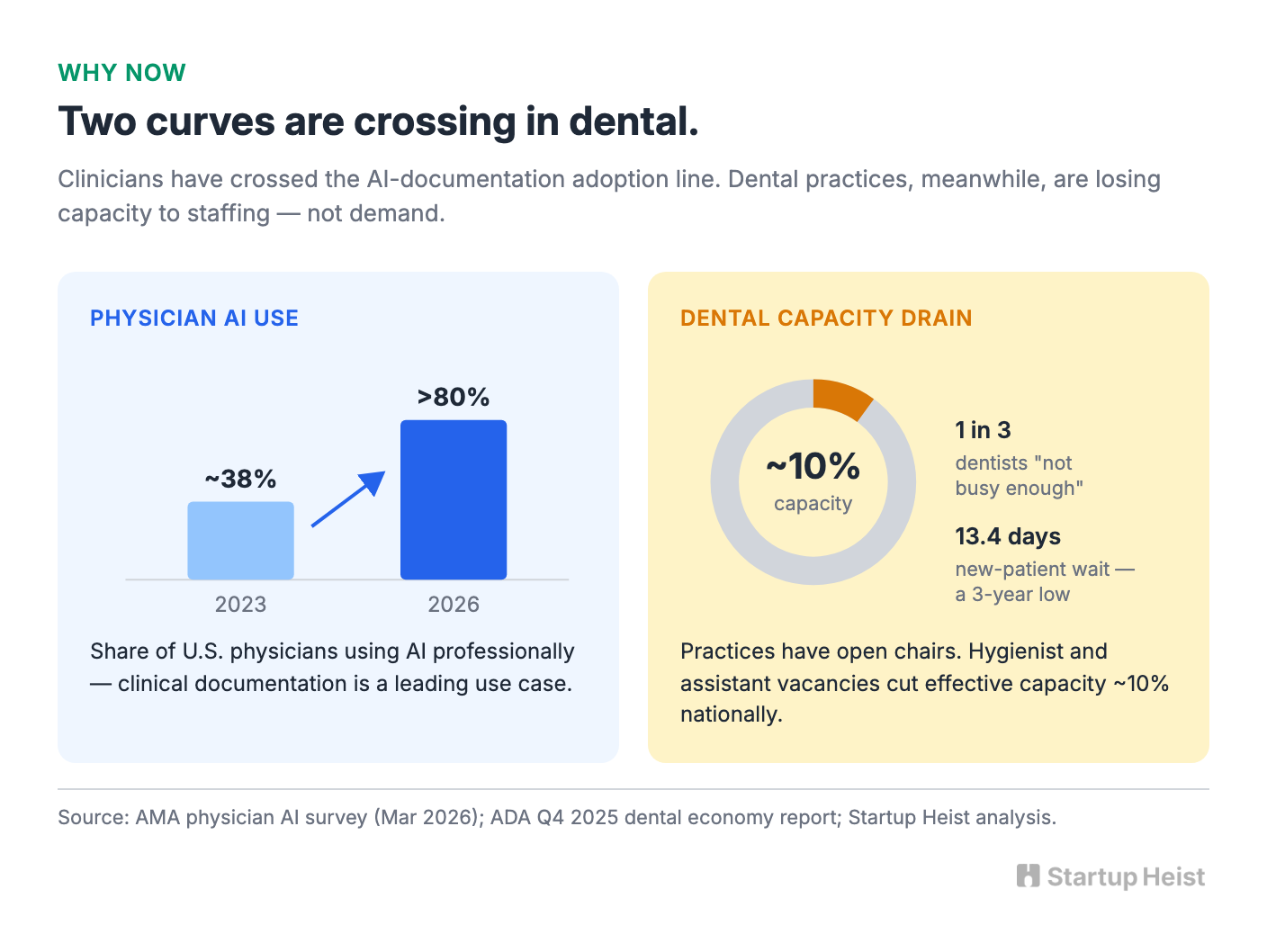
Healthcare has crossed an adoption threshold. The American Medical Association reported in March 2026 that more than 80% of physicians surveyed now use AI professionally, more than double the 2023 level, with clinical documentation as one of the leading use cases. Abridge alone serves more than 250 health systems and was last valued at $5.3 billion after raising nearly $800 million. KLAS named it #1 Best in KLAS for Ambient AI in February 2026.
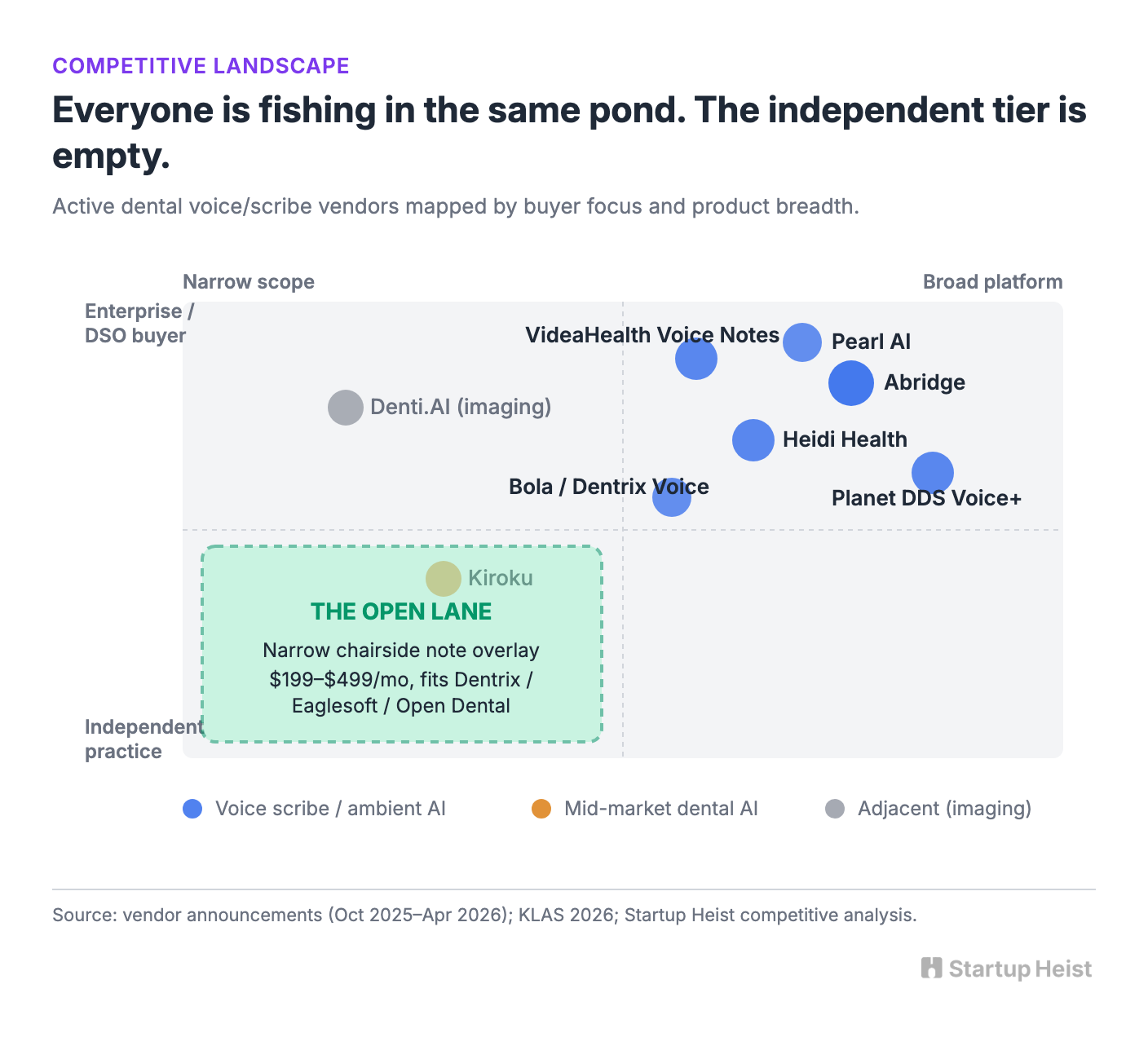
Dentistry-specific scribes are already in market, and they're pointed up-market. VideaHealth launched Voice Notes in October 2025, marketed as the first ambient AI scribe purpose-built for dentistry, and claims providers save more than ten hours per week. Henry Schein One partnered with Bola AI to ship Dentrix Voice for verbal charting. Planet DDS expanded its Clinical Voice+ suite with AI Voice Restorative Charting in April 2026. Denti.AI holds the first FDA-cleared dental auto-charting product, but that one reads x-rays — it's imaging-based charting, a complementary tool rather than a voice scribe (Denti.AI's separate Voice product handles perio charting, no clearance). The pattern across the voice scribe lane is consistent: enterprise pitch, DSO buyer, premium pricing.
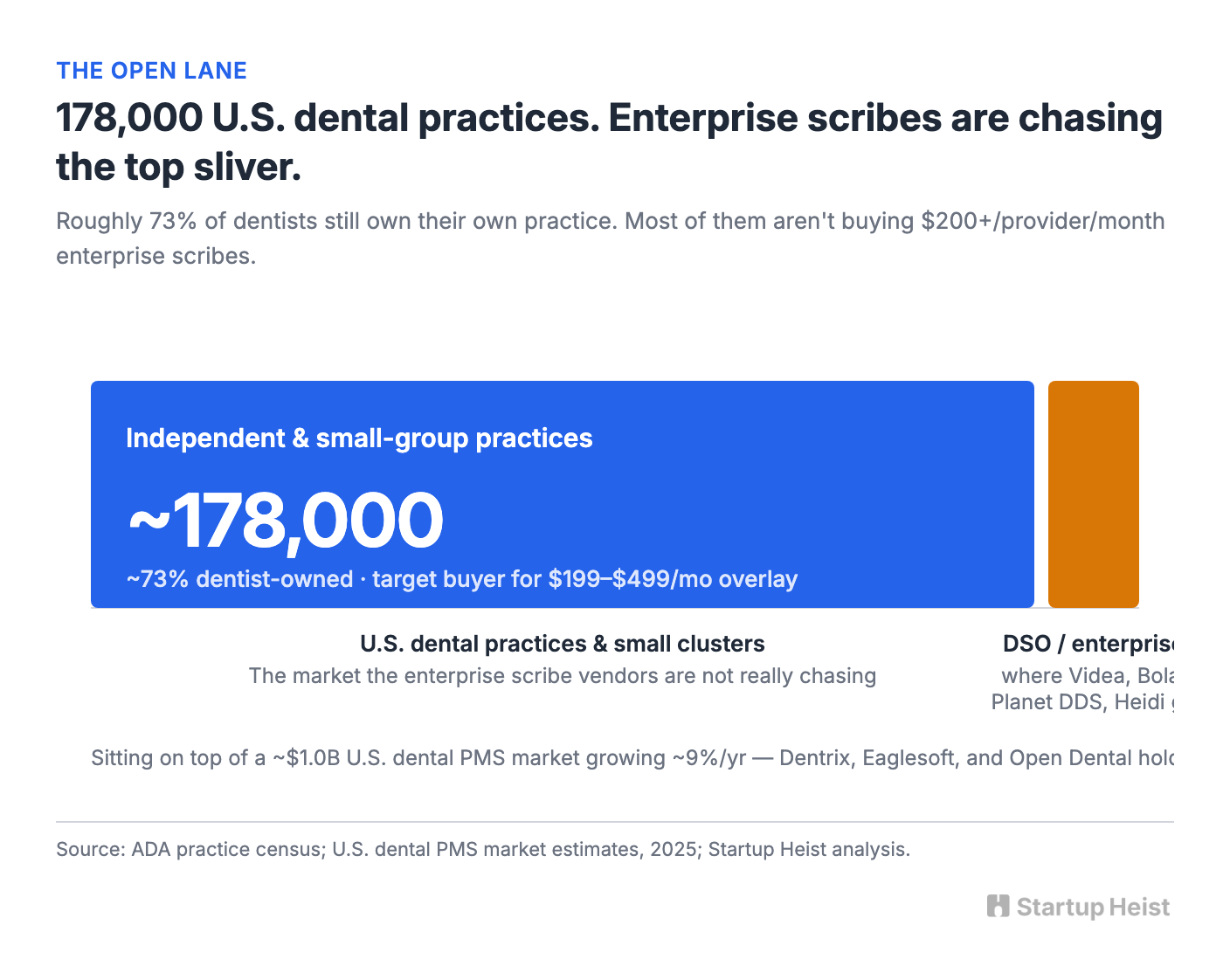
Meanwhile the market underneath is large and predictable. The U.S. dental practice management software market hit roughly $1 billion in 2025, growing at about 9% per year. Dentrix, Eaglesoft, and Open Dental together account for more than half of all installs. There are over 178,000 dental practices in the United States, and roughly 73% of dentists still own their own practice. Most of them aren't buying enterprise scribes priced at $200+ per provider per month. That's the open lane for an AI dental scribe built to fit independent practices.
The Pain Is Not Typing
The lazy version of this idea: dentists hate typing, give them voice. That isn't sharp enough.
The real pain is documentation integrity under time pressure. Dental clinical notes aren't casual notes. They need patient history, clinical findings, tooth-specific observations, treatment performed, materials used, recommendations, follow-up, and billing-supporting detail. Industry guidance treats them as legal documents that matter in malpractice claims. Incomplete notes create clinical, operational, and reimbursement risk in one move.
Practice economics make it worse, but not in the way most people assume. The American Dental Association's Q4 2025 dental economy report shows the opposite of a demand crunch: one-third of dentists now say they're "not busy enough," up from one-quarter a year earlier, and new-patient wait times have dropped to 13.4 days, among the shortest in over three years. The constraint isn't patient flow. It's staffing. Hygienist and assistant vacancies are reducing effective practice capacity by roughly 10% nationally, and offices that can't fully staff the chair can't safely add visits even with appointment slots open. Voice recognition, used well, can cut documentation time by close to half. So the right pitch isn't "save five minutes typing." It's recover chairside capacity, reduce after-visit cleanup, improve note consistency, and reduce dependence on perfect staffing. A $99 dictation app feels optional. A $399 documentation layer that takes friction out of every hygiene chair, every day, feels like operational leverage.
The Wedge: Hygiene and Exam Notes for Independent Practices
Don't start with "all dental charting." That sounds impressive and pulls the product into too many edge cases: restorative charting, complex procedures, specialty workflows, imaging, claims, perio measurements, consent language, liability.
Start narrower. Hygienist documentation and exam notes for independent dental practices and small DSO clusters. Hygiene visits are repetitive. The note patterns are roughly standardized. The language is structured and predictable. The user is hands-busy. The workflow happens many times per day. The documentation burden is annoying but concrete. The ROI fits on one slide.
The MVP should handle real-world dictation like:
"Adult prophy. Medical history reviewed, no changes. Generalized light calculus, moderate plaque lower anterior. Bleeding on probing localized posterior. Periodontal status stable. Reviewed flossing technique and recommended electric toothbrush. Doctor exam completed, no caries noted, watch number 14 distal. Six-month recall."
And turn it into a clean hygiene note, a SOAP-style version on request, tooth-specific watch items, a periodontal summary, a patient instruction summary, code prompts for clinician review, and copy-ready output for Dentrix dictation, Eaglesoft, Open Dental, or whatever template the office already uses.
This is where the product earns its price. Transcribing words is table stakes. Transforming spoken workflow into usable dental clinical notes is the business.
The money: 100 practices at $499/mo = $50K MRR for a solo founder. 500 practices ≈ $250K MRR. VideaHealth providers report saving 10+ hours per week.
Inside:
• Three-mode product spec: Quick, Chairside, Template
• 8–12 week MVP scope and compliance baseline
• Founder-led sales motion with cold email scripts
• 90-day plan to 5 paid founding practices
The Incumbents Are Both the Enemy and the Distribution Surface
Dentrix, Eaglesoft, Open Dental, and other PMS systems already own the practice's core workflow. That makes replacement a bad opening move. Even when users dislike them, ripping them out is disruptive. They touch scheduling, charting, billing, imaging, claims, patient records, reporting, and staff habits.
The better move is to become an overlay. The first version doesn't need deep writeback. It needs to make the existing workflow feel 30% lighter. Start with a web app or desktop app, microphone capture, dental-specific note structuring, practice-custom templates, copy-to-clipboard, export to PDF or text, patient/date/provider labels, audit trail, admin review, and an optional integration bridge later.
The strategic trick is to refuse to let integration block adoption. If the practice already copy-pastes notes into its PMS, the product can improve the note before the paste. If the office uses templates, the product can generate in that template. If the office wants direct writeback later, that becomes an expansion feature, not a launch dependency.
The Product
Call it ChairNote, PerioVoice, HygieneScribe. The name matters less than the positioning. The landing page should say:
AI dental scribe for chairside dictation. Works with Dentrix, Eaglesoft, and Open Dental workflows without replacing your PMS.
The product should ship in three modes:
Unlock the Vault.
Join founders who spot opportunities ahead of the crowd. Actionable insights. Zero fluff.
“Intelligent, bold, minus the pretense.”
“Like discovering the cheat codes of the startup world.”
“SH is off-Broadway for founders — weird, sharp, and ahead of the curve.”


