


The Song That Costs $5,455
On August 10, 2026, YouTube turns music selection from a creative decision into a margin decision. Somebody has to give editing teams the spreadsheet before they make the cut.
YouTube is phasing out paid licenses inside Creator Music, the music library built into YouTube Studio. Until August 10, 2026, a creator browsing the Creator Music catalog can pay a fixed fee for a track and be done with it. After that date, the catalog narrows to two options: tracks that cost nothing, and tracks that require the creator to share the video's ad revenue with the music's rights holders. Licenses already attached to published videos stay valid until they expire. Unused licenses get refunded.
The announcement reads like housekeeping. What it actually changes is the unit economics of every professional YouTube operation that touches the catalog.
A $50 license is legible. You pay $50, the expense lands in the production budget, and the video's upside belongs entirely to the channel. A revenue-sharing track shows $0 at checkout and takes its payment later, as a percentage of whatever the video earns. The better the video performs, the more that "free" song costs.
Somebody should be pricing that gap before the edit is locked.
Build a pre-upload music margin calculator for YouTube editing teams. Enter the economics of a channel, evaluate a Creator Music track against the libraries the team already pays for, and record the decision before the video goes live.
The calculator gets you in the door. The business is the policy layer sitting on top of it.
Here's the shape of the opportunity:
The money: 200 agencies at $79 a month plus 500 creators at $12 is roughly $21,800 MRR, built on deterministic math instead of expensive inference.
Inside:
• Four-week build plan for the MVP
• Free calculator to paid agency workflow
• Cold email that gets agency replies
• Four moats a calculator cannot copy
The math nobody runs before they publish
YouTube's standard deal on long-form video gives the creator 55% of eligible ad revenue. Creator Music changes that number when a revenue-sharing track is in the edit, and YouTube's own published examples are more aggressive than most creators expect.
With one revenue-sharing track, the 55% share is split with the rights holder: 55 divided by 2, or 27.5%. YouTube then deducts additional music-rights costs for performing rights and similar obligations, which can run up to five percentage points. In YouTube's worked example, 2.5 points come off, leaving the creator with 25% of the video's total revenue.
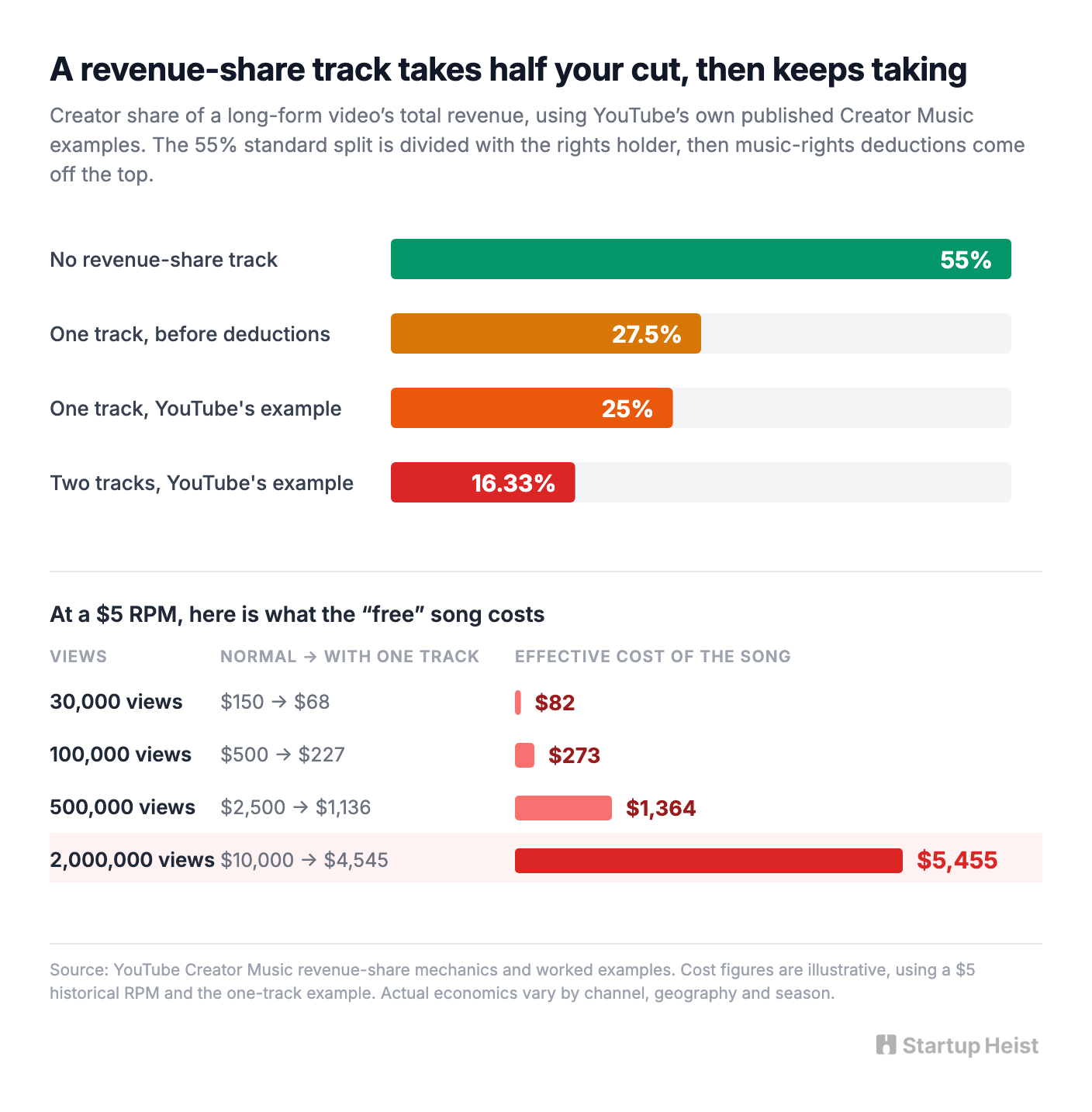
With two revenue-sharing tracks, the split becomes 55 divided by 3, or 18.33%, before deductions. YouTube's example lands the creator at 16.33%.
Put that against a real channel. Say a channel historically earns a $5 RPM, meaning roughly $5 of creator revenue per 1,000 views. That's a reasonable middle for a U.S. long-form channel, where the range typically runs from about $3 to $11 depending on niche and audience.
At 25% instead of 55%, the creator keeps 25/55 of what they'd otherwise make. Roughly 45%.
| Views | Normal revenue | With one rev-share track | Effective cost of the song |
|---|---|---|---|
| 30,000 | $150 | $68 | $82 |
| 100,000 | $500 | $227 | $273 |
| 500,000 | $2,500 | $1,136 | $1,364 |
| 2,000,000 | $10,000 | $4,545 | $5,455 |
Illustrative, using a $5 historical RPM and YouTube's one-track example. Actual economics vary by channel, geography and season.
Add a second revenue-sharing track and that 2-million-view video keeps about $2,970. The soundtrack now costs north of $7,000.
The last row is the whole business. An editor picks a song on a Tuesday afternoon, and if the video breaks out, the client is out five figures of revenue. Nobody signed a purchase order or asked for approval in Slack. The expense never showed up in a budget, because it isn't an expense at all. It's a haircut on future income, applied automatically.
That's a strange hole to leave open in a production workflow.
The real competitor is a subscription the team already pays for
The decision gets stranger once you put Creator Music next to the royalty-free music libraries every serious editing operation already subscribes to.
Epidemic Sound lists its Creator plan at $9.99 per month billed annually and Pro at $16.99. Artlist's Music & SFX Social plan is $9.99 per month annually, with its professional music tier at $16.58. Soundstripe runs $119 a year for Personal and $239 for Pro. These aren't identical licenses, and an agency doing client work needs the commercial tiers rather than the cheap ones. But the pattern holds: a production team with an appropriate subscription has already paid for the catalog, and the marginal cost of pulling one more track out of it is approximately zero.
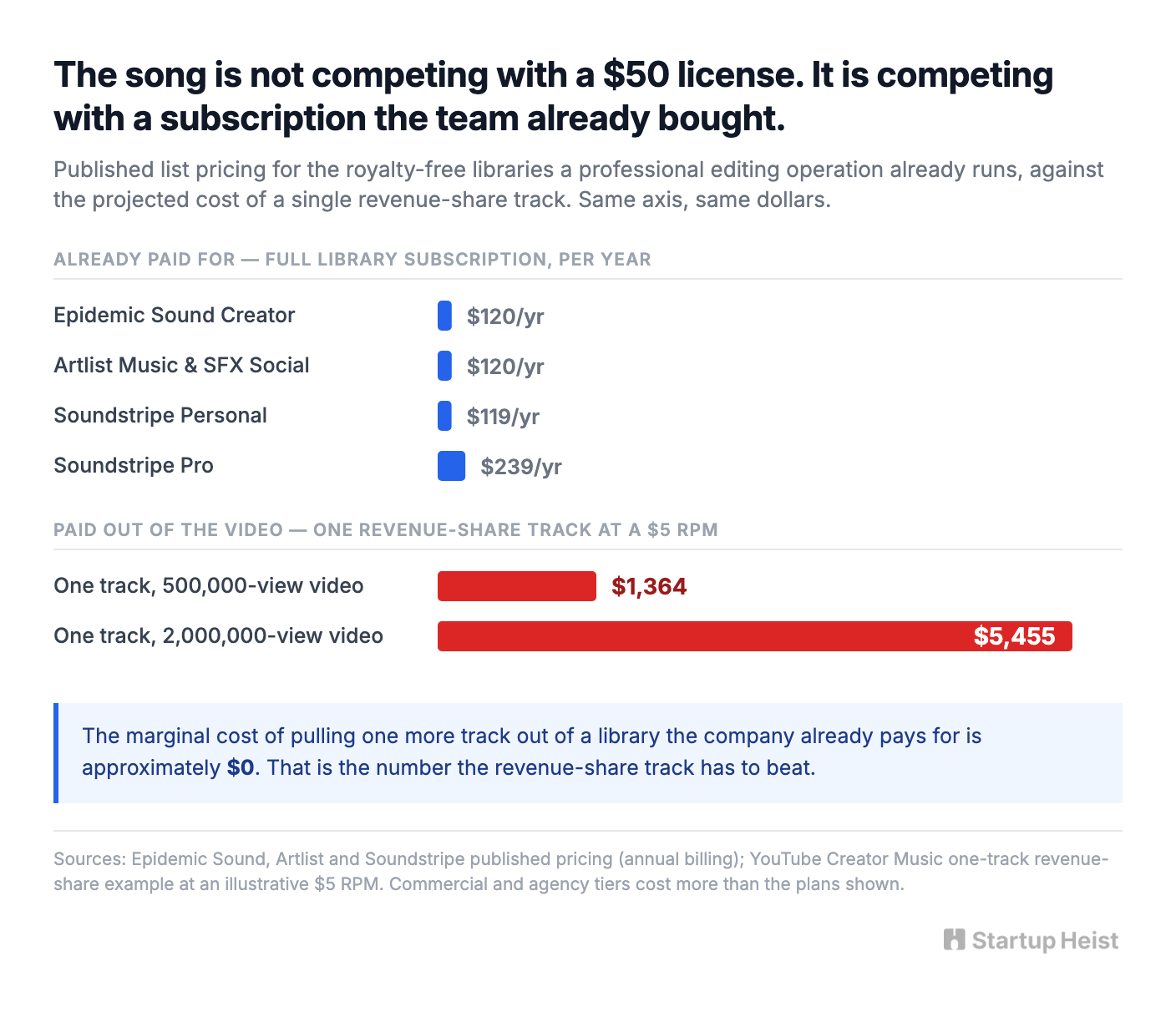
So the editor isn't weighing a free song against an expensive one. The real choice is between surrendering a slice of this video's lifetime revenue and pulling a perfectly good track from a library the company pays for whether or not anyone opens it today.
The libraries help you find music and YouTube publishes the terms, but nothing in the workflow answers the question that matters at the moment of the cut: is this particular song worth it for this particular video?
Who actually has this problem
Creator Music is still limited to U.S. creators in the YouTube Partner Program, with international expansion pending. Revenue sharing applies to long-form video only, not Shorts and not livestreams. And plenty of serious creators earn most of their money from sponsorships and products, which makes a few hundred dollars of ad-revenue leakage a rounding error they'll never think about. The Partner Program now holds more than 3 million channels, and YouTube said in January 2026 that it has paid creators, artists and media companies more than $100 billion over the previous four years. Your slice of that is small.
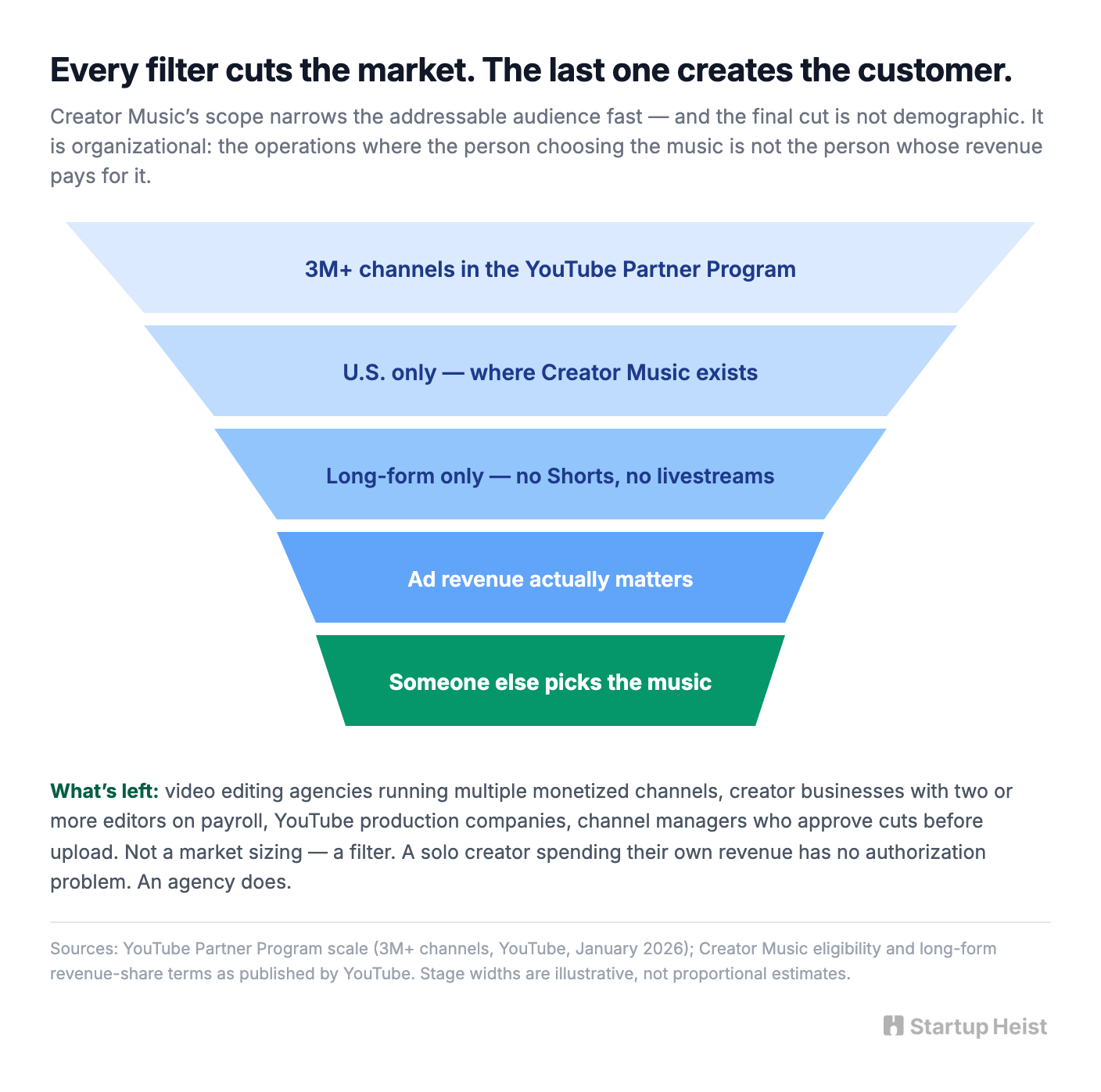
The customer worth chasing is narrower and much easier to find: high-volume long-form YouTube operations where someone other than the channel owner picks the music. Video editing agencies running multiple monetized channels. Creator businesses with two or more editors on payroll. YouTube production companies. Channel managers who approve cuts before upload.
A solo creator and an agency face completely different decisions. A solo creator can say "I love this song, use it," and that's a legitimate answer, since it's their revenue to spend. An agency has to answer a different question when the invoice arrives: who authorized giving away $2,000 of the client's money for a song?
Taste has nothing to do with it. That's a controls problem, and controls problems get solved with software.
The product: Music Margin
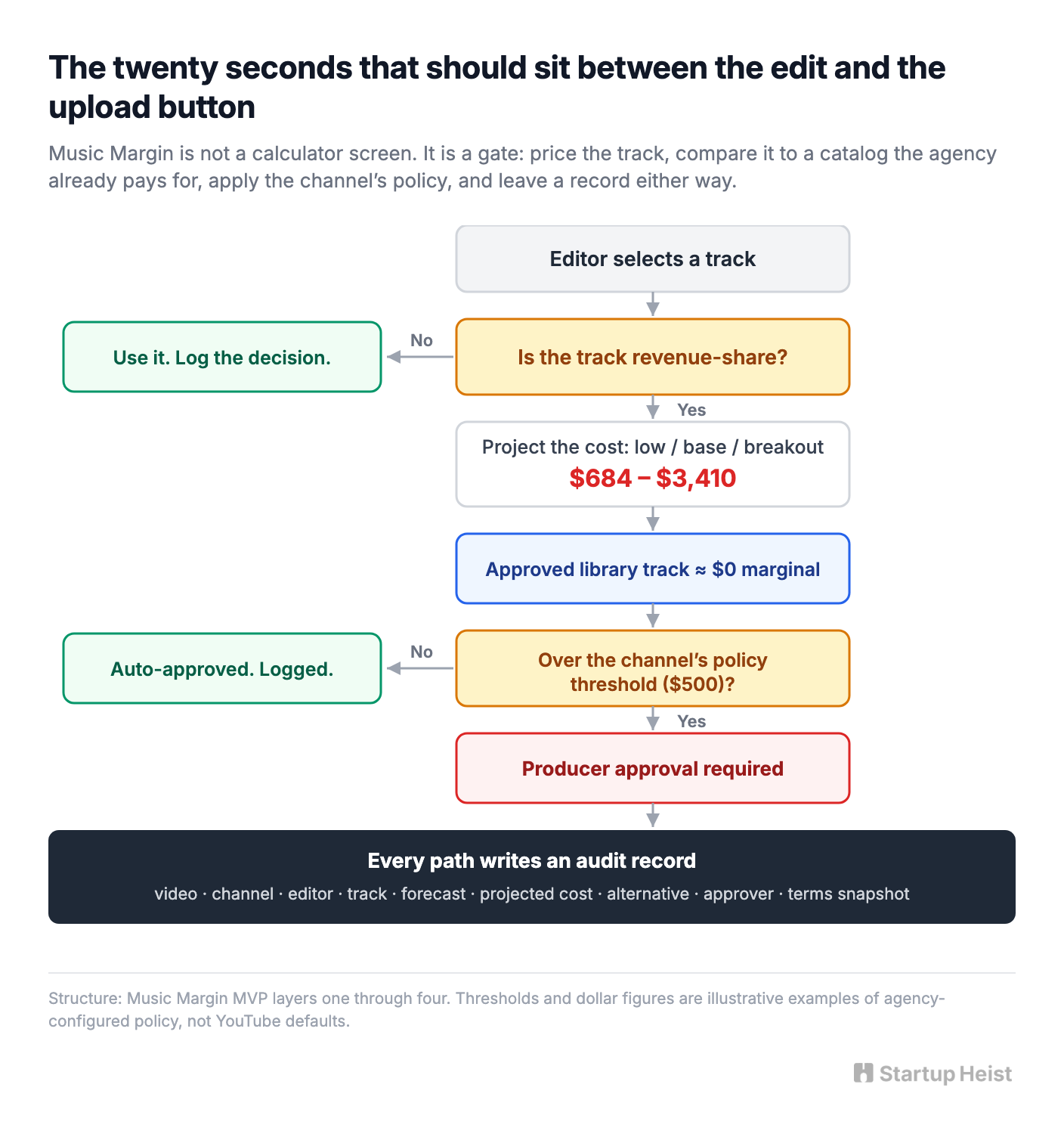
The first version should be almost offensively simple. Skip the AI soundtrack generator, the catalog, the audio embeddings, and any ambition of becoming a licensing company. You're building the spreadsheet that should already exist between the edit and the upload button, then turning that spreadsheet into company policy.
Unlock the Vault.
Join founders who spot opportunities ahead of the crowd. Actionable insights. Zero fluff.
“Intelligent, bold, minus the pretense.”
“Like discovering the cheat codes of the startup world.”
“SH is off-Broadway for founders — weird, sharp, and ahead of the curve.”


