


The 48-Hour Compliance Clock Hiding Inside Thousands of Online Communities
A new federal takedown rule is forcing small forums, gaming communities, member portals, and nonprofit platforms to stand up a miniature trust-and-safety operation. Big Tech can absorb the work. The long tail needs a compliance layer.
A niche forum operator wakes up to an email from a stranger.
The sender says an intimate image of them was posted without consent. It may be real. It may be a deepfake. They want it gone now.
The operator's mind fills with questions. Is this a valid request? Is the sender the person depicted, or someone authorized to act for them? Where exactly is the image hosted? Does it appear anywhere else on the site? When did the clock start? What gets documented? What happens if the wrong content comes down? What happens if the message sits in a shared inbox until Monday?
A year ago, the operator could have handled this informally. Forward the email to an admin, delete the post, ban the user, move on. That window is closed.
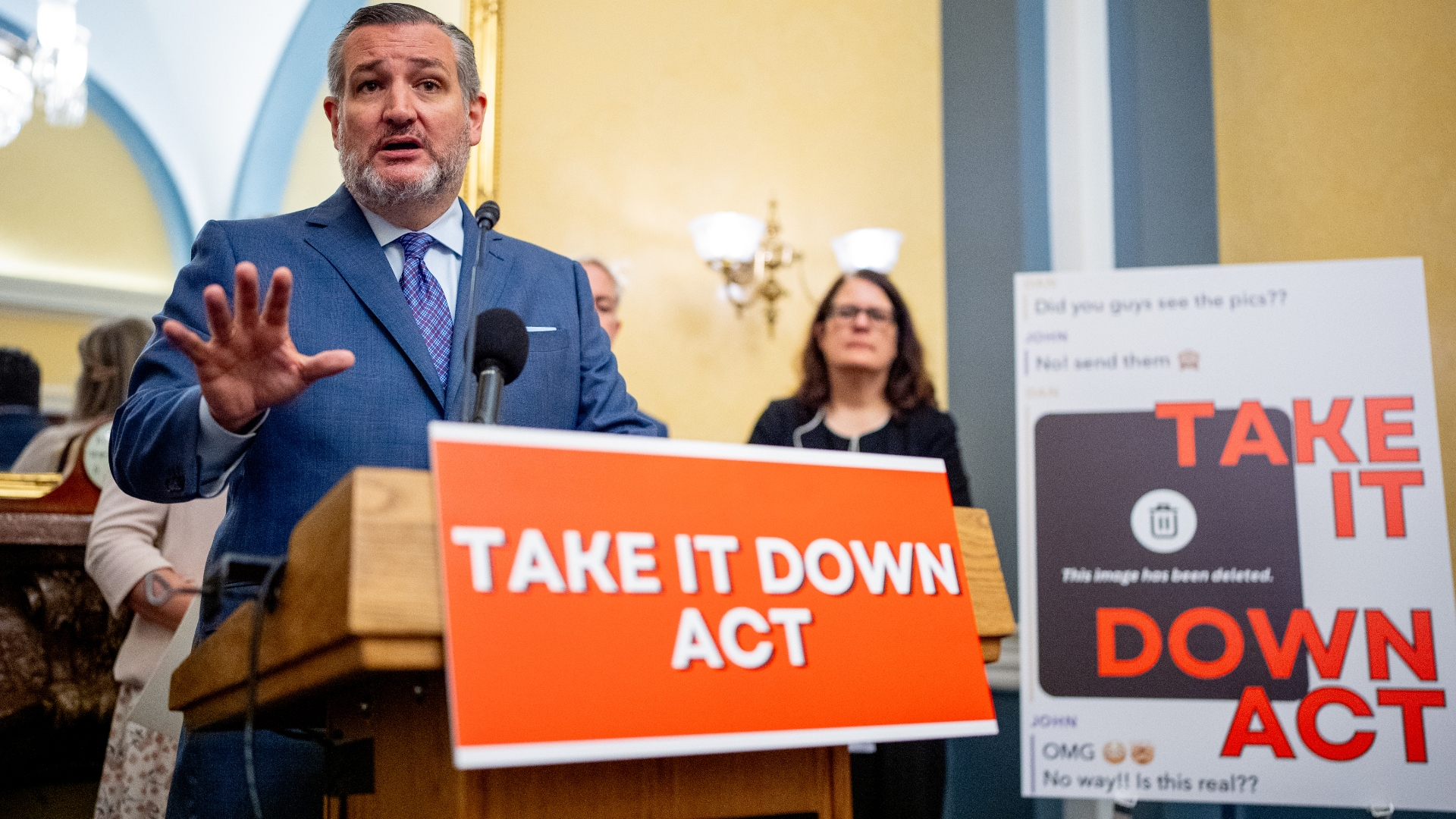
On May 19, 2026, the Federal Trade Commission began enforcing Section 3 of the TAKE IT DOWN Act. Covered platforms must now publish a clear notice-and-removal process for nonconsensual intimate imagery, including certain AI-generated deepfakes. Once a valid request lands, the platform has to act as soon as possible and no later than 48 hours after. It must pull the reported material and make reasonable efforts to find and remove known identical copies. The FTC has been blunt about the stakes: civil penalties of up to $53,088 per violation.
This isn't just a new rule for Meta, Reddit, and TikTok. The definition of a covered platform reaches public-facing websites, online services, and mobile apps that primarily host user-generated content — messages, videos, images, games, audio files. It carves out email providers, broadband providers, and sites where user interaction is incidental to preselected editorial content. A static company blog with a comment box probably isn't the target. A niche discussion forum, dating app, gaming platform, user gallery, creator membership site, or association portal almost certainly is. Nonprofit status is no shield: the law specifically extends FTC enforcement authority to organizations not organized for profit.
That gap is the opportunity. Build the TAKE IT DOWN Act compliance layer for smaller platforms that can't afford an internal trust-and-safety team.
The money: 300 community operators at $99/month plus setup fees lands around $30K MRR. No competing lightweight TIDA SaaS exists yet.
Inside:
• Six-module MVP, shippable in two to six weeks
• Three-tier pricing plus a duplicate-detection add-on
• Education-led GTM with an outbound template
• Five compounding moats around the system of record
Skip the AI moderation moonshot, the generic legal dashboard, the magic deepfake detector. What nearly every covered operator now needs is the boring, urgent layer underneath all of that — a hosted intake workflow, a 48-hour deadline tracker, a notice generator, and an audit-ready evidence locker.
A Legal Obligation Just Became an Operations Problem
The requirement sounds simple. Remove reported content within 48 hours. In practice, the operator needs a repeatable system.
The statute is specific about what a valid request contains: a physical or electronic signature, enough information to locate the content, a good-faith statement that the publication was nonconsensual, and contact details for the individual or their representative. The platform also has to publish a clear and conspicuous notice explaining how to submit one.
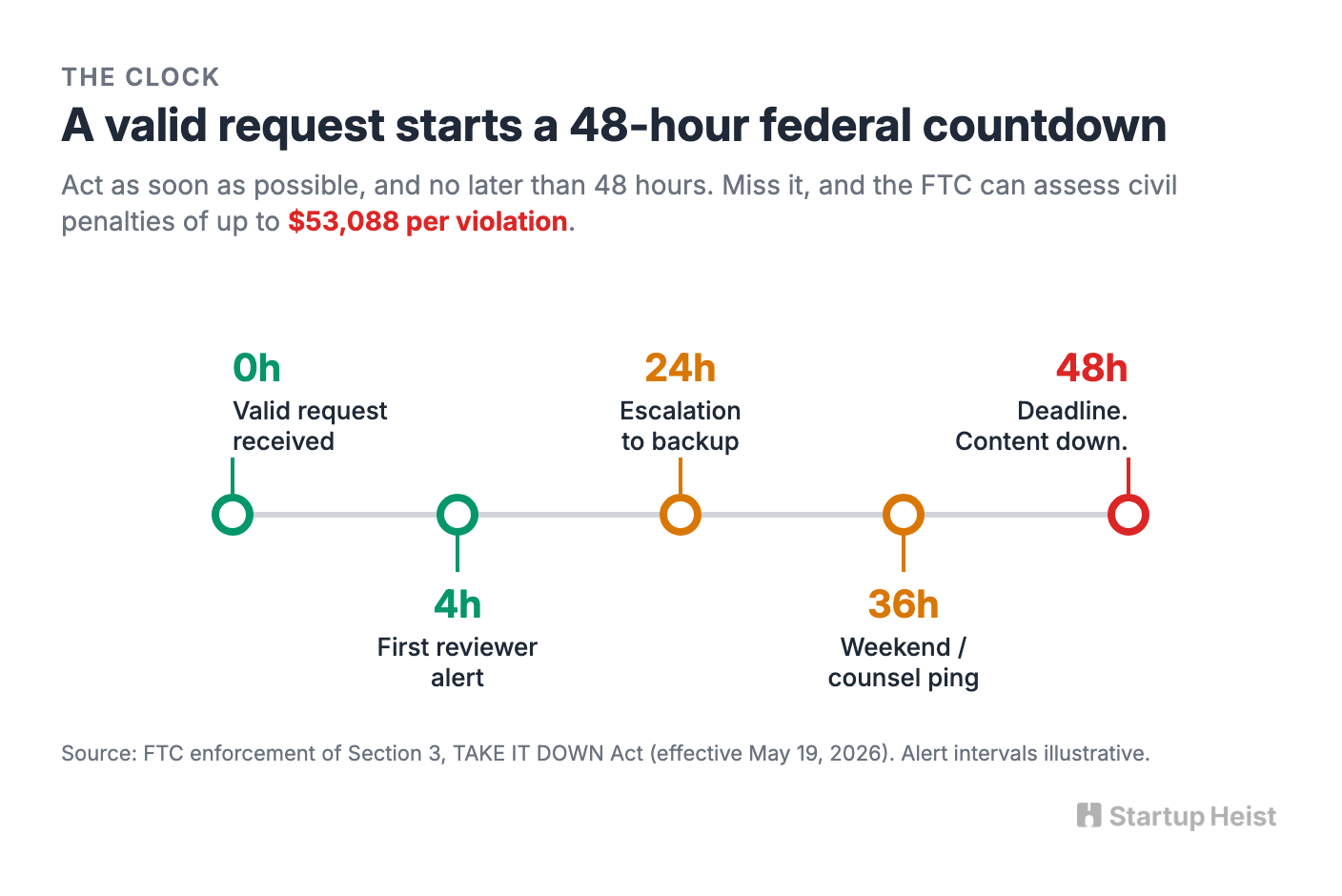
So a "Report abuse" email address no longer cuts it. The operator needs structured intake that captures the required fields without forcing a distressed person through a legal maze. Timestamps. Alerts. A queue. An internal record of what happened and when. A way to export a case file if the FTC comes asking. The FTC's own guidance points the same direction: assign confirmation or report numbers, share status updates with victims, document compliance, and consider hashing technology so removed material doesn't reappear.
This is a classic compliance-software wedge. The law manufactures the obligation. Most small operators stall because the implementation feels unfamiliar. The same pattern built durable businesses across privacy, accessibility, security, tax, and HR compliance — package an unavoidable workflow into software that's easier to buy than to build. Demand is already there. Someone just has to make it trivial to satisfy.
"Stripe Checkout" for Takedown Compliance
The pitch is one line.
Add a compliant takedown process to your community in one afternoon.
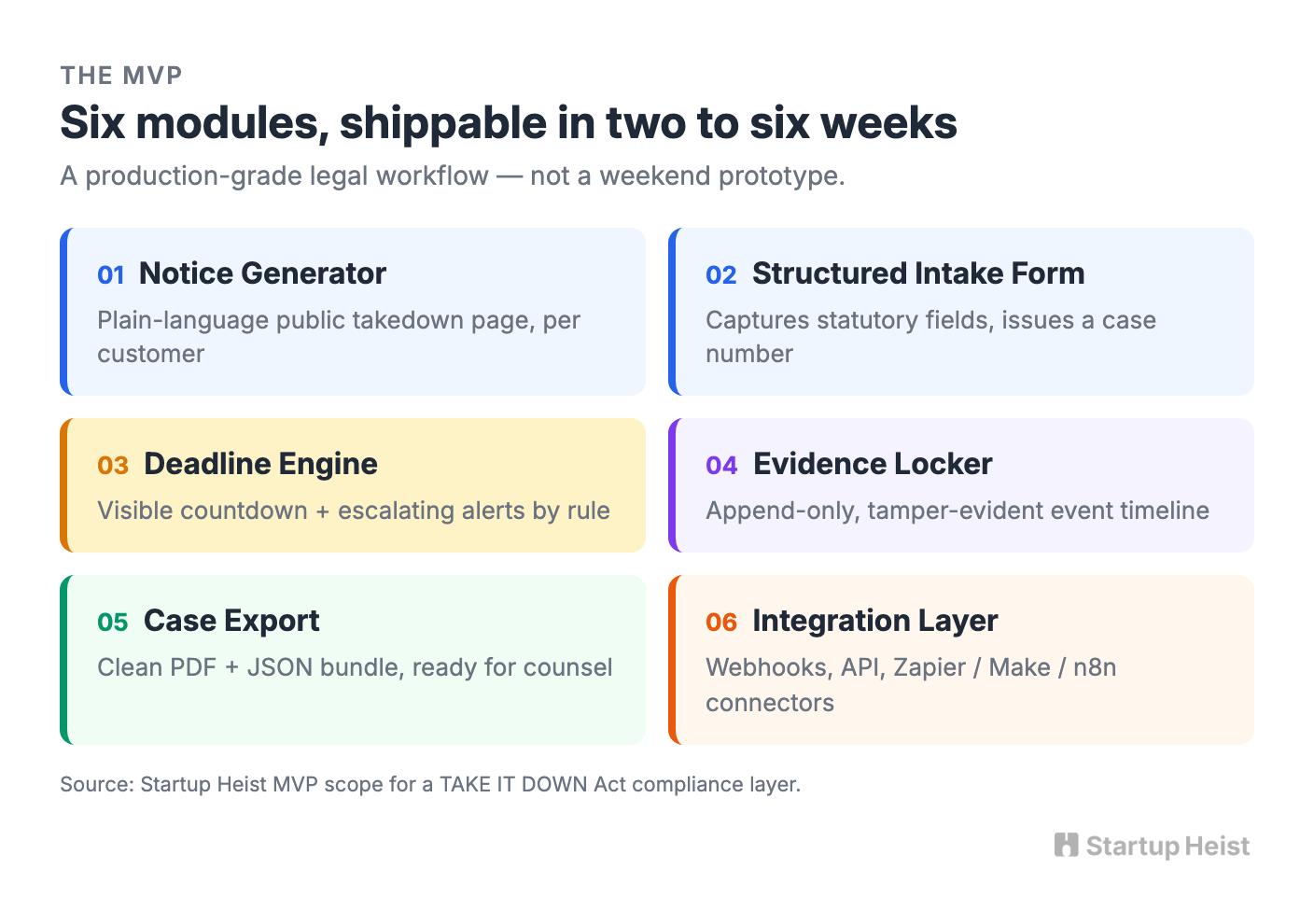
V1 shouldn't try to solve every trust-and-safety problem. It should make the minimum defensible workflow easy to install and hard to mishandle. A customer signs up, answers a short onboarding questionnaire, and walks away with the full kit: a hosted public takedown page with plain-language notice, an embeddable widget for their site, a structured intake form built around the statutory fields, a case dashboard with a visible 48-hour countdown, escalating alerts over email, SMS, and Slack, a review workflow for approving and documenting requests, a tamper-evident activity log, a downloadable case file, a public status page keyed to a report number, and basic webhooks to trigger removal inside the customer's own system.

None of it should feel like enterprise compliance software. The buyer is a founder, a community manager, a nonprofit executive director, a part-time admin. The product should feel closer to Typeform or Intercom than to a legal document vault. The onboarding asks practical questions — Where can users upload media? Do they send direct messages? Are there private groups or member galleries? Who reviews urgent requests, and are weekends covered? — and generates the right implementation path from the answers.
The temptation is to open with detection. Don't. The law covers real images and digital forgeries, including content created or altered with software, apps, or AI. That makes deepfake detection strategically relevant, but it doesn't make it the right first product. The statute requires reasonable efforts to remove known identical copies — far narrower than a promise to catch every cropped variant, altered video, screenshot, or freshly generated fake. The v1 has no business promising universal image matching, reliable video fingerprinting, or a definitive real-or-synthetic verdict. Those features are expensive, hard, and dangerous to oversell. Start with case management and documented response. Add duplicate detection later, as a premium module, where you can make an honest claim.
The initial promise isn't "we'll eliminate abuse from your platform." It's smaller and more credible: we'll help your team receive valid requests, respond before the deadline, document every action, and prove you followed a repeatable process. A customer can trust that.
The Buyer Sits Above the Hobbyist and Below Big Tech
This is not a mass-market app for every abandoned phpBB forum. Plenty of tiny operators will ignore the law, bolt on a basic form, or decide their interactive features are incidental until a lawyer or angry user forces the issue.
The early customers sit one rung up: SaaS products with user profiles, messaging, or uploaded media; paid membership communities; dating and social-discovery apps; gaming communities with user-generated content; marketplaces; online-education communities; professional associations with member portals; nonprofits with message boards and galleries; and the agencies and white-label platforms managing all of them. These buyers already pay for infrastructure. Discourse, which says it powers more than 22,000 communities, charges $100 a month for its Pro tier and $500 for Business. Circle runs $89 a month for Professional and $199 for Business. An operator already spending in that range understands a separate compliance fee when the alternative is building the workflow themselves or calling outside counsel after a complaint lands.
The nonprofit and association angle is the sweet spot. These groups run discussion boards, member directories, document libraries, and private galleries — Higher Logic alone says more than 1,700 associations use its platform — and they pair real operating budgets with thin technical staff and board-level reputational fear. A federal deadline sells itself there in a way another engagement feature never could. The product shouldn't position as software for hobby forums. It's takedown compliance infrastructure for small and midsize community operators.
The Gap Between a Legal Memo and an Enterprise Platform
The trust-and-safety market already has serious vendors, and none of them are aimed at this buyer. Hive sells detection and moderation — deepfake detection, reverse-image search, hash matching. Cinder sells operations tooling for abuse-fighting at scale, and recently shipped a direct StopNCII integration, the kind of enterprise capability that only deepens the gap below it. Big platforms build internally or buy these stacks. Nobody is aiming at the operator who has never hired a trust-and-safety lead — the one who gets two relevant complaints a year, not two thousand an hour, and just needs to avoid fumbling the one request that matters.
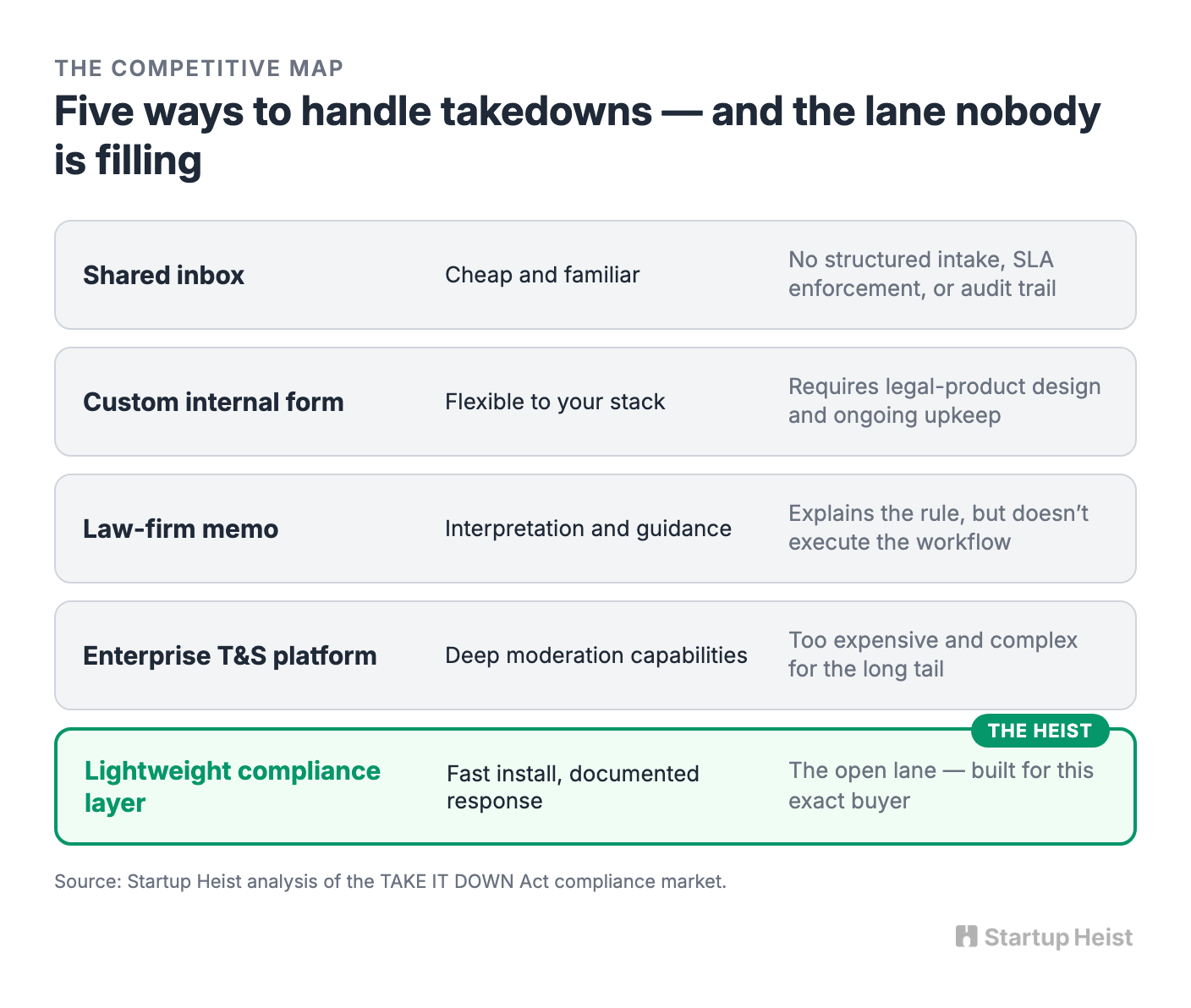
On the other end, law firms are publishing TIDA explainers. Those help a customer understand the obligation. They don't hand over a working intake form, a weekend escalation flow, an immutable timeline, or a regulator-ready export. The opening is in the middle.
The product isn't a replacement for legal advice. It's the operating system that makes counsel's advice executable. And right now, nobody is selling it to the people who need it most.
Build the Workflow Before the Intelligence
A strong full-stack founder can ship a credible v1 in two to six weeks. A weekend prototype is possible; a production-grade legal workflow is not. The MVP needs six modules.
Unlock the Vault.
Join founders who spot opportunities ahead of the crowd. Actionable insights. Zero fluff.
“Intelligent, bold, minus the pretense.”
“Like discovering the cheat codes of the startup world.”
“SH is off-Broadway for founders — weird, sharp, and ahead of the curve.”


