


The Japanese Tackle Translation Lab
Quick Steal: Find the weird Japanese bass-fishing techniques nobody in America understands yet, test them on U.S. water, explain them in plain English, and sell the complete rig as a limited preorder drop before the technique becomes another wall of SKUs at Tackle Warehouse.
In the spring of 2026, the hottest product in American bass fishing looked like a rubber sea urchin.
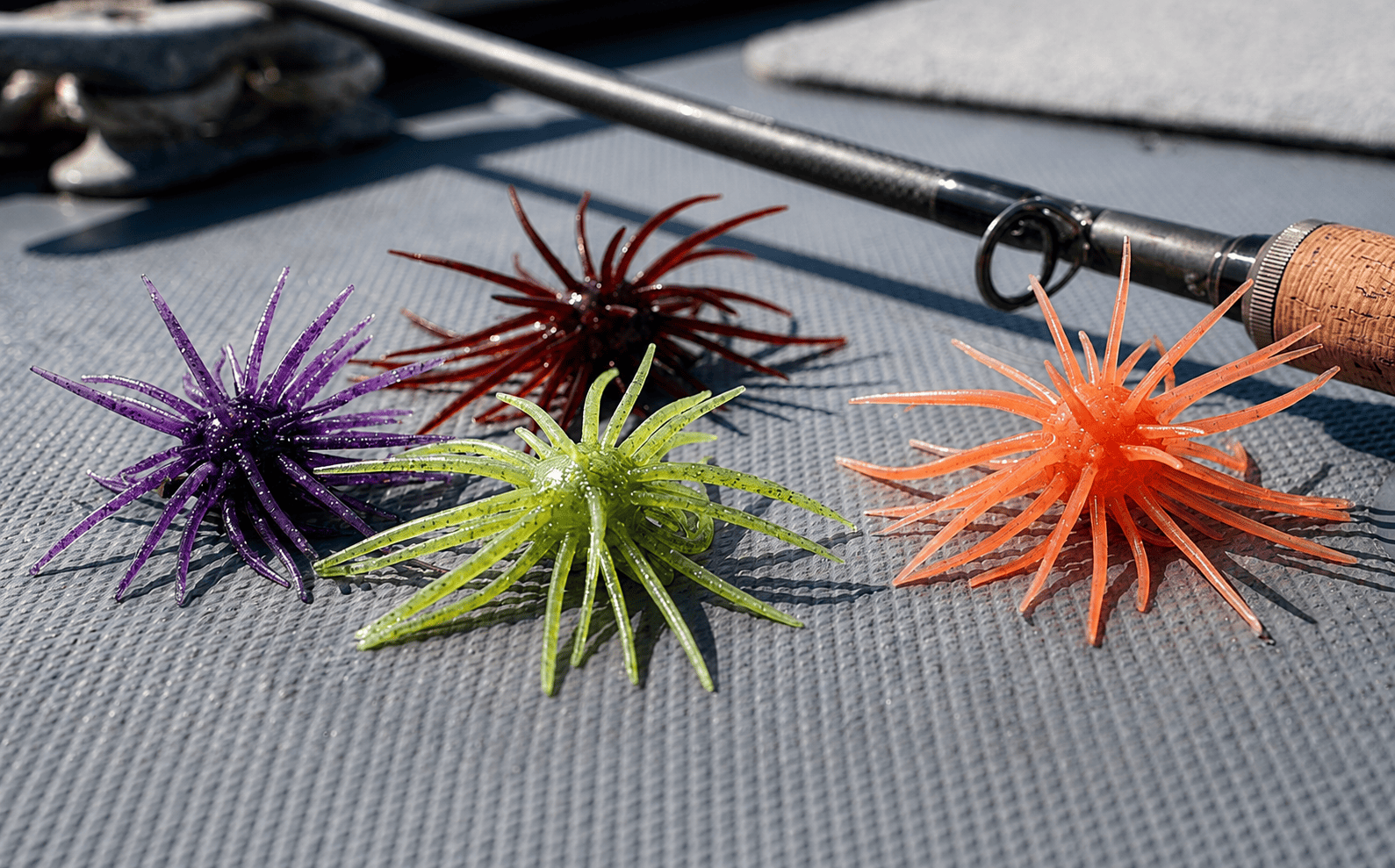
It's called the Coike, a Hideup design that has been made in Japan for more than twenty years. Owner Hideo Yoshida built the original: a dense elastomer sphere between 13mm and 17mm, bristling with soft spines that quiver on their own. You barely move it. The spines work while the bait hangs in front of a fish that has already refused everything else in the box.
For two decades it stayed a Japanese curiosity. Then Kyoya Fujita, a Japanese pro with two Bassmaster Elite Series wins, started catching fish with urchin baits in front of American cameras. Other pros copied him. Social media did the rest. By May 2026 most Coike variants were sold out, and anglers were paying eBay prices for a bait that retails in the high teens. Three tournaments inside four weeks fell to a Coike or a knockoff: Chris Johnston at Santee Cooper, Alex Davis for $100,000 at Lay Lake, Jason Christie on the Pasquotank River on June 14, 2026. Bassmaster's headline for Johnston's win turned the bait into a verb: "Johnston Coikes his way to Bassmaster Elite Series victory."
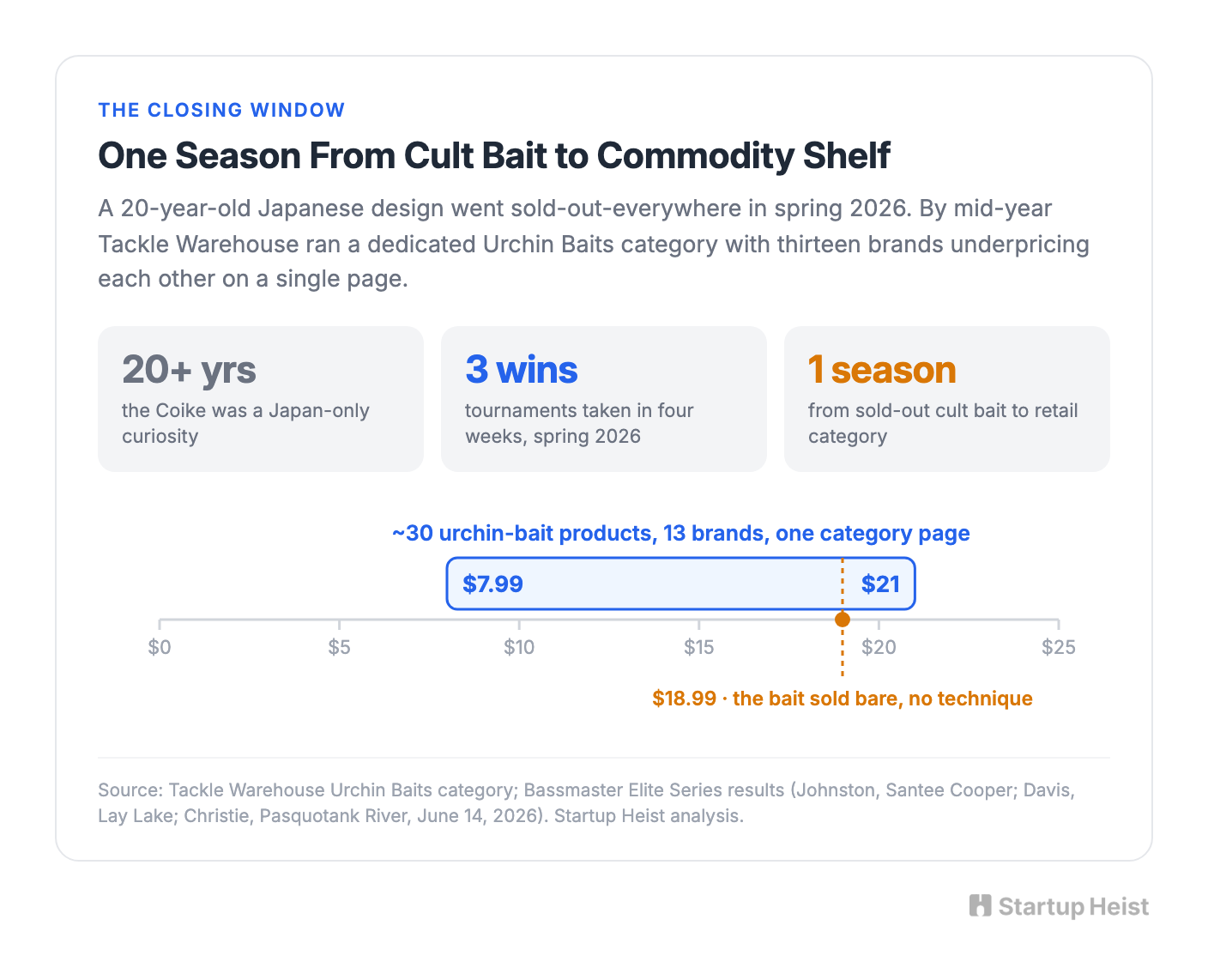
Then the window closed. Tackle Warehouse now runs a dedicated Urchin Baits category: roughly thirty products across thirteen brands, priced from $7.99 to around $21. Hideup and Imakatsu sit next to Berkley, Yamamoto, Missile, 6th Sense, G-Ratt and a handful of garage operations. The impossible-to-find Japanese alien bait became a merchandising category in one season.
Here's the opportunity:
The money: 250 buyers at a $55 average order across 18 drops a year is $247,500. Run it well and it's $585,000.
Inside:
• Six-factor scorecard for picking a drop
• $49 kit economics with a 41% contribution line
• Field-test protocol that doubles as marketing
• 90-day launch plan with honest kill metrics
Don't start an import shop whose only advantage is knowing where to buy Japanese lures. Digitaka ships to your door by FedEx in three to seven days, Japan Import Tackle is one of the longest-running independent Japanese domestic market importers in the country, and Tackle Warehouse runs a full JDM department. Access is solved.
The opportunity sits one layer above access: the translation between Japanese tackle innovation and American fishing conditions. That translation is a judgment problem. What is this thing, why does anyone fish it that way, what hook and weight does it need, when should you throw it, what American water looks like the water it was designed for, and what happened when somebody credible tried it here.
That's a smaller business than "the future of fishing commerce," and a real one.
Japan Runs America's Bass R&D Department
This isn't a one-off. The drop shot came from Japan. So did the Neko rig, invented in the late 1990s for ultra-pressured fish in glass-clear water, now standard equipment in every serious American tackle box. The Tokyo rig, minnow shaking, half the finesse vocabulary on the Elite Series: all of it crossed the Pacific first. Even the free rig, which started in South Korea, reached American anglers by way of Japanese tournament pros. Tackle Warehouse markets its JDM section with the line "As goes Japan, so goes the bass fishing world."
The reason is structural. Japanese bass water is small, clear, heavily fished and brutally pressured. Anglers there solve problems American anglers won't face for another five years, and the tackle industry iterates hard against them. America imports the answers later, usually after a tournament makes them impossible to ignore.
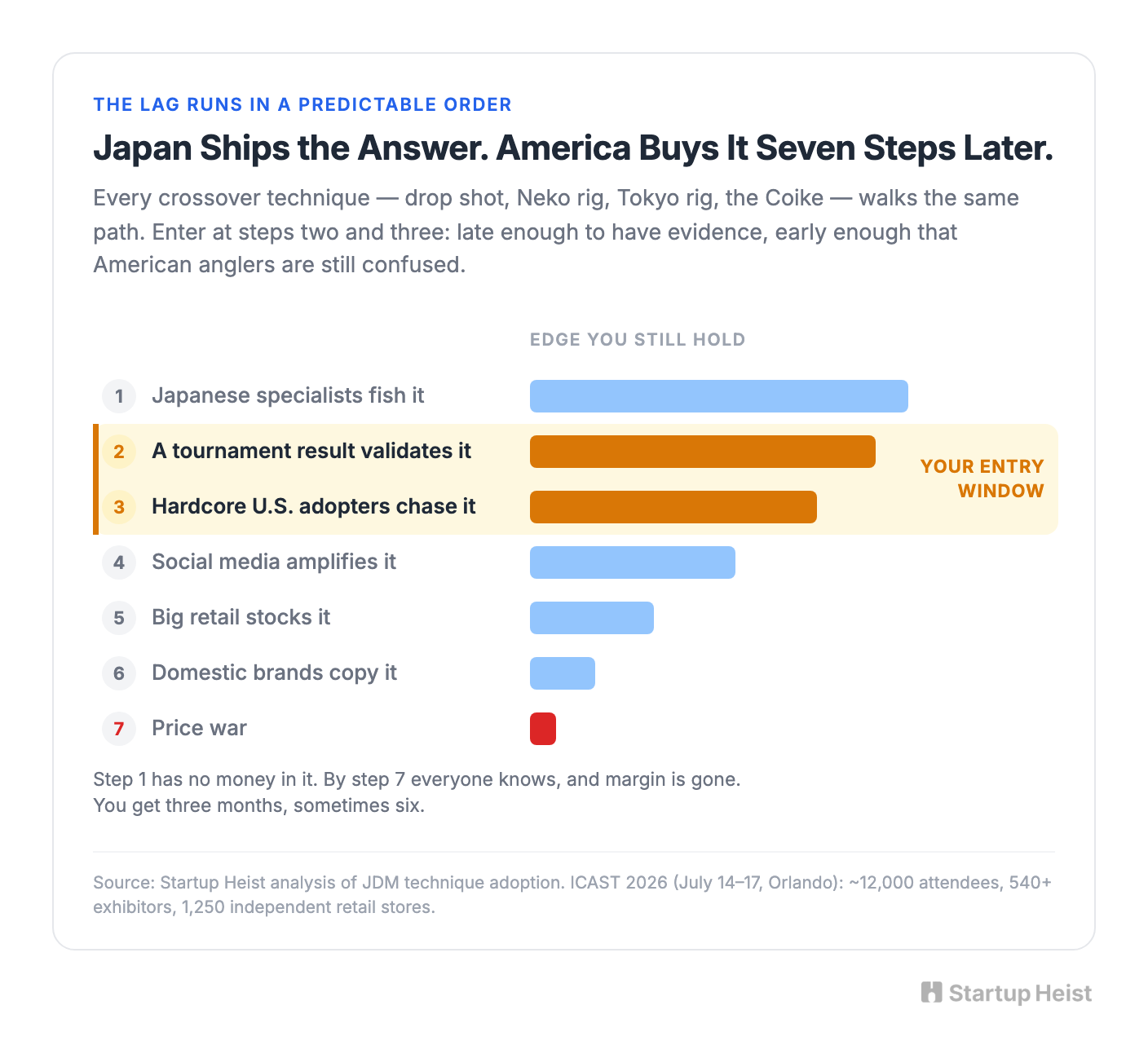
The lag runs in a predictable order. Japanese specialists use it, a tournament result validates it, hardcore American adopters chase it, social amplifies it, big retail stocks it, domestic brands copy it, and it lands in a price war.
There's no money at step one. Being first is hard, and Japanese anglers and retailers will always know their own market better than you do. Steps two and three are where you can operate: early enough that American anglers are still confused, late enough that you have evidence instead of hype.
The Coike shows how narrow that gap has become. ICAST 2026 ran July 14 to 17 in Orlando and drew close to 12,000 attendees, 540-plus exhibitors and 1,250 independent retail stores, 250 more than the year before. Once a product reaches that machine, everybody knows within a week and copies are in development within a month.
You aren't protecting a secret for three years. You have three months, sometimes six. That's plenty, as long as the business runs on temporary informational edges and never on permanent exclusivity.
What the Angler Is Actually Buying
An angler sees a strange Japanese bait on Instagram and can buy it himself in about ninety seconds. Purchasing was never his problem.
His problem starts after the purchase. Which size, which color, which hook, what weight, braid or fluoro, where in the water column, smallmouth or largemouth, grass or rock or suspended fish, and does he twitch it, drag it, hover it, or leave it dead still. Underneath all of it sits the real question: is this useful on my lake, or did I just spend $24 because a pro caught a six-pounder on one in Texas?
What you're selling is the elimination of that guesswork. Every drop ships as a technique package, never as a bare imported SKU.
Take the fourth drop as an example. The Pressured-Water Hover Kit, $49. One authentic Japanese bait, the exact hooks used in testing, two weight options, a waterproof rigging card, a QR code to a ninety-second setup video, and three documented U.S. field tests stating plainly where it worked and where it didn't.
Set that next to the same bait sold alone for $18.99, which is a commodity with a shipping problem. The kit is a decision somebody already made for you, and the gap between the two is the entire company.
Traditional tackle retailers optimize for selection. A big one carries twenty thousand products. You'll carry twenty techniques, and the homepage should read like an anti-store: we test strange Japanese bass techniques so you don't have to, rigged and explained on American water. Some work. Some don't. We publish both.
Publishing both is the asset. Fishing is unusually vulnerable to marketing nonsense because outcomes are intermittent: put any lure in front of enough fish and eventually somebody lands a giant, and the photo becomes the advertisement. You can't out-inventory Tackle Warehouse, but you can out-trust it, and you do that by publishing the bait you fished for four outings and refused to sell.
The Market Is Big. Your Slice Isn't.
The American Sportfishing Association reported on July 29, 2026 that 57 million Americans fished in 2025, roughly 18% of the population, taking 918 million outings, up 3% year over year. Recreational fishing pulls close to $100 billion in annual spending across gear, licenses and trips.
Read the rest of that report before you get excited. Participation fell from 57.9 million in 2024, the first annual decline since 2021, and 19 million people dropped out in a single year, the highest churn ASA has ever recorded. An enormous market with a leaky bucket is exactly the condition under which loyalty and repeat purchase get valuable.
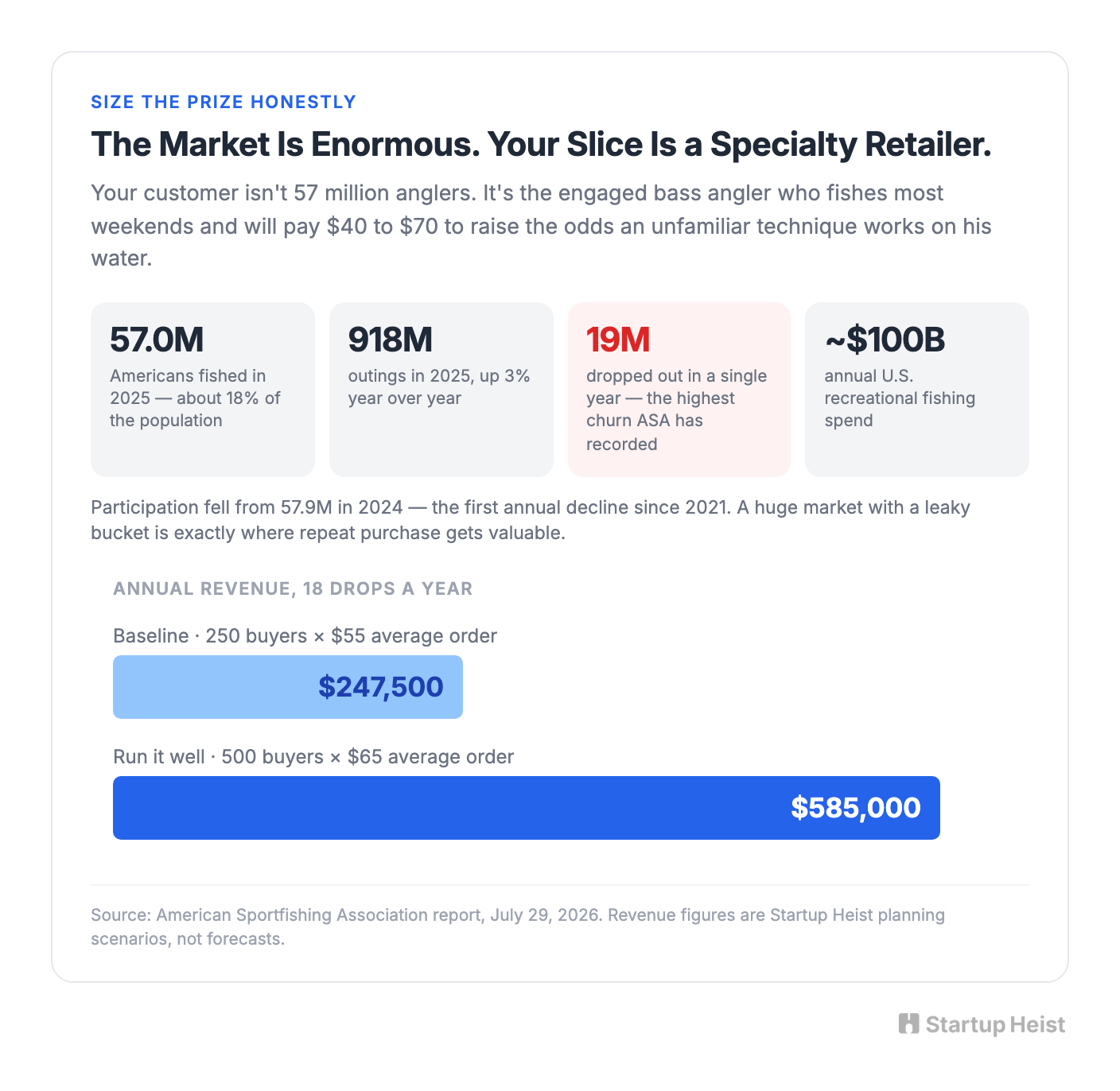
Your actual customer is narrow: an engaged freshwater bass angler who fishes most weekends, follows emerging techniques, enjoys experimenting with gear, and will pay $40 to $70 to raise the odds that an unfamiliar technique works on his water.
The math is honest and unglamorous. Two hundred fifty buyers at a $55 average order across 18 drops a year is $247,500. Get genuinely good and it's 500 buyers at $65, or $585,000. Add evergreen reloads, terminal tackle and two or three permanent winners, and you have a high-six-figure specialty retailer with real margins and no investors.
That's a commerce-first quick steal with an optional second act. It's not a hundred-million-dollar platform, and pretending otherwise is how founders talk themselves into building software nobody needs.
The Competition, Honestly
Four players define the water you're swimming in. Don't attack any of them head-on.
Unlock the Vault.
Join founders who spot opportunities ahead of the crowd. Actionable insights. Zero fluff.
“Intelligent, bold, minus the pretense.”
“Like discovering the cheat codes of the startup world.”
“SH is off-Broadway for founders — weird, sharp, and ahead of the curve.”


