


Build the 10%, Not the Simulator
On August 12, 2026, a solo developer in Berlin named John Goering released a World War II submarine game called Silent Shark on Steam. There's no 3D U-boat interior, no crew walking between compartments, no forty-minute transit across open ocean. Most of the game happens on a chart.
You listen for a contact on the hydrophone. You estimate its course and speed. You plot an intercept, raise the periscope, guess the range with a stadimeter, feed imperfect numbers into a torpedo data computer, and fire. Then you wait to find out whether your geometry was right.
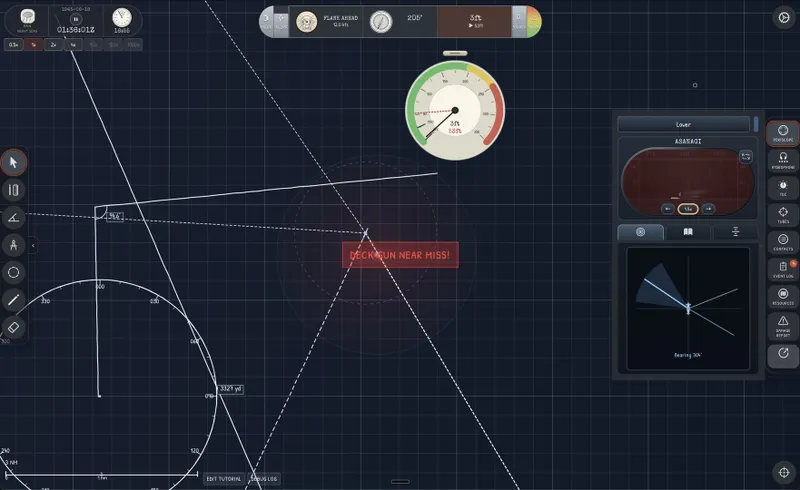
A month after launch, Steam showed 125 reviews at 98% positive. On August 24, Goering told Hacker News he'd sold "a few thousand copies," still had more than 25,000 wishlists, and had built the whole thing in six months of evenings and weekends with Codex writing every line of code. Those sales figures are developer-reported, but they square with the review count and with the 17,000 wishlists he posted about three days before launch.
The tempting conclusion is that AI coding made this possible, and that's half the story. The other half is that Goering grew up playing Silent Service II on an Atari ST with his dad, moved on to Silent Hunter IV, then UBOAT, and told the same forum that "the part I always enjoy the most is the plotting and charting aspect, essentially beating uncertain estimates with geometry." The idea of pulling that one mechanic out of a sprawling simulator and building a game around it had been in his head for years.
Codex made the implementation fast. Knowing what to cut was his, and that's where the opportunity sits.
The money: 2,500 to 5,000 copies at $17.99 is $45,000 to $90,000 gross for one builder, against a $100 Steam fee. Silent Shark did it in twelve days.
Inside:
• Five genres with the loop already exposed
• The offensively small MVP spec and kill gates
• Wishlist, demo, and pricing benchmarks
• The seven-month calendar and outreach email
The narrowness is the product
Simulation games accumulate systems the way old houses accumulate wiring. A flight simulator becomes aircraft models, avionics, weather, scenery, radio procedures, career modes, and hundreds of configuration screens. A railway sim becomes track construction, signaling, timetables, rolling stock, economics, and network expansion. A submarine sim becomes navigation, crew management, damage control, fuel, patrols, maintenance, and a campaign.
Hardcore players tolerate all of it, but they rarely love all of it equally. Somebody logs hundreds of hours in a railway sim because he loves untangling junction conflicts. Somebody else sits through a long flight because she loves planning a difficult approach through bad weather. A naval player enjoys the campaign, but the thing that makes him lean toward the screen is inferring an enemy's position from three bad bearings.
The subtractive-sim founder asks one question: what's the 10% of this enormous simulation that some players would happily play without the other 90%?
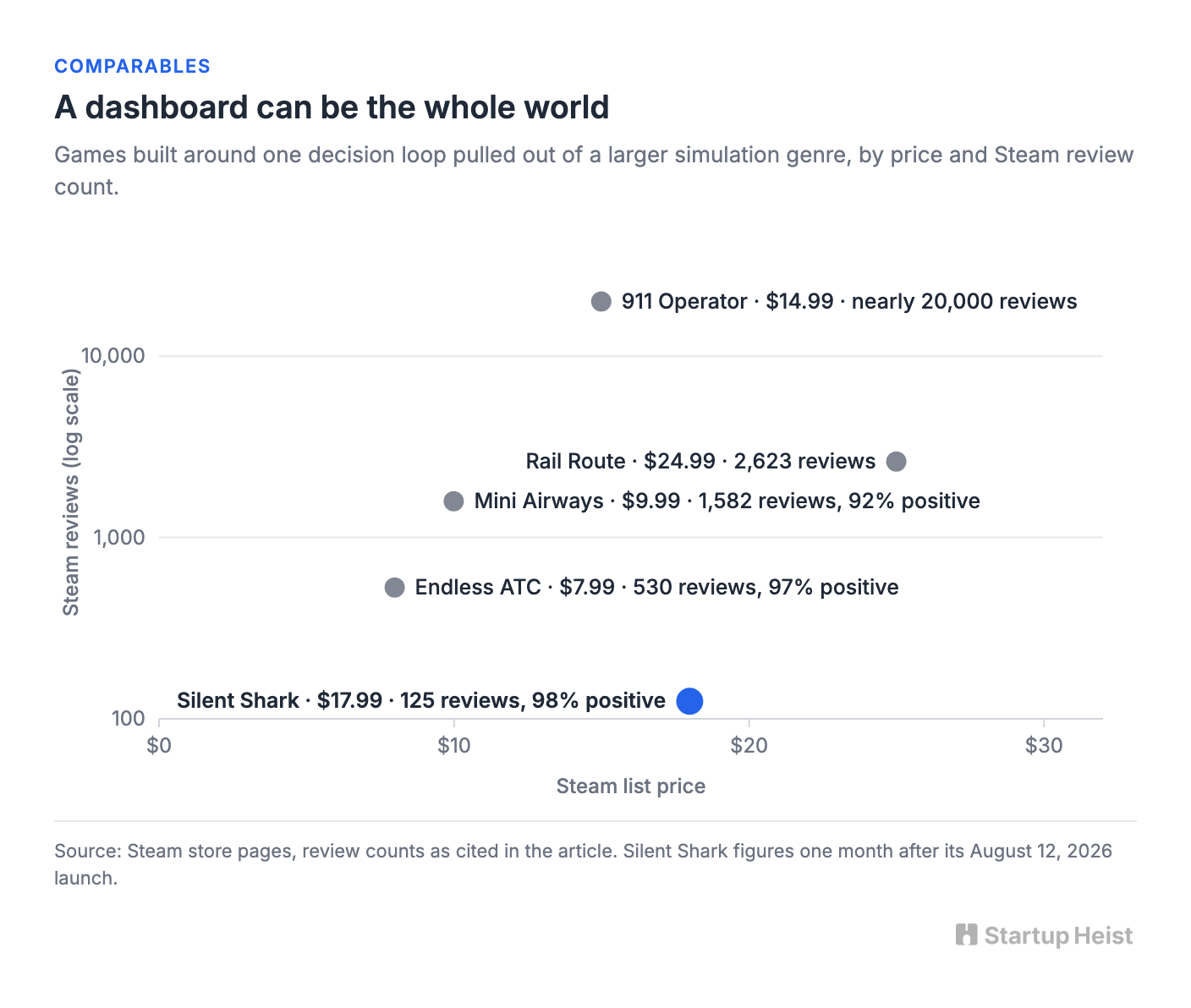
There's already a shelf of evidence that the answer is a business. Endless ATC strips air-traffic control down to a radar scope, headings, altitudes, and landing sequencing; it sells for $7.99 and holds 97% positive across 530 Steam reviews. Mini Airways takes the same job and makes it a $9.99 real-time management game with 1,582 reviews at 92%. Rail Route builds an entire $24.99 product around dispatching and automating a railway network, with 2,623 reviews. 911 Operator took the dispatch decision, a side system in every city builder, and turned it into a game with nearly 20,000 reviews. None of these proves that every obscure sub-mechanic deserves a standalone product. What they prove is more useful: a dashboard can be the whole world if the decisions on the dashboard are interesting enough.
AI made building cheap and being noticed worthless
A decade ago, a founder with deep railway-dispatch knowledge and mediocre engineering skill had a production problem. Hiring programmers for a weird $15 niche game made no financial sense, and learning enough game development to ship it alone took years. That constraint is gone. Deterministic simulation logic, UI state machines, save systems, scenario loaders, procedural generators, internal editors, test suites, and packaging scripts are precisely the work coding agents handle well.
Silent Shark is the aggressive version of this. In the May 2026 beta thread, Goering said he'd "not touched a single line of code" beyond occasional CSS, that the game was TypeScript built with Vite and packaged with Electron for desktop, and that the project had convinced him his "20+ years of professional experience in coding are clearly worth far less than they were just a couple years ago."
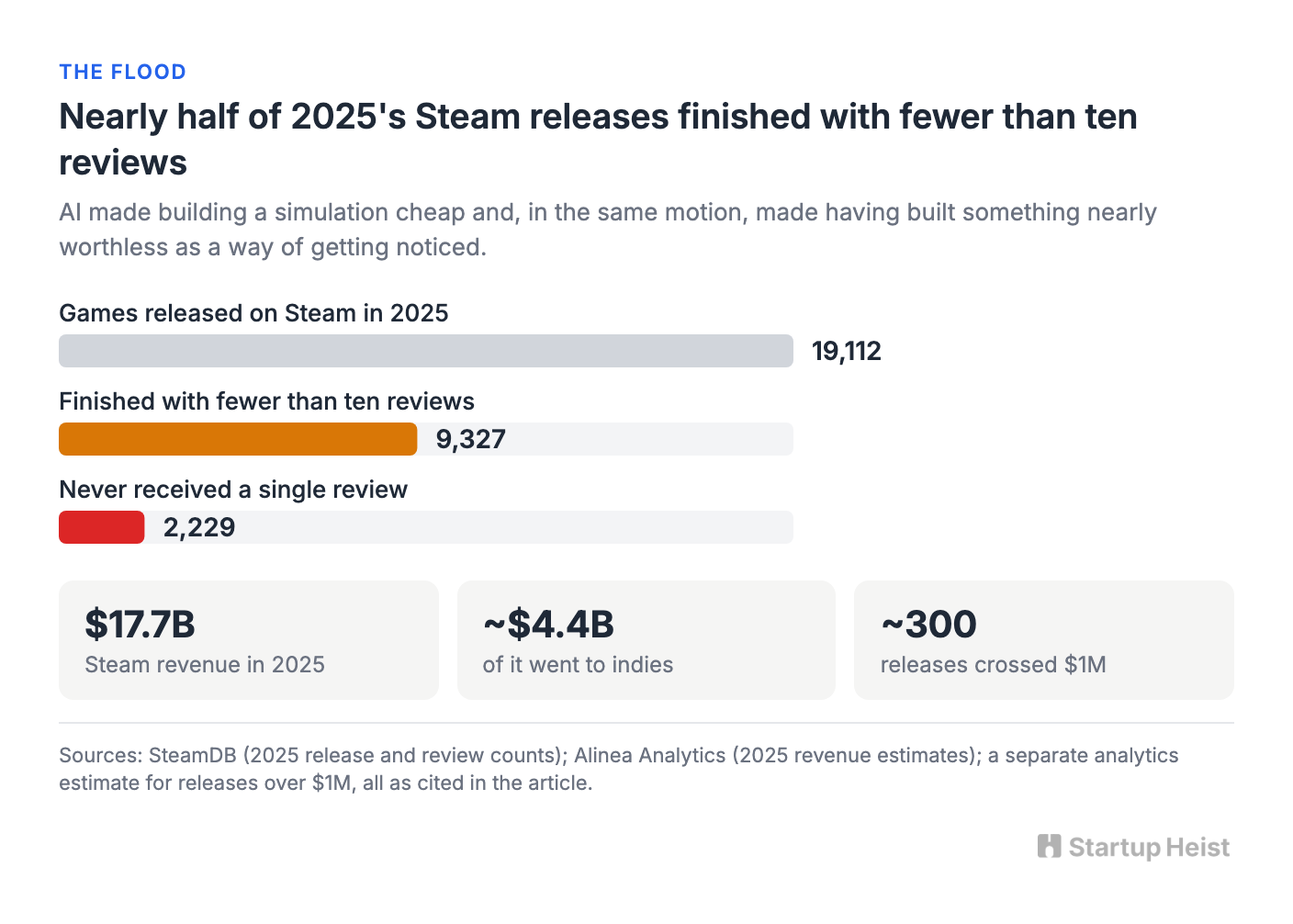
The same technology floods the market. SteamDB counted 19,112 games released on Steam in 2025. Of those, 9,327 finished with fewer than ten reviews, and 2,229 never received one. Alinea Analytics estimates indies pulled roughly $4.4 billion of Steam's $17.7 billion in 2025 revenue, and by another analytics estimate only about 300 of the year's releases crossed $1 million. AI made building a simulation cheap and, in the same motion, made having built something nearly worthless as a way of getting noticed.
The moat has moved to knowing which simulation deserves to exist, and to finding that out before you spend seven months on the answer.
Hunt for the buried loop
Don't start with "I want to build a train game." Start with a community where people repeatedly argue about one mechanic. The ideal wedge passes six tests.
| Test | What you want to see |
|---|---|
| Existing obsession | Forums, Discords, subreddits, leagues, mod scenes, specialist YouTubers |
| Buried mechanic | Players discuss one part of larger games far out of proportion to its screen time |
| Short decision cycle | A satisfying run fits in 10 to 30 minutes |
| Cheap representation | Maps, charts, timetables, logs, or instruments can carry the whole state |
| Interesting failure | Losing teaches something and creates an immediate urge to retry |
| Founder credibility | You know the subject well enough that enthusiasts cannot smell a tourist |
The last one matters most. Silent Shark didn't come from someone scraping Steam reviews for "underserved submarine niches." It came from someone who had been feeding bearings into a torpedo computer since the Atari ST. So look backward through your own obsessions. Which system have you spent years using, studying, fixing, watching, or modding? That's a stronger hunting ground than any category-growth chart.
Five places to dig
Unlock the Vault.
Join founders who spot opportunities ahead of the crowd. Actionable insights. Zero fluff.
“Intelligent, bold, minus the pretense.”
“Like discovering the cheat codes of the startup world.”
“SH is off-Broadway for founders — weird, sharp, and ahead of the curve.”


