


The IRS Is Killing FIRE. Sell the Migration Audit Before Filing Season.
On August 24, 2026, the IRS put a date on the death of one of the oldest rails in American business software.
The Filing Information Returns Electronically system, known as FIRE, has carried 1099s and related information returns for decades. Accounting firms, payroll bureaus, property managers, and vertical software vendors all built quiet little pipelines that end with a fixed-width text file getting uploaded to it. Most of them have run for years without anyone touching the code.

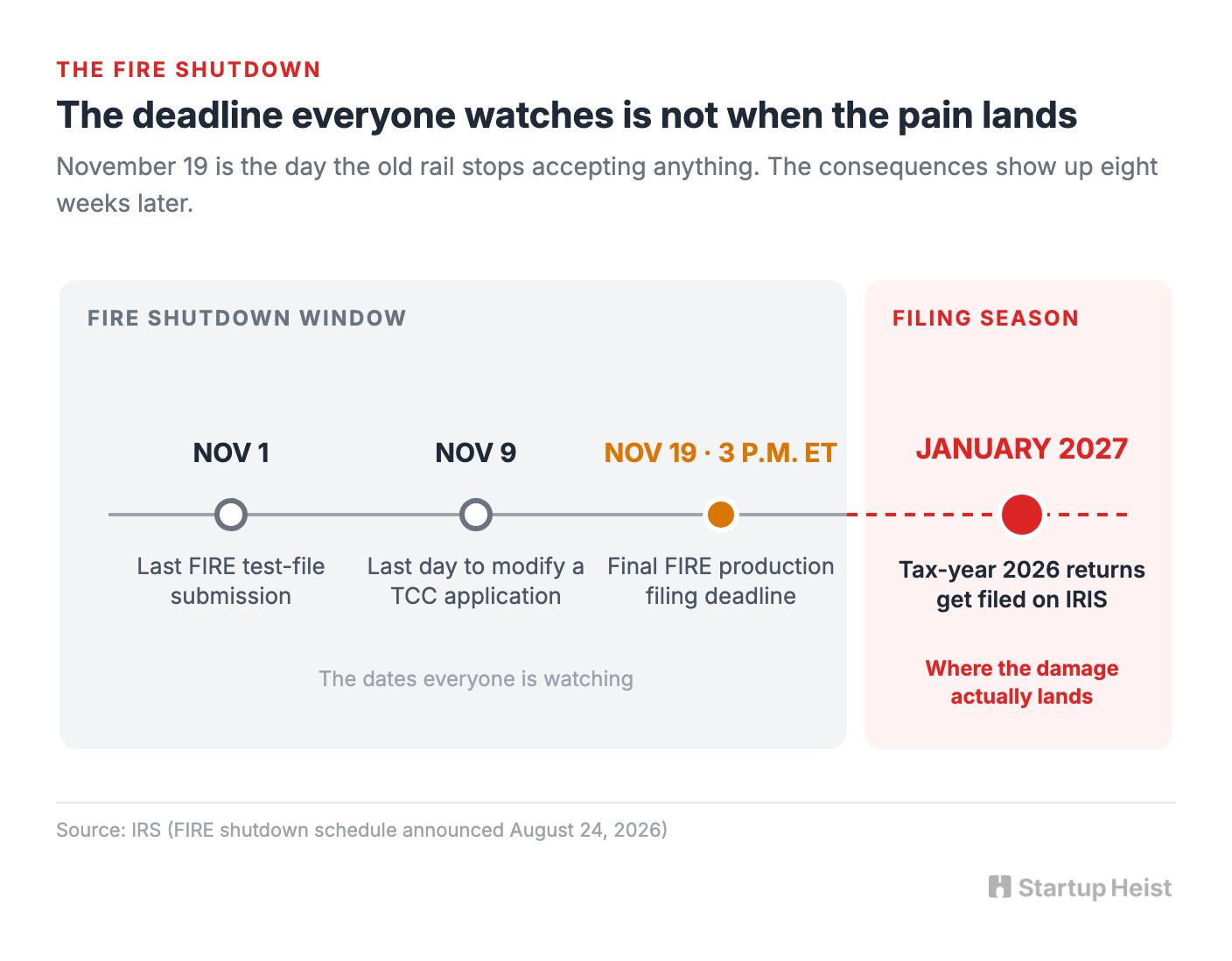
Now there's a shutdown schedule. November 1, 2026 is the last day to submit test files through the FIRE Trading Partner Test System. November 9 is the last day to modify an Information Returns Application for a Transmitter Control Code. November 19 at 3 p.m. Eastern is the final production filing deadline. Starting in 2027, the Information Returns Intake System, IRIS, becomes the destination for the forms FIRE used to accept, including prior-year filings and corrections.
November 19 isn't a new deadline for your 2026 1099s. It's the day the old machine stops accepting anything at all, a distinction most of the coverage has blurred. The damage arrives in January 2027, when firms sit down to file tax-year 2026 information returns and find that the workflow they've used for a decade has nowhere left to send its output.
That gap is the opportunity, and the obvious way to attack it is the wrong one. Skip the 1099 filing company. Build the tool that tells a firm whether its aging data pipeline survives the switch, and exactly what has to change before January.
Call it a FIRE-to-IRIS Readiness Audit: a privacy-first browser or desktop application that ingests an old FIRE file or a current source export, tests it against IRIS requirements, identifies the data and mapping failures, and produces a remediation plan plus test-ready output. It doesn't submit returns, calculate tax, or replace Avalara, Tax1099, Yearli, or anyone's accountant. It's the diagnostic layer sitting immediately upstream of all of them, and that's what separates a real business from a commodity file converter.
The business underneath it is small, fast, and seasonal.
The money: One forced filing season: 100 workspaces at $349, 40 firm licenses at $2,400, and 20 implementation sprints at $2,000 is about $171,000.
Inside:
• Five-layer audit spec, parse to remediation
• Pricing ladder from $99 to $3,600 a season
• Partner-first outreach with a cold email
• The mapping library that becomes the moat
What Actually Breaks
FIRE is built around electronic filing conventions from another era. A FIRE-format file follows Publication 1220: fixed-width records stacked in sequence, transmitter, payer, payee, end-of-payer, state totals, end-of-transmission. A report runs, a text file appears, somebody uploads it, January ends, and nobody opens the code in between.
IRIS moves the destination and changes the shape of what arrives there. Lower-volume filers use the IRS Taxpayer Portal, entering returns by hand or uploading CSV files. Higher-volume and automated filers use IRIS Application-to-Application, which speaks XML schemas and enforces IRS business rules at intake. What the IRS doesn't supply is a button that fixes the twelve systems feeding the old one.
Take a 12-person accounting firm with 180 small-business clients. Data arrives from QuickBooks Desktop, a property management package, a payroll application, spreadsheets, and two oddball client systems nobody can name. Staff normalize it by hand and an old utility spits out the FIRE file. A niche property-management SaaS built in 2009 has the same problem: its year-end module produces a Publication 1220 export that hundreds of property managers depend on, and the developer who wrote it left in 2017. Neither one is asking whether a text file can become a CSV. They're asking which fields map to the new workflow, which records are invalid, and what has to change upstream before thirty clients start calling in January. That's implementation work, and implementation prices very differently than conversion.
The Change That Made This Everyone's Problem
Two regulatory shifts stacked on top of the shutdown, and both push in your favor.
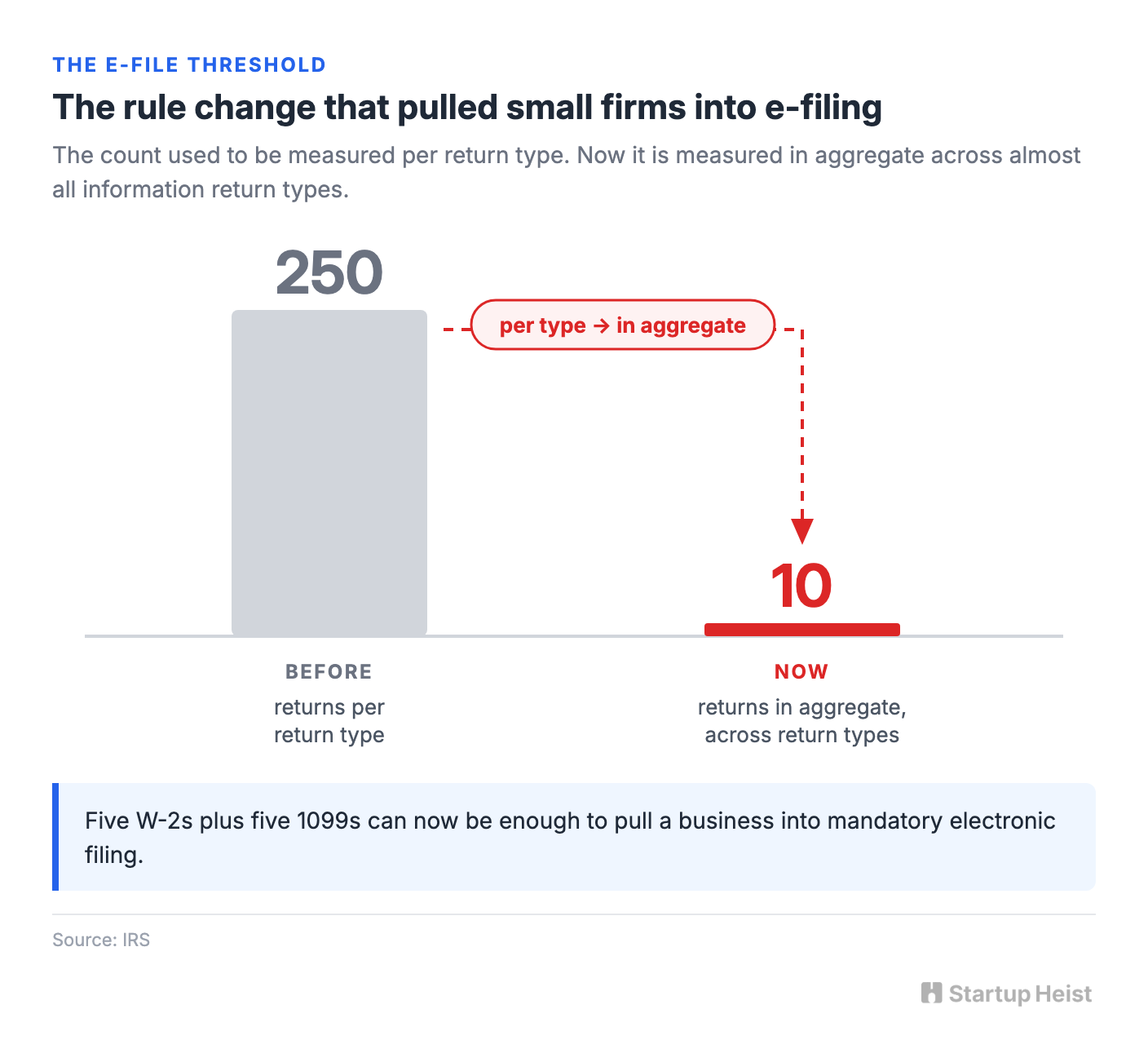
The electronic filing threshold collapsed from 250 returns per return type to at least 10 returns in aggregate across almost all information return types covered by the regulation, so five W-2s plus five 1099s can be enough to pull a business into mandatory electronic filing. Small practices, bookkeeping shops, and service bureaus now live inside electronic information reporting whether they wanted to or not.
Mistakes also carry a price. For information returns required to be filed in 2027, the general Section 6721 penalty for failing to file correct information returns is $340 per return, with reduced amounts when the problem is corrected quickly, and separate penalties can apply for incorrect payee statements. Don't sell this with scare tactics, because a formatting error doesn't automatically become a $340-per-record assessment. The economics work without the theater: a firm doesn't need many staff hours spent diagnosing rejected files before a few hundred dollars of audit looks like the cheap option. What the buyer is purchasing is certainty before filing season.
A second clock is already running and most firms haven't noticed. Filing through IRIS requires a Transmitter Control Code, and the IRS says the application may take up to 45 days to process. That's your opening question on a sales call: do you already have your IRIS TCC? If the answer is no in October, the customer's migration problem is considerably larger than file formatting, and they don't know it yet.
Why the Obvious Build Is a Trap
A competent founder looks at fixed-width FIRE input on one side and IRIS CSV on the other and sees a weekend project. Parser, mapper, download button, charge $99.
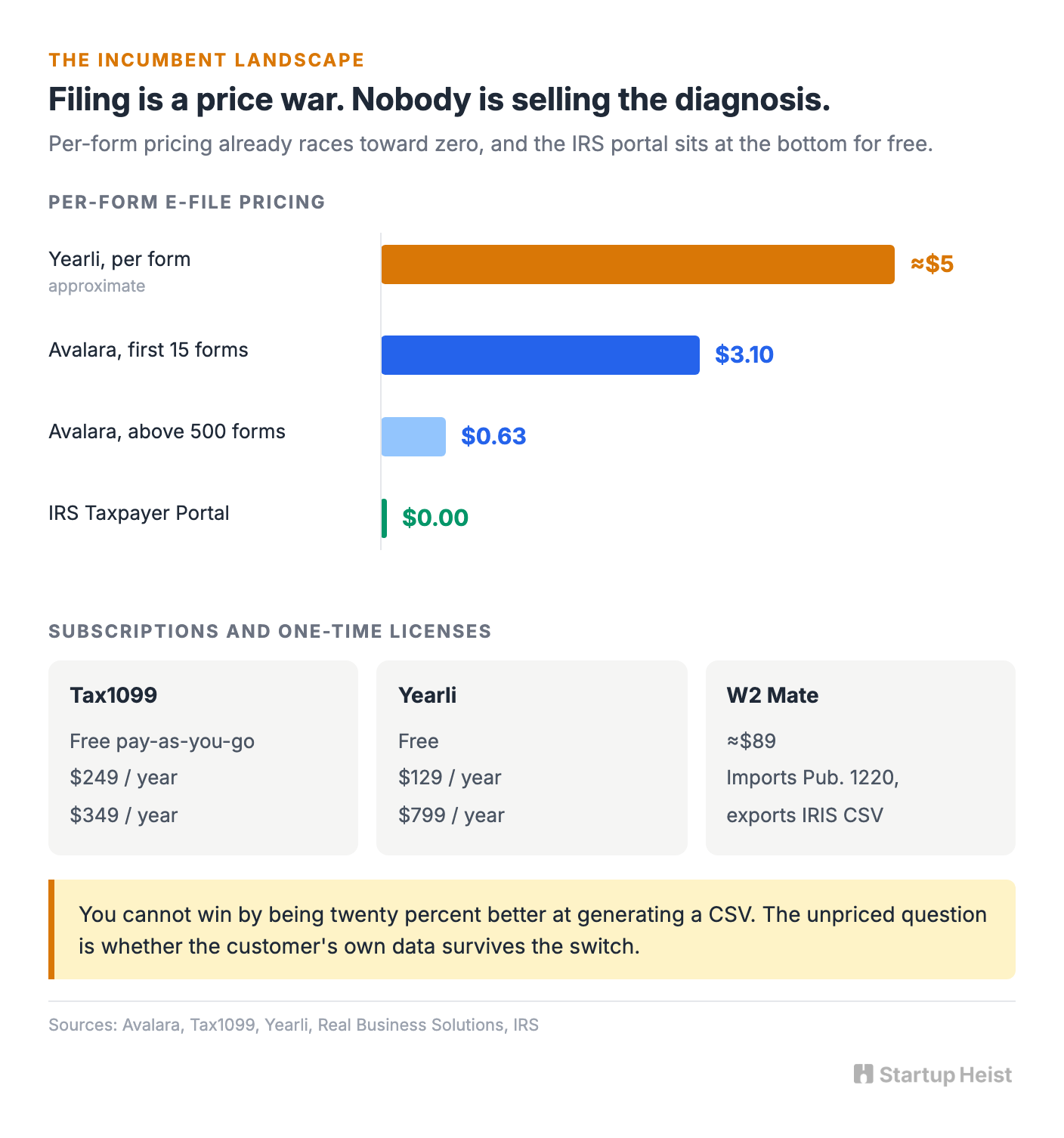
Someone already shipped it. Real Business Solutions markets a W2 Mate workflow that imports Publication 1220 files and exports IRIS-compatible CSV, and the product sells for around $89. 1099 Pro, which claims more than 10,000 companies on its platform, already accepts 1220 imports alongside TIN matching and recipient delivery. Upload FIRE, download IRIS CSV is a checkbox on someone else's feature page. The rest of the neighborhood is worse: Avalara charges $3.10 per e-file for the first 15 forms and steps down to $0.63 above 500, Tax1099 runs a free pay-as-you-go tier alongside $249 and $349 annual plans, and Yearli starts free and layers $129 and $799 subscriptions on top of roughly $5 per form. They own filing, recipient delivery, and state reporting. The IRS owns the free portal at the bottom of the market. You can't win by being twenty percent better at generating a CSV.
Notice what those same companies are doing with content. Search "FIRE to IRIS" and the first page is filing vendors publishing migration guides. They've decided the transition is a lead-generation event. Fighting them for search rankings in September wastes your only real advantage, which is time.
Your wedge is migration intelligence: knowing which real-world systems break against the new specification, and being the only party in the room who can prove it with the customer's own data.
The Product: A Readiness Audit in Five Layers
The application opens with two doors. Audit a historical FIRE file, or audit a current source export. Everything runs locally unless the customer explicitly chooses otherwise. Drop in last year's 1099-NEC file and the app detects the tax year and record structure, parses the records, and reconstructs the underlying dataset. Then it asks how the customer intends to file in 2027: the IRIS portal, a third-party provider, an internal or partner A2A implementation, or unknown. Unknown is the best answer you can get.
Unlock the Vault.
Join founders who spot opportunities ahead of the crowd. Actionable insights. Zero fluff.
“Intelligent, bold, minus the pretense.”
“Like discovering the cheat codes of the startup world.”
“SH is off-Broadway for founders — weird, sharp, and ahead of the curve.”


