


The $26 Billion Scholarship Program Doesn't Need Another Scholarship App
On January 1, 2027, America's first nationwide school-choice tax credit goes live. Section 25F of the tax code, created by the One Big Beautiful Bill Act in July 2025 and also known as the Education Freedom Tax Credit, lets an individual claim a dollar-for-dollar federal credit of up to $1,700 for cash donations to approved Scholarship Granting Organizations, or SGOs. Treasury's proposed rules treat each spouse on a joint return as a separate taxpayer, so a married couple can claim up to $3,400 if both give. As of August 2026, 30 states had elected to participate.
Treasury's projections are enormous. By 2030 it expects 600 to 700 SGOs operating in those states, with more than 11 million taxpayers giving about $26 billion a year, enough to fund 2 million full-time scholarships at $12,000 or 5 million part-time ones at $4,500.
Numbers like that make the obvious startup write itself: an "SGO operating system" that takes donations, issues receipts, collects applications, verifies family income, awards scholarships, moves money and packages everything for audit. That startup already exists, several times over. FACTS, the Nelnet-owned tuition and aid company that serves more than 13,000 schools and more than 120 SGOs, is building Compass to manage donor contributions, applications, eligibility verification and disbursement for state and federal programs. SGO Guide sells ClearPath, four modules pitched as "one system of record," covering unique-donor-number receipts, income verification, per-state 90/10 monitoring and the audit evidence package. A scatter of smaller sites is already chasing searches for scholarship granting organization software.
The better heist is narrower, and it lives in the gaps between the systems SGOs already run.
The money: 50 SGOs at $499/month is about $25K MRR, roughly $299K ARR, before $2,500–$5,000 implementation fees. Treasury expects 600 to 700 SGOs by 2030.
Inside:
• Seven-function MVP built on three ugly CSVs
• $3,500 readiness offer plus SaaS pricing
• CPA-led go-to-market and cold email
• Validation gate: three paid pilots first
Build the compliance sidecar that sits between an SGO's existing donation, scholarship and accounting systems and turns their records into a reconciled Section 25F evidence trail. Think BlackLine, the software corporate accounting teams use to reconcile accounts and close the books, built for one strange new federal tax-credit program.
You don't own the application, custody the money, replace QuickBooks or decide which child qualifies. You make sure that when the accountant, board, state or auditor asks why a $4,500 payment was permissible and where the money came from, the answer takes thirty seconds instead of three days.
Why January 1 Creates the Opportunity
The proposed regulations, released October 1, 2026, turn a charitable donation into a chain of evidence. The SGO must generate a unique donor number for every qualified donor, deliver it in a written acknowledgment by January 31 of the following year, and report each donor's number, name, address and aggregate total to the IRS by February 28. The number exists so SGOs never have to collect Social Security numbers, and the SGO can only issue it after registering in a new IRS portal. If a donor's return lacks the number, the IRS presumes no qualified contribution was made, so a sloppy receipt can cost a donor the credit.
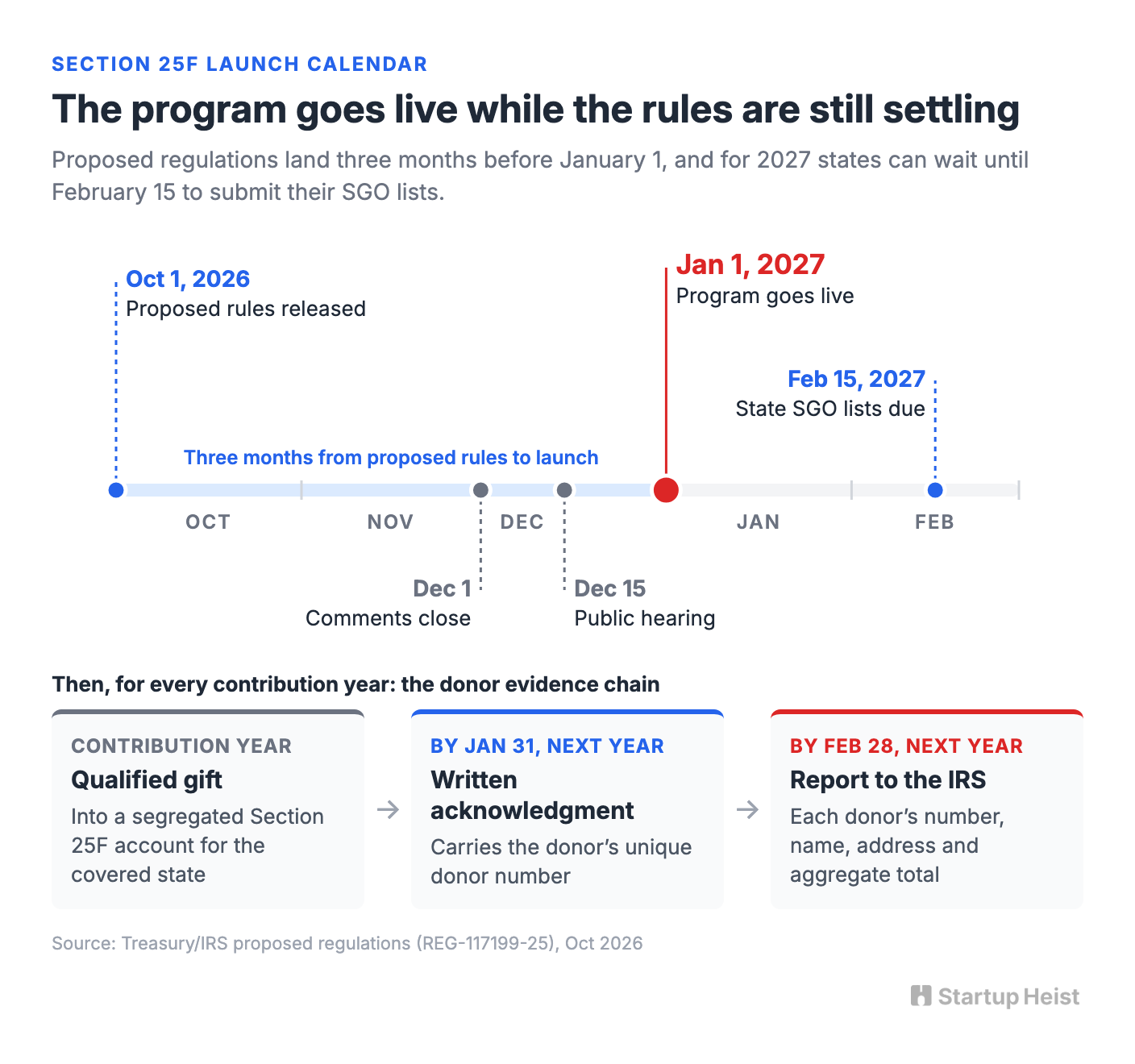
The money and the scholarships each carry their own rules. Qualified contributions go into a segregated Section 25F account, and a multistate SGO needs a separate account for every covered state, each with complete books. At least 90% of income must go to scholarships. Awards must reach at least 10 students who don't all attend the same school, require verified household income, give priority to returning recipients and then their siblings, can't be earmarked for a particular child, can't go to disqualified persons, and can only cover qualified K–12 expenses.
Then someone has to prove it. Every SGO must commission an annual financial and programmatic audit and deliver the results to each state that lists it. Treasury puts the bill at $10,000 to $30,000 a year and projects that 53% of SGOs will cross the $500,000 receipts line that requires an outside professional auditor. Those organizations are your market. What you sell them is a cheaper nonprofit audit and a faster close with fewer exceptions to chase.
The Mess Lives Between Systems
Consider a mid-sized SGO in late 2027. Fundraising runs on one donation platform while finance keeps the books in QuickBooks or another fund accounting system. Applications live in FACTS, Foundant, SmarterSelect or another scholarship platform, and families upload documents somewhere else entirely. Payments get recorded in accounting, bank transactions flow into the ledger, and receipts go out from the donation system. Each tool may work perfectly on its own. The SGO compliance problem lives between them.
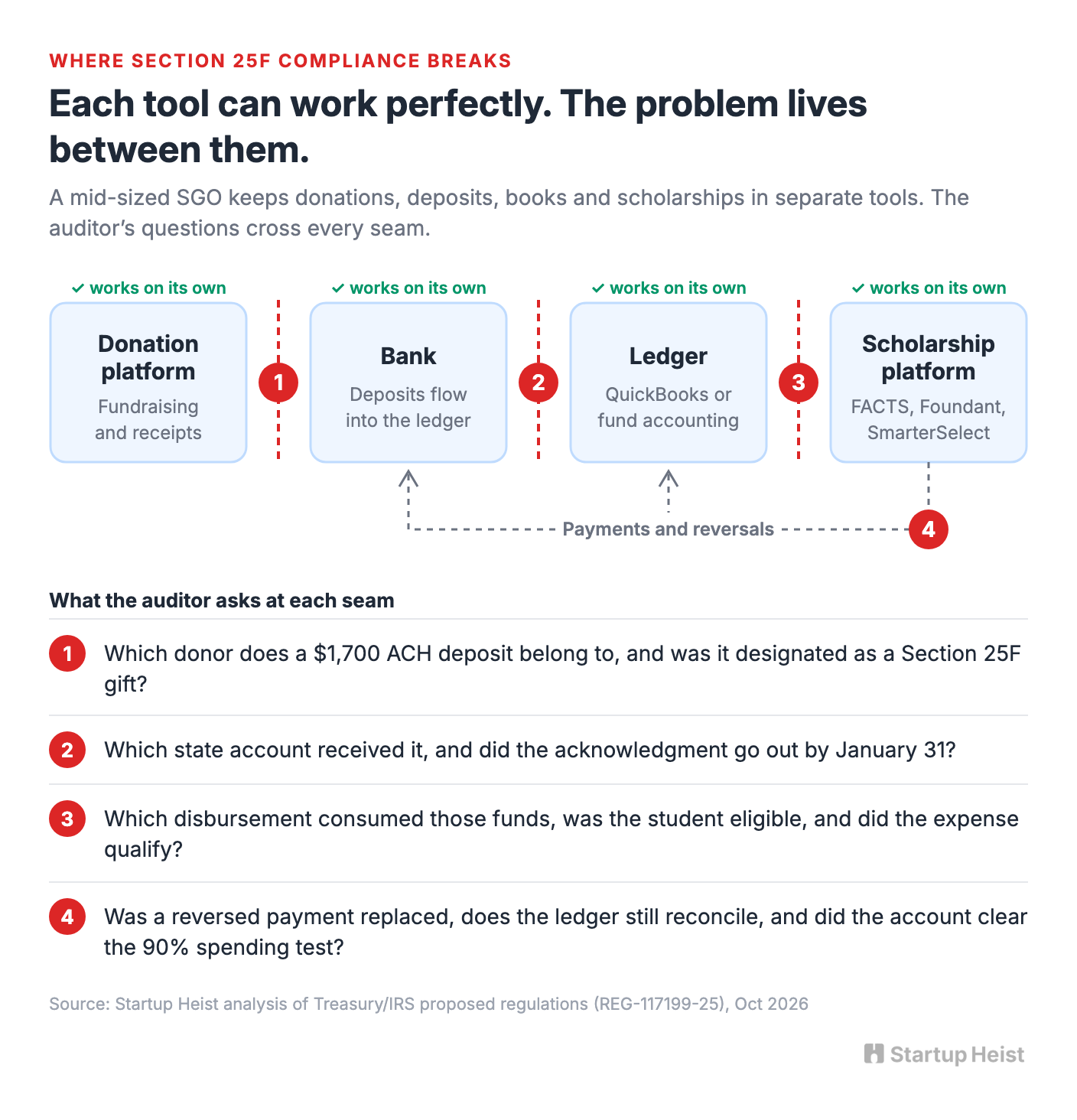
The auditor's questions cross every seam:
- Which donor a $1,700 ACH deposit belongs to, and whether it was designated as a Section 25F gift
- Which state account received it, and whether the acknowledgment went out by January 31
- Which disbursement consumed those funds, whether the student was eligible, and whether the expense qualified
- Whether a reversed payment was replaced, whether the ledger still reconciles, and whether the account cleared the 90% spending test
Point solutions answer one piece. SmarterSelect starts at $2,000 a year for applications and evaluation; Foundant's Scholarship Lifecycle Manager starts around $9,900. Scholarship organizations clearly already pay thousands a year for specialized software, so the sale you have to make is narrower: reconciliation deserves its own line item.
The all-in-one platforms solve the seams by asking the SGO to move everything onto them. Migration works for a new organization starting clean. It's a hard sell to an SGO already running a state tax-credit program, with years of donor history in one system, a ledger in another and an auditor who knows both, weeks before a new federal program launches. "Keep your systems, we'll reconcile them" is the easier sale, and none of the visible vendors lead with it.
The Product: 25F Close
Call it whatever you want. For now, call it 25F Close. Its job fits on a sticky note:
Import everything. Match everything. Flag what doesn't reconcile. Produce the evidence packet.
Version one has seven functions.
Unlock the Vault.
Join founders who spot opportunities ahead of the crowd. Actionable insights. Zero fluff.
“Intelligent, bold, minus the pretense.”
“Like discovering the cheat codes of the startup world.”
“SH is off-Broadway for founders — weird, sharp, and ahead of the curve.”


