


The Creator Receipts Kit
A media-literacy business for the TikTok news generation
A high schooler in Tampa doesn't say "I read an article." She says "I saw a TikTok." Her brother quotes a YouTuber. Her friends forward Instagram explainers. ChatGPT answers their homework questions. The news arrives mediated, clipped, personalized, and wrapped in a creator's vibe.
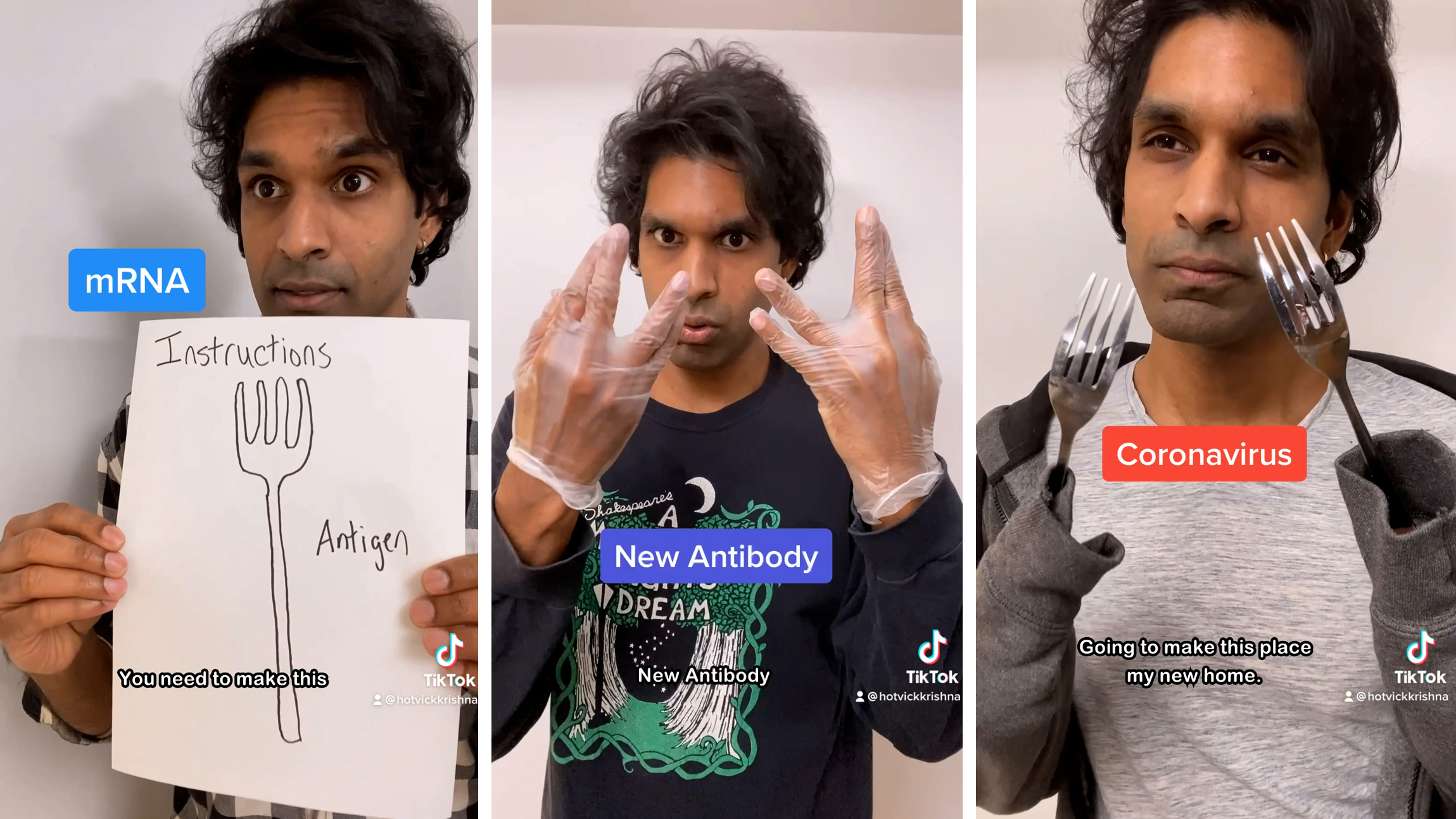
Old media literacy taught students to inspect a website's domain. That worked when the threat was fake-news sites and forwarded chain emails. The threat has moved, and creator literacy is now the harder skill.
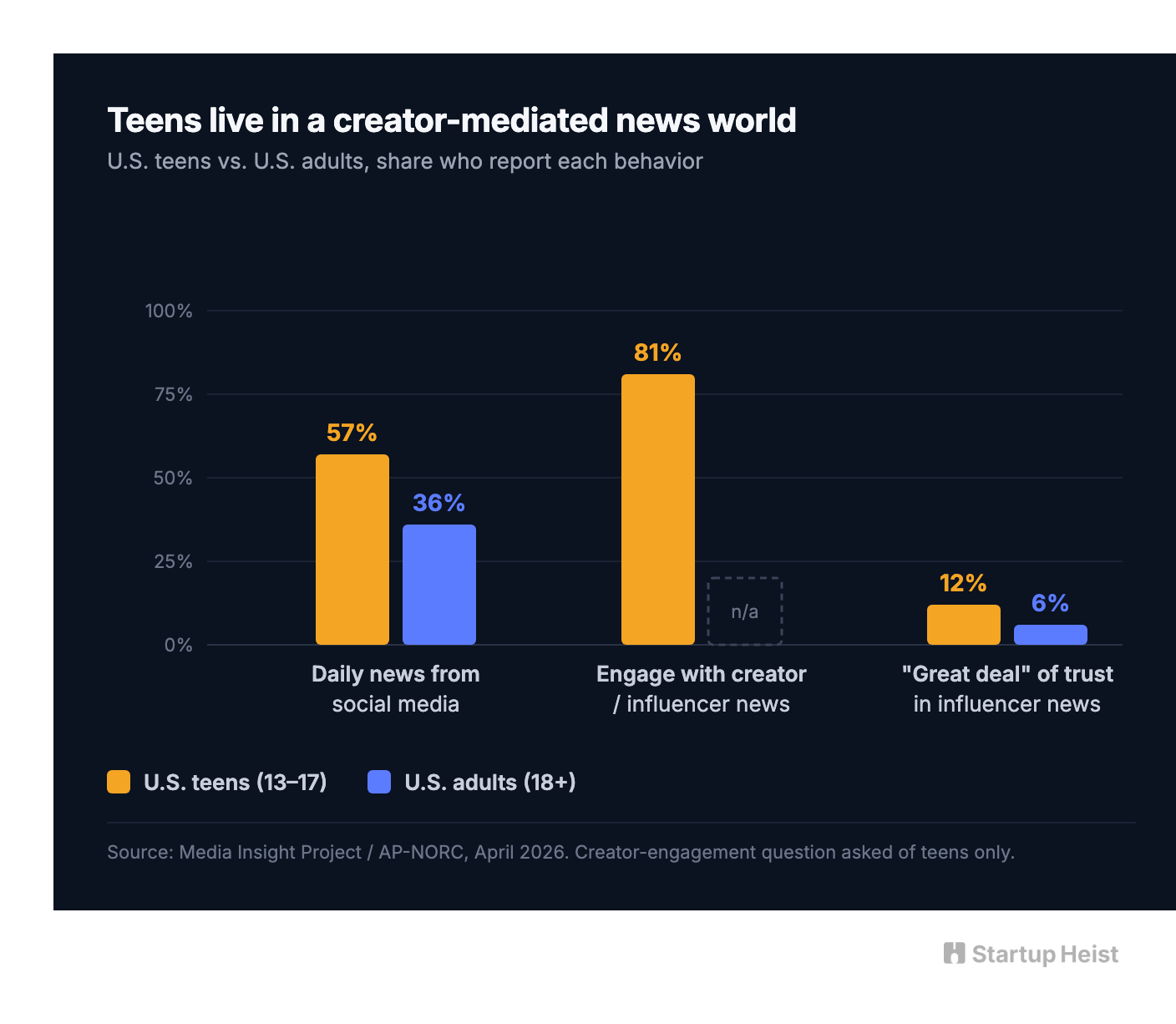
Teens already know creator content is shaky. They consume it anyway because it fits their attention span and feels more honest than legacy media. The Media Insight Project's April 2026 study found 57% of U.S. teens get news from social media daily, against 36% of adults. About 81% engage with influencer or independent-creator news content, and only 12% fully trust it. Pew Research's December 2025 survey found 28% of U.S. teens use AI chatbots daily and roughly one in five teens use them specifically for news. The contradiction is the business.
Here's the opportunity worth stealing.
The money: 1,000 teachers at $79/year is $79K ARR. 2,000 teachers plus a few school licenses pushes ~$300K and climbing without district sales.
Inside:
• 8 classroom packs ready for TPT and Gumroad
• Six-tier pricing ladder, $5 packs to district
• MVP scope: 4-8 weeks, no scraping required
• 30-day fast heist plan and outreach template
The Opportunity
The market gap isn't teenagers. It's teachers. Parents aren't buying yet. Districts move slowly. Teachers are already searching at 9 p.m. for a worksheet that handles whatever students saw on TikTok this week. Build the worksheet.
Call it Receipts Mode: a creator-era media-literacy and news-literacy product that turns viral clips into structured "show your receipts" classroom activities. Pull claims out of a clip. Ask what evidence would prove each one. Look for primary sources. Check incentives and disclosures. Score the creator's evidence behavior. Skip the ideology debate.
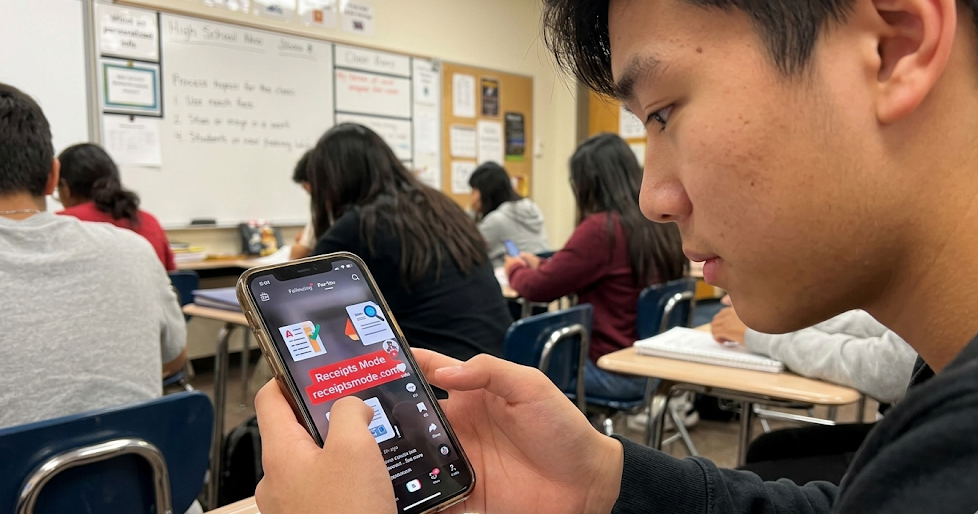
The wedge is one teachable habit: What did they claim, and did they show receipts? That single rubric is the brand. The first product isn't district software. It's a $19–$49 classroom pack on Teachers Pay Teachers and a teacher membership underneath it. Help one overworked teacher run a better Friday class. Sell the shovel before building the mine.
Why This Exists Now
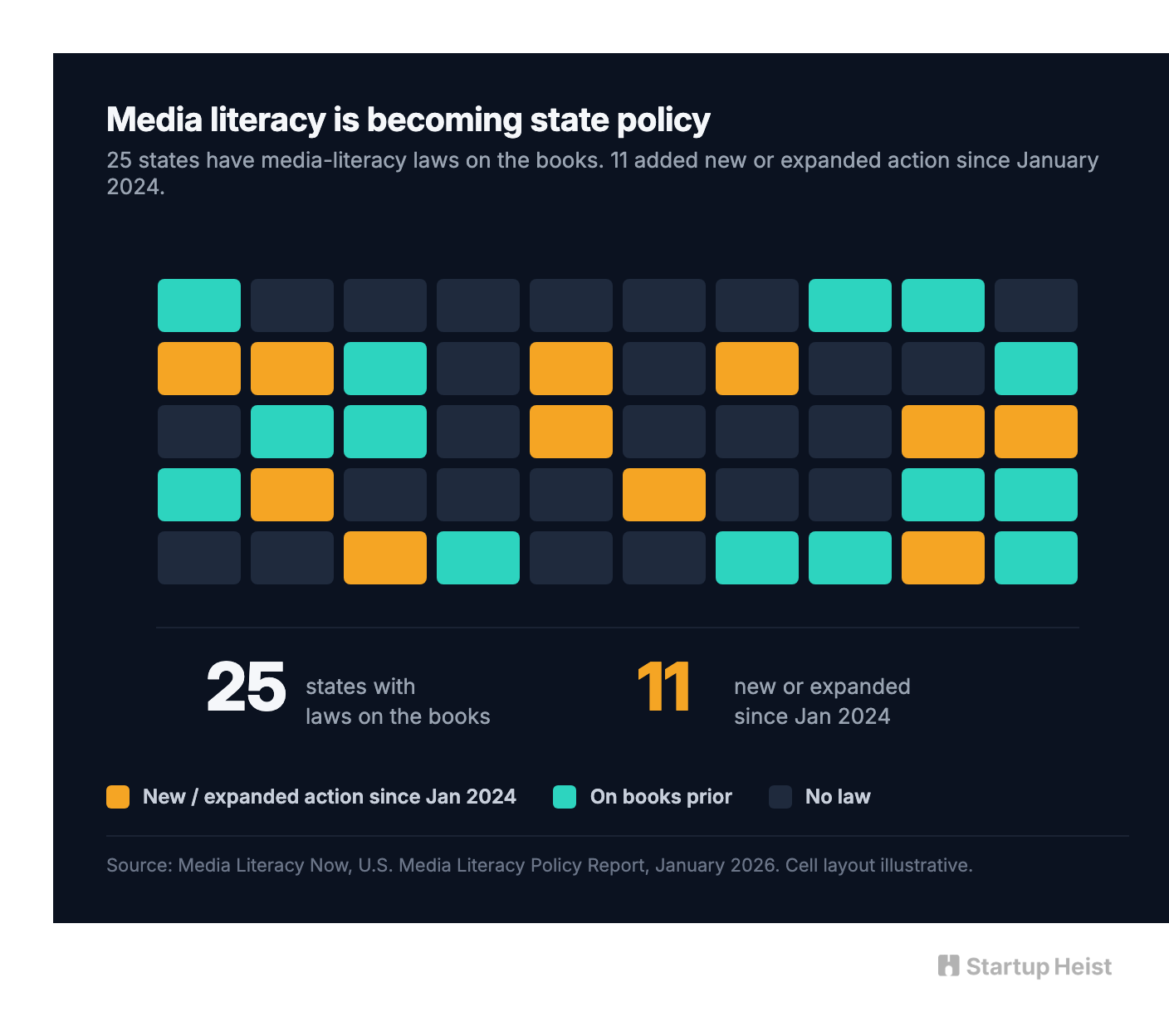
Media Literacy Now's January 2026 policy report flagged an inflection point. Twenty-five states have media-literacy laws on the books, and eleven states added new or expanded action since January 2024. Lawmakers are pairing phone bans and social-media restrictions with instructional mandates, embedding media literacy across English, civics, health, and science instead of treating it as a standalone subject. AI literacy and media literacy are converging in the same legislation.
A new state law doesn't give a teacher a Friday lesson plan. It creates demand for one.
The classroom unit of analysis has shifted. The old workflow asked students to find an article, check the author, and identify domain bias. The new workflow has to handle a stitched TikTok that mentions a study, layers AI-generated visuals, mixes a real statistic with a misleading conclusion, and may or may not disclose a sponsorship. The "source" is now a person, a platform, an edit, a screenshot, an algorithm, and a vibe. Teachers are improvising. A polished, evidence-focused workflow saves them an hour every time it lands.
The Market Is Smaller Than EdTech Twitter Wants, But Better Than It Looks
Teachers Pay Teachers already validates the buying behavior. Media-literacy worksheets and bundles sell at $5, $7, $9, $11, with mega-bundles climbing higher. The category is crowded but generic. Most resources still feel built for a 2015 internet, which means a creator-clip-specific product can stand out by being visibly current.
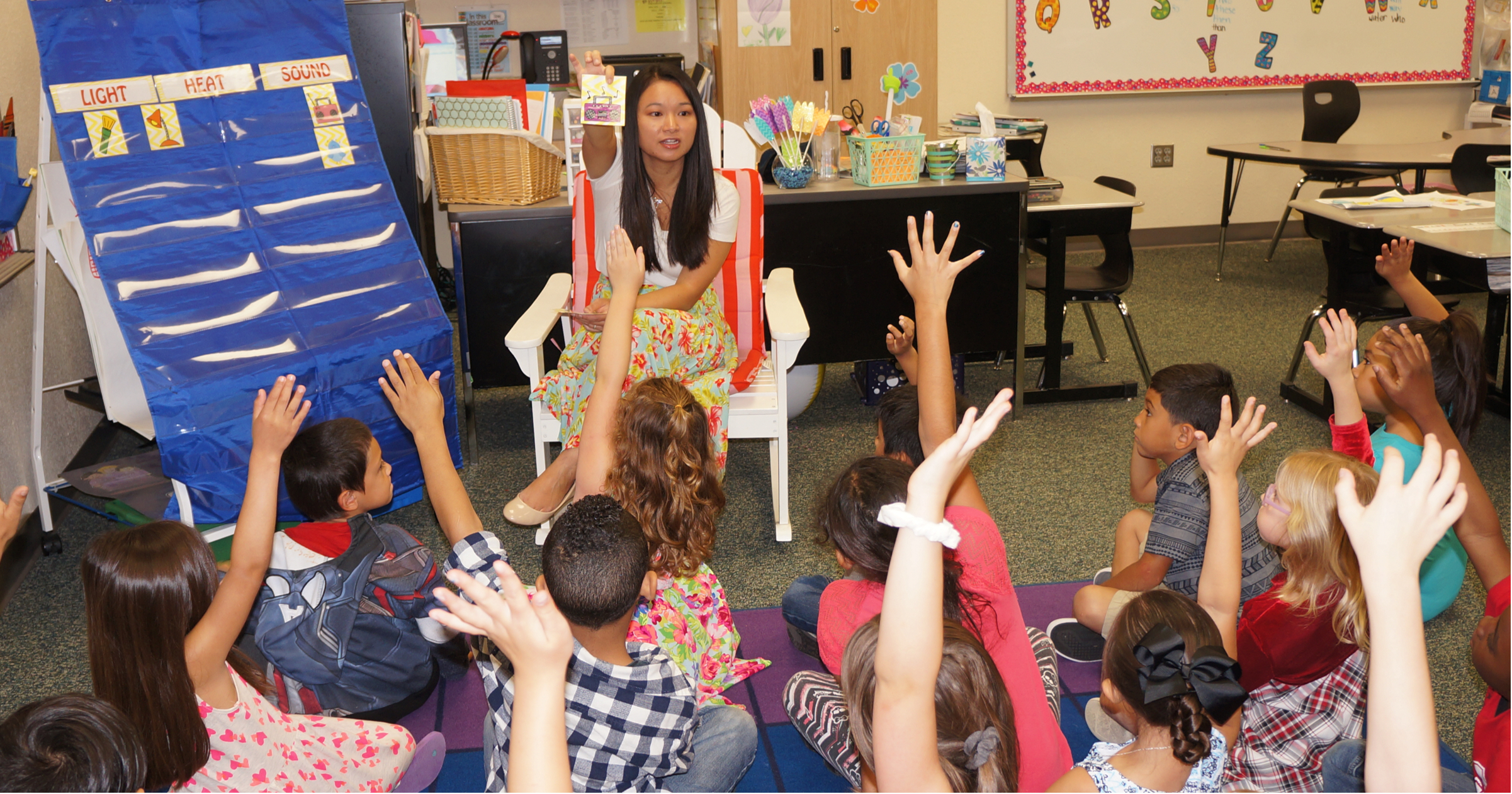
The first market is middle and high school educators who already care about media literacy, digital citizenship, journalism, civics, social studies, English, research skills, or AI literacy. Add school librarians and media specialists, who own information-literacy instruction and adopt earlier than classroom teachers. Add homeschool parents and journalism club advisors. The buyer is the adult responsible for teaching teenagers how to think.
The wedge sentence does the work: Turn today's viral creator clip into a classroom-ready receipt-checking activity in five minutes. That beats "more media literacy" because teachers don't wake up wanting more media literacy. They wake up because students are repeating something from TikTok and Friday's lesson plan is blank.
Competitors Are Strong, But Not Fatal
The category has serious adjacent players, and no one owns the creator-clip workflow. The News Literacy Project's Checkology platform reaches educators in all 50 states with hundreds of free lesson plans and quizzes, but it teaches general news evaluation rather than creator-specific claim auditing. Common Sense Education ships a sweeping K-8 digital literacy curriculum with nearly 150 new lessons including AI literacy, strong on breadth across grade bands and less focused on a single classroom ritual. NewsGuard runs source-trust ratings and a free media-literacy program used across 800+ public libraries globally, which works at the publisher level and stalls on a 90-second Reels clip. Stanford's Civic Online Reasoning offers 30 free fact-checker-method lessons that pre-date the creator economy as a primary news vector. NAMLE convenes the field through events and frameworks. TPT sellers cover the cheap end with generic worksheets.
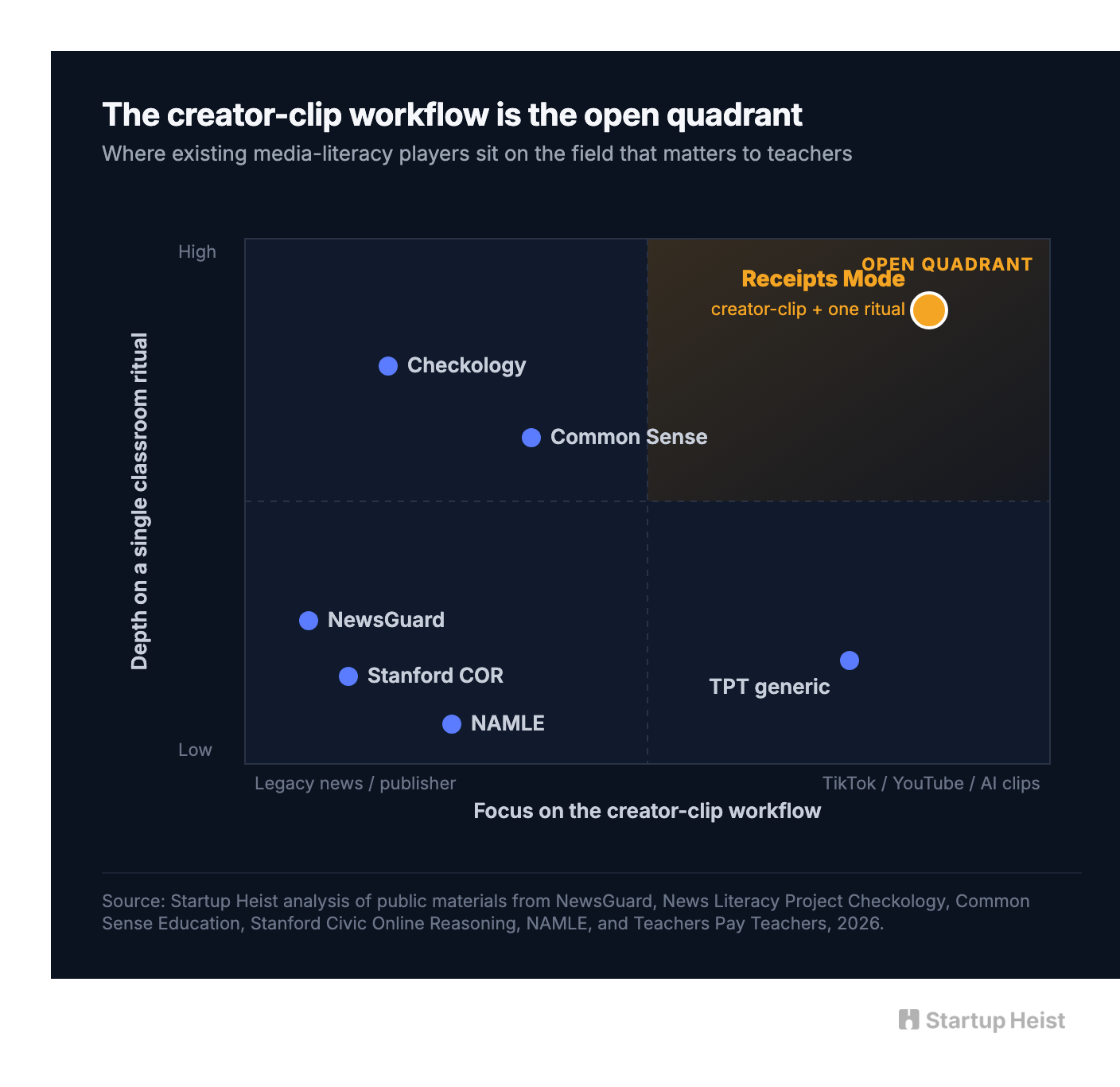
That stack defines the gap. A TikTok transcript isn't a news article. A YouTube explainer isn't a newspaper editorial. A sponsored creator post isn't a biased cable segment. The winner here doesn't claim to be the best media-literacy company. It owns one sentence: We help students check the receipts behind creator claims. That sentence is the moat seed.
The Product: Curriculum First, Software Slowly
Build curriculum first. Add software slowly. The graveyard is full of edtech founders who tried to ship a browser extension, student accounts, an LMS integration, and district procurement on day one. COPPA paperwork alone burns a quarter.
Open with eight polished classroom packs covering real scenarios:
Unlock the Vault.
Join founders who spot opportunities ahead of the crowd. Actionable insights. Zero fluff.
“Intelligent, bold, minus the pretense.”
“Like discovering the cheat codes of the startup world.”
“SH is off-Broadway for founders — weird, sharp, and ahead of the curve.”


