


Google Just Shipped a Follow Button. The Layer Above It Is Wide Open.
Publishers have worked from the same short menu of asks for years: subscribe to the newsletter, download the app, turn on notifications, follow on social, become a member.
On August 20, 2026, Google added a sixth item: tell Google that this publication is one of your preferred sources.
Google released an interactive Preferred Sources button that publishers can drop into their own pages. A reader clicks it, confirms in a small Google overlay, and lands back exactly where they were reading. Google says preferred publications surface more prominently for that reader in Top Stories, and can be highlighted inside AI Overviews and AI Mode.

Adoption has been steep. Around 90,000 unique sources had been selected by December 2025. By April 30, 2026, Google put the number past 200,000. On August 20, it announced more than 600,000. In that same April post, Google said readers are roughly twice as likely to click through to a site after marking it as a preferred source.
A brand-new conversion event, a user base that tripled between April and August 2026, and a button that installs in two lines of HTML add up to a narrow, well-timed software opening. Here's the shape of it:
The money: $5K to $20K MRR as a bootstrapped SaaS, or 50 to 200 publishers on the $99 plan. The only tool in the niche is free and can't A/B test.
Inside:
• Six-part MVP scope for the WordPress build
• Three-tier pricing from $39 to $249 a month
• Four campaign recipes to ship on day one
• The measurement claims that will sink you
Build the conversion-optimization layer for Google Preferred Sources.
Skip the SEO dashboard, the AI visibility platform, and the product promising to recover traffic Google took away. Build the publisher tool that answers one narrow question:
Which readers should I ask to prefer me on Google, when should I ask them, and which prompt gets the most action?
Think OptinMonster pointed at an algorithmic follow button instead of an email field. On its own that's a bootstrapped SaaS in the $5K–$20K MRR range if you move within ninety days. The second act gets more interesting if the engine underneath outgrows Google.
The publisher funnel just got a sixth rung
The old search bargain was simple: a publisher creates content, Google indexes it, someone searches, and Google sends a visitor. That bargain has collapsed on a schedule everyone in the industry can recite. Chartbeat data published in the Reuters Institute's 2026 trends report puts Google Search referrals to publishers down 33% globally year over year, and down 38% for U.S. publishers; Discover referrals fell 21% globally and 29% in the U.S. A separate Chartbeat analysis, measured across two years, shows where the pain concentrates: sites averaging 1,000 to 10,000 daily pageviews lost roughly 60% of their search referral traffic, mid-size publishers lost 47%, and the largest lost 22%. The smaller you are, the harder the floor came up.
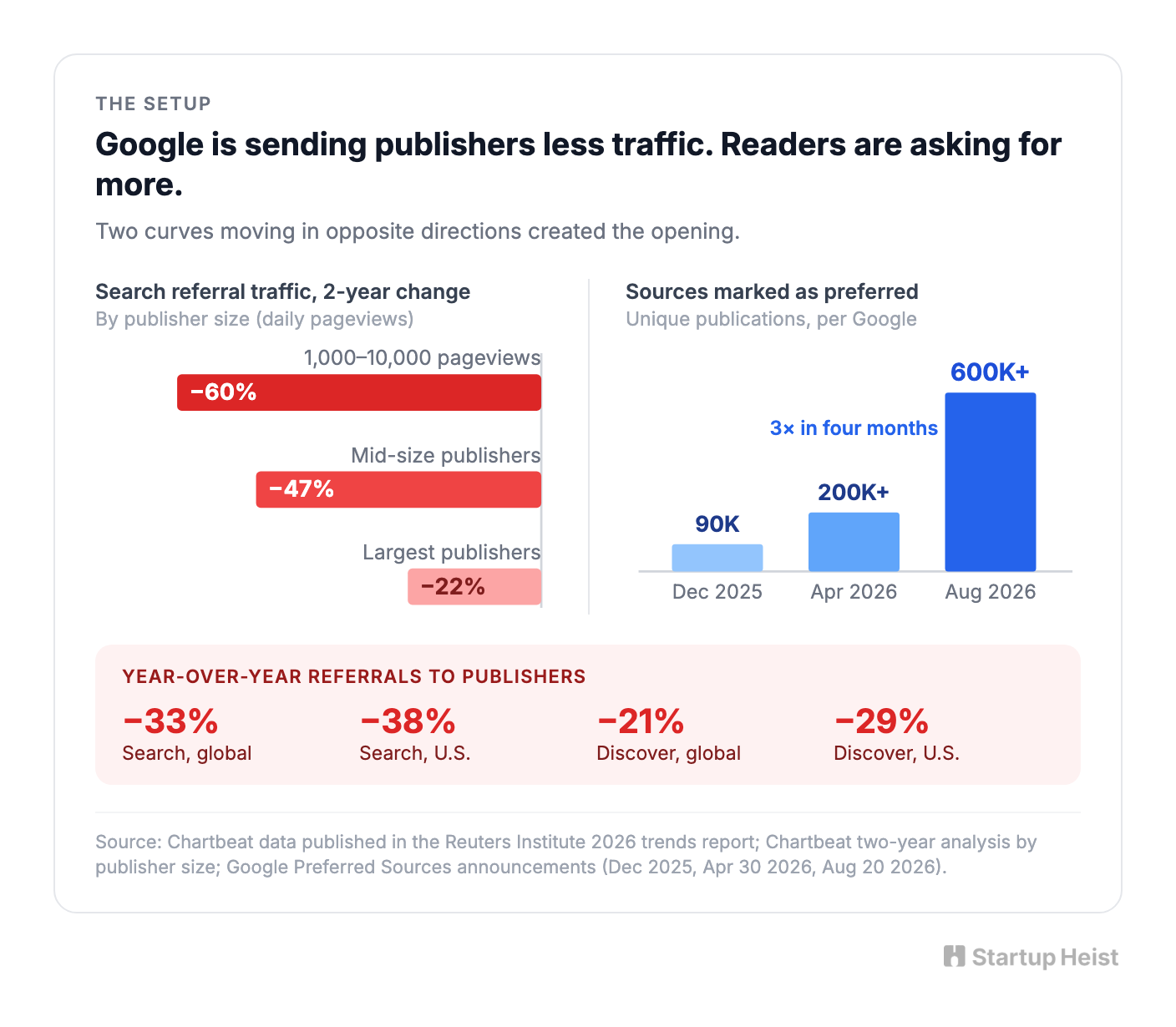
Publishers have spent three years responding the same way, converting borrowed traffic into an owned relationship: the email, the app install, the membership. Preferred Sources is a different animal. Instead of pulling the reader out of Google, you're persuading them to reach into the algorithm and say: when this site has something relevant, show me more of it. The popup vendors have a decade of tooling built for the first kind of ask. The second kind shipped on August 20, 2026.
Installing the button is not the business
Google made implementation almost insultingly easy. One async script tag in the head, one empty div carrying a `google-add-preferred-source-btn` attribute in the body, and you get a localized, Google-styled button in light and dark themes. For custom interfaces, the library exposes an `addPreferredSource()` call you can bind to any trigger.
Someone has already taken the free tier. A WordPress plugin called Add as Preferred Source on Google has been in the directory for months at 400-plus active installations, with banner and inline placements, 17 localized badge languages, scroll-depth and time-delay triggers, category and device targeting, dismissal caps, and a dashboard counting impressions and clicks. One person built most of the MVP a founder would have sketched on August 20, before Google shipped the on-page embed at all.
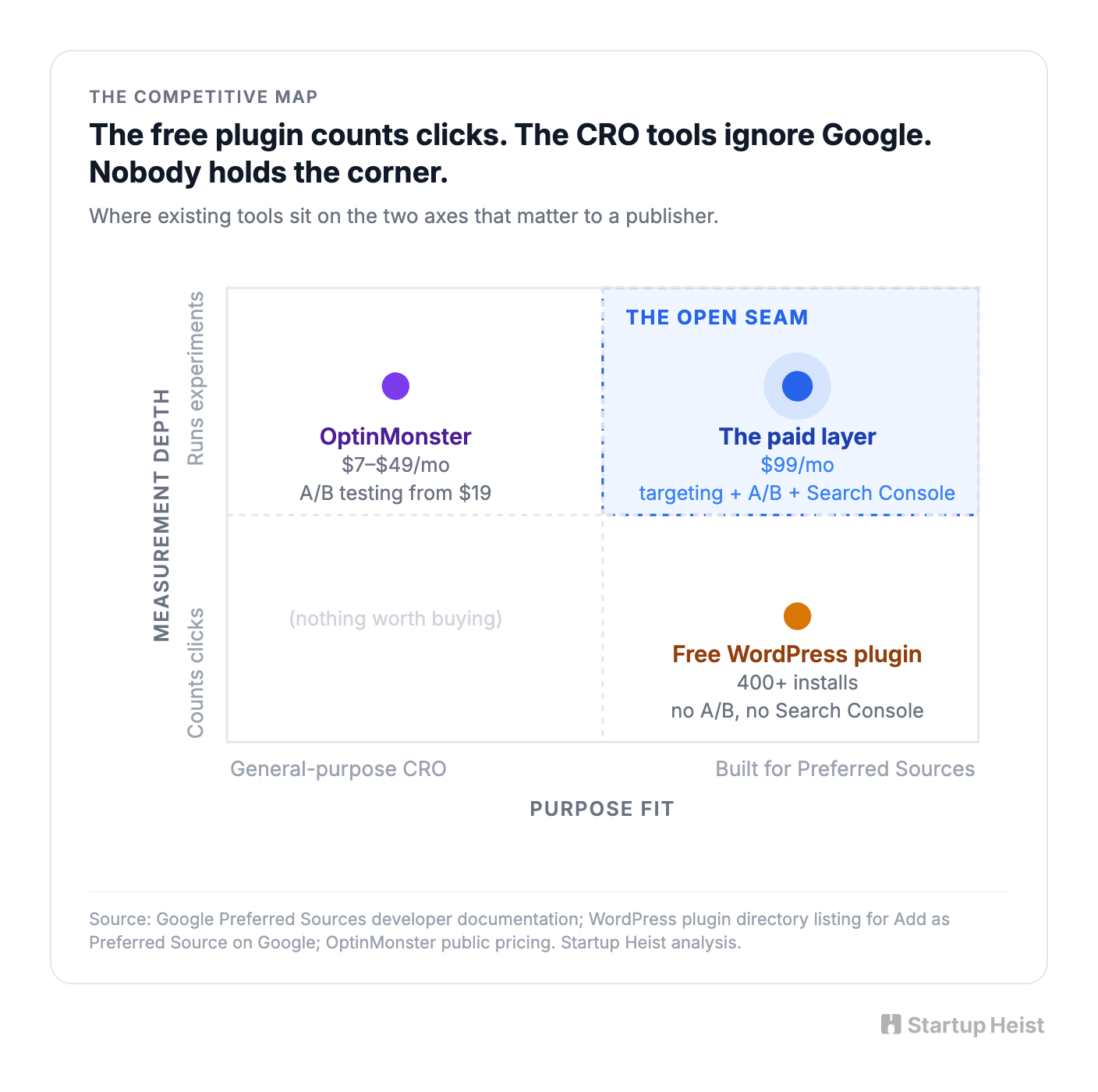
The instinct is to close the tab. Resist it. That plugin is the strongest signal in the opportunity: demand was obvious enough that someone built for it unprompted, and the ceiling of what they built is where the paid product starts.
Consider two publishers running the same button. Publisher A puts it in the footer of every article. Publisher B knows this reader has visited four times this month, reached 80% of the article, reads the same vertical repeatedly, and dismissed the newsletter popup twice without subscribing. Publisher B waits until the reader finishes, then shows one line:
Keep seeing our reporting in Google. Add us as a preferred source.
Publisher B generates more preference actions per thousand readers with the identical button and identical Google rendering. The only variable is when it gets invoked, and that decision is the product. You don't need to own Google's preference system, only the moment it gets offered.
OptinMonster built exactly this business around email capture. The form was never technically hard; the value sat in targeting, timing, experimentation, templates and measurement, sold at $19 a month to people who could have built it themselves. Preferred Sources sits where the email form sat before anyone built tooling around it. Google supplies the action, and the optimization layer above it is open, down to the vocabulary for describing it.
The measurement trap that will kill the careless version
Unlock the Vault.
Join founders who spot opportunities ahead of the crowd. Actionable insights. Zero fluff.
“Intelligent, bold, minus the pretense.”
“Like discovering the cheat codes of the startup world.”
“SH is off-Broadway for founders — weird, sharp, and ahead of the curve.”


