


Halloween Moved 19 Days. Sell Brands a Better Calendar.
On July 16, 2026, Home Depot put its Halloween collection online: a twelve-foot Skelly with new servo motors, an eleven-foot mummy, a plant monster.
The year before, the same collection went live on August 4.
Nineteen days earlier, from one of the largest retailers in the country, with no announcement anywhere that the calendar had moved.

The candy aisle tells the same story. Ferrara, citing Circana data, says 17% of candy corn purchases happen before Labor Day. A Morning Consult survey Hershey ran July 8-10, 2026 across 3,026 U.S. adults found that 67% of parents had already bought Halloween candy during the summer, and 55% said they enter Halloween mode before October arrives. Mars began its national rollout of a 120-item Halloween portfolio in July.
Summerween is the easy read on all this. The more useful one is that the retail calendar has come loose, and most of the companies that depend on it can't see it move.
The blindness is the opening.
The money: Thirty brands at $499 a month is roughly $15K MRR. Pilots start at $1,500 a season, before you write a line of code.
Inside:
• The four-part weekly brief buyers pay for
• Season Start Index: five signal families scored
• MVP stack, data model, and 30-day launch plan
• Pricing ladder from $1,500 pilot to $499/month
The calendar wobbles in both directions
Creep is easy to plan for. If Halloween moves three days earlier every year, you write a rule and go back to work.
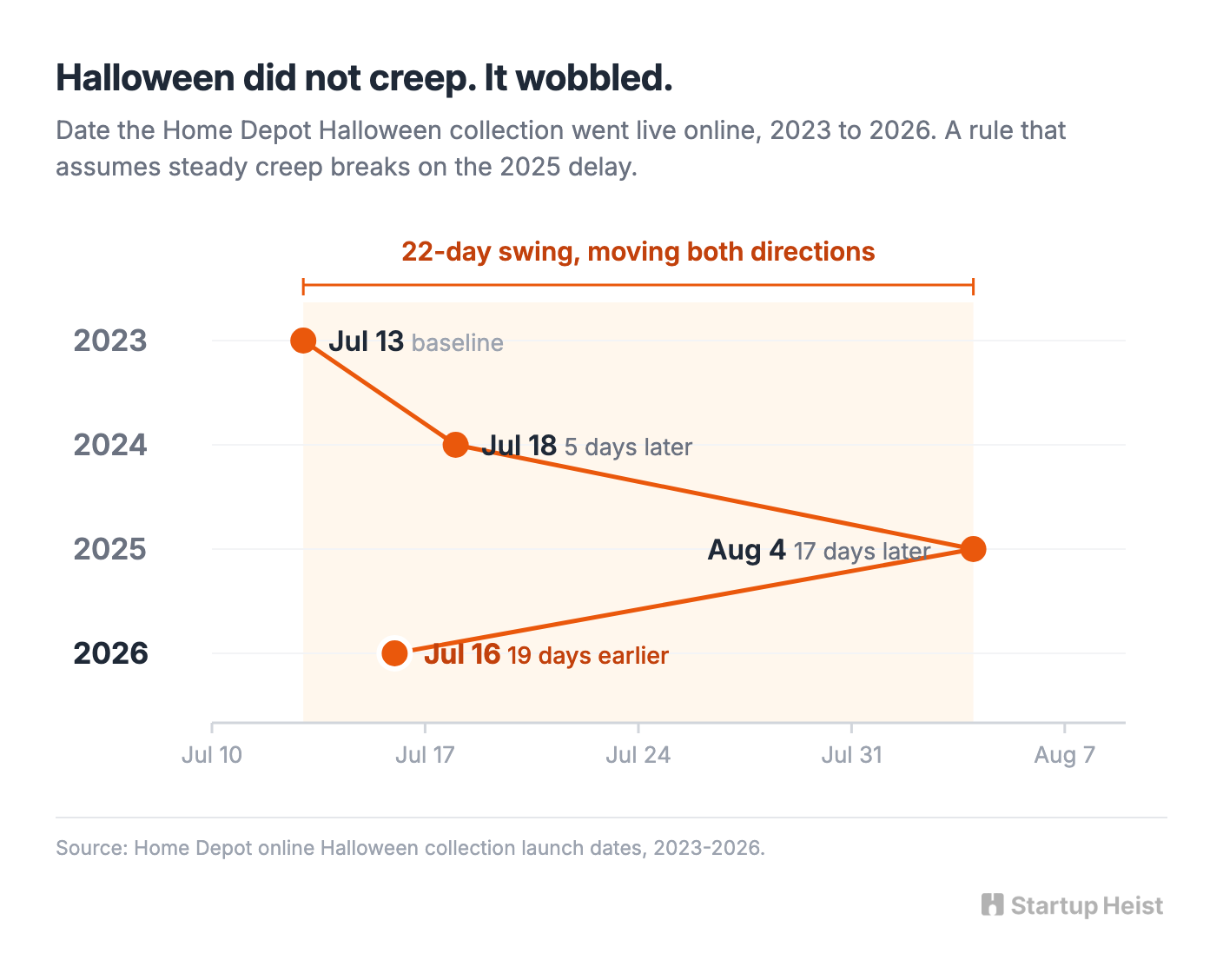
Home Depot's record refuses to cooperate. Its Halloween collection went online July 13 in 2023, July 18 in 2024, August 4 in 2025, and July 16 in 2026. That's a 22-day swing across four years, moving both ways. The 2025 delay was as real as the 2026 pull-forward.
Back-to-school behaves the same way. The National Retail Federation found 55% of shoppers had started by early July in 2024, 67% in 2025, then 62% in 2026. Holiday buying stretched the other direction: 42% of shoppers planned to start before November in 2025. Even manufactured events refuse to hold still. Amazon ran a four-day Prime Day on July 8-11 in 2025, then moved the same four-day event to June 23-26 in 2026.
For Target, Walmart, Amazon, Hershey, and Home Depot, none of this is a problem. They have merchandising departments, category managers, syndicated consumer data, agencies, and enough market visibility to watch the calendar move. Several of them are the reason it moves.
A $5 million Shopify brand has a spreadsheet and a founder's memory of last year's launch.
That gap is the business. Build a seasonal-launch intelligence service for $1M-$20M ecommerce brands: watch what the market is actually doing, then tell the operator when their own deadlines should move.
The weekly deliverable reads something like this. "Nine of the 20 brands we track launched fall collections 12 to 18 days earlier than last year. Category search has broken above its two-year baseline. Three major retailers moved placement forward. Move final photography approval from August 22 to August 7 and start email warm-up next week."
A change alert reports that a competitor updated its homepage and leaves the operator to work out what it means. This hands them a commercial decision instead. Everything below depends on holding that line.
Why the date is load-bearing
Ecommerce software mostly looks backward. Shopify tells you what sold, Klaviyo tells you what converted, and inventory tools project forward from what you've already held.
Seasonal brands need an answer to a different question: when does the season actually start this year?
That date sits at the top of a dependency chain. Product selection feeds purchasing, which feeds photography, then creative, landing pages, email, paid media, launch, replenishment, and finally markdowns. Every link inherits the date above it.
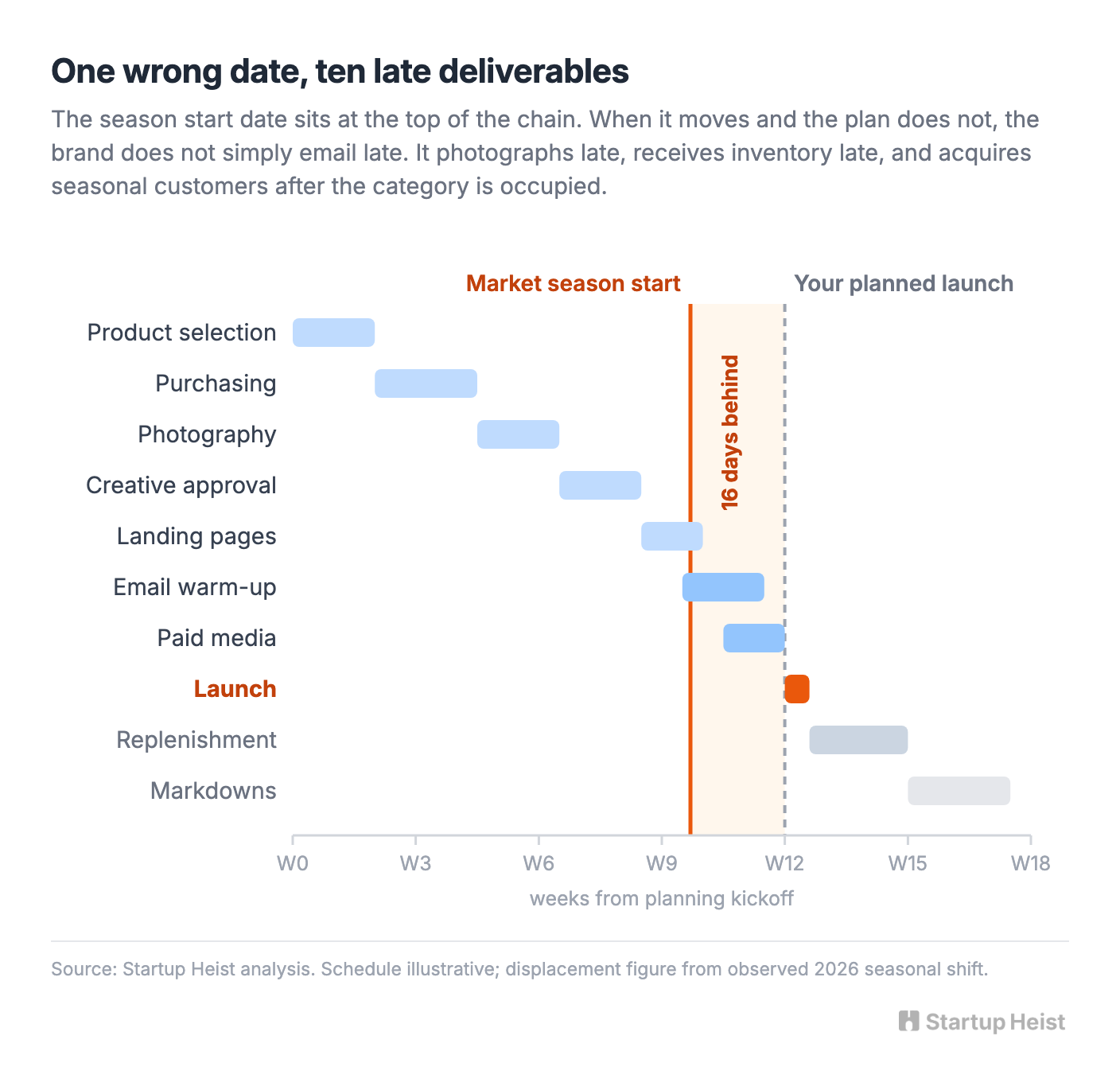
So when seasonal demand slides forward two weeks and the plan doesn't, the brand doesn't simply email late. It photographs late, approves creative late, receives inventory late, and starts acquiring seasonal customers after competitors have already occupied the category. Then it marks down into a season that's already ending.
Plenty of software helps brands execute a calendar. Almost nothing changes the calendar before execution starts.
The money math
The ecosystem is comfortably large enough for a small, specialized business. U.S. ecommerce hit $326.7 billion in the first quarter of 2026 alone, 16.9% of all retail. Shopify merchants moved $378.4 billion in GMV during 2025, up 29% year over year. Halloween by itself reached a record $13.1 billion in 2025, up from $11.6 billion the year before.
None of that means you should pitch a billion-dollar AI retail intelligence platform. The opportunity is much narrower, and the narrowness is what makes it winnable.
Take a $5 million DTC décor brand with 30% of sales concentrated in a handful of seasonal windows. That's $1.5 million exposed to timing. If landing a campaign at the right moment improves capture by a single percentage point, you've created $15,000 of revenue.
Treat that as the economic hurdle you have to clear rather than a forecast. A product priced at $4,000 to $8,000 a year doesn't need to rebuild anyone's supply chain. It needs to prevent one or two badly mistimed launches. Operators can do that arithmetic in their heads on a sales call.
Don't build another monitoring dashboard
The trap here is obvious in hindsight and nearly invisible while you're building.
You see the opportunity and immediately build website screenshots, change alerts, Google Trends graphs, competitor email monitoring, a pretty timeline, and an AI summary button. What you've assembled is five features people can already buy for pocket change.
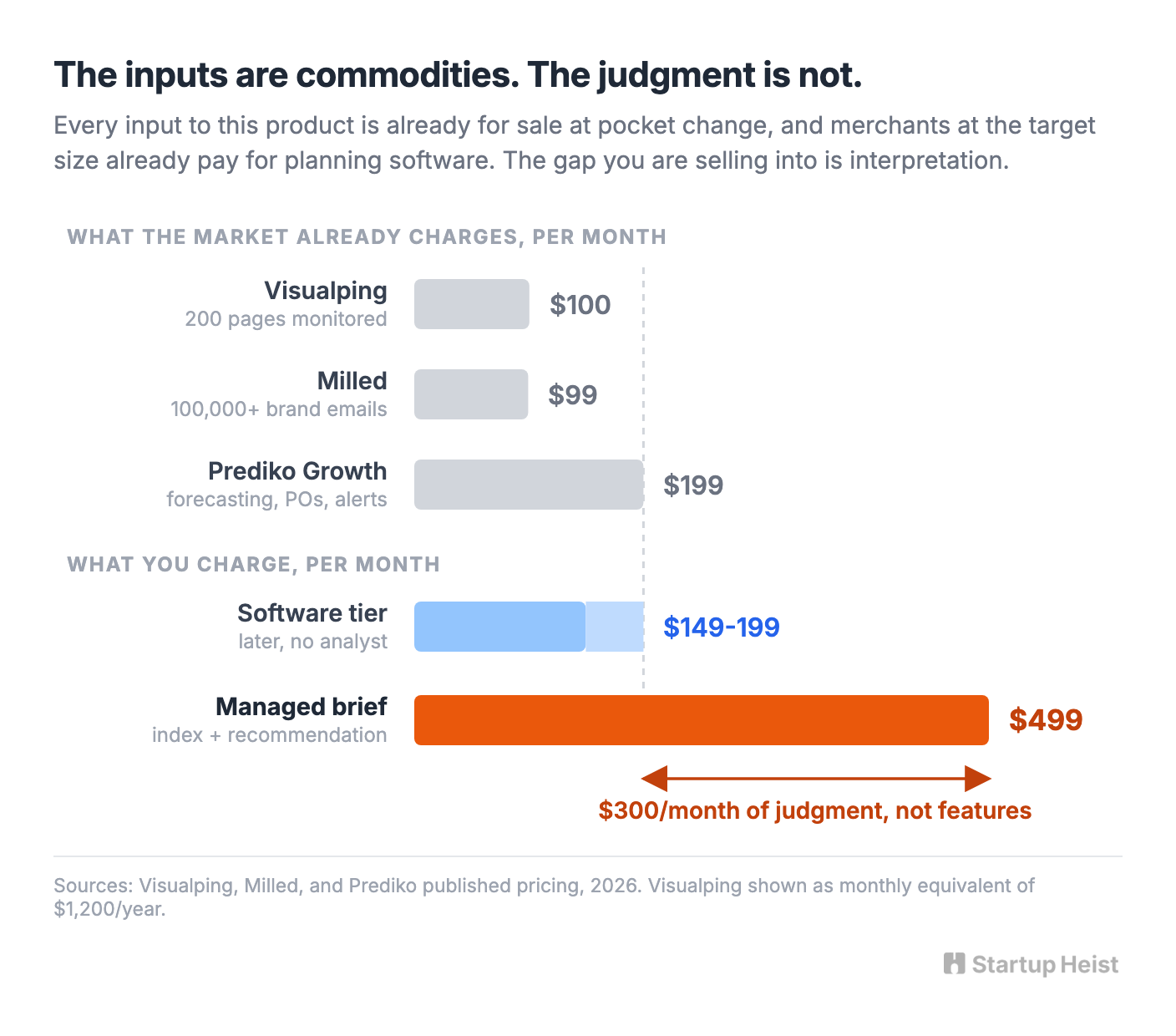
Visualping sells 20,000 checks across 200 pages for $1,200 a year, which works out to $100 a month. Milled gives marketers a database of emails from more than 100,000 brands for $99 a month. DataForSEO prices Google Trends queries at $0.0027 per standard task, roughly $540 per million keywords. And merchants already own serious planning software: Prediko charges $199 a month at its Growth tier for stores up to $2 million, including forecasting, purchase orders, inventory alerts, and integrations.
You can't charge $500 a month for arranging commodity feeds on one screen. The scarce input is the judgment applied to those feeds, which is why version one of this business should barely look like software at all.
Sell the analyst before you build the robot
Start with one category, and make it narrower than you think. Halloween décor. Pet costumes. Holiday gifting. Kids' seasonal apparel.
Your first product can be almost embarrassingly simple: a weekly Season Start Brief with four parts.
Unlock the Vault.
Join founders who spot opportunities ahead of the crowd. Actionable insights. Zero fluff.
“Intelligent, bold, minus the pretense.”
“Like discovering the cheat codes of the startup world.”
“SH is off-Broadway for founders — weird, sharp, and ahead of the curve.”


