


The Contractor Control Firewall
A compliance tool for the local businesses accidentally turning 1099s into employees, one text at a time
The risk in contractor-heavy local services rarely begins in a boardroom. It begins in a text message.
A dispatcher tells a security guard, "You need to be at the site by 8:00 sharp." A roofing sales manager tells a rep, "Use this exact script and send me photos after every door." A home care coordinator tells an aide, "You cannot decline this shift." A landscaping owner messages a crew lead in language that sounds less like coordination and more like command.

None of these messages feel dramatic in the moment. They feel like operations.
In worker classification disputes, the operational details are the evidence. Who controlled the worker's schedule? Who dictated the method of work? Could the worker accept or reject assignments? Did the business treat the person like an independent contractor, or like an employee with a different tax form?
There's a clean opportunity to build a compliance monitoring tool for contractor-heavy local service businesses that scans dispatcher, manager, and sales communications for employee-like control signals before they become litigation exhibits. Not a legal AI promising to "solve" employment law. Not a generic HR compliance platform. Something narrower: a practical worker misclassification risk filter that watches the exact place where small operators create liability — SMS, WhatsApp, Slack, and field-service chat.
The pitch is simple:
"We help you keep your contractor communications from sounding like employee control."
Here's the opportunity at a glance:
The money: 50 customers at $399/month is roughly $20K MRR. 200 customers approaches $80K MRR. Partner channel pushes toward $1-3M ARR.
Inside:
• 8-week MVP: SMS ingestion + risk engine
• Four-tier pricing from $149 to $799/mo
• Partner-led GTM via lawyers, PEOs, brokers
• Four moats including vertical risk taxonomy
Why the ground is shifting under operators
On February 26, 2026, the U.S. Department of Labor issued a Notice of Proposed Rulemaking to rescind the 2024 independent contractor rule. The proposal replaces the 2024 rule's six-factor totality test with a streamlined analysis anchored on two "core" factors: the nature and degree of control over the work, and the worker's opportunity for profit or loss. The DOL has also said it's no longer applying the 2024 rule in its investigations during the rulemaking process. The 60-day comment period closed on April 28, 2026, and a final rule is expected later in the year.
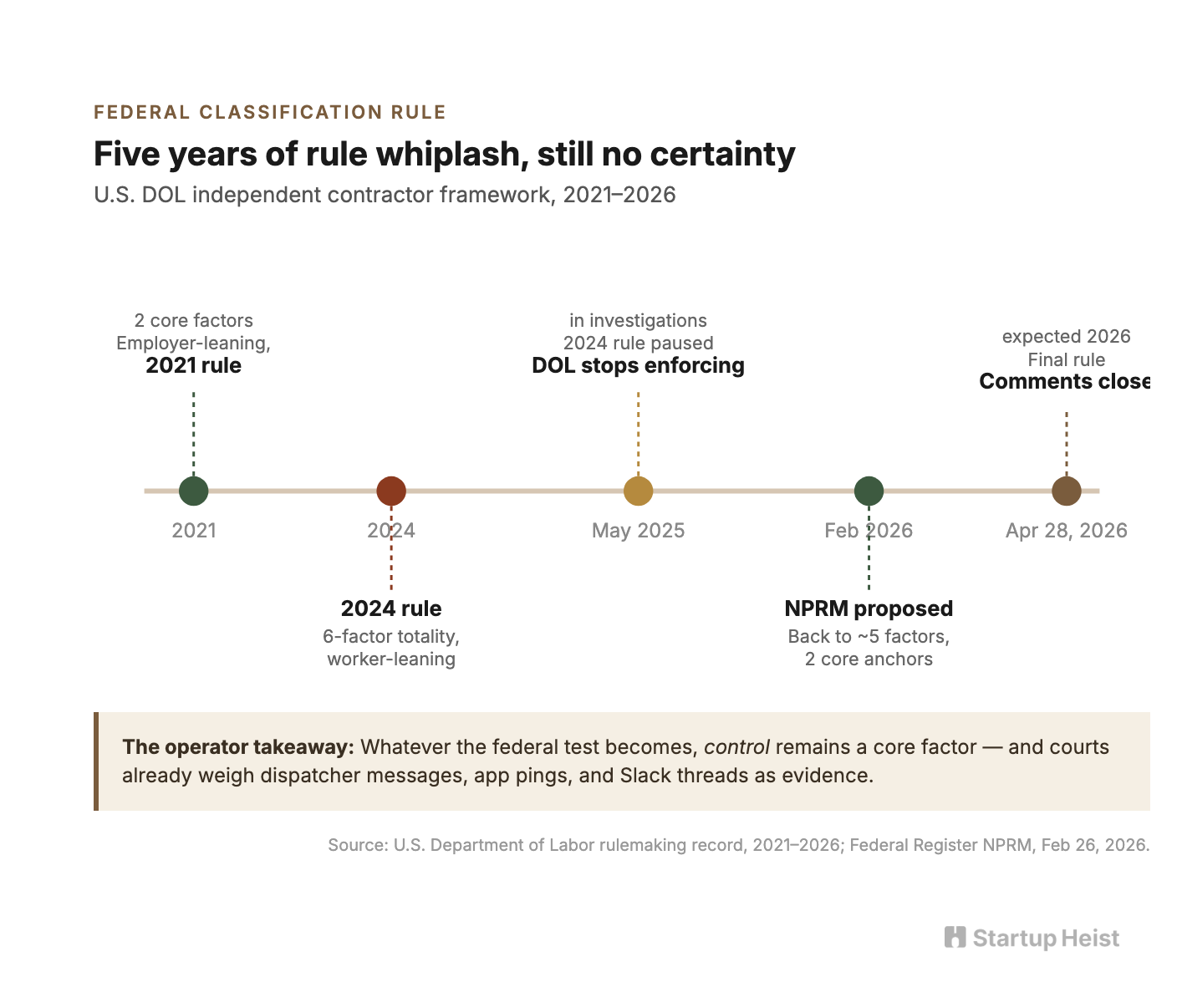
That sounds employer-friendly on the surface. It doesn't eliminate risk. It creates confusion. Private litigation, state rules, industry-specific lawsuits, and old-fashioned wage-hour claims still grind on. And owners miss a detail: the 2024 rule made one thing explicit that any successor framework will respect in practice. Control includes technological supervision. The rule's text specifically named devices and electronic monitoring as relevant evidence of control. Whatever Washington calls the test next, judges have been weighing dispatcher messages, app pings, and Slack threads as classification evidence for years.
The clearest recent proof came from the DOL itself. In a case captioned Chavez-DeRemer v. CE Security LLC, a federal court hit the company with roughly $6 million in back wages and liquidated damages and entered a permanent injunction barring it from treating "spotholders" as independent contractors. The fact pattern is almost a parody of the wedge. The workers drove to job sites, parked, and placed traffic cones near utility structures. They were dispatched by the company, required to follow company rules, and disciplined when they did not. They had no real opportunity for profit or loss, no special skills, no independent initiative. The dispatcher's daily instructions weren't just operations. They were the case.
The opportunity isn't "the government just made a scary new rule." That story is too crude, and partly wrong in 2026. The real opportunity is messier and more durable. Businesses are operating in a shifting classification environment where the line between contractor and employee is fought over in daily behavior. What owners need isn't another PDF from a lawyer. They need a live guardrail inside the workflow.
The pain is operational, not theoretical
Classification is usually discussed like a legal doctrine. Economic reality tests. ABC tests. Control factors. Opportunity for profit or loss. Integration into the business. Permanence of the relationship.
That language matters in court. It isn't how a 25-person roofing company thinks.
The owner thinks: Can I send my sales guys where the leads are? Can I require them to use our CRM? Can I tell them what time to show up? Can I fine them if they no-show? Can my dispatcher tell the contractor to wear our shirt? Can I ask for proof photos?
Those questions live inside the communications layer of the business. A monitoring product has a real wedge there because it doesn't need to replace counsel. It needs to catch the risky behavior before it compounds.
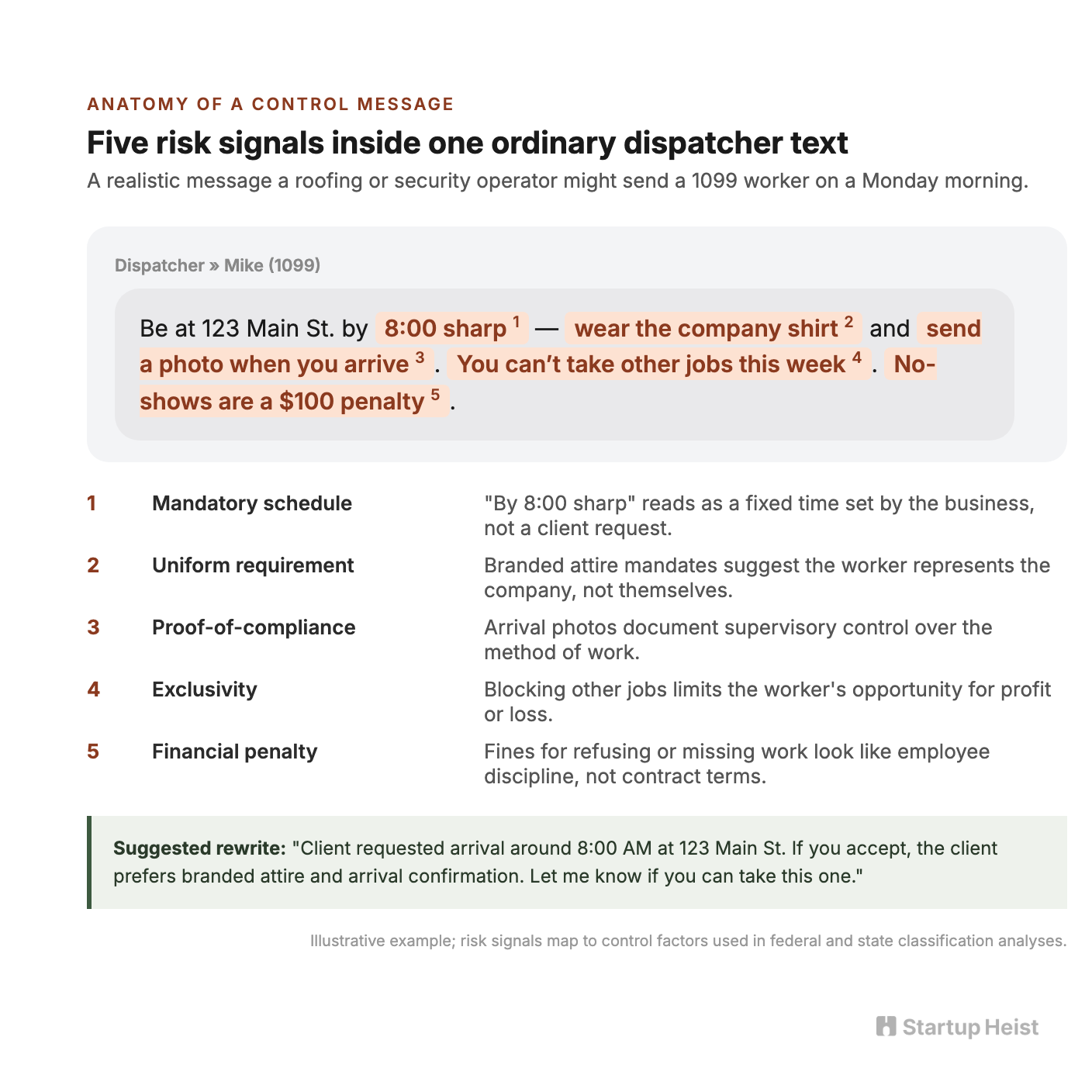
A good first version would flag messages like:
- "You must be on site at 7:30 AM or you'll be penalized."
- "Use this exact sales script."
- "You are not allowed to take jobs from anyone else this week."
- "You need approval before you can decline a route."
- "Wear the company uniform and send a photo before every shift."
The tool wouldn't say, "This is illegal." That would be reckless. It would say: "This message may create employee-like control evidence. Suggested rewrite: The client requested arrival around 7:30. Please confirm whether you can accept this assignment."
The product isn't selling legal certainty. It's selling fewer unforced errors, cleaner habits, and a defensible audit trail.
Where the wedge is sharpest
The U.S. home services market is enormous, but TAM is the wrong way to size this. The right frame: large market, narrow pain, high-consequence wedge. The initial market isn't "all home services." It's contractor-heavy operators with distributed labor, frequent field communication, and meaningful misclassification exposure.
The best early verticals are predictable once you look at where dispatcher language and worker autonomy collide:
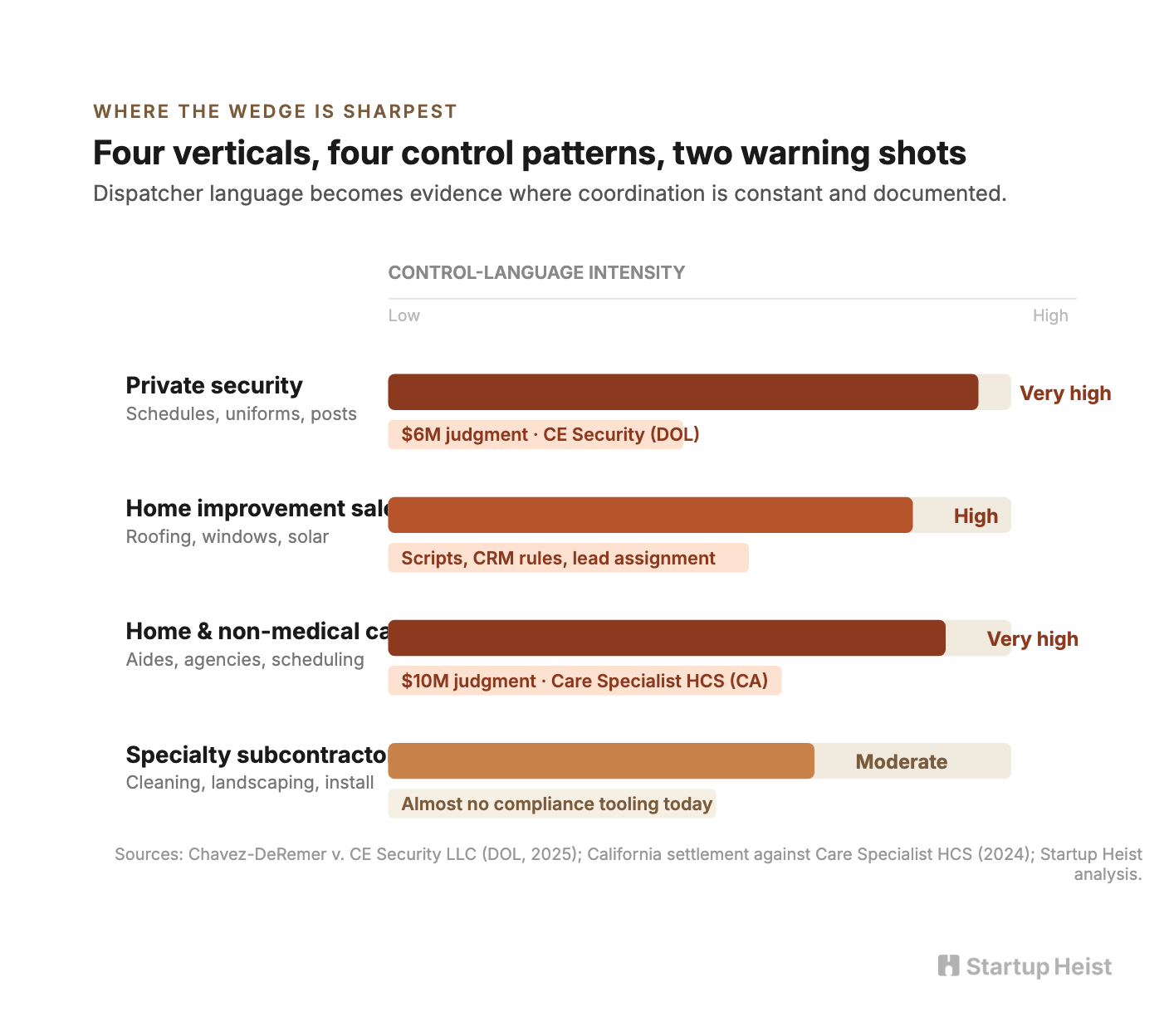
- Private security firms. Guards are dispatched to sites with schedules, uniforms, procedures, reporting requirements, and replacement instructions. CE Security shows what happens when that coordination is documented.

- Home improvement sales organizations. Roofing, windows, solar, siding, and exterior remodeling lean on commission-heavy reps, scripts, canvassing rules, lead assignment, and CRM requirements. The category has been a misclassification flashpoint for two years.
- Home care and non-medical care agencies. Care quality demands supervision, but those same behaviors create classification risk. California's $10 million judgment against Care Specialist HCS, a home-care company accused of misclassifying hundreds of aides based on scheduling, pay rate control, and "no-poach" arrangements, is a recent warning.
- Specialty subcontractor networks. Cleaning, maintenance, restoration, pest control, installation, and repair businesses all run the same coordination playbook. Landscaping and seasonal field crews sit in the same bucket — informal operators, scheduling control, route control, and almost no compliance tooling.
The buyer isn't a Fortune 500 general counsel. It's the owner, COO, HR lead, payroll consultant, employment lawyer, PEO, or insurance broker serving field-service businesses. The emotional buying trigger isn't "AI compliance automation." It's the unsettling thought: my managers might be creating evidence in text messages every day, and I have no idea.
The product watches behavior that is currently invisible. That's the wedge.
The product: Grammarly for contractor control risk
The cleanest mental model is "Grammarly for 1099 communications." A dispatcher writes: "Be at 123 Main St. at 8:00 AM sharp. You must wear the company shirt. Send me a picture when you arrive." The tool flags three risk signals: mandatory arrival time, uniform requirement, proof-of-compliance language. Then it offers a safer rewrite: "Client requested arrival around 8:00 AM at 123 Main St. Please confirm whether you can accept. If you take this assignment, the client prefers branded attire and arrival confirmation."
The rewrite may still warrant attorney review. For a small business, it's immediately useful. It changes manager behavior at the point of risk creation.
The MVP has five core functions:

This one's free.
This playbook is unlocked for members. Grab a free account — no card, ten seconds — and keep reading. You'll also get one free briefing every weekday morning.


