


The Public-Fleet Buy List
Government auctions already moved online. Nobody tells dealers which of those vehicles are actually worth buying.
There is a permanent secondary market for vehicles the government no longer wants.
Police departments retire Explorers, cities unload F-150s, school districts sell activity vans. Public-works departments dispose of pickups with 90,000 hard miles on them, and federal agencies cycle sedans, SUVs and specialty trucks out of their fleets on a fixed schedule. GSA alone sells more than 30,000 retired federal vehicles in a typical year, and that's one channel among hundreds.
The marketplace layer carrying this supply has become a real business. GovDeals, the largest public-surplus platform, recorded $274 million in gross merchandise volume for the quarter ended June 2026, a company record and a 9% increase over the same quarter a year earlier. Its parent, Liquidity Services, cleared roughly 334,000 completed transactions in that quarter, up 17%.
The supply is online and growing, which is exactly what makes the obvious version of this business a trap.
Here's the opportunity:
The money: Fifty dealers at $499 a month is $25,000 MRR. GovDeals cleared $274 million in surplus volume in the quarter ended June 2026.
Inside:
• Max-bid math for public-fleet listings
• The idle-hours edge on ex-police units
• $250 pilot to $999 group pricing ladder
• The outcome database rivals can't copy
The listings are already free
The instinct is to build the aggregator. Pull GovDeals, Public Surplus, Municibid, GSA Fleet and a few regional auctioneers into one searchable feed, add filters and a map, sell access.
That product exists and it costs nothing. GovAuctions.app already indexes the major government auction platforms into a single free searchable feed, broken out by platform and state. GovDeals exposes a JSON search endpoint returning structured listing data across roughly 26,000 active listings: title, current bid, close date, seller, location, category. Municibid publishes browsable category and geography pages. Municipalities want their assets found.
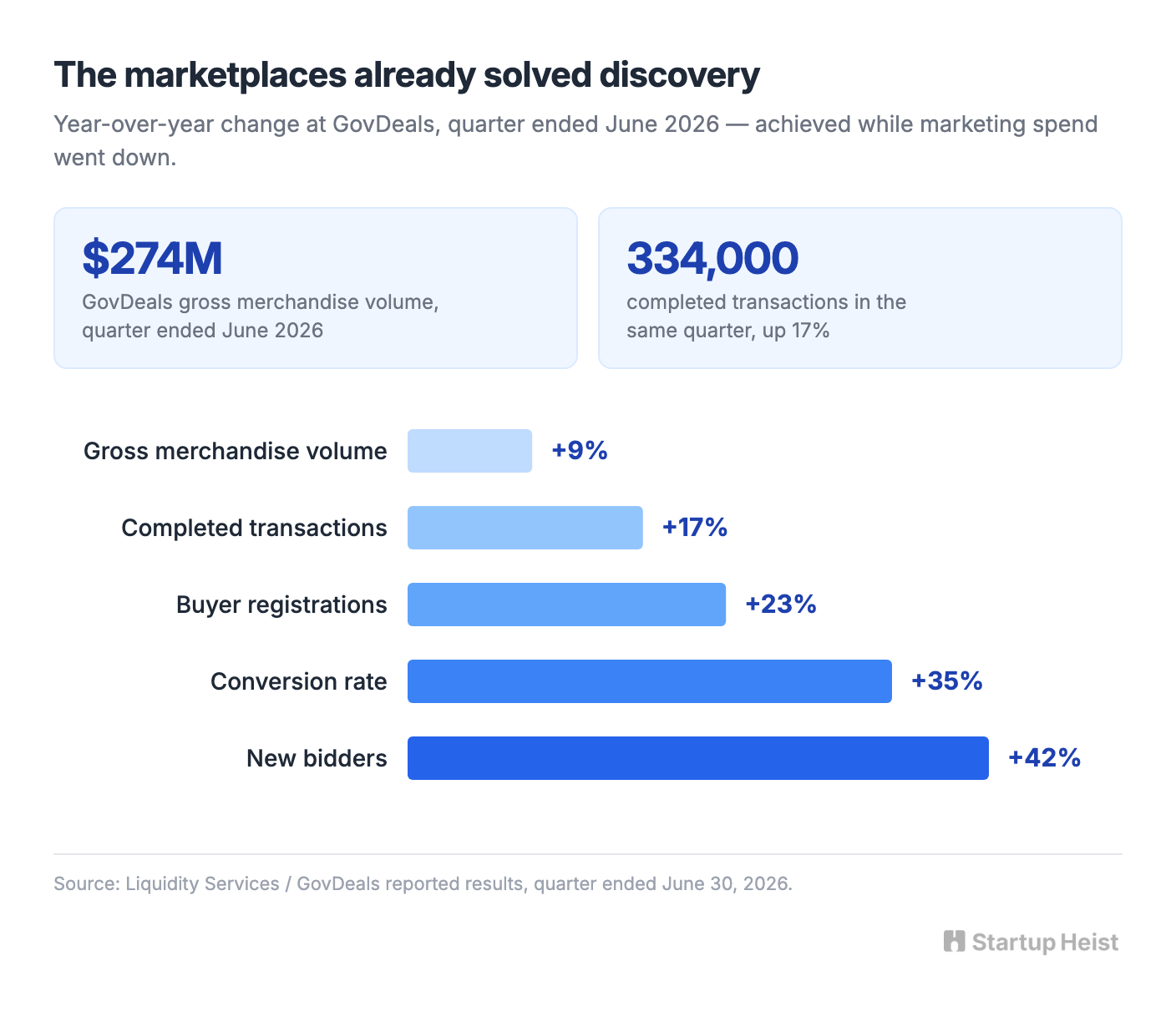
The marketplaces are also pushing hard on discovery themselves. In its June 2026 quarter, GovDeals reported buyer registrations up 23%, new bidders up 42% and conversion rates up 35%, all while marketing spend went down. The company credits AI-driven personalization and buyer education.
Discovery, in other words, is handled. Everything between finding a vehicle and deciding whether to bid on it is still done by hand.
Why the timing works
Dealers aren't short of vehicles. They're short of cheap ones, which is precisely what public fleets produce.
In July 2026, franchised and independent dealers held 2.15 million used vehicles in retail inventory at 46 days' supply, with an average listing price of $27,028. By historical standards, those are comfortable numbers.
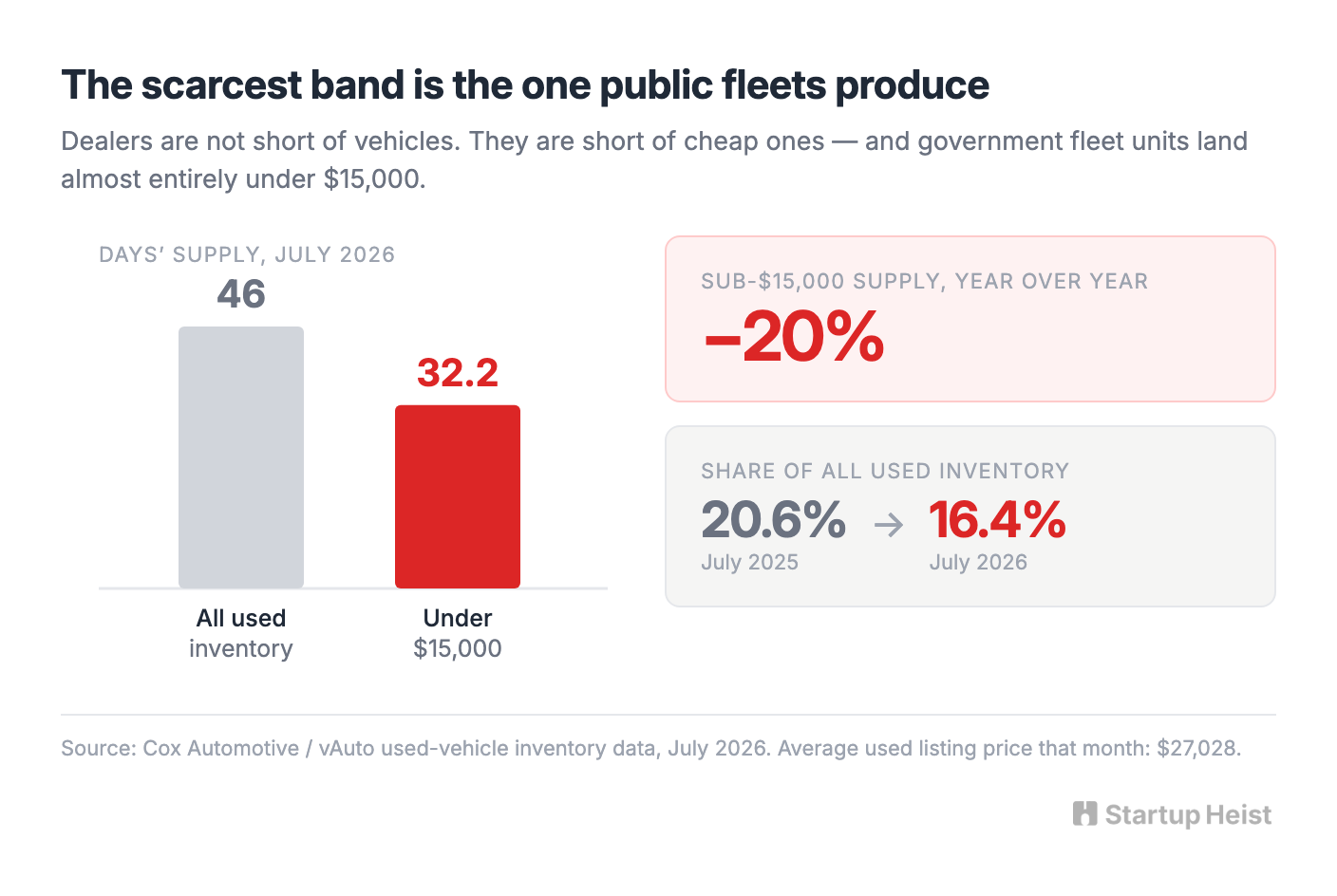
The band under $15,000 tells a different story. Those vehicles carried 32.2 days' supply in July 2026. Supply in that band fell 20% year over year and now accounts for 16.4% of all used inventory, down from 20.6% a year earlier.
Government fleet vehicles land almost entirely inside that band. High-mileage sedans, work trucks, cargo vans, ex-municipal SUVs. The scarcest retail segment in the country is the one public agencies produce on a schedule.
Wholesale prices have meanwhile stopped climbing. The Manheim Used Vehicle Value Index closed July 2026 at 210, up 1.3% year over year and down 1.4% from June. This isn't 2021, when anything with four wheels retailed. When wholesale is flat and the affordable band is starved, buying discipline outperforms sourcing volume.
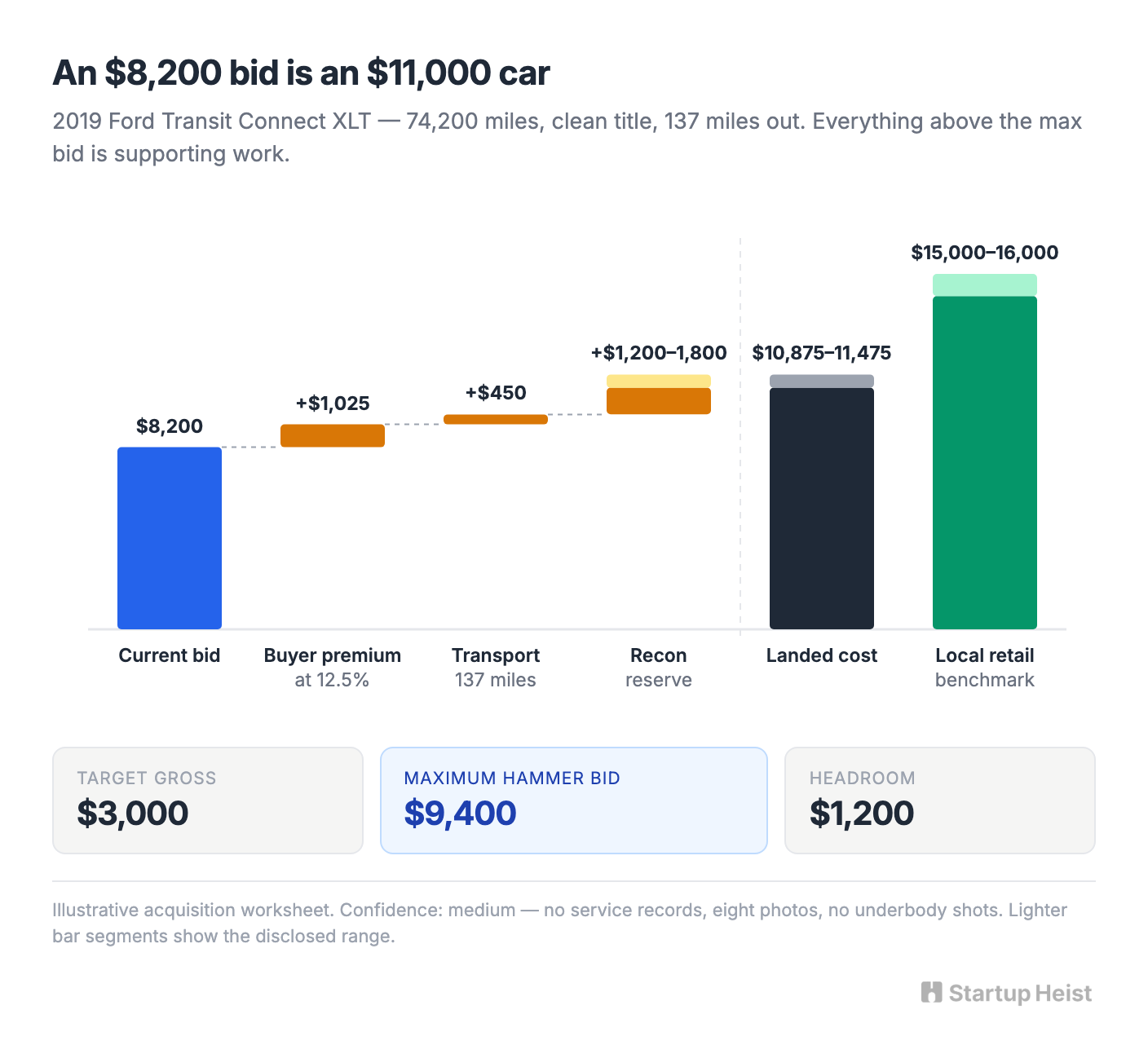
A $7,000 bid is not a $7,000 car
Ask an independent dealer what keeps them out of government fleet auctions and they won't say they can't find the vehicles. They'll say the math is miserable to run on a listing page.
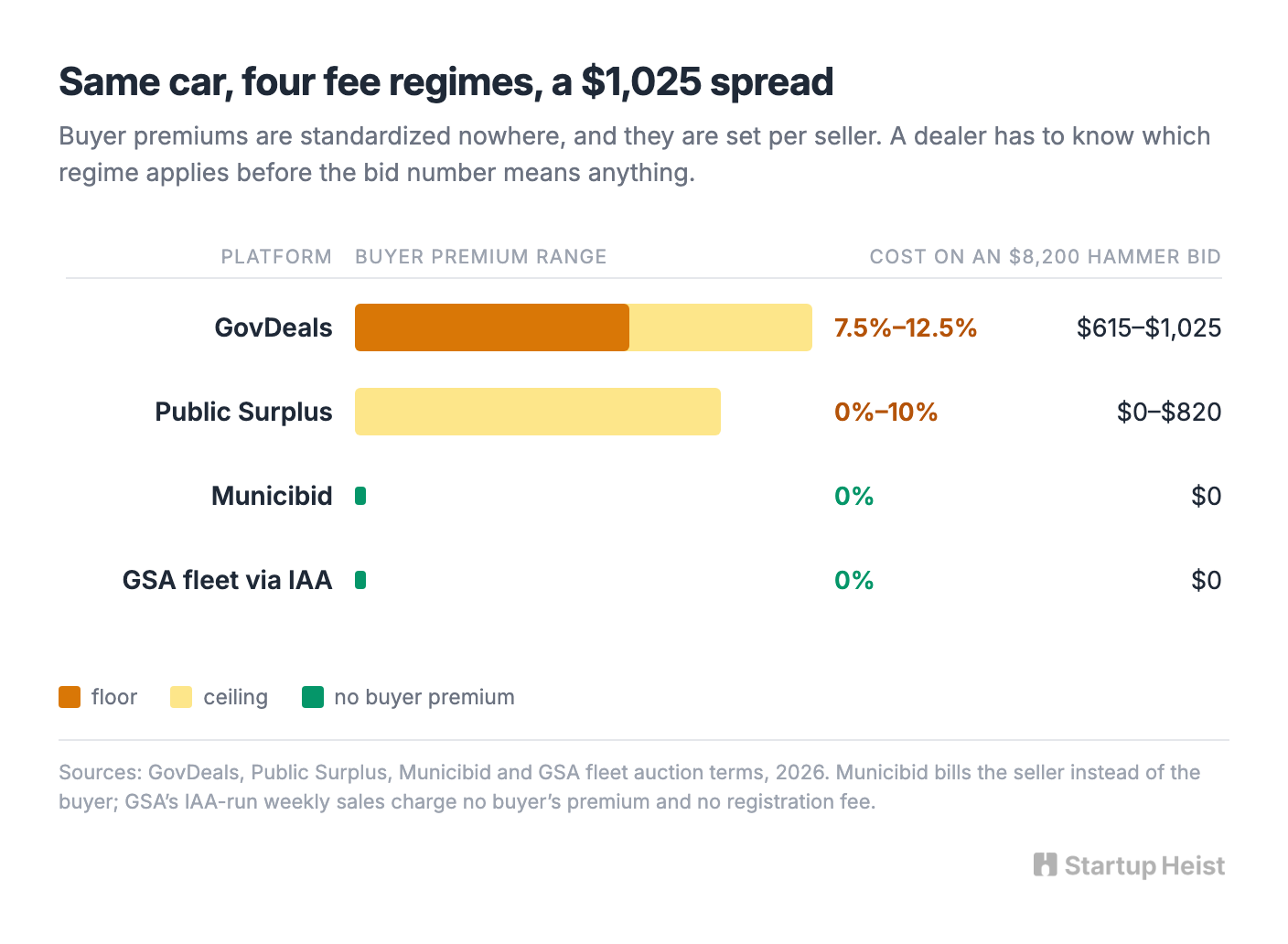
Start with fees, which are standardized nowhere. GovDeals buyer premiums typically run 7.5% to 12.5% depending on the seller, with 12.5% common. Public Surplus premiums range from zero to about 10%, set per agency. Municibid charges buyers no premium at all and bills the seller instead. And since January 2026, GSA has moved its retired fleet through weekly nationwide auctions run by IAA, consolidated into four regional sales a week, with no buyer's premium and no registration fee at all. One of the largest federal channels in the country charges zero while GovDeals runs to 12.5%, and a dealer has to know which regime applies before the bid number means anything.
Then transport. Short-haul open-carrier moves under 500 miles generally land between $400 and $850, and quotes vary enough that the per-mile rule of thumb breaks down under 200 miles. Short runs cost more per mile because the carrier's fixed costs spread across fewer of them. A vehicle 137 miles away isn't a rounding error.
Then reconditioning, which averages around $1,112 per vehicle industry-wide and splits hard underneath that average: $300 to $600 for cosmetic work, $800 to $1,500 for moderate repair, past $2,000 once something mechanical is wrong.
Then the government-specific traps: missing keys, titles that take weeks to process, pickup deadlines with no flexibility, and condition disclosures written by a fleet clerk who has never sold a car.
Every one of those numbers is knowable. None of them appears on the listing page. So the dealer either runs the arithmetic in their head at 11 p.m. or skips the channel entirely, which is what most of them do. Nobody is selling them the arithmetic.
What you are actually building
Call it FleetMargin.
Unlock the Vault.
Join founders who spot opportunities ahead of the crowd. Actionable insights. Zero fluff.
“Intelligent, bold, minus the pretense.”
“Like discovering the cheat codes of the startup world.”
“SH is off-Broadway for founders — weird, sharp, and ahead of the curve.”


