


The Creator Economy's Billion-Dollar Security Blind Spot
On August 12, 2025, the official Google India YouTube channel went dark. Attackers wiped the branding, hid the videos, and ran a live crypto-trading "giveaway" to its millions of subscribers before the channel was pulled offline. If Google's own account can get hijacked in broad daylight, the Shopify merchant running her store from a kitchen table doesn't stand a chance.
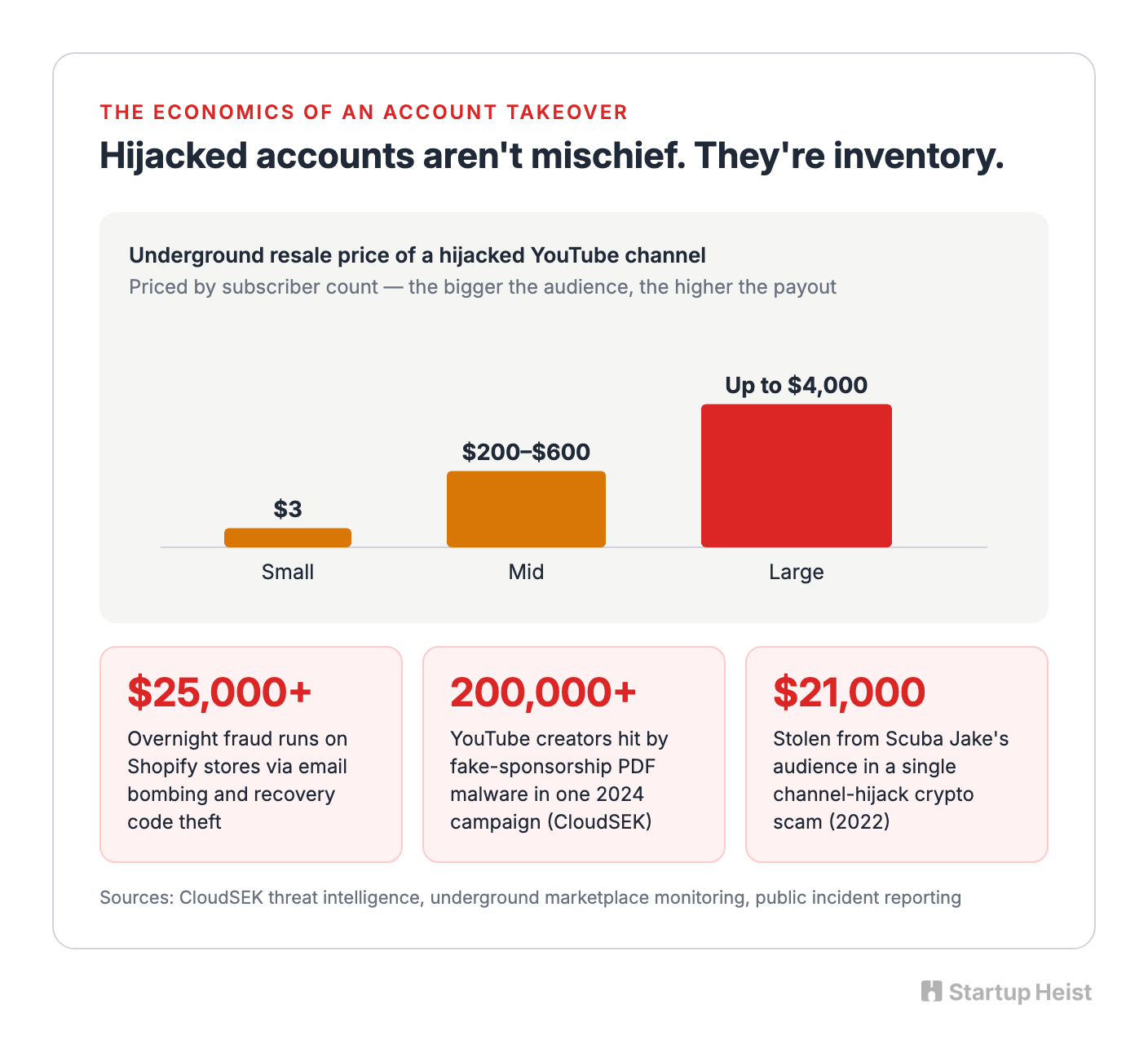
She isn't alone. Creators, indie founders, and small online operators are watching peers get taken almost weekly. Scuba Jake, the 13-million-subscriber YouTuber, lost his channel back in September 2022 and roughly $21,000 of his audience's money to a crypto-giveaway takeover. That case was a precedent. What's happening now is a full-blown pattern, and the pattern is the opening for a media business.
Here's the opportunity:
The money: Realistic early scale: 25K YouTube subs and 10K newsletter readers producing $15–$40K MRR through ads, affiliates, sponsorships, and small digital products. Cybersecurity is one of YouTube's fastest-growing niches in 2026.
Inside:
• Incident-led content system
• 10-video launch slate that tests the thesis
• Three-phase monetization ladder
• Five-part moat for a category brand
Why now
The threat has moved downstream, and the fix has finally caught up.

Account takeover is now the default creator risk, not a rare one. YouTube has warned that attackers are privately sharing AI-generated deepfakes of CEO Neal Mohan dressed up as "new monetization policy" announcements to phish credentials and drop malware. CloudSEK documented a 2024 campaign that hit more than 200,000 YouTube creators with malware-laden .rar files disguised as PDF sponsorship contracts, the exact playbook that keeps surfacing in hacked-channel post-mortems. Shopify operators are getting hit by a coordinated attack combining email bombing, recovery code theft, and overnight fraud runs north of $25,000 that bypasses authenticator-app 2FA. On underground markets, hijacked YouTube channels trade for anywhere from $3 to $4,000 depending on subscriber count.
On the defense side, passkeys are finally mainstream. Monthly passkey authentications more than doubled year over year to roughly 1.3 million, and about 40% of Dashlane users now have at least one stored. Microsoft began auto-enabling passkeys for all new accounts in May 2025, producing a reported 120% surge in authentications almost overnight. The passwordless authentication market hit $24.1 billion in 2025 and is projected to reach $55.7 billion by 2030. Every video can now end with a concrete install instead of a vague "be careful online."
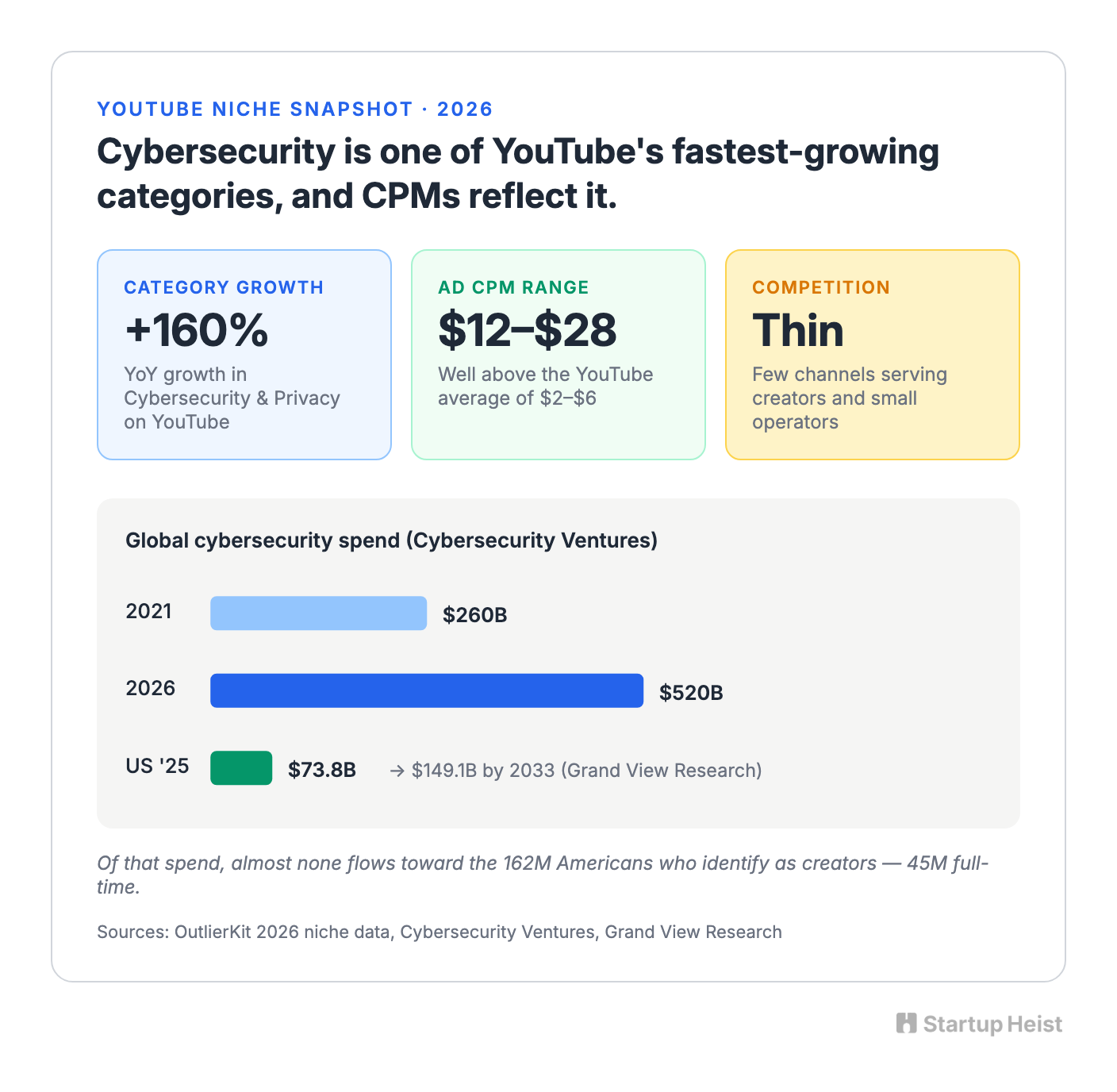
OutlierKit's 2026 niche data ranks Cybersecurity & Privacy as one of the fastest-growing categories on YouTube, with roughly +160% growth, CPMs in the $12–$28 range, and relatively thin competition. Cybersecurity Ventures projects global security spending to top $520 billion annually in 2026, up from about $260 billion in 2021. Grand View Research pegs the U.S. market at $73.8 billion in 2025, growing to $149.1 billion by 2033. Almost none of that spend flows toward the roughly 162 million Americans who identify as content creators, the 45 million full-time, or the millions of Shopify merchants and indie SaaS founders whose entire business lives inside a handful of logins.
Great media businesses live at the intersection of fear, money, and actionability. This niche has all three, and every story ends with a fix a solo operator can install before lunch.
The gap
There are large cybersecurity channels on YouTube, but they're pointed at other audiences. NetworkChuck sits north of 5 million subscribers teaching Linux, networking, and IT fundamentals for career switchers. David Bombal pulls 2.7 million on a similar track. The Cyber Mentor trains aspiring pentesters toward OSCP. Null Byte, LiveOverflow, and Hak5 play in the hacker-culture and offensive-security lanes. None of them are built for the Shopify merchant who just saw a "Shopify Compliance Team" email in her inbox at 10pm on a Sunday and doesn't know whether to click the link.
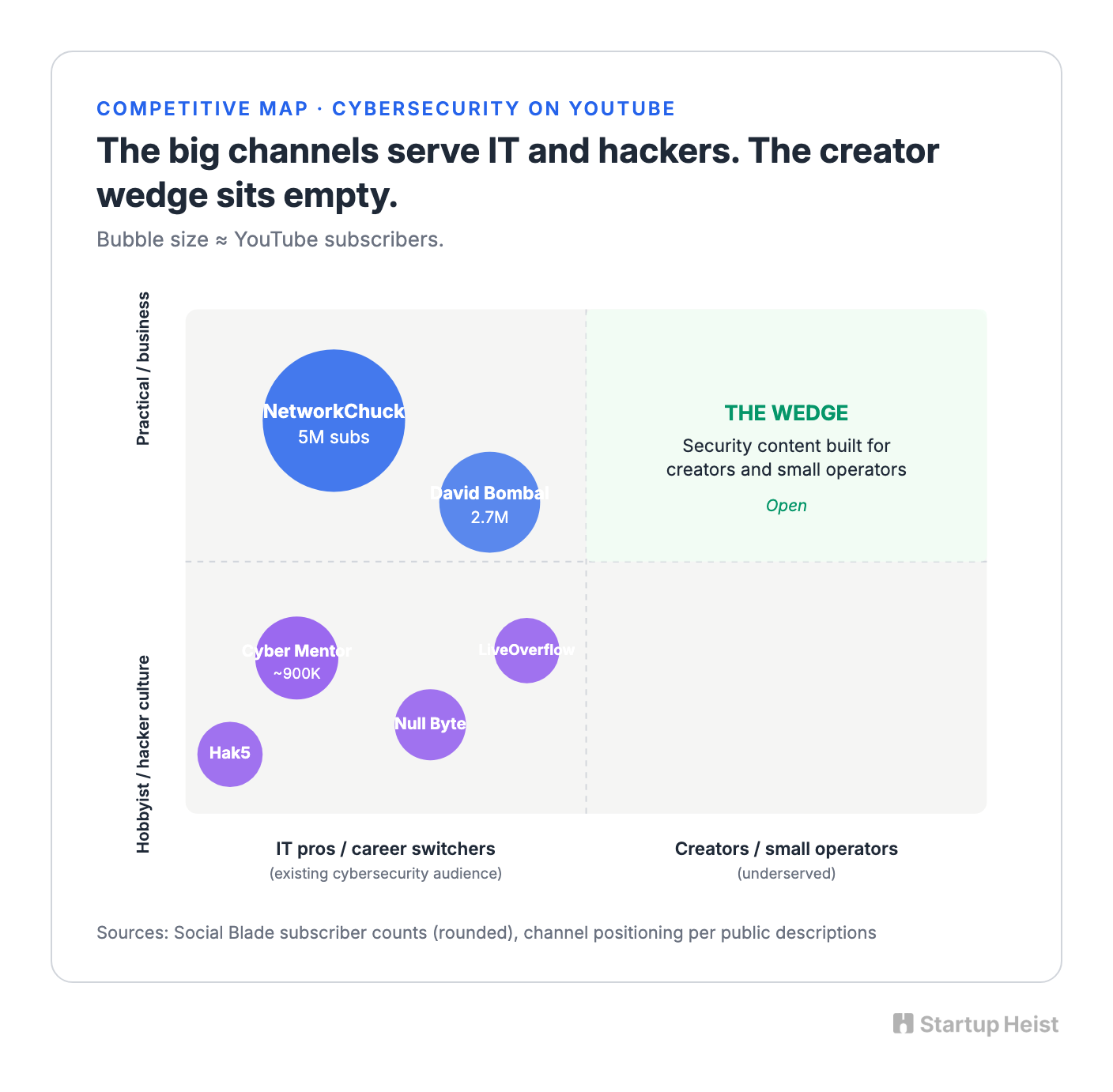
That's the wedge. Don't try to beat the big cybersecurity channels on their turf. Own the security layer for the creator economy. Narrower. More winnable. And the audience is measurably underserved.
The real product and what it becomes
The product isn't the channel. It isn't the newsletter. It isn't "cybersecurity education." The product is confidence for internet-native operators. The audience wants to know five things, over and over: how these hacks actually happen, which risks are real for a one-person business, the cheapest highest-leverage thing to fix this week, which tools are worth paying for, and what happens if they get hit tomorrow. Answer those questions repeatedly in a creator-native format and the business compounds in three phases.
Phase one: media business. YouTube ads, affiliate revenue from password managers, hardware keys, VPNs, backup tools, authentication products, cyber insurance, identity monitoring, and secure email or device-management tools. Sponsorships from B2B security vendors hunting SMB and creator distribution. Newsletter sponsorships once list quality is proven. Light digital products — emergency response checklists, creator security audits, a "secure your business in 90 minutes" playbook — layer on top.
Phase two: lead-gen and trust business. Paid security templates for creators and indie founders. A premium newsletter tier. A vetted marketplace of freelancers and consultants for post-hack recovery. Incident response retainers for small digital businesses. Affiliate-driven "recommended stack" bundles. Sponsored benchmark reports like "The Creator Security Stack 2026."
Phase three: optional software or services. If trust compounds, build tooling around security hygiene for small digital operators. The media business alone is meaningful.
A realistic early version grows to 10,000–50,000 YouTube subscribers, 5,000–20,000 newsletter subscribers, a few high-converting affiliate relationships, and a sponsorship layer. That's a serious one-person or two-person business. It doesn't need to become the Morning Brew of cybersecurity to work, and it isn't capped at $5K MRR either. The threat surface keeps widening as more businesses go digital-native.
The moat
Technical depth isn't the moat. Go head-to-head with NetworkChuck on technical depth and you lose. The moat is five things stacked:
Unlock the Vault.
Join founders who spot opportunities ahead of the crowd. Actionable insights. Zero fluff.
“Intelligent, bold, minus the pretense.”
“Like discovering the cheat codes of the startup world.”
“SH is off-Broadway for founders — weird, sharp, and ahead of the curve.”


