


Routine-Core Micro-Games
Ten million people play NYT Games every day. Wordle trained them into a ritual: a two-minute cognitive warm-up wedged between coffee and email. Daily puzzles aren't casual entertainment anymore. They're infrastructure for how a large, commercially attractive segment of the internet starts its day.
The numbers back this up. NYT Games pulled 11.1 billion total plays in 2025 across Wordle, Connections, Strands, the Mini, and Sudoku. More than one million users pay roughly $40 a year for a Games-only subscription, generating an estimated $25 to $40 million in annual revenue from puzzles alone. That helped push the Times' total digital subscription revenue past $1 billion for the first time. Then, around August 2025, the Times moved the Mini Crossword behind a paywall. Players revolted. A developer reverse-engineered the client-side paywall and published a bypass within hours. Another built an entirely free Mini alternative. Within 90 days of Wordle's original breakout, more than 100 clones and variants launched, and many still have active audiences years later. The demand for daily puzzle rituals is real, fragmented, and growing.
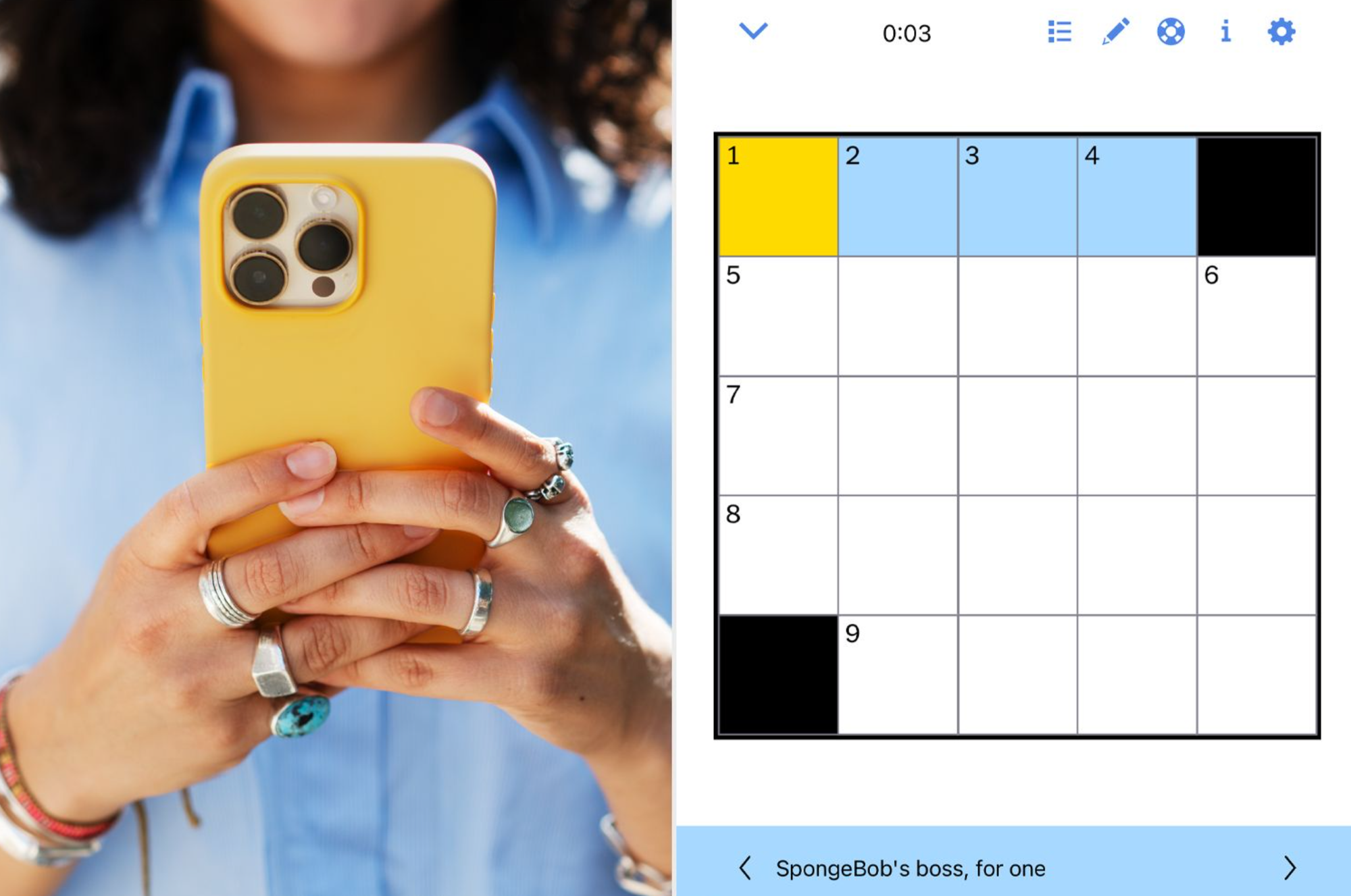
NYT trained millions to build daily puzzle habits, then started restricting access. Mobile puzzle apps remain overrun with banners, interstitials, and progression loops designed to maximize session time. Between those two poles sits a clean gap: an ad-light daily browser puzzle experience that respects the ritual instead of exploiting it. That gap is the opportunity.
The money: At 5,000 daily players, one weekly sponsor plus 2% paid conversion produces roughly $42K/year with clean margins.
Inside:
• Full MVP scope: three games, under 5 minutes
• Share mechanics that drove Wordle's growth
• Solving the daily content treadmill
• Sponsor outreach template included
Where the Real Play Is
"Three little browser games" gets you a side project. The version worth building is a psychographic ritual product aimed at a narrow, sponsor-friendly audience: engineers, data analysts, geography nerds, product managers, quant-curious knowledge workers. People who check Hacker News before Slack. People who subscribe to newsletters from Ben Thompson or Lenny Rachitsky.
Narrowing the audience sounds counterintuitive when the whole point is daily active users. But a narrow audience produces stronger retention language, better sponsor fit, and dramatically higher monetization per user. The math works even at modest scale because the people playing are unusually identifiable and commercially valuable.
Once you've picked that audience, the design follows. Your map game becomes a fast geography or infrastructure puzzle: identify a transit system from its route map, name the city from its street grid. Your number game becomes sequence detection, probability intuition, or estimation. Fermi problems. Growth rate puzzles. Bayesian reasoning in miniature. Your logic game becomes a tight deduction puzzle with clean visual feedback. And your sponsor inventory starts attracting B2B newsletters, developer tools, data platforms, productivity software, and technical education brands. If the players are identifiable and habit-driven, the business gets easier at every stage.
The Landscape
NYT Games dominates with 10 million daily players across its puzzle bundle and an expanding paywall. The Times optimizes for subscription conversion across its entire media portfolio, not for the puzzle experience itself. Every free game is a funnel to a $50/year package that also includes news and cooking.
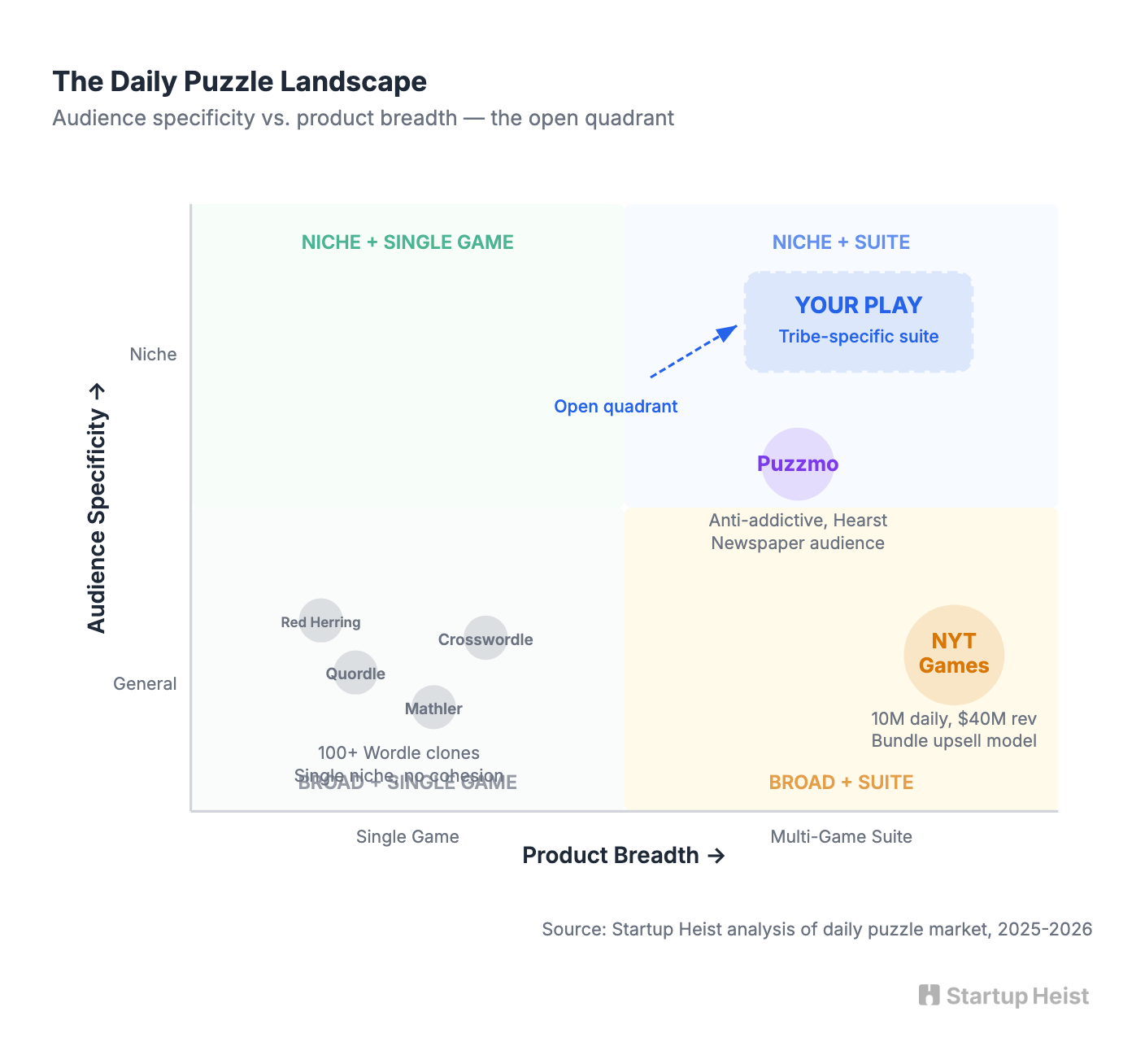
Puzzmo, founded in 2023 and acquired by Hearst the same year, is the most interesting indie comp. Creator Zach Gage designed it to be explicitly anti-addictive: games end, there's no infinite scroll, no push notifications. The design taste is genuine. But Puzzmo distributes through Hearst's newsroom properties and targets a general newspaper audience. Its "anti-addictive" positioning overlaps meaningfully with this opportunity, and anyone building here should study it closely. The difference is audience specificity. Puzzmo serves newspaper readers who want better puzzles. This play serves a defined professional tribe who want puzzles built for how they think.
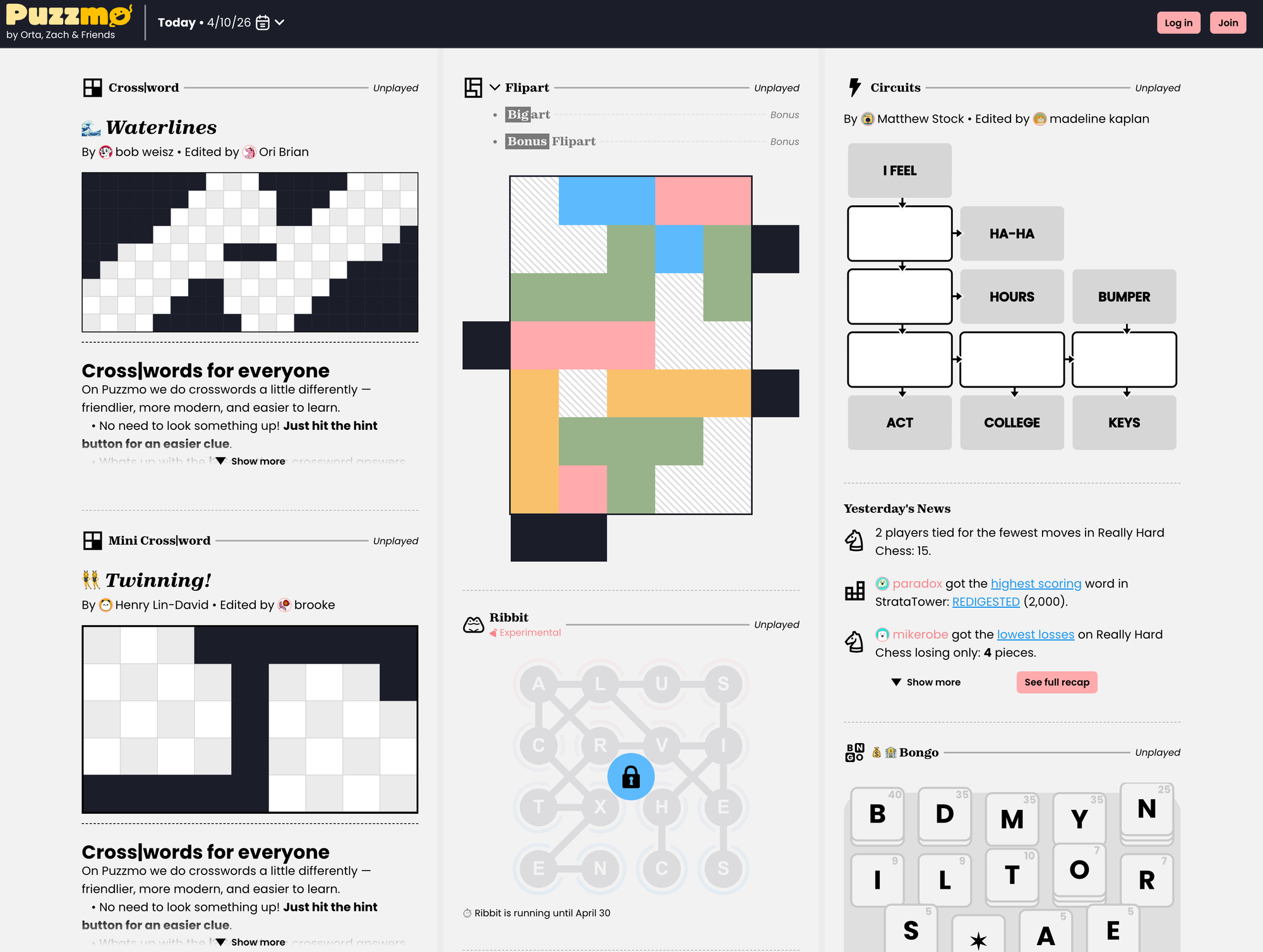
The rest of the field is fragmented single-game clones: Crosswordle, Quordle, Mathler, Red Herring. Each solves one puzzle niche. None are building a cohesive ritual suite with a defined audience identity, premium monetization, and owned distribution.
The Business Model
Subscriptions: A free tier offers today's three daily games, one streak counter, simple sharing, and a single weekly sponsor placement. No account required. A paid tier at $3/month or $24/year unlocks archives, deeper statistics, percentile rankings, streak history, and hard-mode variants. An optional premium tier at $6/month adds friend leaderboards, monthly challenge sets, early experimental games, and Sunday deep puzzles. Skip Patreon. The whole proposition is elegance. Direct Stripe billing, first-party experience.
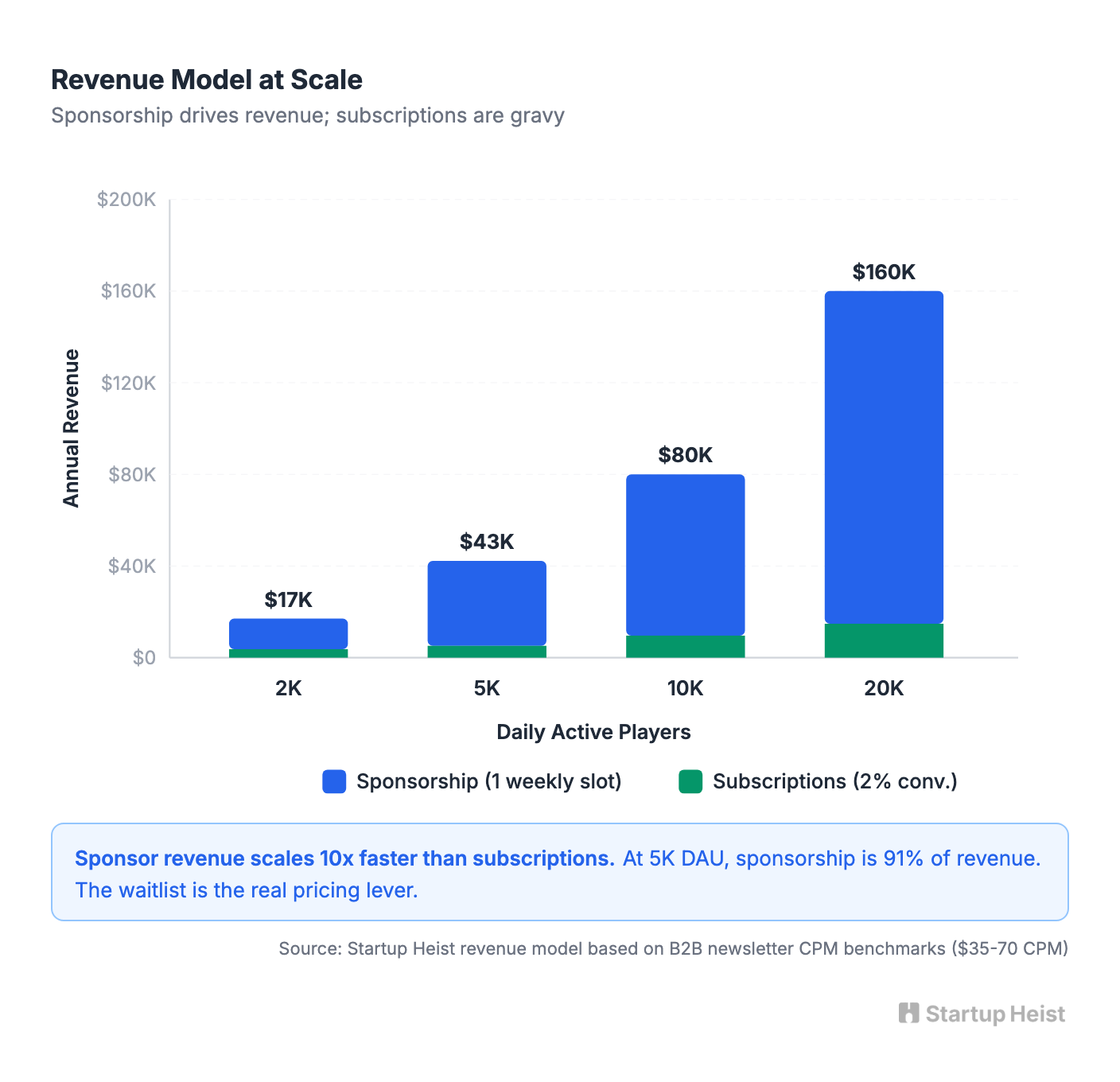
Scarce sponsorship: One sponsor per week, native text placement, positioned under the game suite or inside the daily email. Category exclusivity. B2B and technical newsletter sponsorships currently command $35 to $70 CPM. Specialized newsletters with 8,000 subscribers regularly charge $2,000 per placement while lifestyle newsletters with 50,000 subscribers struggle to fill $800 slots. Engagement and niche beat raw volume every time.
At 5,000 daily players with 2% paid conversion, subscription revenue runs roughly $3,600 per year. Add one weekly sponsor at $750 per slot (conservative for a B2B tech audience) and sponsorship contributes $39,000. Together, that's a real indie business before you hit 10,000 users. The sponsor line scales faster than the subscription line once demand exceeds supply.
MVP Scope
Version one needs seven components:

Unlock the Vault.
Join founders who spot opportunities ahead of the crowd. Actionable insights. Zero fluff.
“Intelligent, bold, minus the pretense.”
“Like discovering the cheat codes of the startup world.”
“SH is off-Broadway for founders — weird, sharp, and ahead of the curve.”


