


Thrift-Store Arbitrage Is Getting Its Own Intelligence Layer
The Market Shift
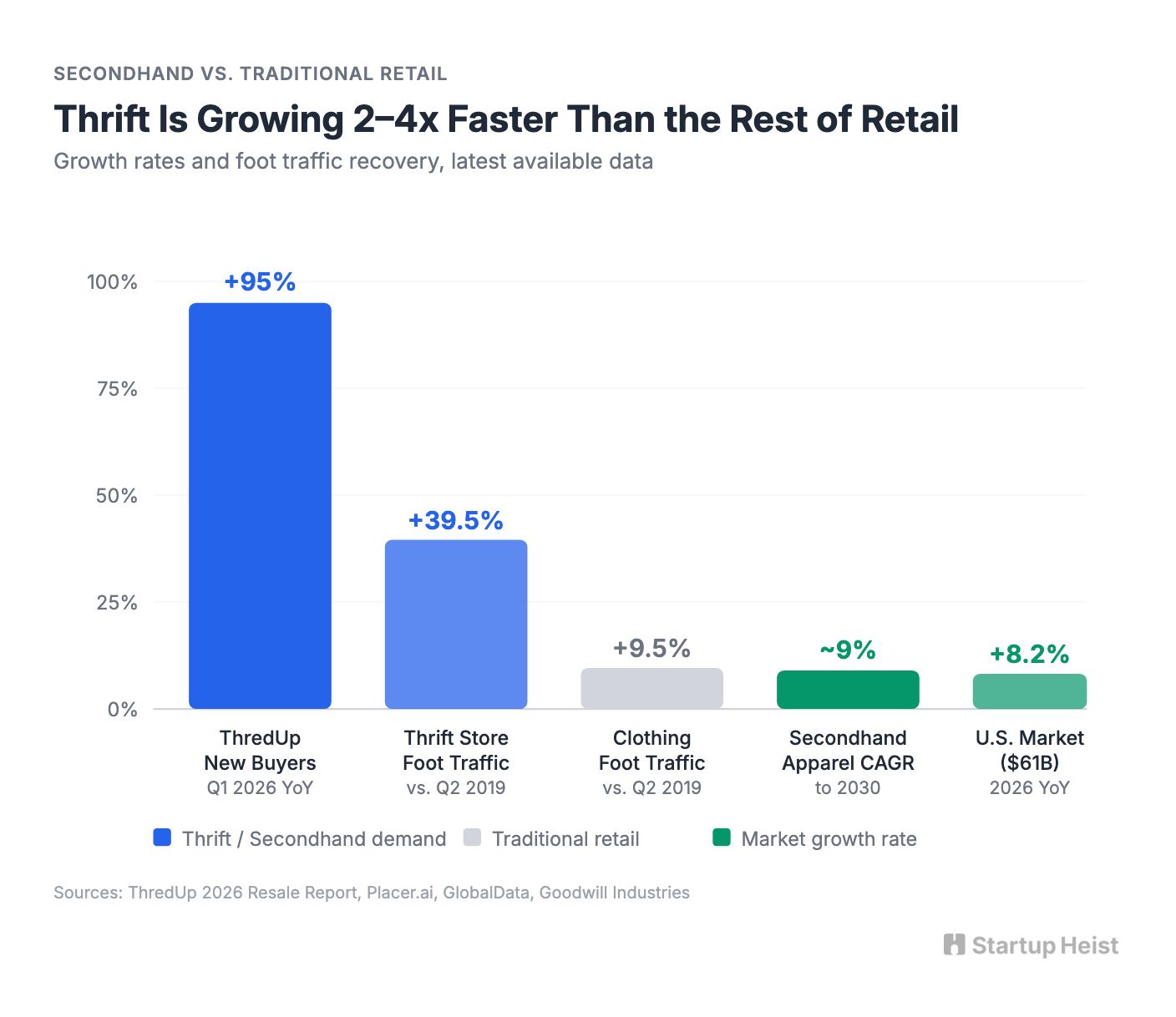
The U.S. secondhand market hit $61 billion in 2026, up 8.2% year over year. Global secondhand apparel is on track for $393 billion by 2030, growing roughly 9% annually — about twice the rate of the broader apparel market. Thrift store foot traffic in Q2 2025 was up 39.5% versus Q2 2019, dwarfing the 9.5% the broader clothing industry managed. Goodwill posted $5.5 billion in retail sales (a record) while announcing plans for 100 new stores in 2026.
The composition of who shops thrift is changing fast. Fifty-nine percent of U.S. consumers shopped secondhand in 2025, up seven points in three years. Forty-nine percent of Gen Z consumers sold a pre-owned item for the first time. More than 70% of Gen Z and millennials report that wealth feels out of reach, with "survival spending" becoming the norm. One-third of Gen Z resellers earn $301 to $500 from secondhand transactions. Tariffs poured accelerant on the trend: ThredUp reported a 95% increase in new buyers during Q1 2026 versus Q1 2025, with nearly 75% new buyer growth sustained through Q2.
More people are walking into thrift stores and asking a different question — not "can I save money?" but "is there money here?"
The answer is yes, and the tooling to prove it in real time is wide open.
The money: 2,000 subscribers at $12/month is $24K MRR. 5,000 at a blended $14/month hits $70K MRR. Thrift resellers already pay for weaker tools.
Inside:
• Velocity-adjusted buy/skip decision engine
• MVP scope: photo-to-verdict in 10 seconds
• Five compounding moats worth building
• Pricing tiers from free to $29/month
The Tool Gap
Resale software has matured fast, but unevenly. The post-acquisition layer is crowded. Vendoo, List Perfectly, Nifty, and Closo compete fiercely on crosslisting, inventory management, and automation across 10+ marketplaces. They assume the user already knows what to buy.
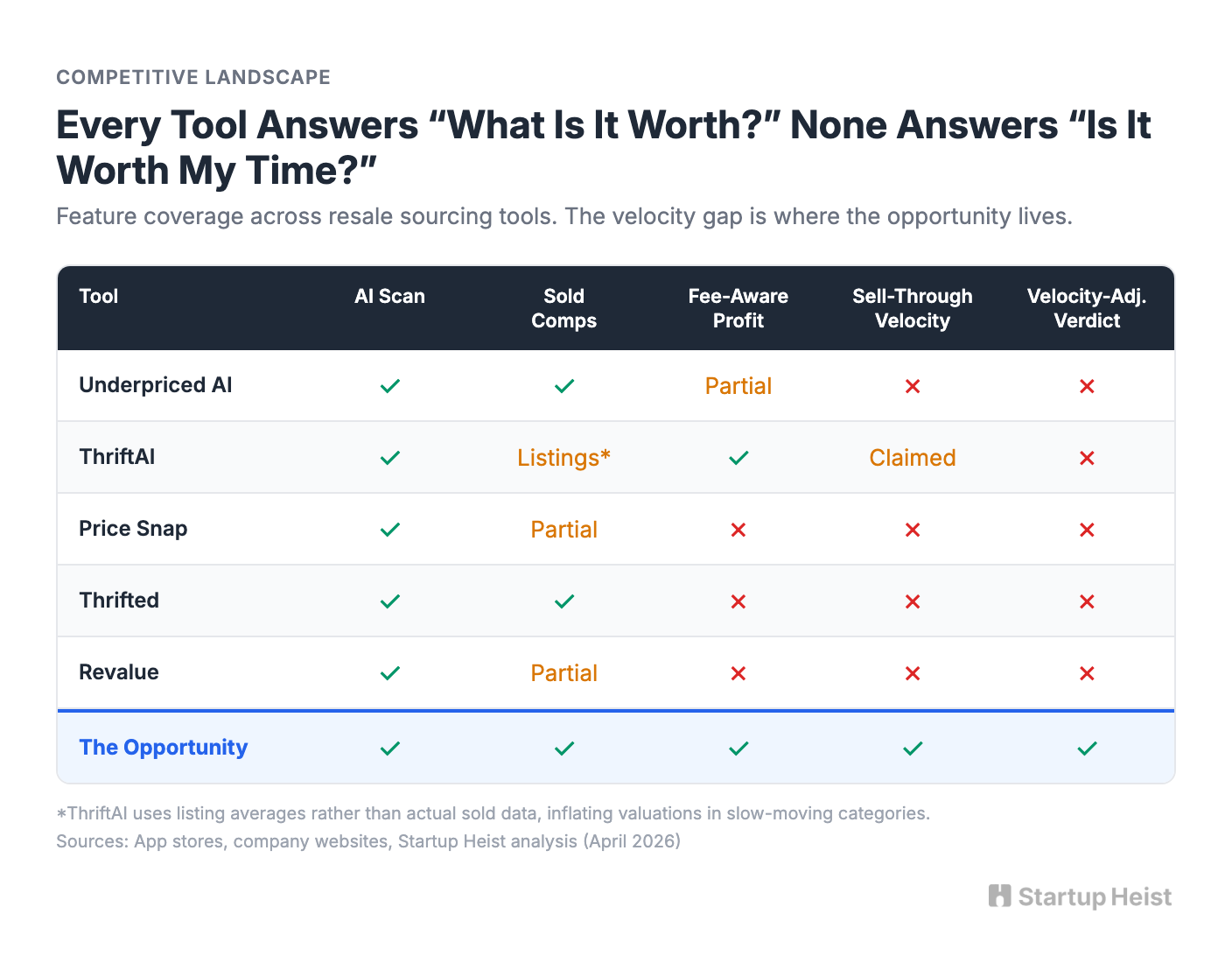
The pre-purchase discovery layer has started filling in. Underpriced AI offers AI identification with sold data from six platforms for $12 per month. ThriftAI has over 100,000 downloads with buy/skip recommendations and a profit calculator. Price Snap provides AI photo-based estimation with authenticity checks. Thrifted layers in rarity signals alongside price comps. Revalue offers photo-to-value lookups. The claim that "no one is building for the sourcing moment" no longer holds.
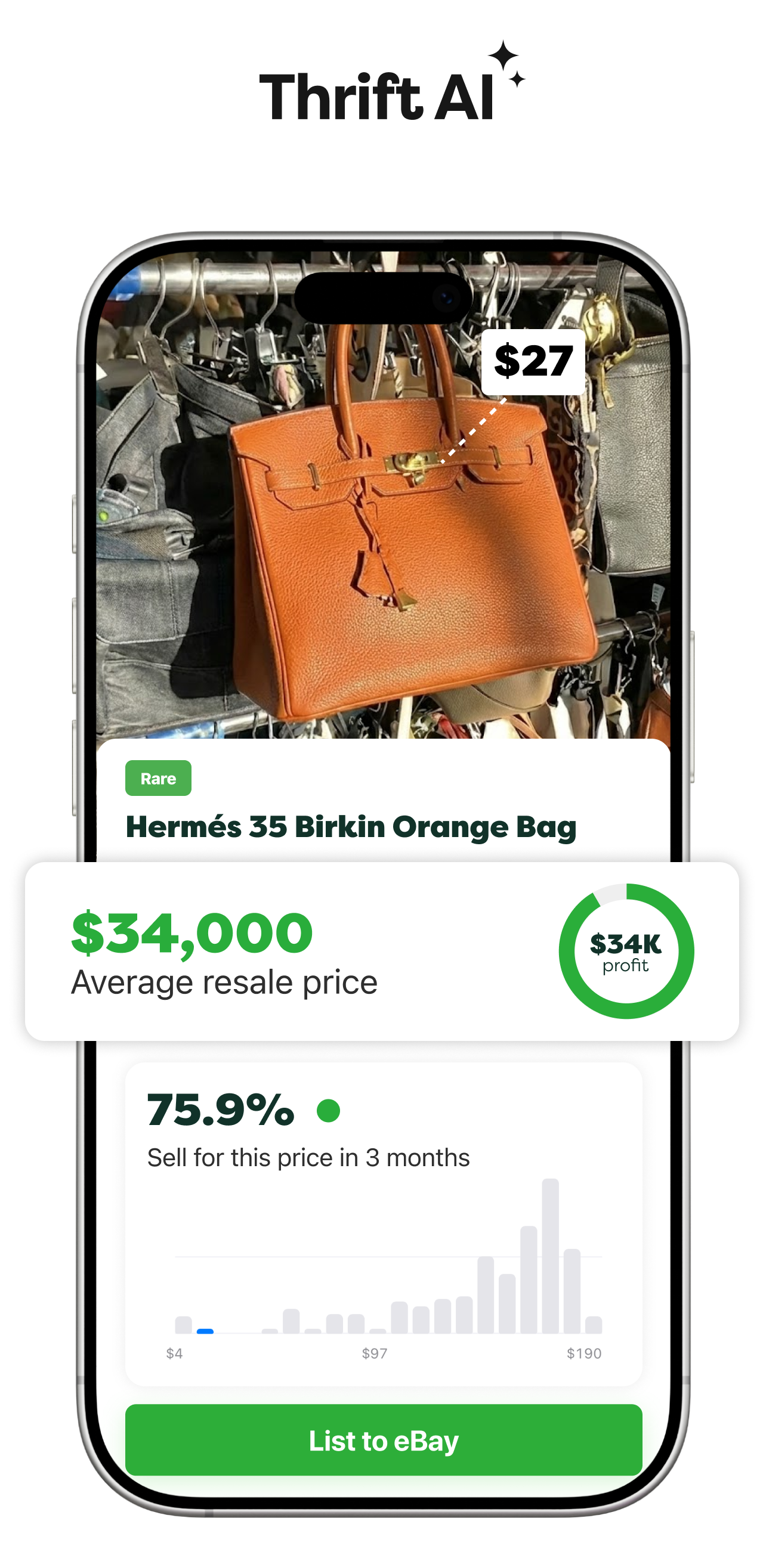

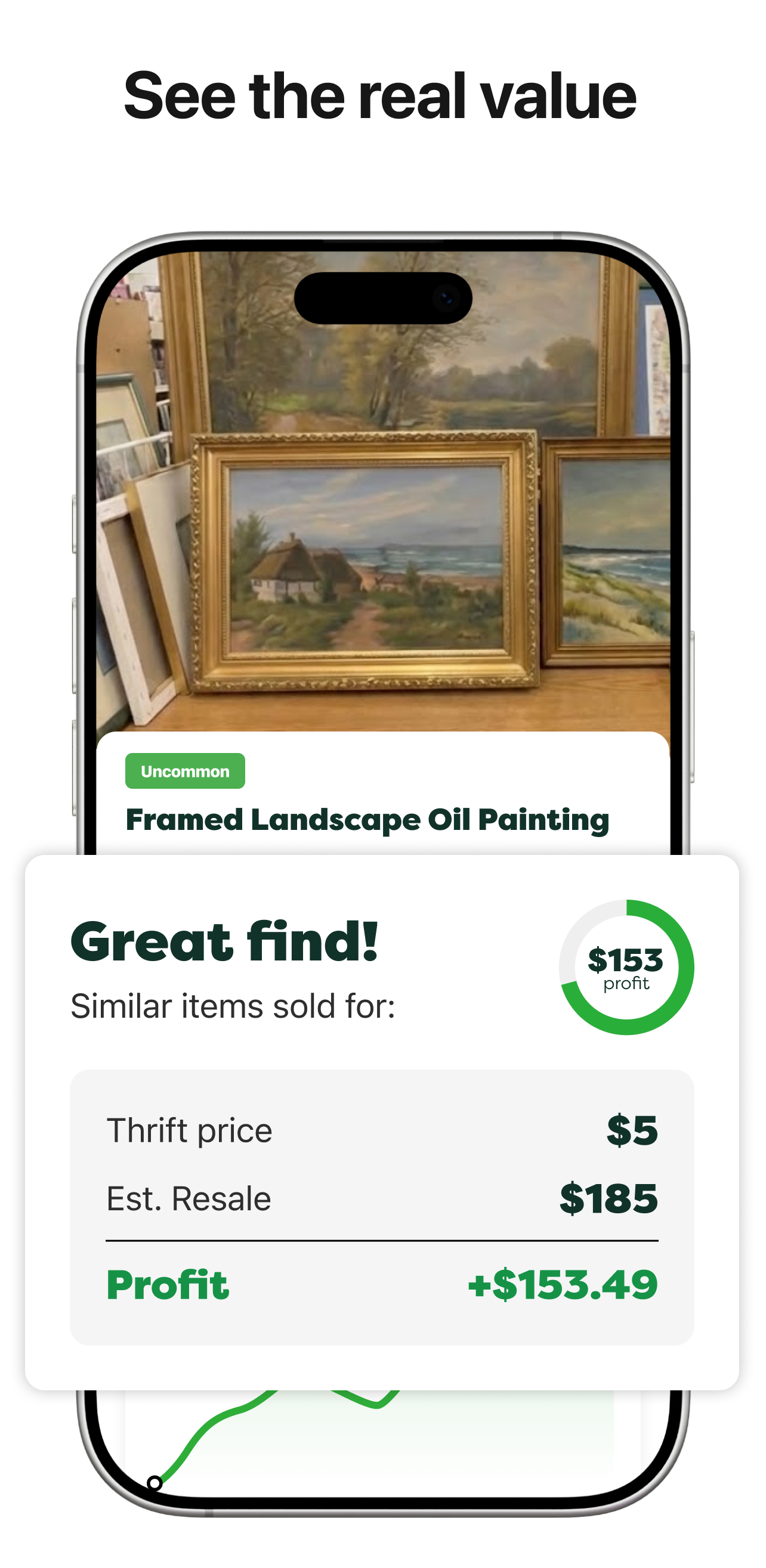
But the quality of the answer is still weak. ThriftAI includes sell-through rates in its feature set, yet relies on listing averages rather than actual sold data, inflating valuations in slow-moving categories. Underpriced AI uses actual sold comps (more rigorous), but focuses primarily on price range without factoring sell-through velocity into its recommendations with any compound accuracy. None of these tools reliably say: "This looks like a $90 jacket, but skip it. Items in this category sit for 110 days on average."
Time is the variable every current tool underweights. For a casual thrift reseller whose time is the scarcest resource, it's the variable that matters most.
The Play: Profitability Intelligence, Not Just Price Intelligence
A coat that sells for $75 but takes four months to move is a bad buy at $15. A pair of vintage Levi's that sells for $60 in under two weeks is a strong buy at $12. The net profit is similar. The velocity makes one worth doing and the other a closet anchor.
The opportunity here isn't another scanning app. It's a decision engine that converts public marketplace data into a go/no-go resale verdict weighted by velocity. The core output is a thrift arbitrage calculator built around four elements:
- Likely resale range based on actual sold comps
- Net profit after fees and shipping computed per platform with the user's purchase price as input
- Sell-through confidence — how fast items like this typically move
- Why the item matters — vintage label, fabric blend, discontinued line, trending brand, seasonal demand
The output looks like: "Strong buy. Median resale $78 on eBay, estimated net $41 after fees and shipping, typical sell-through under 14 days. This is a 1990s Carhartt Detroit jacket — heritage workwear is in a sustained demand cycle."
Price intelligence tells you what something could sell for. Profitability intelligence tells you whether it's worth your time. The thrift resale market still underserves the second one.
Why This Position Is Defensible
Unlock the Vault.
Join founders who spot opportunities ahead of the crowd. Actionable insights. Zero fluff.
“Intelligent, bold, minus the pretense.”
“Like discovering the cheat codes of the startup world.”
“SH is off-Broadway for founders — weird, sharp, and ahead of the curve.”


