


Every Thursday afternoon, the same ritual plays out across affluent American suburbs. A parent opens their phone and starts hunting: the spring fair that's actually worth the drive. The library storytime that won't be a zoo. The farmer's market with the petting zoo their kid has been asking about. The museum free day before tickets disappear.
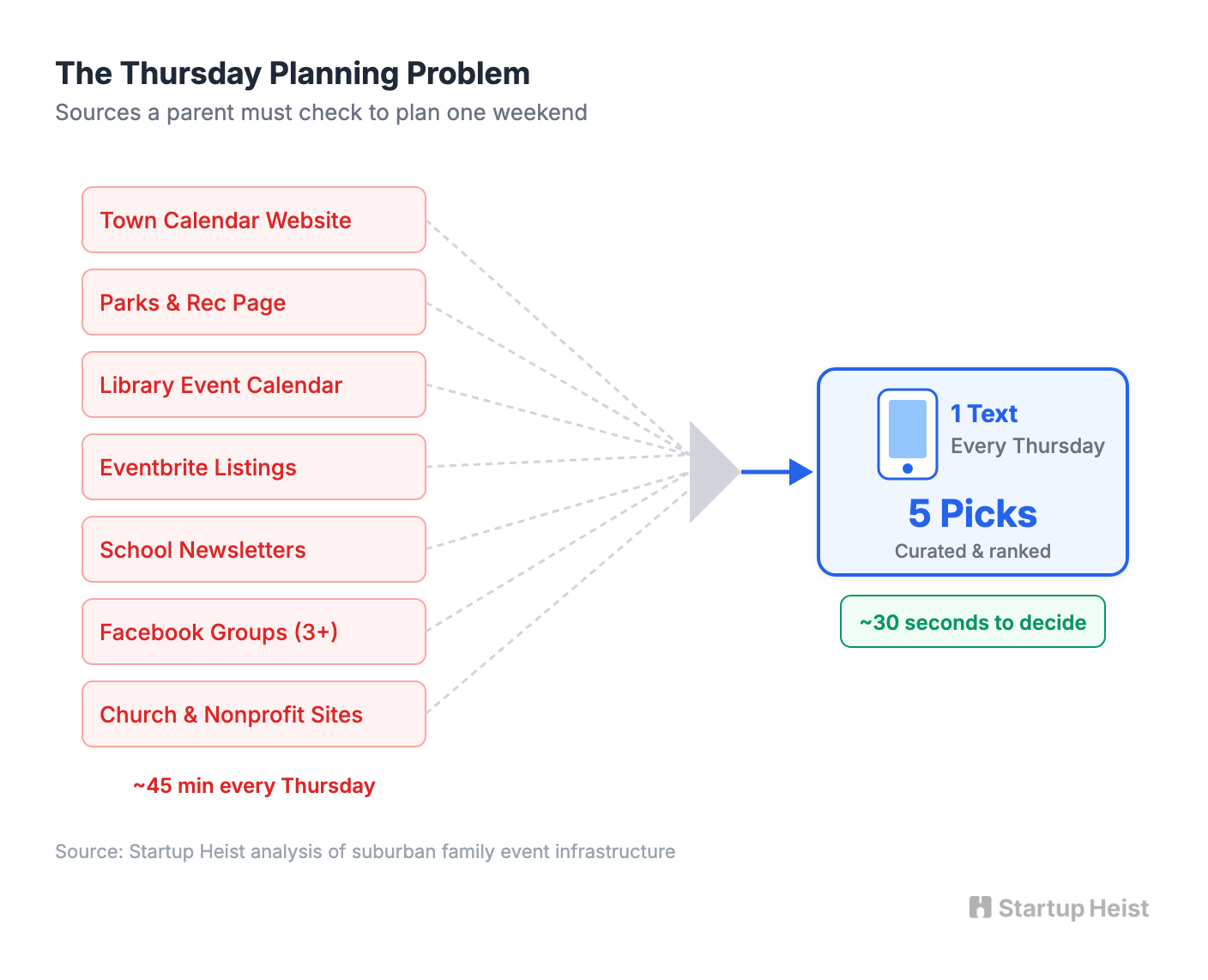
The information exists. It's scattered across town calendars, parks-and-rec websites, library event pages, Eventbrite listings, church bulletins, school newsletters, and at least three Facebook groups with overlapping but incomplete coverage. Nobody has a single, curated source.
That gap is the entire business.
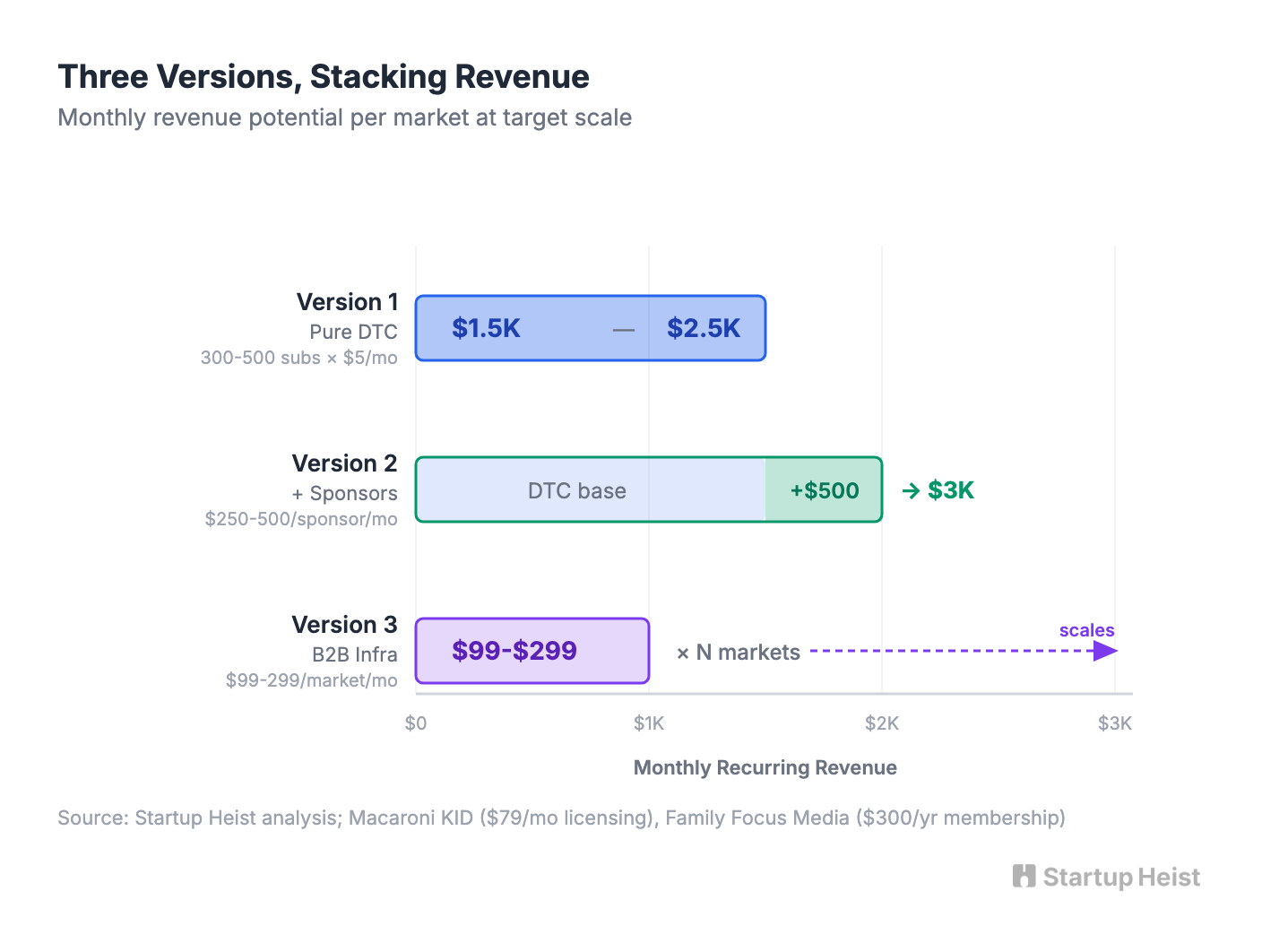
The money: 300 subscribers at $5/month is $1,500 MRR. One local sponsor at $250 to $500/month replaces 50 to 100 of them.
Inside:
• Full MVP scope and tech stack
• Three revenue versions (DTC to B2B)
• Unit economics at 200 subscribers
• Go-to-market with outreach templates
The Pain Is Decision Compression
Parents in high-income suburbs don't lack event options. They have too many mediocre ones and no filter.
By Thursday afternoon, a dual-income household in Wellesley or McLean isn't asking "What exists this weekend?" They're asking: What should we actually do? Which option works with a stroller? Which one is worth the parking situation? Which thing will make me feel like I planned a good weekend without spending forty-five minutes cross-referencing six websites?
That problem gets expensive fast in suburbs where households have money, kids, and no free time. Scarsdale (average household income: $601,193), Wellesley ($367,801), and McLean ($303,649) are packed with families fitting exactly that description.
Who Already Owns Pieces of This
Three established players confirm the behavior is real and monetizable.

Macaroni KID runs a publisher network across 4,000+ communities in North America, reaching more than 3 million families annually. Each local edition is operated by a community publisher who curates family events and keeps 100% of the advertising revenue in exchange for a $79/month licensing fee. Family Focus Media, founded in 2010, publishes Main Line Parent, Philadelphia Family, and Bucks County Parent, reaching 400,000+ local families. Their "High Five Weekend Planner" email goes out weekly with curated events. They monetize through business memberships starting at $300 per year. Yodel occupies a different layer: AI-powered event collection infrastructure for chambers of commerce, tourism bureaus, and local media. Their platform scans hundreds of thousands of web sources for community events, saving client organizations 350 to 450 hours per year on manual data entry.
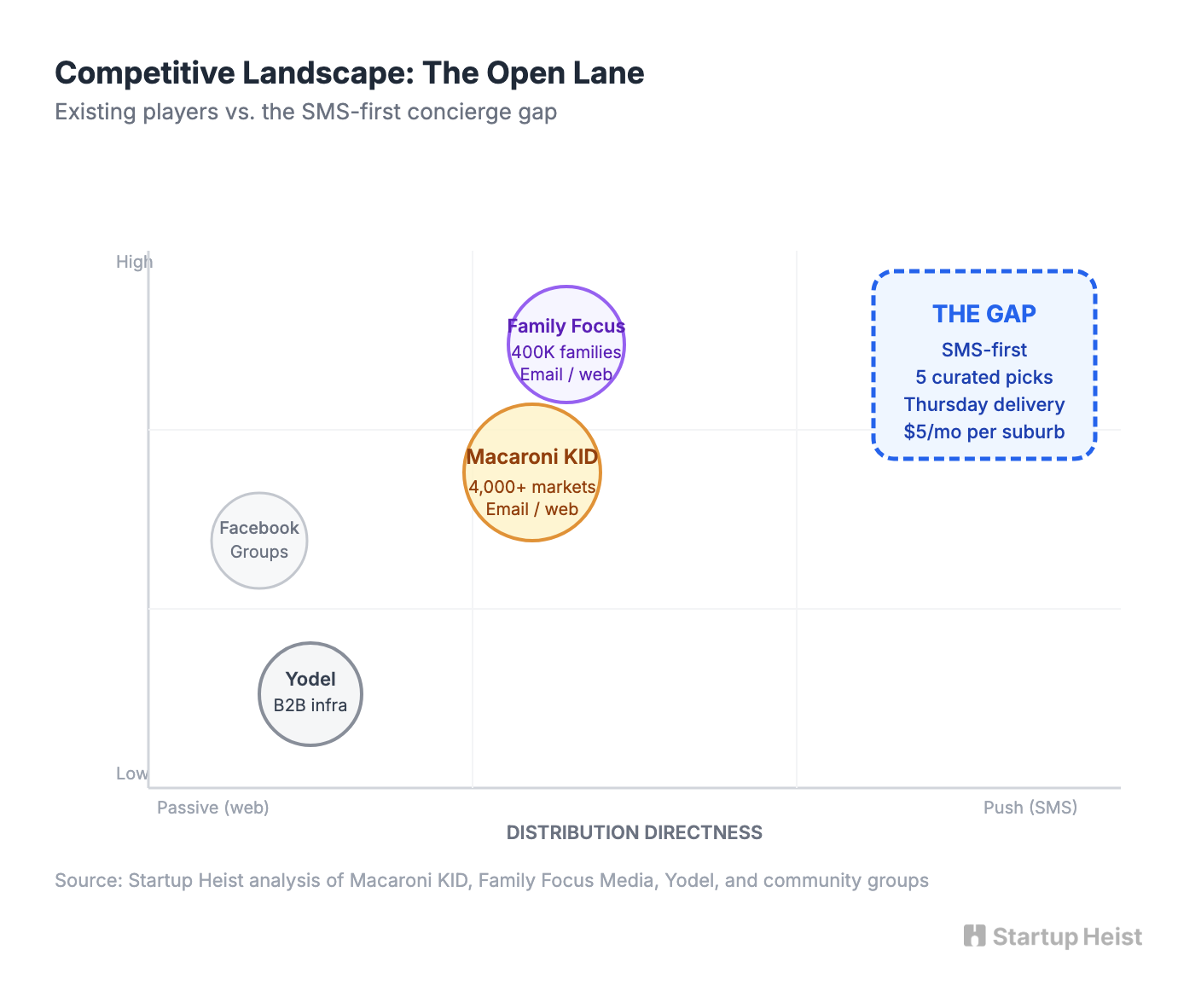
Macaroni KID proves parent audiences monetize through local advertising. Family Focus Media proves the content-plus-membership model at regional scale. Yodel proves B2B demand for the event collection engine itself. None of them offer the stripped-down, SMS-first, five-picks-on-Thursday product. That specific combination of format, timing, and channel is still open.
Three Versions of This Business
Version 1: Pure DTC micro-SaaS. One suburb cluster. Parents pay directly. One weekly SMS plus a companion email. At 300 households paying $5/month, that's $1,500 MRR. At 500, $2,500 MRR. Clean margins, low burn, high retention if the curation stays sharp.
Unlock the Vault.
Join founders who spot opportunities ahead of the crowd. Actionable insights. Zero fluff.
“Intelligent, bold, minus the pretense.”
“Like discovering the cheat codes of the startup world.”
“SH is off-Broadway for founders — weird, sharp, and ahead of the curve.”


