


The Probate Flipper
A strange category of dead business is entering probate. One-person internet businesses.
Small SaaS products. Affiliate sites. Newsletter businesses. Premium domains. Stripe accounts throwing off recurring revenue. Micro-acquisitions that would have sold in a founder forum in two weeks, except the founder died and the assets are now trapped inside an estate. Nobody at the table knows what they're worth, how to access them, or where to sell them.
That gap is the opportunity.
The money: One case a month at a $15K average fee builds a $15-30K/mo specialist firm. Nobody occupies this niche yet.
Inside:
• Three-product service model
• Attorney outreach templates and pitch
• Full asset inventory framework
• Lightweight valuation model
Why This Exists Now

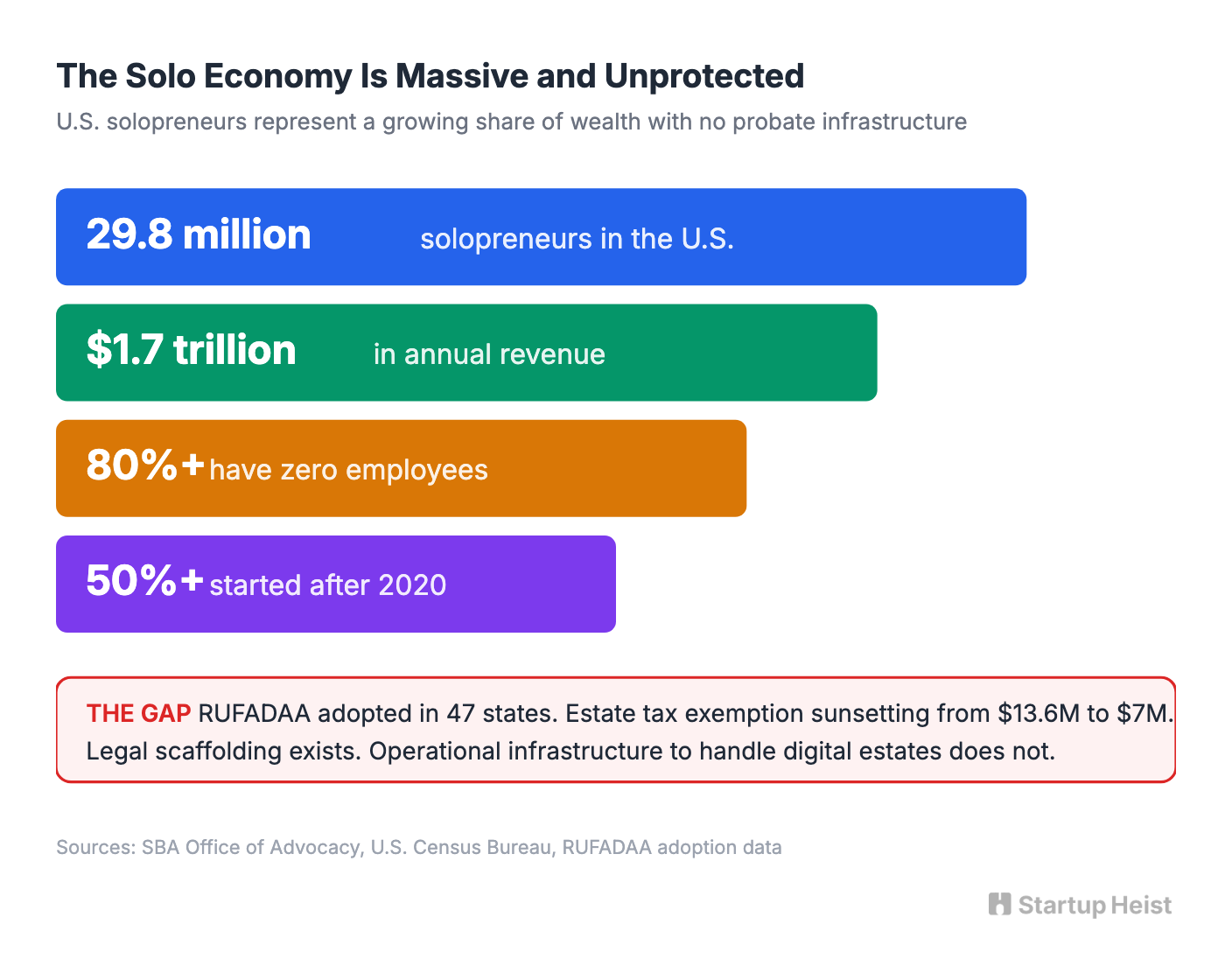
There are 29.8 million solopreneurs operating in the United States, generating $1.7 trillion in annual revenue. More than four out of five small businesses have zero employees. Over half started after 2020. A meaningful and growing share of personal wealth now sits in digital form: domains, SaaS subscriptions, monetized content, payment processor accounts, recurring revenue streams that exist entirely online. When these founders die, that wealth enters probate. Probate isn't built for it.
The legal framework has caught up faster than the operational one. The Revised Uniform Fiduciary Access to Digital Assets Act (RUFADAA) has been adopted in 47 U.S. states. States continue to expand its scope: California's SB 1458, effective September 27, 2024, broadened RUFADAA to include conservators and agents acting under power of attorney. Across the Atlantic, the UK's Property (Digital Assets etc) Act 2025 received Royal Assent on December 2, 2025, establishing digital assets as a third category of personal property under English law. The scaffolding for treating online businesses as real property-grade assets is in place. The operational infrastructure for handling them isn't.
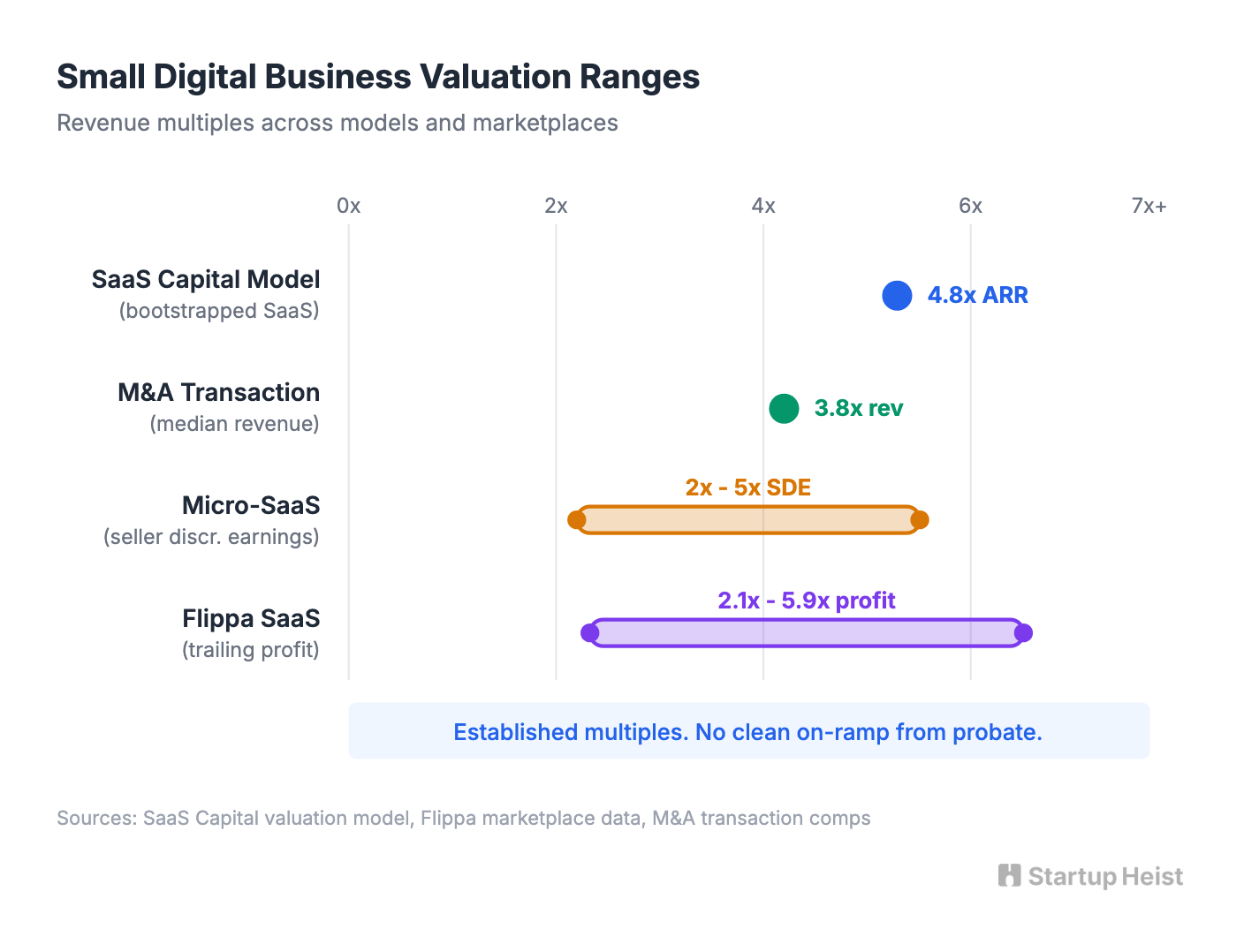
Small digital businesses now trade on established marketplaces with real comparables. SaaS Capital's model puts bootstrapped SaaS valuations at roughly 4.8x ARR, though actual M&A transaction medians run closer to 3.8x revenue. For micro-SaaS under $1 million in trailing revenue, realized sale prices typically land at 2x to 5x seller discretionary earnings, with the higher end reserved for businesses showing strong growth and low owner dependence. On Flippa, SaaS businesses sell for 2.1x to 5.9x trailing profit. The market has multiples and deal flow. What it doesn't have is a clean on-ramp from the probate system.
Meanwhile, the federal estate and gift tax exemption is scheduled to sunset after 2025, reverting from roughly $13.6 million to $7 million per person. That alone will push more estates into active planning and more heirs into the process of valuing assets they barely understand.
What's Broken
Most estate lawyers know how to handle brokerage accounts, real estate, and closely held businesses. They don't know what to do with a dormant Shopify app, a profitable Chrome extension, a portfolio of aged domains, or a small B2B SaaS with $4,000 in monthly recurring revenue. Some platforms cooperate with estate documentation. GoDaddy has a documented process: a completed access form, death certificate, estate administrator photo ID, and authority documentation, with a 72-hour processing window. Stripe has no clean estate access process at all. Each platform is different, and most attorneys aren't equipped to navigate any of them.
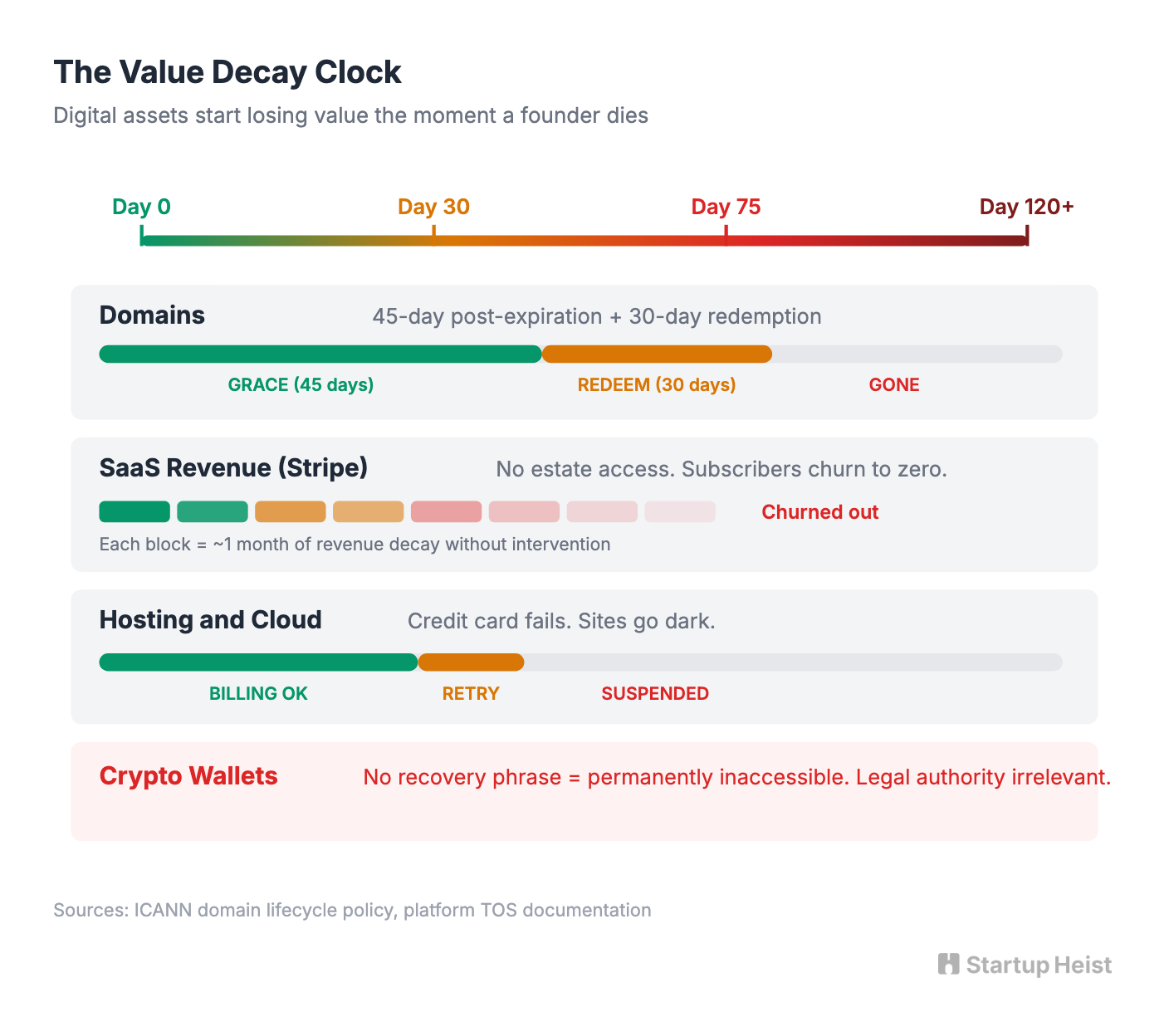
The clock matters. ICANN gives registrars a 45-day post-expiration window plus a 30-day redemption grace period before a domain goes public. An abandoned Stripe account with active subscribers will churn itself to zero. The moment the founder dies, value starts decaying.
The Wedge and the Moat
The wedge is outsourced digital business disposition for probate attorneys. Attorneys have the problem and the professional incentive to solve it cleanly. They control the trust gateway. Your first sale isn't to the estate. It's to the attorney's desire to avoid looking incompetent in front of a client when a dead founder leaves behind a Stripe dashboard, a registrar account, a GitHub org, and a monthly AWS bill.

No direct competitor currently offers the specific combination of probate coordination and digital business brokerage. Adjacent players like Trust & Will, Everplans, and Eternal.me focus on estate planning documentation or account closure. Nobody is doing the operational work of appraising, packaging, and selling small digital businesses out of estates.
Once you're in, the switching cost is high. Estate work is referral-driven. Once a law firm trusts you not to overstep legal authority or mishandle sensitive data, they won't swap you casually. Process knowledge compounds quickly: RUFADAA access rules, platform-specific estate procedures, data-room preparation, transfer sequencing, billing continuity, subscriber migration. Every annoying detail you learn makes you harder to replace. And if you consistently bring cleaned-up, diligence-ready assets to market, you develop a repeat-buyer pool that compresses sale time and increases realization.
The Sweet Spot and the Red Flags
The sweet spot is founder-owned internet property between roughly $10,000 and $250,000 in likely disposition value: micro-SaaS, content sites with affiliate revenue, newsletters with sponsorship history, e-commerce brands with stable traffic, domain portfolios, Shopify apps, WordPress plugins, and small B2B tools with subscription revenue. Venture-backed companies already have lawyers, investors, and process. The estates that need you are the ones where a solo founder's business was small enough to run alone but valuable enough to matter.
Part of your value is telling an attorney, quickly and credibly, "This looks like a business, but it dies with the operator," or "This is a real transferable asset, don't let it rot."
Access is the biggest operational constraint. RUFADAA gives fiduciaries tools, not a blank check. Access to the content of electronic communications remains restricted without prior user consent. Crypto wallets without recovery phrases are permanently inaccessible regardless of legal authority. Licensing can get messy if you lean into "broker" too aggressively: state rules around compensation and registration vary. The safest early posture is specialist advisor and project manager who prepares assets, coordinates with approved marketplaces and counsel, and charges for valuation plus success-based support. Liability is real: mishandled wallets, exposed subscriber lists, botched transfers all carry exposure. This is a business that needs tight SOPs, clear engagement letters, professional liability coverage, and conservative security practices. Those risks shape the business. They don't kill it.
The Best Version of the Business
The best version is a quiet B2B specialist service with three products.

Unlock the Vault.
Join founders who spot opportunities ahead of the crowd. Actionable insights. Zero fluff.
“Intelligent, bold, minus the pretense.”
“Like discovering the cheat codes of the startup world.”
“SH is off-Broadway for founders — weird, sharp, and ahead of the curve.”


