


The $150 Fan Became a Fashion Object. Sell It Jewelry.
Shark launched the ChillPill in March 2026 at $149.99. A bladeless fan, a dry-touch mister, and a contact cooling plate stacked into one twin-barrel body you can hold, clip to a strap, wear crossbody, or twist into a hands-free tabletop position. Shark claims it drops skin temperature by up to 16°F.
Technically it's a fan. By July 2026, in Europe, it was behaving like a handbag.
During the June and July heatwaves the ChillPill turned up at the Wimbledon men's semifinal in 35°C heat, at Cannes Lions, at Paris Men's Fashion Week in June and Haute Couture Week in July, and on the shoulders of people walking through Chelsea, Mayfair, and Saint-Tropez. British Vogue called it the most important accessory of Paris Men's Fashion Week. Aryna Sabalenka was photographed with one at Roland Garros. Justin Bieber's label SKYLRK produced a limited edition in a custom "Heat" colorway and debuted it on stage at Coachella in April.
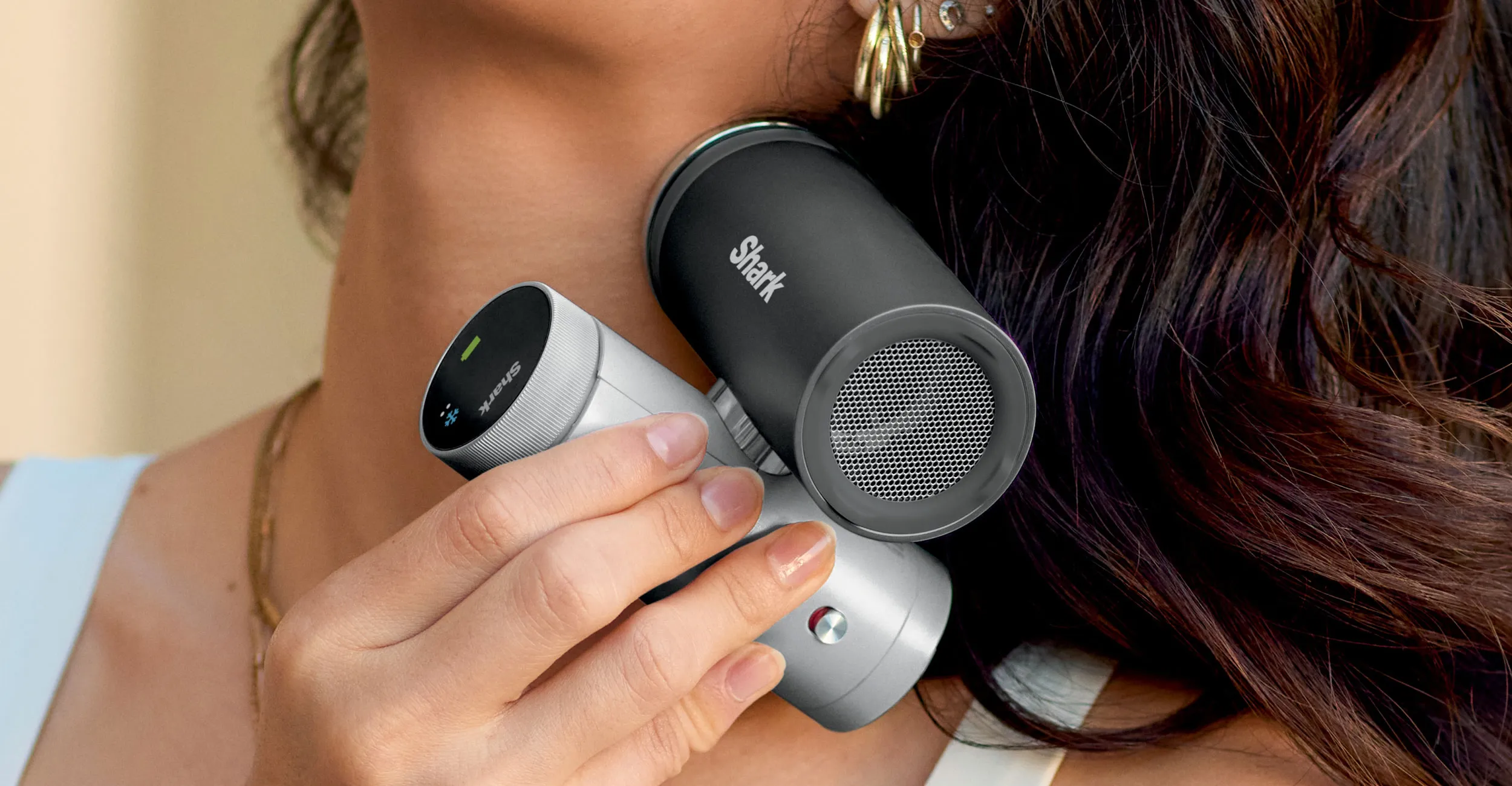
The commerce moved with the culture. Shark says its best week hit three units sold per minute. More than 280 UK posts went viral organically and generated 65 million impressions. TikTok Shop UK told Business Insider that ChillPill sales rose more than 1,200% from the April–May window to June–July. It was a day-one bestseller on Amazon UK's Prime Day. Search interest spiked in the UK, France, and Germany in step with the heat.
One detail from that coverage matters more than the growth rate. A London model-agency owner explained the appeal to Business Insider in terms that have nothing to do with cooling: the ChillPill is recognizable from across the street, and recognizable in a photo even when it's small in frame. Legibility at that distance is a property of logos, not appliances, and when an expensive object acquires it, a second market opens beside it. Everyone who owns one wants theirs to look like theirs.
Nobody is selling them that yet:
The money: 1,500 Starter Sets at $34, with a two-charm attach rate, is roughly $100K across one summer. Crocs' Jibbitz line does $271 million a year on the same logic.
Inside:
• The Charm Keeper spec and fit constraints
• Four SKU launch collection and price ladder
• Contribution margin math on a $44 order
• 30-day playbook with creator outreach script
Three conditions, and Shark just proved the hardest one
A portable fan accessories business is normally a hopeless idea. The typical handheld fan costs twelve dollars, looks like every other one, and nobody can identify your model from twenty feet away. Decorating it would be like monogramming a phone charger.
An accessory ecosystem needs three things, and the ChillPill is the first handheld fan to have all three. The base object has to be expensive enough that another $20 feels trivial against it. It has to be visible enough that decorating it buys you something socially. And owners have to already be attaching it to their bodies, so there's a physical place for decoration to live.
The bag charm trend did the cultural work already. Shoppers spent 2024 and 2025 hanging charms and plush off handbag handles, so nobody needs convincing that a carried object is a surface for decoration.
Shark proved that third condition with its own P&L. It sells a $9.99 wristlet, a $24.99 adjustable crossbody strap, a clip attachment for belts and backpack straps, and a protective sleeve-and-strap bundle. People are paying extra for carrying hardware on a device that already ships with a wristlet.
Every one of those products answers the same kind of question: how do I carry it, clip it, protect it, store it. Shark has covered the functional side thoroughly and left the aesthetic side alone. Nothing in the catalog helps you make yours look like yours.
The Jibbitz number nobody quotes correctly
In 2006, Crocs paid roughly $10 million up front, with an earn-out of up to $10 million more, for a company that made small plastic charms designed to snap into the holes of its clogs. By 2024 that charm line, Jibbitz, was generating about $271 million a year, over 8% of Crocs' total revenue. Even at the full $20 million, that is one of the better acquisitions in footwear. Roughly three-quarters of Crocs buyers now purchase charms, at $5 to $8 each.
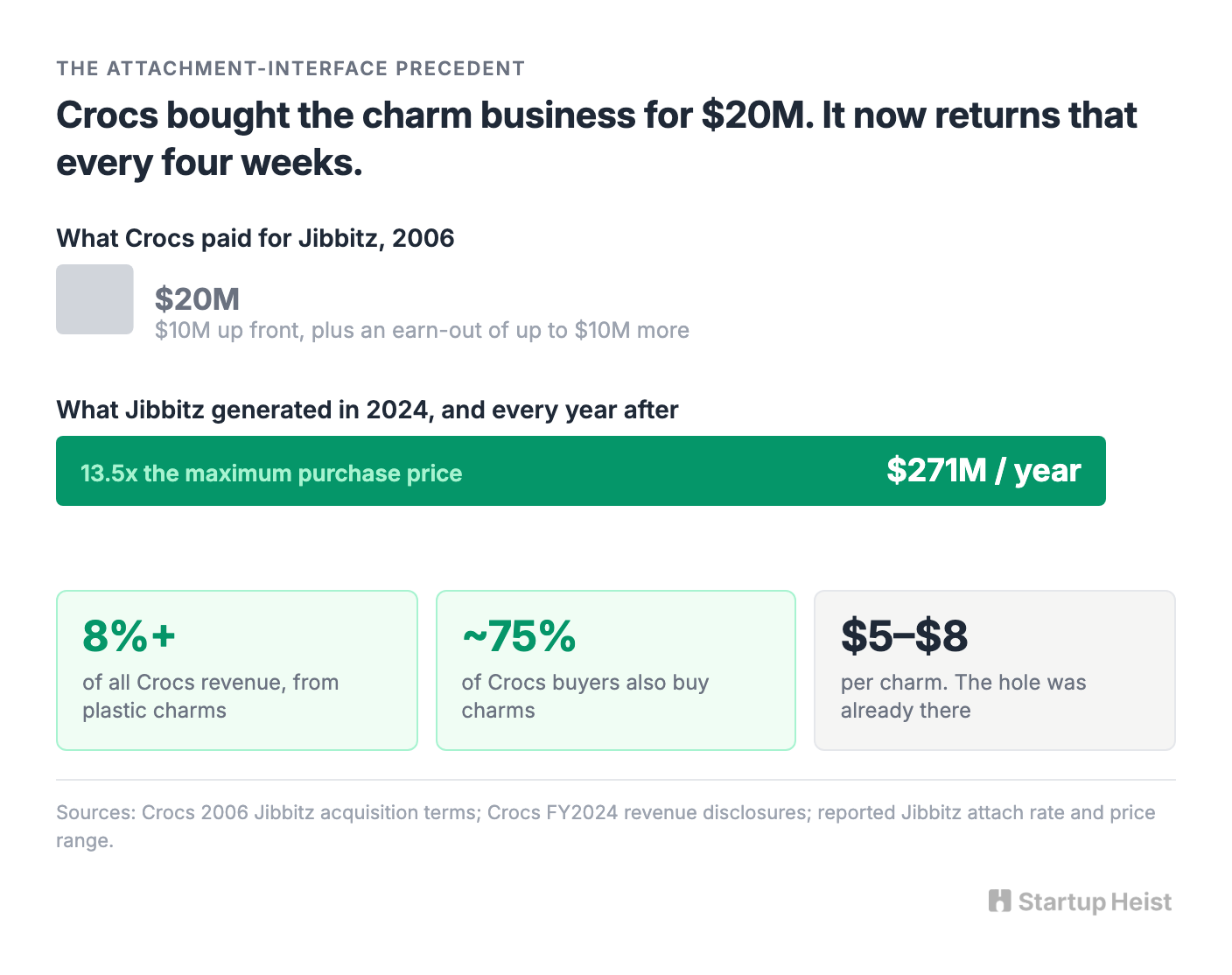
The Jibbitz business model usually gets read as proof that people like customizing things. The more useful reading is that Crocs owned the holes before it ever owned a charm business.
The hole is the platform. Whoever controls the attachment point collects the recurring revenue, because every future charm has to be compatible with it. Crocs got its holes for free, as a molding decision made years before anyone at the company thought about merchandising.
Nobody owns the hole in the ChillPill. Shark hasn't cut one, and no third-party seller has built one either.
The copycats already arrived, and they all made the same mistake
Search Amazon for Shark ChillPill accessories in August 2026 and you'll find a crowd of sellers who are not Shark. GENCAM, Baaletc, SZBAMI, and Bobobigo are all shipping ChillPill-specific crossbody straps, wrist lanyards, two-in-one bundles, and hard carrying cases. Over on MakerWorld, hobbyists are giving away printable ChillPill carry cases with PETG shells and TPU inserts.
The crowd is validation. Sellers with fast tooling and no patience don't build model-specific SKUs for products that aren't selling. Within about five months of launch, the ChillPill had generated enough attachment behavior to justify custom inventory from multiple independent operators, which is a harder demand signal than any press clipping.
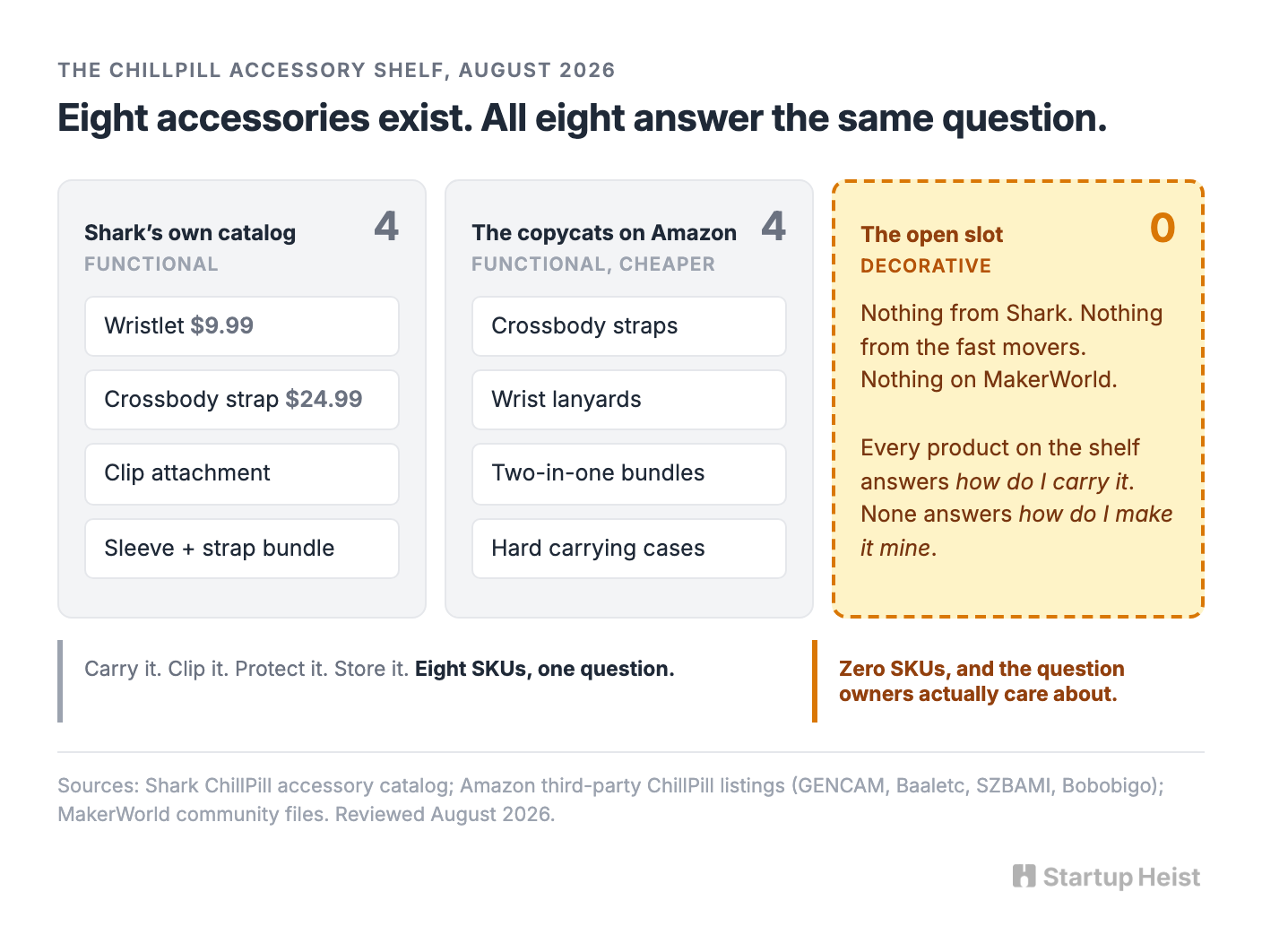
The same crowd is your clock. Everyone who moved fast cloned Shark's catalog: straps, lanyards, cases, the same four functional answers at a lower price with worse photography. Not one of them asked the aesthetic question. The people racing into this market have confirmed the gap in it without noticing the gap.
That gap won't stay open. Shark has already shown it understands the ChillPill as a fashion object; the SKYLRK collaboration was a colorway, which is to say a decorative product with no new engineering in it. A company that ships a Bieber colorway will eventually ship ChillPill charms.
There's no moat here, so stop looking for one. Someone can buy your product, measure it, and CAD a competing version in two weeks, and Shark owns the hardware files, the brand, the retail shelves, and the option to make official charms whenever it likes. What you get instead is five temporary advantages: speed, fit, taste, creator distribution, and the installed base of your own attachment. None of them last, but stacked together they might buy twelve productive months.
For a steal, twelve months is plenty.
Build the earring hole first
The obvious version of this business is to buy charms in bulk, hang them on chains, photograph them next to a ChillPill, and open an Etsy shop. That version dies in about six weeks, because anyone can do it by Tuesday.
Build the piece in between instead. Call it the Charm Keeper.
Unlock the Vault.
Join founders who spot opportunities ahead of the crowd. Actionable insights. Zero fluff.
“Intelligent, bold, minus the pretense.”
“Like discovering the cheat codes of the startup world.”
“SH is off-Broadway for founders — weird, sharp, and ahead of the curve.”


