


A creator with 70,000 Instagram followers does not need another $800 brand deal. She is sitting on something worth far more: a ten-person culinary trip through Sicily, a photography workshop in Iceland, a yoga retreat in Costa Rica, a running camp in Japan.
The math is where most people get it wrong. She does not need thousands of followers to buy anything. She needs a dozen loyal fans to spend a few thousand dollars each on an experience they already want: access, community, and a week built around a shared obsession. Twelve people at $3,000 is $36,000 of demand sitting inside an audience she already owns.

This is no longer theoretical. TrovaTrip, the most visible name in creator-led travel, says it has facilitated 2,300 trips for 33,000 travelers across 2,000 hosts. The model is clean. A creator promotes a trip to her audience, certified operators handle the logistics on the ground, and the host travels free and keeps a cut. The category is also pulling in real capital. In May 2026, Airbnb led a $58 million Series C in WeRoad, an Italian adventure-travel company built for millennial and Gen Z travelers, taking roughly a 10% stake and a board seat as WeRoad prepared to enter the United States, starting in Austin. WeRoad is not a pitch deck. It cleared €130 million in revenue in 2025, up 30% year over year, carrying more than 100,000 travelers. The category has money and proof.
Here's the opportunity:
The money: 40 creators at $249/mo plus operator plans and a small payments cut clears ~$200K ARR. WeRoad just raised $58M proving the category.
Inside:
• Full 90-day MVP across three surfaces
• Three-tier pricing plus concierge upsell
• The compliance boundary that becomes a moat
• Creator-first GTM with outreach templates
The obvious read is to build another travel operator. That read is wrong. The opening sits in front of the operator, in the creator-owned sales engine. Think Shopify or Gumroad for creator-hosted trips: branded trip pages, waitlists, audience surveys, deposits, payment plans, referral links, customer data, conversion analytics. The creator owns the storefront and the relationship with the traveler. Licensed operators handle fulfillment. The ugly operational machinery stays where it belongs, behind the scenes.

The easy version is a landing-page builder. The real business is a vertical commerce operating system for people selling high-ticket experiences to communities they already command. Build a white-label platform that helps creators launch, validate, and sell branded group trips, routing fulfillment to licensed operators while keeping the creator in control of the audience.
Why the window is open now
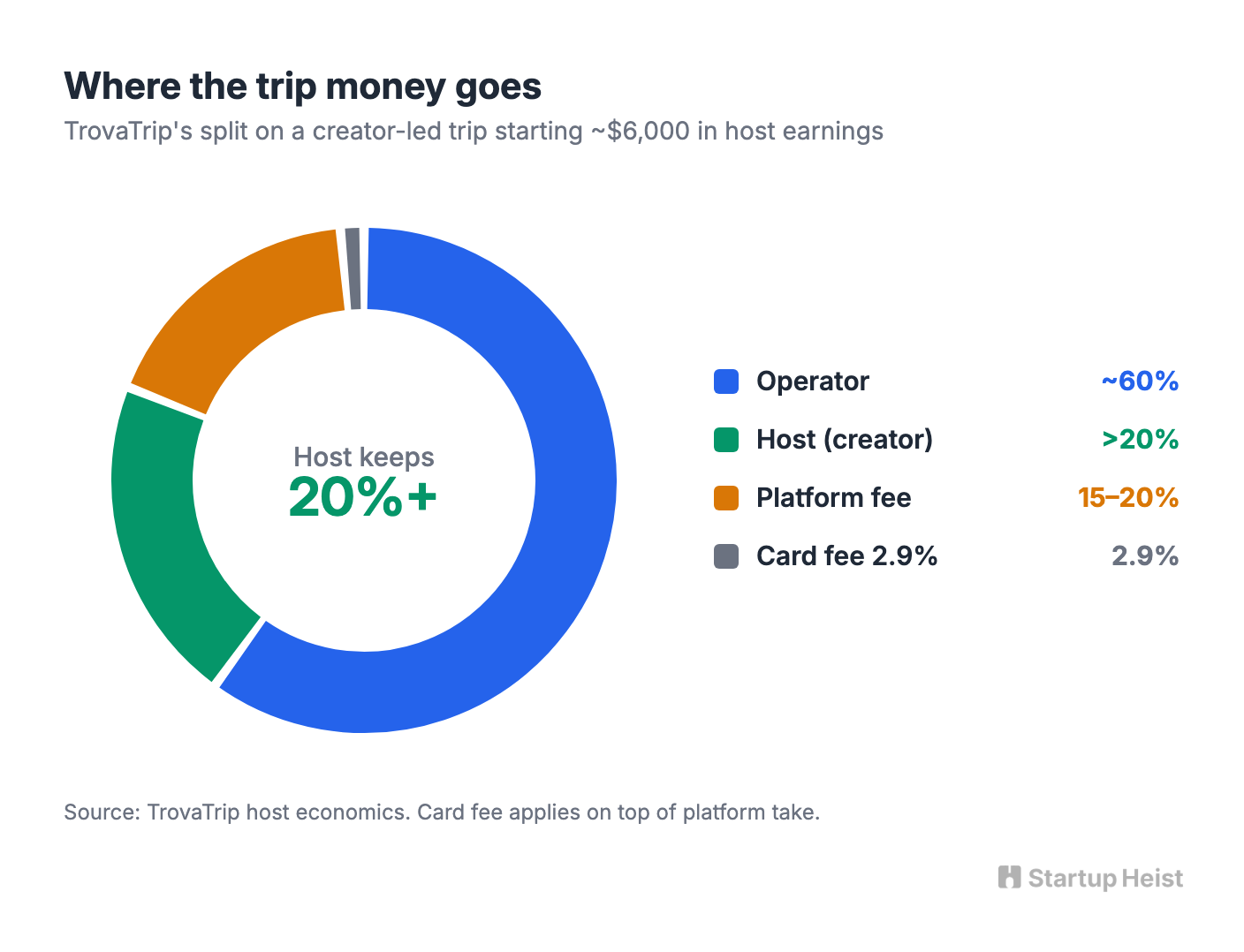
Creators are running out of road on advertising, affiliate links, and $19 digital products. A mid-sized creator has a deeply engaged audience but almost no leverage with platforms or brands. Group travel flips the equation, because the product is expensive, scarce, social, and nearly impossible to commoditize. TrovaTrip's own numbers show the upside: hosts earn over 20% of trip revenue, starting around $6,000 per trip. The operator takes roughly 60%, the host more than 20%, and TrovaTrip keeps 15% to 20% plus a 2.9% card fee. The money is real, and it recurs every time the creator runs the trip again.
The behavior is already trained. TrovaTrip is not educating the market from zero. It tells hosts to reserve domestic trips at least six months out and international trips eight months out, and to survey their audience on destination, budget, and readiness before launching. That long runway is the whole game. A creator can spend months collecting emails, testing price sensitivity, dangling early-bird spots, and converting a small audience into deposits. The storefront is not decoration. It is the engine.
Meanwhile, the rules around money are tightening in the platform's favor. The FTC's rule on unfair or deceptive fees took effect on May 12, 2025, forcing upfront total-price disclosure for live-event tickets and short-term lodging. A creator-trip platform is not automatically covered, but the direction is unmistakable: high-ticket checkout needs clean pricing and no nasty surprises. And the payment primitives already exist. Stripe Connect handles marketplace flows, destination charges that route funds to operators while the platform keeps a fee, plus recurring billing and installments. The rails are laid. The opportunity is packaging them into something that feels native to creator travel.
The gap hiding in a crowded market
At a glance, this looks taken. It isn't, and the two incumbents reveal exactly why.
TrovaTrip is a managed marketplace. It hands creators itineraries, surveys, payments, support, and vetted operators, and its power comes from controlling all of it. For a first-timer who wants simplicity, that's a gift. WeTravel comes at the problem from the opposite end: an operating system for multi-day travel businesses, with trip pages, payment plans, booking management, supplier payouts, and reporting, priced at $0 for Basic and $79 a month for Pro. One owns the marketplace and the brand. The other owns the back office. Neither lets the creator own the storefront.
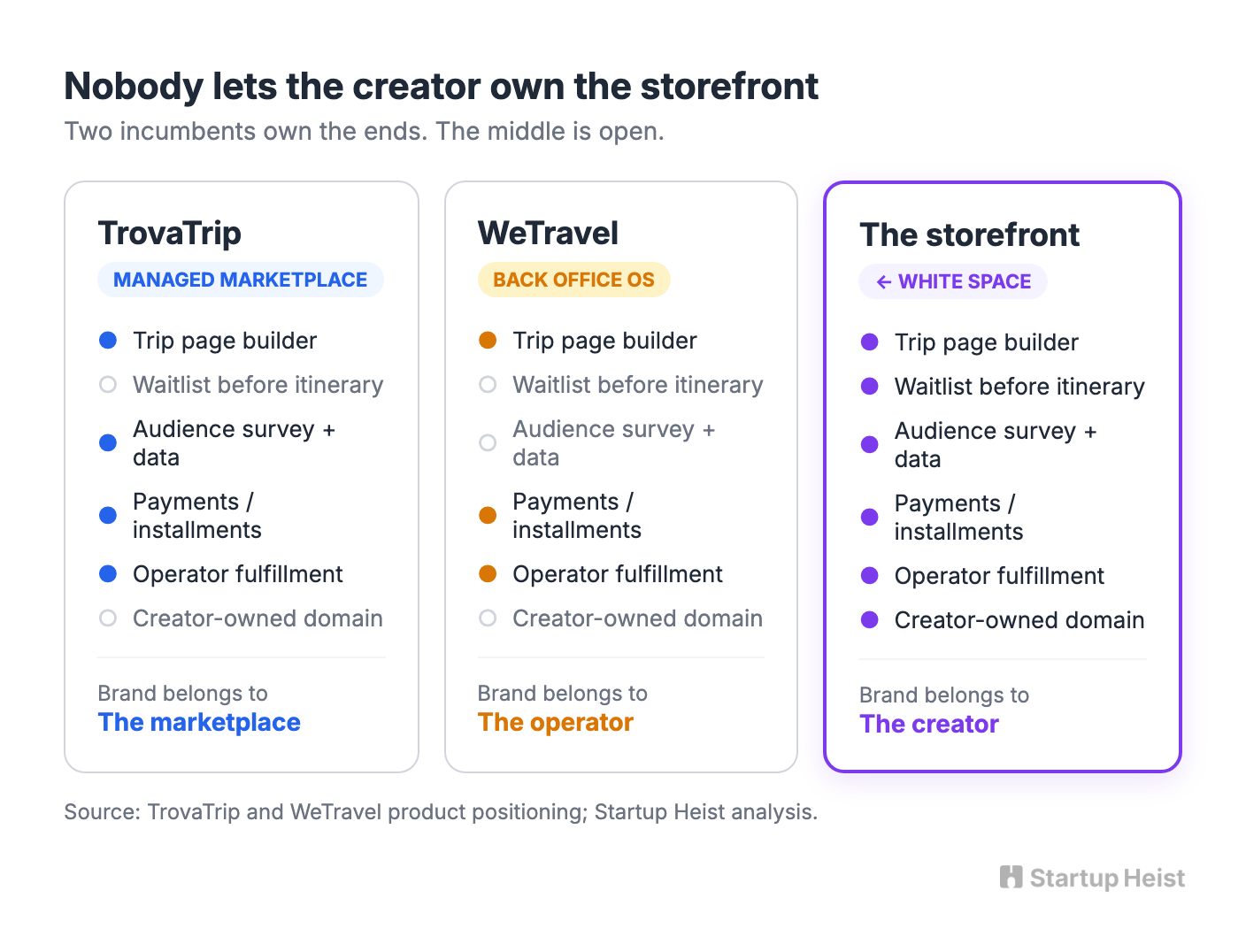
That is the white space. Some creators will outgrow the marketplace fast. They want a page on their own domain. They want the waitlist before they pick an itinerary. They want to remarket to people who clicked but didn't book, work with a boutique operator they already trust, and run the same retreat every year without rebuilding the audience from scratch. They want their brand to be the relationship, not a marketplace's. The product is a creator-native commerce layer with the polish of Shopify, the simplicity of Gumroad, and the travel-aware plumbing of WeTravel. It does not replace operators. It helps operators and creators sell together, and it bets that the brand belongs to the creator, not the platform.
The wedge: validate before you operate
Here is the discipline that separates a real business from a template shop. The first product should not start with a booking engine. It should start before the trip exists.
TrovaTrip's own host playbook explains why. Creators survey the community, analyze budgets, pick an itinerary, lock dates months out, and promote hard enough to book early. TrovaTrip even requires two bookings in the first two weeks after launch. So the earliest pain is not fulfillment. It is uncertainty. Will anyone actually pay? Which destination converts? Is the audience comfortable at $1,800 or $3,500? How many want a private room? Which followers get the early-bird offer? Which operator should run it if the demand is real?
That is where a small startup enters without pretending to be Expedia. The first product is a branded trip demand page: a hero section, sample dates, an estimated price band, destination options, a creator intro, an audience survey, an email and SMS waitlist, a refundable expression-of-interest deposit where it's legal and clean, referral tracking, and a dashboard slicing demand by destination, budget, room preference, and source. It looks more like a Kickstarter pre-launch than a travel agency, and it answers one question: is this trip worth building?
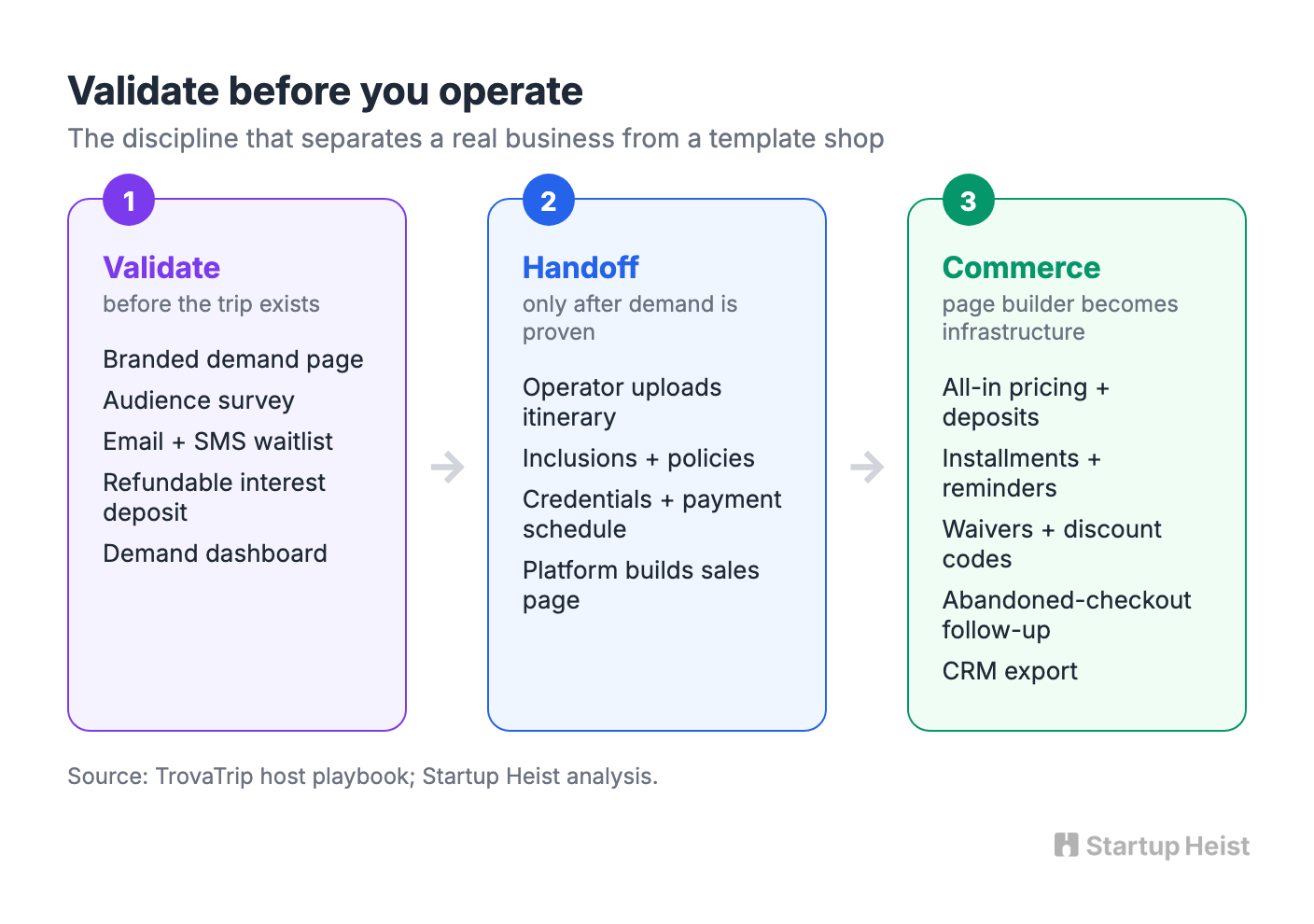
Only after demand is proven does the operator step in, uploading the itinerary, inclusions, accommodations, cancellation policy, credentials, and payment schedule, which the platform turns into a polished, creator-branded sales page. Then comes the commerce layer: all-in pricing, deposits, installment schedules, balance reminders, discount codes, waiver collection, abandoned-checkout follow-ups, CRM export. That is the moment the product stops being a page builder and becomes revenue infrastructure. The creator has already de-risked the launch before a single operator contract is signed.
The compliance trap
There is a reason a weekend template shop hasn't already eaten this. Travel is not a normal digital product.
The instant a startup holds deposits, packages travel services, issues refunds, or behaves like the merchant of record, the risk profile changes overnight. Cancellations, chargebacks, supplier failures, currency swings, weather, traveler disputes: any one of them can turn a clean SaaS product into a customer-support business. Stripe spells out one financial trap plainly: refund a successful payment, and the original processing fees are generally gone. State law adds another layer. California, for one, requires sellers of travel to register with the Attorney General and display the registration number in advertising.
The strategic rule is one line: do not become the travel operator by accident. The licensed operator stays responsible for fulfillment and, where appropriate, acts as the merchant of record. The startup provides software, branded conversion tools, workflow automation, and customer data. That boundary has to live in the contracts, the onboarding, the checkout disclosures, the support escalation, and the payout logic, and the company should get specialized travel-industry legal advice before processing a single real booking. Get the boundary right and it becomes a moat. Get it wrong and it becomes a liability that compounds with every trip.
The MVP: what to build in the first 90 days
A small team does not need a full travel operating system. It needs a sharp wedge that creates measurable value, and that splits cleanly into three surfaces.

Unlock the Vault.
Join founders who spot opportunities ahead of the crowd. Actionable insights. Zero fluff.
“Intelligent, bold, minus the pretense.”
“Like discovering the cheat codes of the startup world.”
“SH is off-Broadway for founders — weird, sharp, and ahead of the curve.”


