


Make Them Earn the Scroll
Don't build another screen-time blocker. Build one offline ritual a stranger understands in two seconds, that people want to complain about on camera, and that they keep doing because the trade is worth it.
The screen-time market doesn't need another dashboard telling people they spent four hours on Instagram yesterday. They know.
It doesn't need another timer either. Apple ships one. ScreenZen ships one. Opal, Jomo, and a dozen other app blockers will politely ask whether you really meant to open TikTok.
The opportunity sits one step further down the behavior chain. If you want the feed, earn it by doing something offline first. Pick up the book, put the shoes on, walk outside, start the guitar practice. Then the app hands you fifteen minutes of Instagram.

The version worth building is narrow: an iOS commitment app that pairs strict blocking with one camera-verified physical ritual, where you test whether that ritual is inherently marketable before you write the blocker underneath it. The sequencing is the whole idea, because this is a crowded market with almost no technical moat. Launch as another screen-time app and you're dead on arrival. Launch with a behavior people want to film, and you have something.
Here's the opportunity:
The money: 10,000 annual subscribers at $39.99 is roughly $27K MRR realized, in a category where Opal already sells the same shelf at $99.99 a year.
Inside:
• The 60-day validate-then-build playbook
• Pricing math after churn and Apple's cut
• Ten-item MVP scope and what to refuse
• Kill criteria before you spend a dollar
The Heist
Call the app Before.
You install it because Instagram is eating your evenings. Onboarding asks two questions. What do you want less of? Instagram. What do you want more of? Reading.
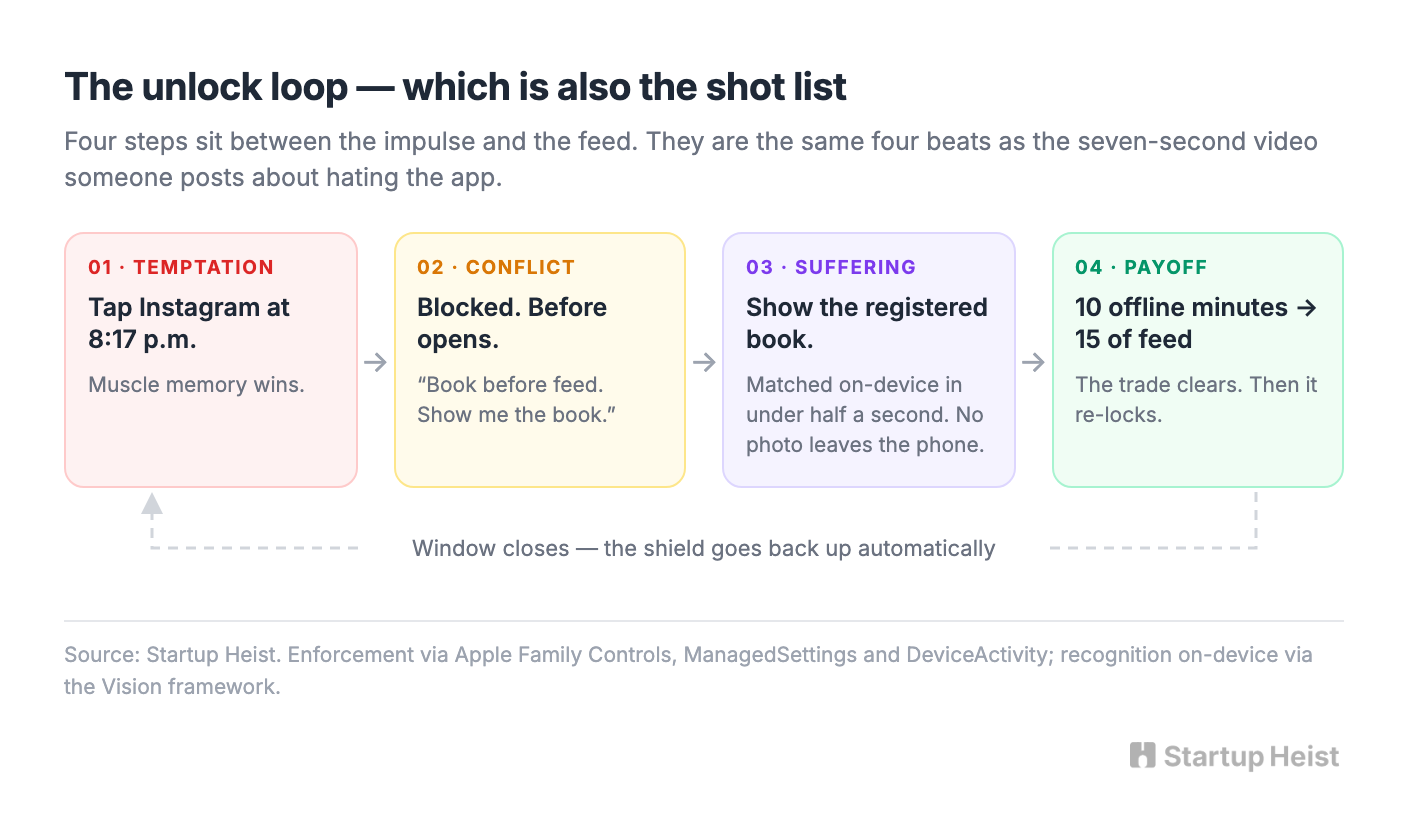
You pick your current book and photograph the cover. Then you sign the contract: from 7 p.m. to 10 p.m., Instagram stays blocked. Fifteen minutes of it costs you one trip across the room.
At 8:17 p.m., muscle memory wins. You tap Instagram. Blocked. Before opens instead.
Book before feed. Show me the book.
You point the camera at the paperback sitting on the shelf. The app recognizes it locally. You've left the couch, picked up the thing you said you wanted more of, and broken the automatic open-and-scroll loop. Start a ten-minute offline session, finish it, and Instagram opens for fifteen minutes.
The enforcement works. What matters more is that the whole thing is filmable. A creator can communicate this product in seven seconds:
"I downloaded an app that won't let me open Instagram until I show it the book I said I was going to read."
Camera turns toward the book. Instagram unlocks.
"I hate this thing."
That clip is the product demo, the testimonial, the joke, and the acquisition creative at once. The inconvenience is the ad.
The Category Already Prints Money
Consumers already pay for digital wellness at scale, so you don't have to invent a story about an emerging category.
Sensor Tower's State of Mobile 2026 put global in-app purchase revenue at $167 billion in 2025, up 10% year over year, with U.S. consumers alone spending close to $60 billion. People are on their phones 5.3 trillion hours a year, roughly 3.6 hours per user per day. Non-gaming spending passed games for the first time.
Screen-time control is a real niche inside that. Here's the landscape as of August 2026:
| Product | Positioning | Current signal |
|---|---|---|
| Opal | Premium focus and blocking suite | 4.7 stars, ~85K ratings; $19.99/mo or $99.99/yr |
| BePresent | Blocking plus gamification | 4.8 stars, ~56K ratings; free with IAP |
| Brick | NFC puck required to unblock | 4.9 stars, ~49K ratings; free app, $59 device |
| ScreenZen | Highly configurable friction | 4.9 stars, ~47K ratings; free, $5–$40 donations |
| one sec | Breath-based pause before opening | 4.8 stars, ~23K ratings; $19.99–$29.99/yr |
| Jomo | Blocking, schedules, budgets | 4.8 stars; $29.99/yr or $99.99 lifetime |
| Focus Friend | Cozy character focus timer | Google Play's 2025 App of the Year; 1M+ Android installs |
| Habit Doom | Habits unlock apps, camera-verified | 4.9 stars, 9 ratings; free core, $2.99/mo |
People clearly want help controlling their phones, and "block distracting apps" is already a commodity. You won't out-feature Opal, out-free ScreenZen, out-cute Hank Green's Focus Friend, or out-hardware Brick with a two-person team. So don't. Look at the last row instead.
Someone Already Shipped Your Feature
Habit Doom, a solo project by developer Richard Thattil, locks Instagram, TikTok, YouTube, and Snapchat until you complete real habits. As of June 2026 it ships a free feature called Anti-Cheat: check off a habit, the camera opens, an on-device model confirms the photo matches in under half a second, and the image never leaves the phone. Zero data collected. Its tagline is "Stop Doomscrolling. Start Earning It."
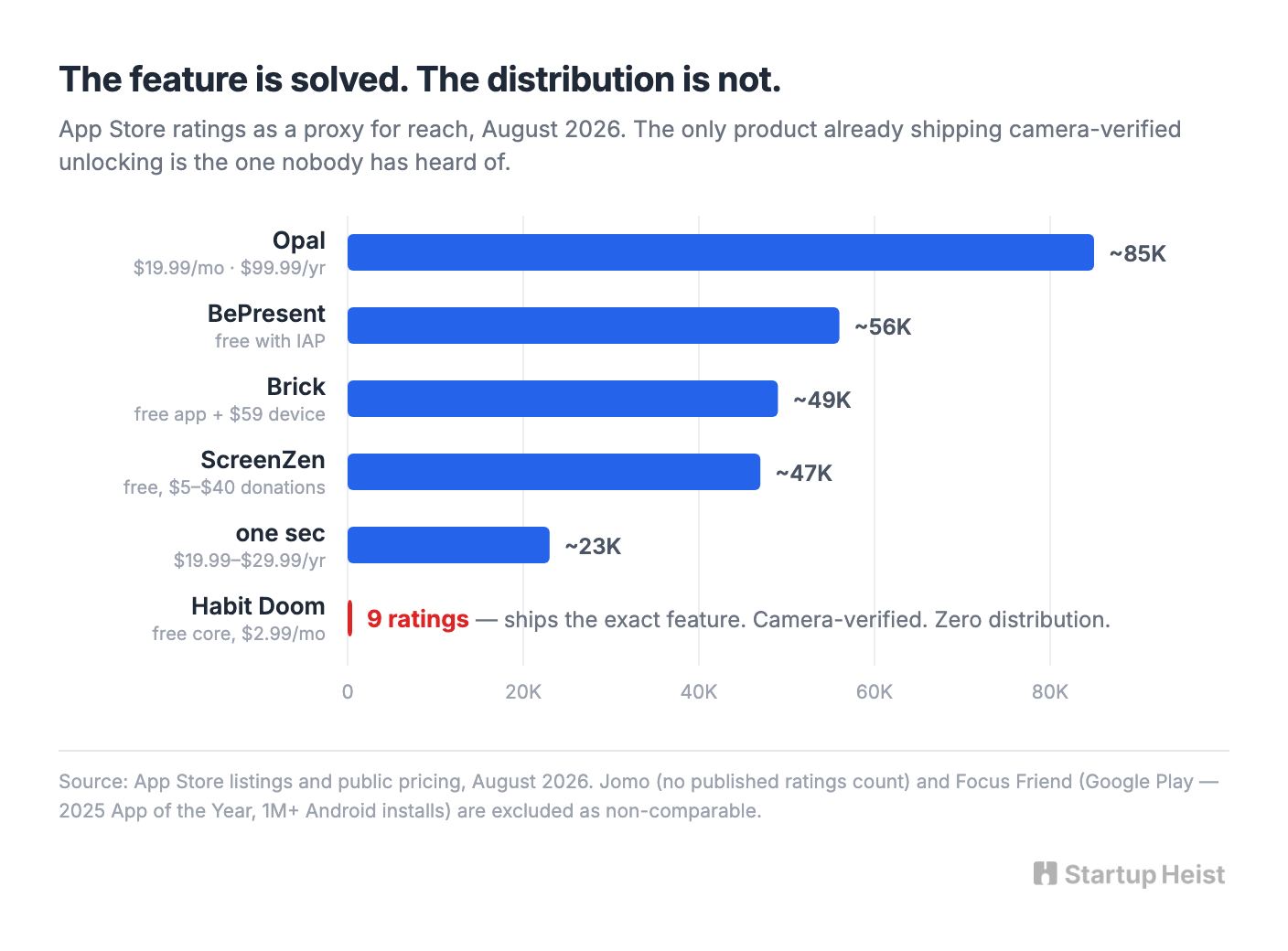
Feature for feature, that's the product described above. It has nine ratings.
That number is the most valuable fact in this write-up. The mechanic is buildable by one person, it works, it's live, and it has no distribution whatsoever. Forfeit tells the same story from another angle, running photo-verified commitment contracts with real money at stake since 2022, reporting a 94% success rate across 75,000-plus forfeits.
Camera-gated unlocking is a solved engineering problem. Whether one specific version of it becomes culturally legible is a completely different discipline from Swift, and that's the discipline this business runs on.
The Swap Beats the Speed Bump
Every product in the category answers the same question: how do we make Instagram harder to open. Delay it, time it, block it, require a breath, require an NFC tap, charge money for failure.
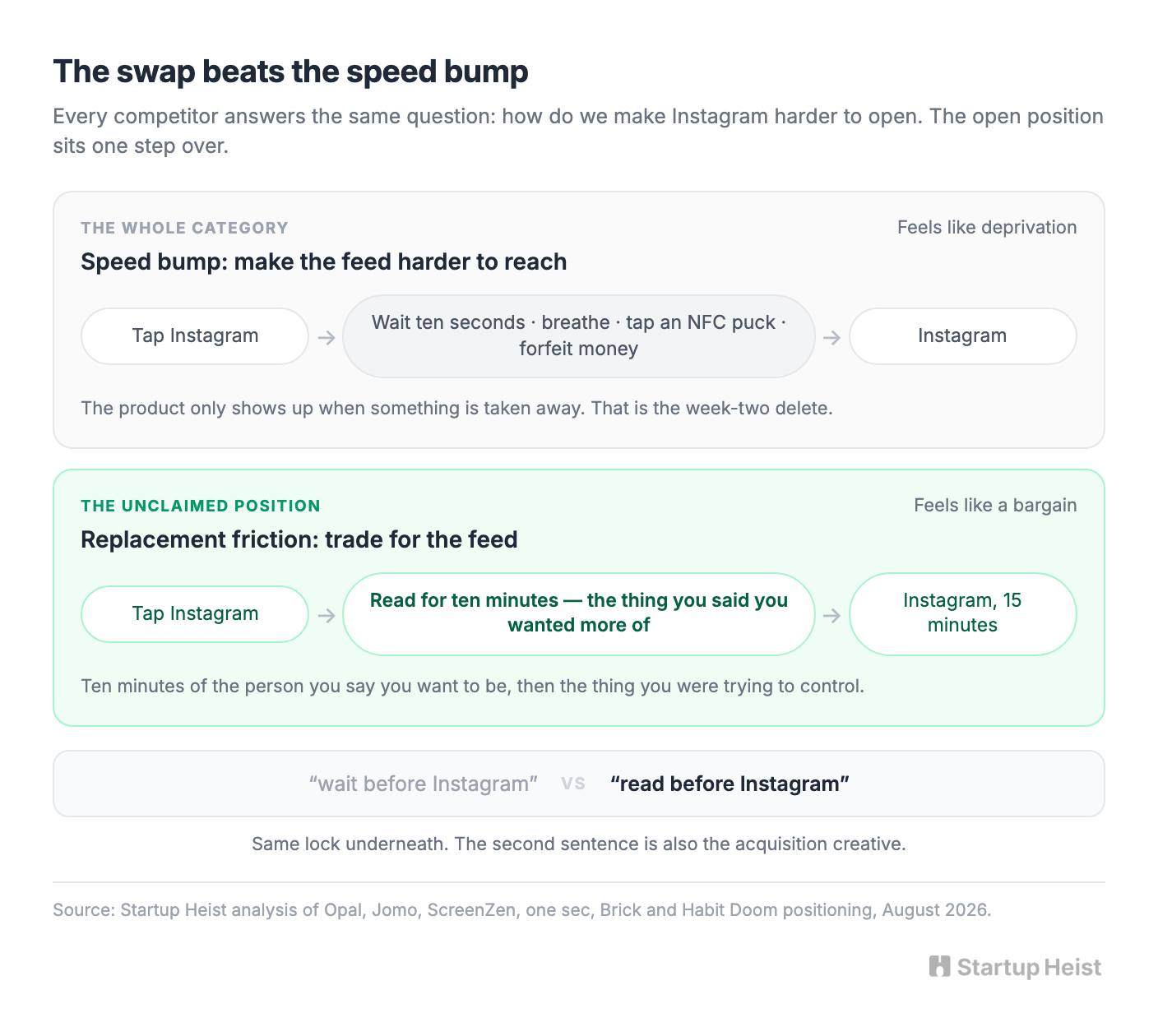
The unclaimed position sits one step over. Call it replacement friction. Instead of "wait ten seconds before Instagram," you sell "read before Instagram." Shoes before Reels. Piano before TikTok.
The distinction sounds like semantics until you look at what it does to the business model. A generic blocker is built on deprivation, and the user only feels the product when something they want disappears, which is why so many of these apps get deleted in week two. A replacement ritual offers a bargain: do ten minutes of the person you say you want to be, then enjoy the thing you were trying to control. You've converted a digital padlock into a behavior contract, and picked up an acquisition message far more concrete than "reduce your screen time."
Pick One Ritual, Then Make the Market Choose It
The temptation arrives immediately. Pushups before TikTok. Meditation before YouTube. Water before X. Homework before Snapchat. You could ship a marketplace of rituals.
Don't. A marketplace destroys the only thing that makes this interesting. The wedge has to be narrow enough that a stranger hears it once and repeats it accurately to someone else.
Unlock the Vault.
Join founders who spot opportunities ahead of the crowd. Actionable insights. Zero fluff.
“Intelligent, bold, minus the pretense.”
“Like discovering the cheat codes of the startup world.”
“SH is off-Broadway for founders — weird, sharp, and ahead of the curve.”


