


The creator economy crossed $200 billion in 2025 and is growing above 20% annually. LinkedIn ghostwriting is a real budget line item for founders and executives, with mid-tier agencies charging $1,500 to $3,500 per month and premium services pushing past $5,000. The market for outsourced authority-building is mature, priced, and growing.
One large class of high-value experts remains almost entirely un-served: professors, researchers, think-tank analysts, niche consultants, and subject-matter experts sitting on years of structured intellectual property that never gets translated into public authority. No major thought leadership agency positions specifically for academics or researchers. The niche is genuine white space.
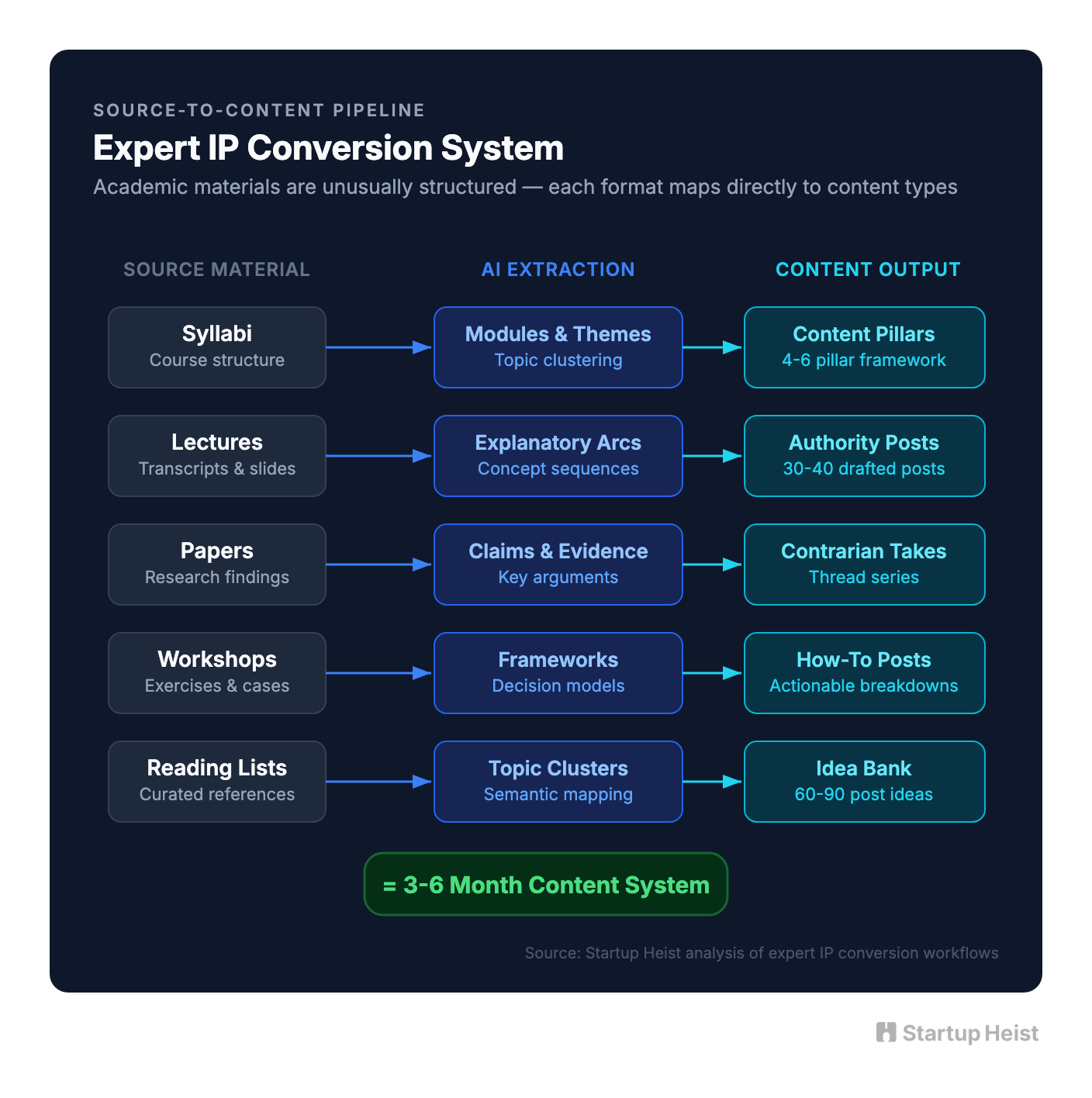
The play is a narrow, AI-powered content transformation service that turns existing expert material — syllabi, lecture decks, transcripts, papers, workshop notes, reading lists — into a 3–6 month LinkedIn/X content system. Sell it as a one-off personal brand setup for $1,500 to $2,000, then upsell a lighter monthly optimization retainer.
The money: Four $2,000 setups per month plus retainers builds a credible path to six-figure annual revenue as a solo operator.
Inside:
• Productized offer tiers and pricing
• Full source-to-content MVP pipeline
• Discipline-specific moat strategy
• Go-to-market with outreach templates
The Opportunity
Take an expert's existing body of work and convert it into a structured social publishing system: platform positioning, content pillars, recurring post series, 30–40 fully drafted posts, 60–90 post ideas, thread outlines, a profile rewrite, and optional newsletter and lead magnet angles.
Most academics and experts don't have a content problem. They have a format problem. They already possess frameworks, original research, and proof of work built up over years. The barrier is packaging. The bridge between deep expertise and the way social platforms reward clarity, compression, and cadence is worth real money — and almost nobody is selling it to this audience.
Why This Works Now
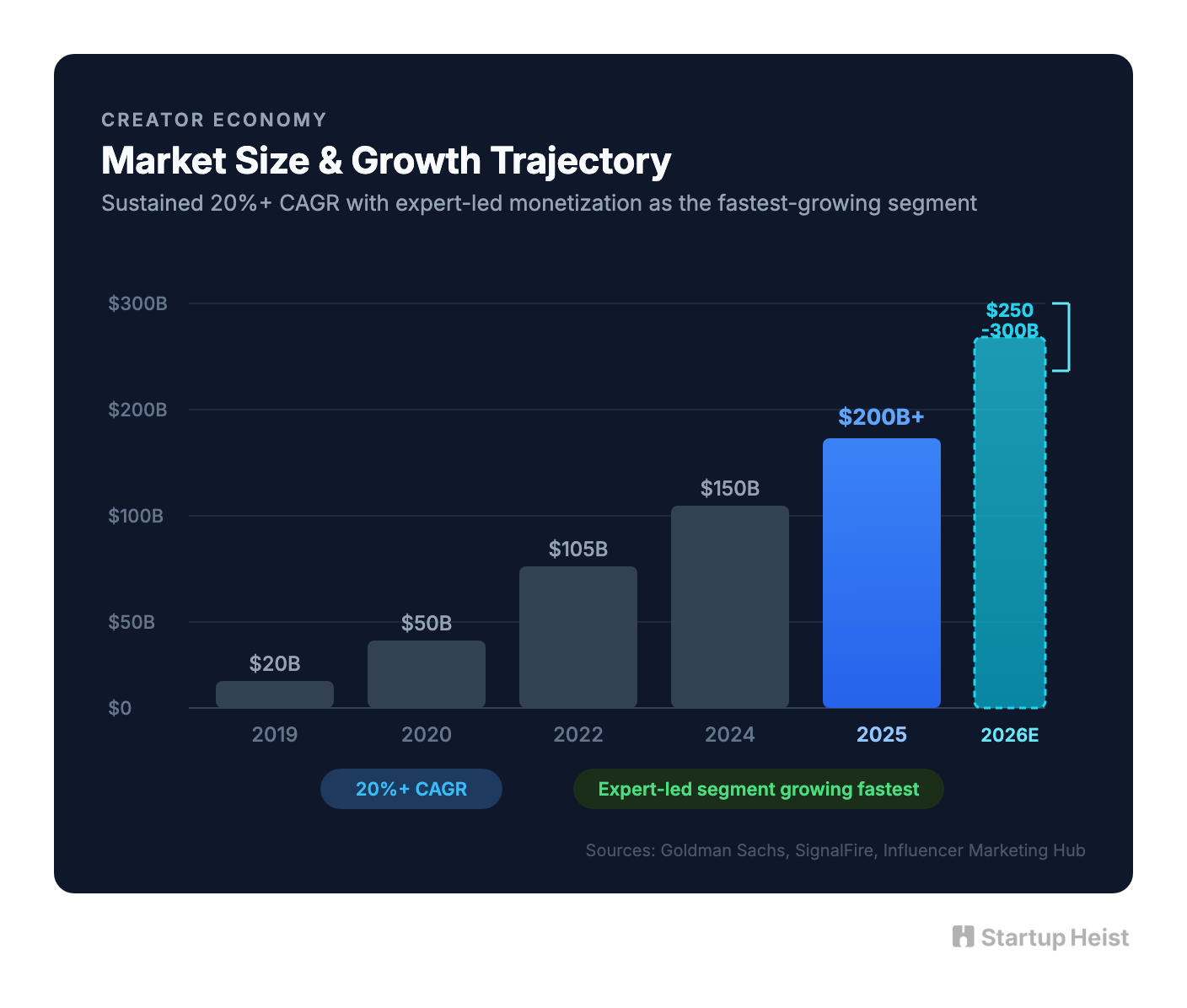
The creator economy has broadened well beyond lifestyle influencers into expert-led monetization, direct-to-audience education, consulting, and authority-based businesses. Market trackers peg it at $200–$300 billion in 2026 with consistent 20%+ annual growth. The number that matters is the trendline: sustained demand for professionalized content systems now includes domain experts, not just creators.

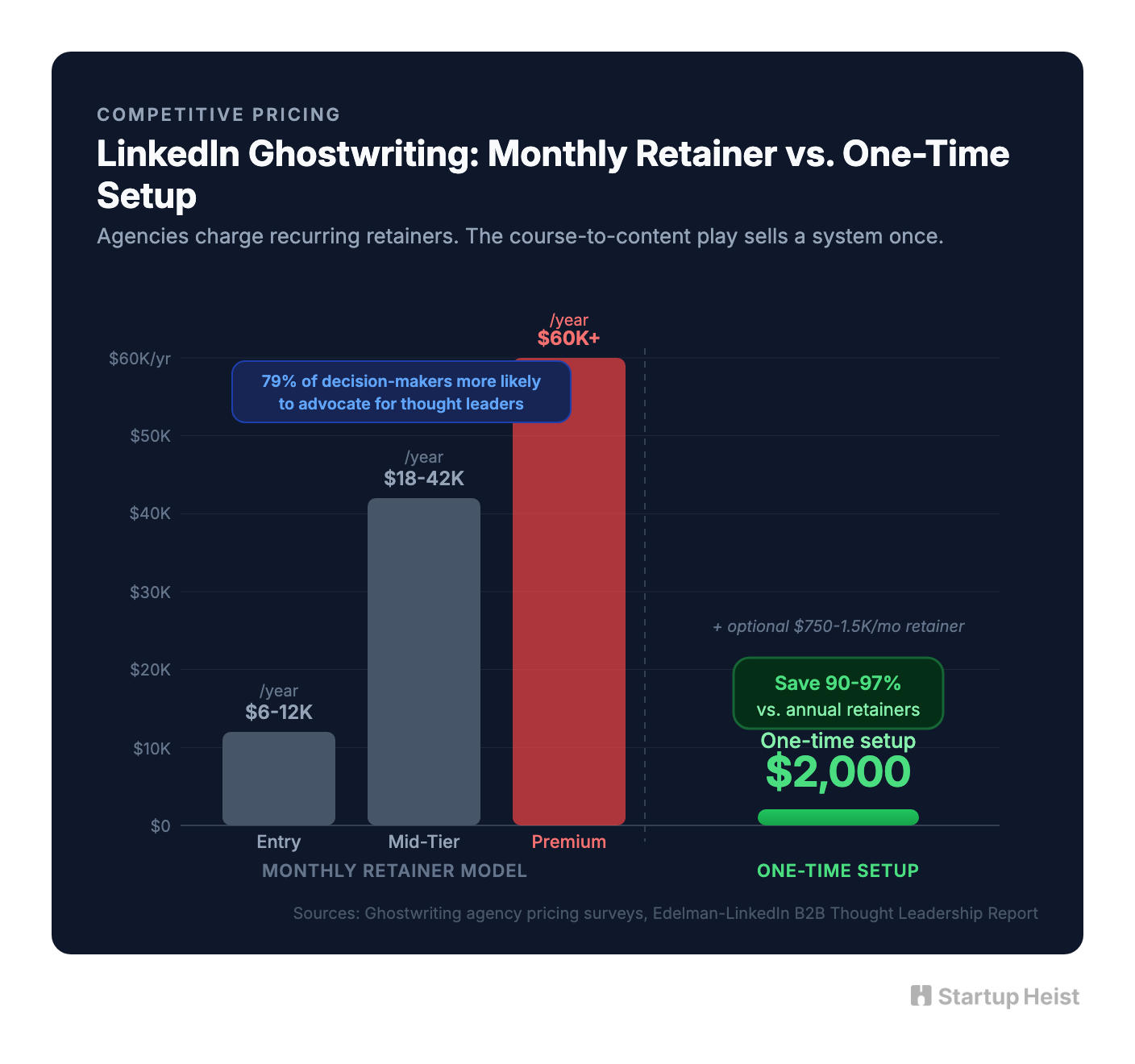
LinkedIn became a serious B2B distribution channel. Ghostwriting agencies frame it as a lead-generation and authority engine, and pricing has settled into clear tiers: entry-level at $500 to $1,000 per month, mid-tier at $1,500 to $3,500, premium above $5,000. That structure gives you room to sell a one-time $2,000 setup without looking cheap or unserious. The Edelman-LinkedIn B2B Thought Leadership Impact Report found that 79% of decision-makers are more likely to advocate for a vendor with consistent thought leadership. For experts trying to build consulting pipelines or speaking careers, that number is the business case.
Long-context LLMs made the workflow commercially viable. A human ghostwriter starting from interviews extracts frameworks from scratch. Your wedge is that the raw material already exists. A model can ingest a semester syllabus, six lecture transcripts, and five papers, then surface the themes, arguments, and recurring claims. The Gotham Ghostwriters study, released at the 2025 Gathering of the Ghosts conference, found that 68% of ghostwriters now use AI for research aggregation and first-draft generation — and that ghostwriters who use AI regularly earn $47,000 more per year on average. The human job becomes selection, editing, voice calibration, and packaging.
Where the Real Play Is
The obvious framing is "ghostwriting for professors." Too small if you stop there.
The stronger framing is AI-powered thought-leadership infrastructure for under-branded experts. Academics are the wedge because their input material is unusually structured. Syllabi break ideas into modules. Lectures explain concepts in sequence. Papers contain claims with evidence. Reading lists imply topic clusters. That structure makes them easier to convert into content systems than founders, who often have opinions but no organized corpus.
The broader market includes business school professors, executive education instructors, think-tank researchers, policy analysts, healthcare professionals, independent researchers, B2B consultants with training decks, and authors with course-like IP. Academia is the first beachhead because asset density is highest there.
Who Actually Buys
Your best early buyers are commercially adjacent experts — people who already monetize through consulting, speaking, executive education, or media and need a consistent public voice.
Business school faculty and executive education instructors can justify a $2,000 content system if it drives one inbound speaking invitation. Academics and researchers command speaking fees from $2,500 to $20,000 or more depending on institutional prestige, and top-tier professors at schools like MIT or Harvard command well above that range. Independent scholars and public intellectuals have more freedom and personal upside. Research-backed consultants already sell outcomes but lack public distribution. Think-tank and policy experts need visibility with donors, journalists, and decision-makers.
The generalist ghostwriting shops are not built for this market. They work from interviews, not from 120-slide lecture decks and 30-page policy briefs. The gap between what these experts need and what existing agencies offer is wide open.
The Offer
Don't start with a retainer. Start with a fixed-scope productized offer.
3 plays. Start with Offer 1 and use it as a retention vehicle:

Unlock the Vault.
Join founders who spot opportunities ahead of the crowd. Actionable insights. Zero fluff.
“Intelligent, bold, minus the pretense.”
“Like discovering the cheat codes of the startup world.”
“SH is off-Broadway for founders — weird, sharp, and ahead of the curve.”


