


Sell the Map, Not the Ghost Town
A $1.4 million lesson in what not to buy
In 2018, Brent Underwood and a group of investors bought Cerro Gordo, a silver-mining ghost town in California's Inyo Mountains, for $1.4 million. The deal came with more than 330 acres and 22 structures. Underwood has said the purchase took every dollar he had, plus a loan and money from friends.
What followed became one of the great content businesses of the decade. He moved to the mountain full time in March 2020, built a YouTube channel now approaching 2 million subscribers, wrote a book, and turned restoration into serialized drama.
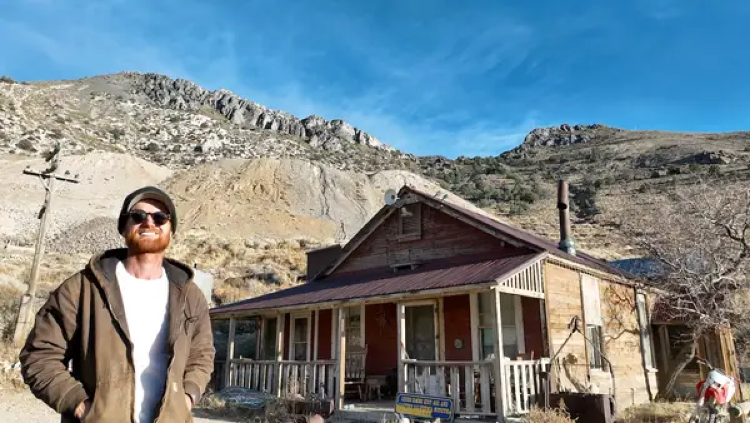
It was also an education in how these deals actually go. In June 2020, an electrical fire burned the town's 1871 American Hotel to the ground along with two other buildings. Rebuilding required a new foundation, a fire-suppression system, and a water tank big enough to feed it, on a mountain road that fights every delivery truck. The structure was finally completed in 2025, five years after the fire.
Cerro Gordo gets told as a romance. The more useful reading is quieter. Finding the property was never the hard part. Knowing what owning it would actually require was the hard part, and nobody sold him that answer in advance.
Don't buy the ghost town. Sell the intelligence to everyone still looking for one.
Here's the shape of it:
The money: 500 subscribers at $29 a month plus ten $1,000 research mandates is roughly $24,500 MRR. Cheap Old Houses proved the audience at $12.
Inside:
• The full Deal Card diligence template
• Why Pennsylvania beats Ohio as territory one
• Three tiers: free, $29, $1,500 mandates
• The 30-day build and the 100-buyer email
A proven audience with nothing to buy
People love looking at strange buildings, and the audience is bigger than the niche suggests. CIRCA Old Houses, a curated marketplace for historic homes, advertises roughly 2 million page views a month and sells a homepage banner against that traffic for $195. Its sibling brand, Cheap Old Houses, turned the same impulse into a media company: a free list with more than 192,000 subscribers, four premium weekly newsletters at $6 each or $12 a month for the bundle, a few hundred thousand Instagram followers, books, and a television show. Above them sits LoopNet, the CoStar-owned commercial marketplace, with about 13 million monthly visitors and more than a million property-detail views every day.
The territory is already carved up. LoopNet owns volume, Cheap Old Houses owns price, CIRCA owns taste, and building another listing site means walking into a fight with a company that owns the category. None of them answer the question a buyer with real money actually asks: can I buy this thing, and can I legally do anything with it? That answer is tedious to produce and currently for sale nowhere.
The supply is surging while the context stays scattered
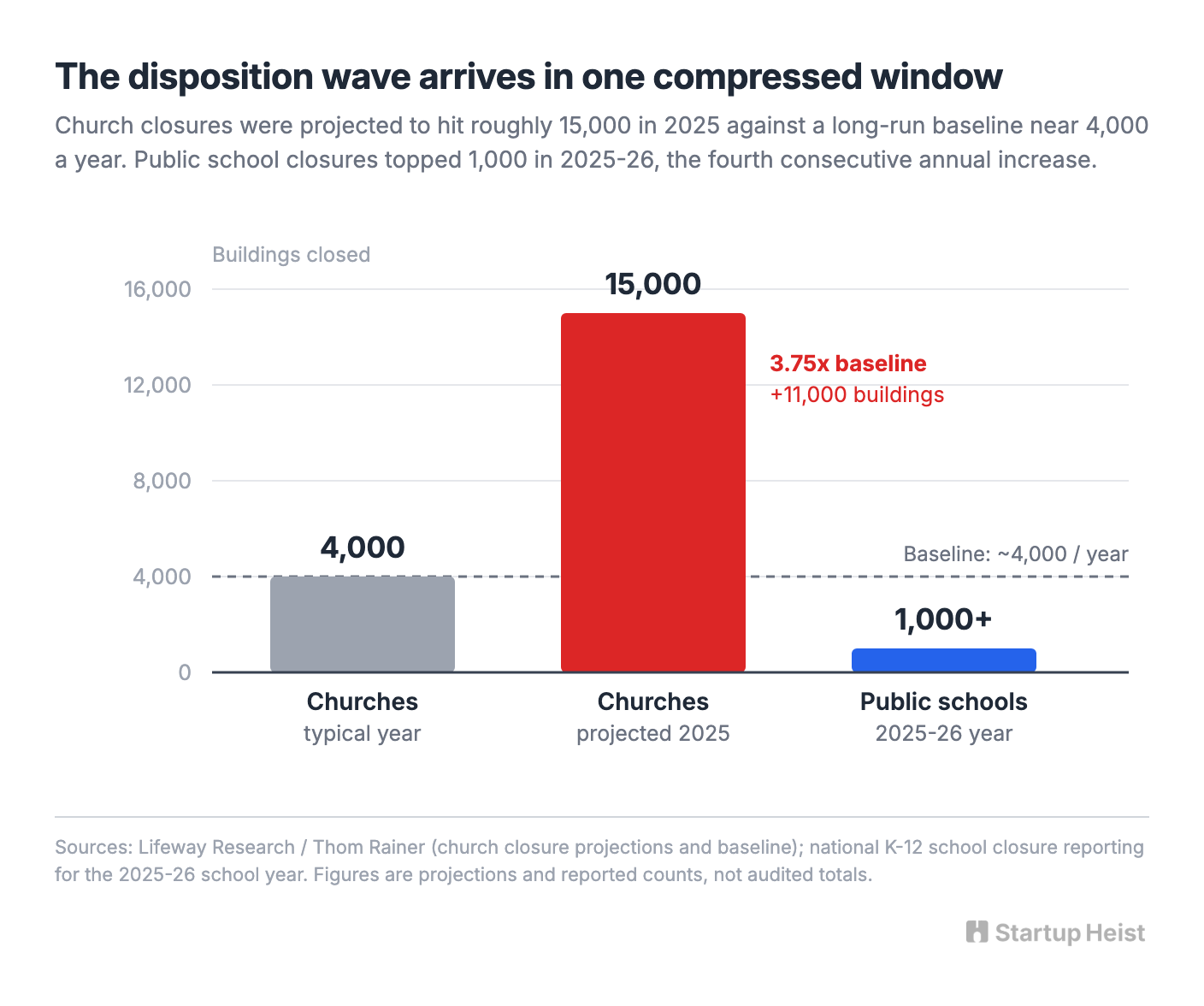
The timing is what makes this worth doing now. American institutions are shedding buildings at a pace that has no modern precedent. Roughly 15,000 churches were projected to close in 2025, against a long-run baseline of about 4,000 a year. Thom Rainer and Lifeway Research call that spike a post-COVID anomaly rather than a new normal, which is exactly the point: the buildings hit the market in a compressed window instead of a steady trickle. More than 1,000 public schools closed during the 2025-26 school year, the fourth consecutive annual increase, driven by falling birth rates and the end of pandemic aid. Districts in Houston, Philadelphia, Pittsburgh, Miami-Dade, and Broward County have all queued up closures. Every one of those buildings eventually becomes somebody's disposition problem, and eventually somebody's adaptive reuse project.
Underneath that sits the permanent machinery. More than 300 land banks operate nationally. Bid4Assets, which pioneered online county tax sales in 2000, has now sold over 150,000 properties for more than $2 billion in proceeds and crossed a million registered bidders in March 2026. GovDeals runs hundreds of real-estate parcels alongside tax-deed and liquidation lots. The federal government doesn't even have a single storefront; USA.gov routes buyers separately to GSA Auctions, Treasury, HUD, USDA, and FDIC.
Add county tax claim bureaus, sheriff sales, municipal surplus, state disposal offices, probate, legal notices in county newspapers, preservation trusts, and the small-town brokers who never post anything to a national platform.
Each of those systems works exactly as intended. Stitched together, they don't add up to a market.
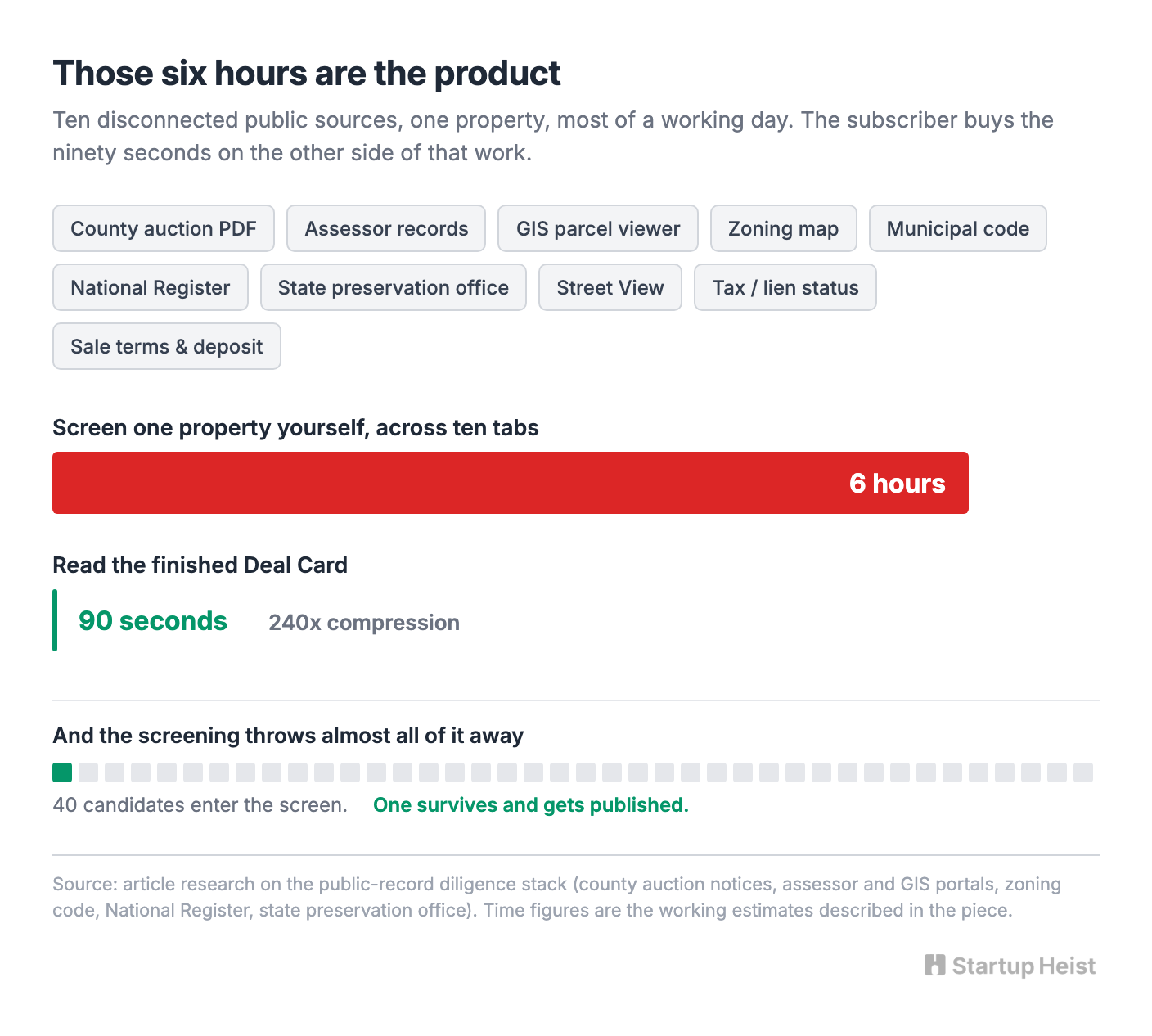
A county PDF gives you an auction date and a parcel number. The assessor gives you an owner. GIS gives you acreage. The zoning map gives you a designation, and the municipal code explains what that designation actually permits. The National Register tells you whether the building is historic, and the state preservation office may know whether that unlocks money or handcuffs. Google Street View tells you whether the "road" is a road.
Ten sources, ten tabs, six hours, and at the end of it you have one property screened out of forty. Those six hours are the product.
What the compression looks like
Start with the artifact. One property, one email, subject line first.
Former 1920s school, western Pennsylvania, $425K opening bid.
Underneath it: parcel number, auction date, deposit requirement, acquisition type, zoning classification, current permitted uses, whether lodging appears permissible, historic-register status, known utilities, road access, flood zone, prior sale price, tax status, the immediate title questions, available preservation incentives, and the five phone calls to make before bidding.
Then two lines a listing site will never give you.
Why we like it: 18,000 square feet, existing commercial access, twenty minutes off a tourism corridor, exceptional facade.
Why it might be a disaster: sewer capacity unconfirmed, probable asbestos in floor tile and pipe insulation, and current zoning does not allow transient lodging.
Nobody skims that for pleasure. It saves a serious buyer most of a working day on a property they'd otherwise never have seen.
Why Pennsylvania is the right first territory
The case for starting regionally comes down to an accident of state law.
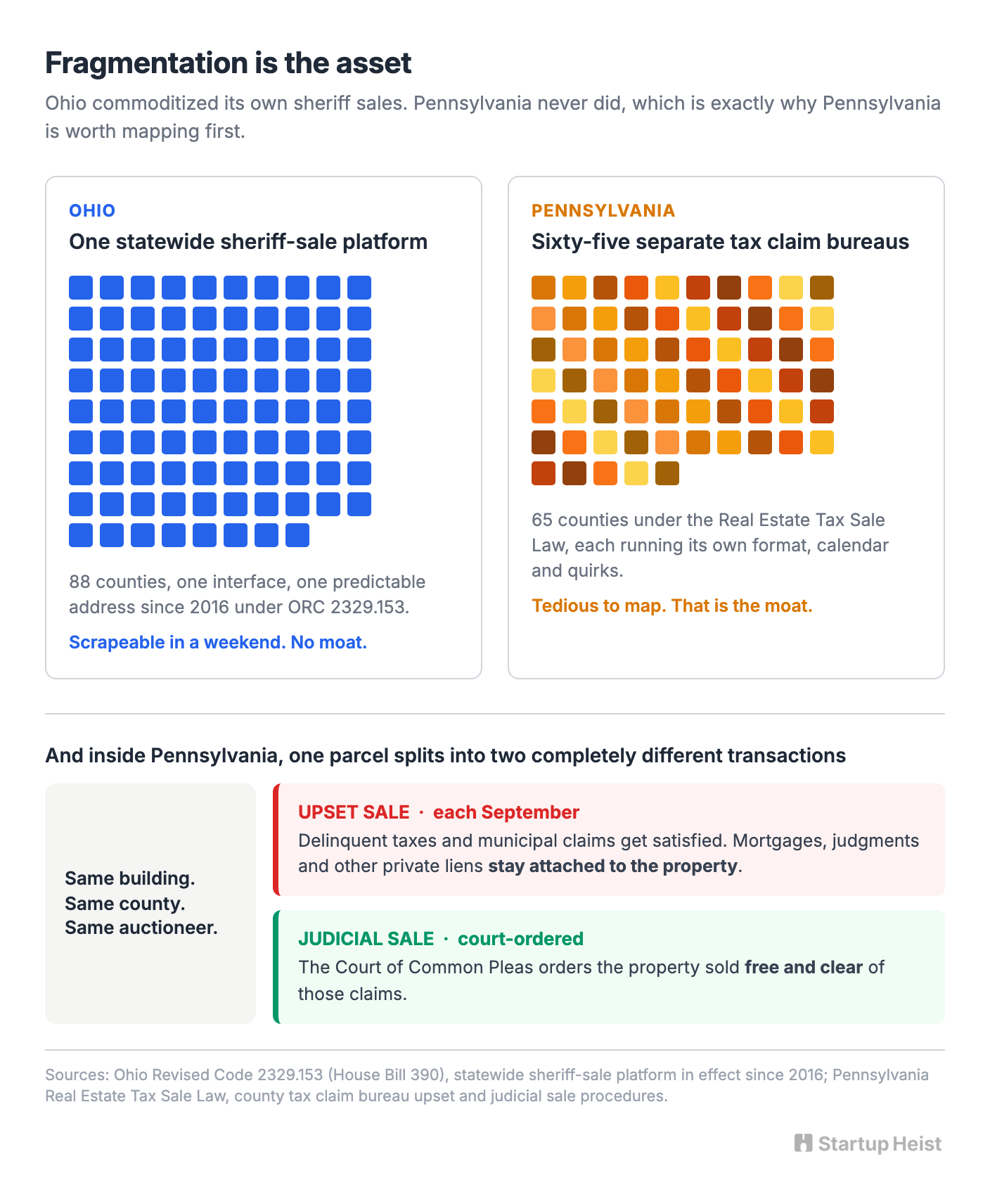
Ohio solved its own fragmentation. Under Ohio Revised Code 2329.153, passed as House Bill 390, sheriff sales moved to a standardized statewide platform operated under state contract, with every county running the same interface at a predictable address. Clean, searchable, and commoditized since 2016. Any competitor can scrape Ohio in a weekend.
Unlock the Vault.
Join founders who spot opportunities ahead of the crowd. Actionable insights. Zero fluff.
“Intelligent, bold, minus the pretense.”
“Like discovering the cheat codes of the startup world.”
“SH is off-Broadway for founders — weird, sharp, and ahead of the curve.”


