


The September Data Drop
Before the end of September, every large retail broker in the United States has to publish a file that has never existed before. Nobody has seen the numbers in it yet, including the brokers.
On August 1, 2026, an amendment to SEC Rule 605 took effect. For the first time, large customer-facing broker-dealers, not just exchanges and wholesale market makers, have to publish standardized statistics on the quality of the executions they get for their customers' stock orders. Reports are due within one month of the month they cover, so the first files under the new regime cover August trading and land before the end of September.

Everything about that dataset exists except the data. The file specification is published. The field list is published. FINRA has been handing out reporter identification codes since June 17, 2026, and the metrics are defined down to the millisecond. What nobody has is a single month of actual numbers.
That gap is the whole opportunity, and it has a few weeks left. Here's the business hiding inside it:
The money: Twenty publishers at $1,000 a month plus 25 broker accounts at $2,000 is $840K ARR on 45 customers.
Inside:
• Six-week build plan for the 55-field parser
• The reporter graph that becomes the moat
• Three-tier pricing from $199 to $3,000
• Outreach email plus the September launch play
Skip the stock screener, and skip the AI-powered "best broker" score. The business is the boring layer underneath both: a B2B normalization API, a monitoring service, and an embeddable execution-quality scorecard for broker-review publishers, research firms, and smaller broker-dealers who want segment-specific comparisons without building a market-structure data team.
On Rule 605 alone, this probably isn't a venture-scale company. It's a credible path to a $1M–$5M ARR vertical data business with unusual defensibility. The whole advantage is timing: nobody has ten years of amended-regime data, because nobody has ten minutes of it.
What actually changed
Rule 605 has existed since 2000. What changed on August 1 is who reports and what they report.
The amended rule captures broker-dealers that introduce or carry at least 100,000 customer accounts. Roughly 85 firms clear that bar, according to the SEC's own economic analysis, and those 85 collectively handle more than 98% of broker-dealer customer accounts and about three out of every five customer orders. Where the old regime described what happened at the execution venue, the new one covers what happens once a customer hands an order to Fidelity or Schwab or Robinhood.
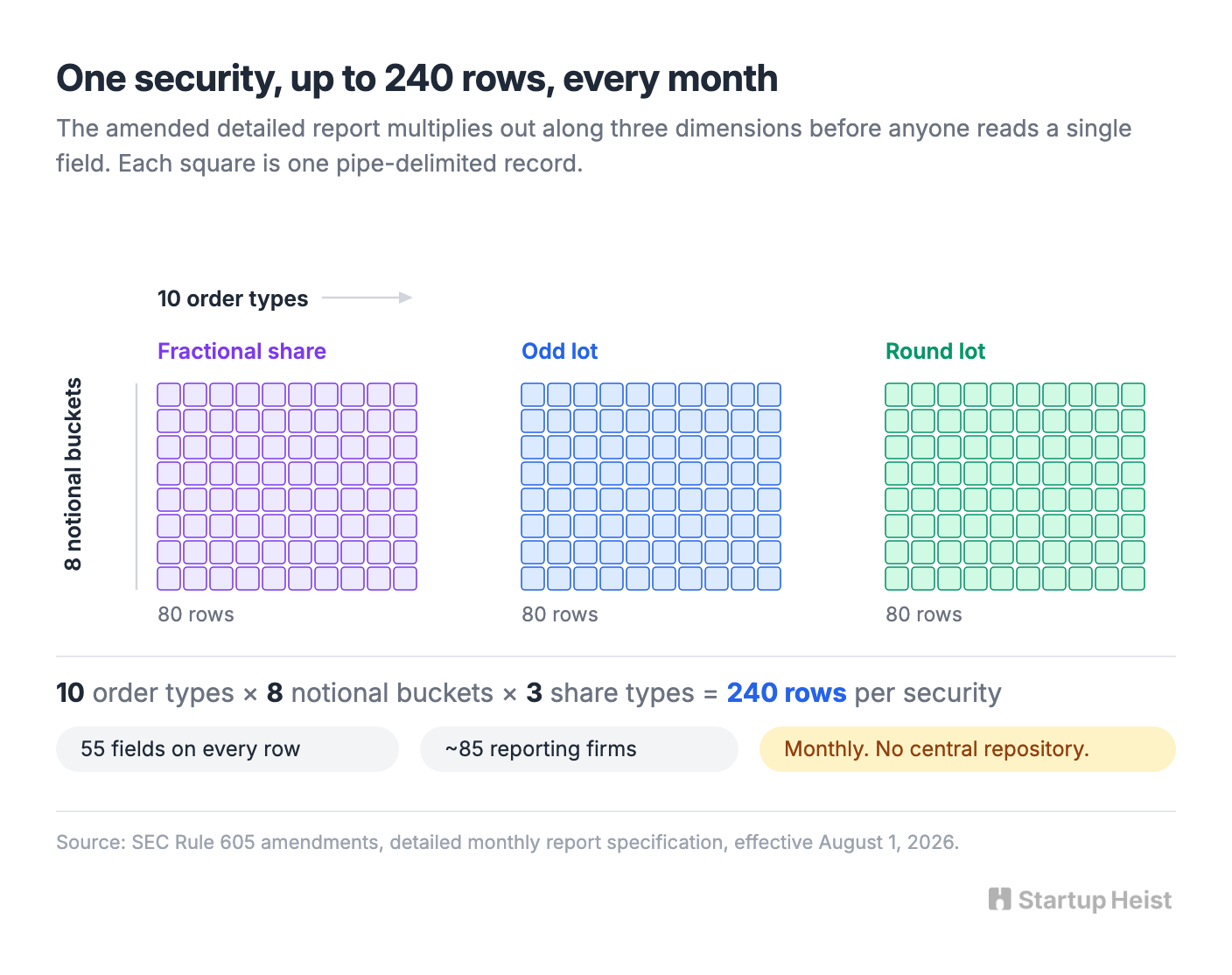
The format got far more usable at the same time. Detailed monthly reports ship as pipe-delimited ASCII files with 55 defined fields, one record for every combination of security, order type, and order size. Ten order-type categories now cover things the old rule ignored, including marketable immediate-or-cancel and midpoint-or-better limits. Order sizes moved from share counts to notional value, in eight buckets from under $250 to $200,000 and up, each flagged as fractional share, odd lot, or round lot. Up to 240 rows per security per reporter, every month, from every large broker in the country.
Reporters also publish a human-readable summary in comma-delimited format with a PDF renderer the SEC specifies, free and online for three years.
More important than any individual metric: there is no central repository. The SEC doesn't host these files. FINRA maintains a page listing reporter identification codes and hyperlinks for firms that designate it, but the actual reports live on each firm's own website, in each firm's own directory structure, on each firm's own schedule. A hundred-plus reporters means a hundred-plus URLs to discover, watch, and re-check for corrections.
The SEC openly expects somebody else to make this legible. Commissioner Caroline Crenshaw said on adoption that the summary report should help independent analysts, consultants, broker-dealers, and the financial press produce more digestible information from the disclosures. A regulator published a customer-discovery list.
Why the obvious version of this fails
The tempting build is a leaderboard: scrape everyone's reports, run a weighted score, publish "Best Execution Brokers of 2026," collect the SEO traffic. It's also the fastest way to publish something indefensible.
Rule 605 data is aggregate data, and the aggregates aren't interchangeable. Different brokers serve different customers trading different securities in different sizes. A firm whose customers trade mega-cap ETFs in round lots looks nothing like a firm whose customers trade fractional shares of volatile small caps, and neither result says much about which one treats orders better.
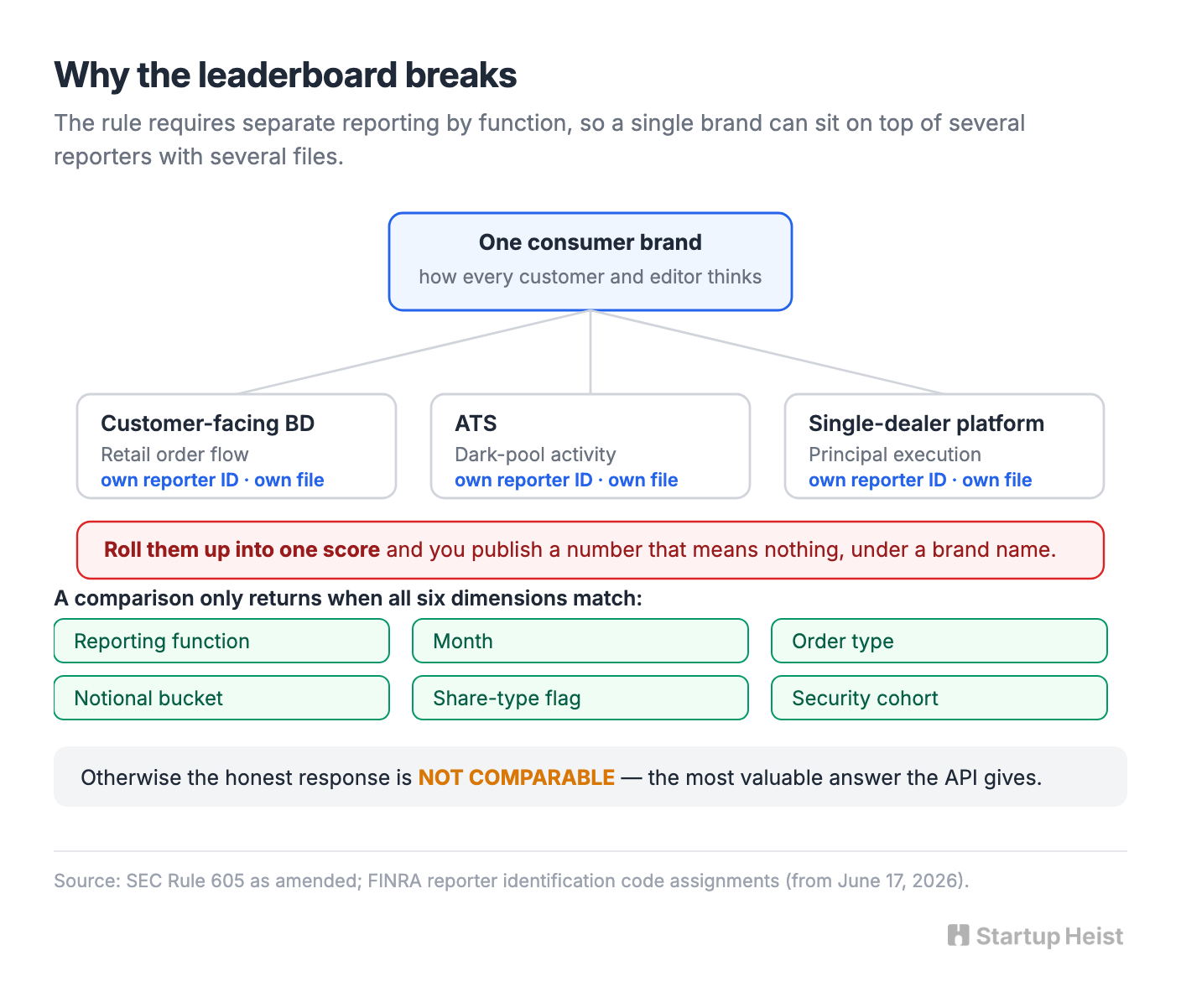
The entity problem compounds it. A single financial company can generate several reports, because the rule requires separate reporting by function. FINRA assigns distinct reporter identification codes for distinct reportable functions, so a firm's ATS activity, single-dealer-platform activity, and customer-facing broker-dealer activity all report separately. Roll those together into one score and you've manufactured a number that means nothing, attached to a brand name, published on the internet.
The value comes from refusing comparisons that shouldn't be made. Instead of answering "which broker is best," the system answers narrower questions: for marketable orders between $1,000 and $5,000 in this security cohort, how does this broker's effective spread compare with matched peers? Which of this reporter's published metrics fell outside its own trailing range?
All of it reads as academic until a misleading ranking goes live and a broker's general counsel picks up the phone. An execution-quality product has to be more conservative than the customers buying it.
The incumbents, and the space they left open
Execution analytics isn't an empty field. S3 sells Rule 605 and 606 reporting software to both sides of the street and supplies the third-party statistics that brokers like E*TRADE and Fidelity publish on their own execution-quality pages. Knowtice Analytics sells broker-dealers a compliance suite that produces regulator-ready 605 and 606 disclosures. Tradeweb runs deeper institutional transaction-cost analytics off clients' own trade data.
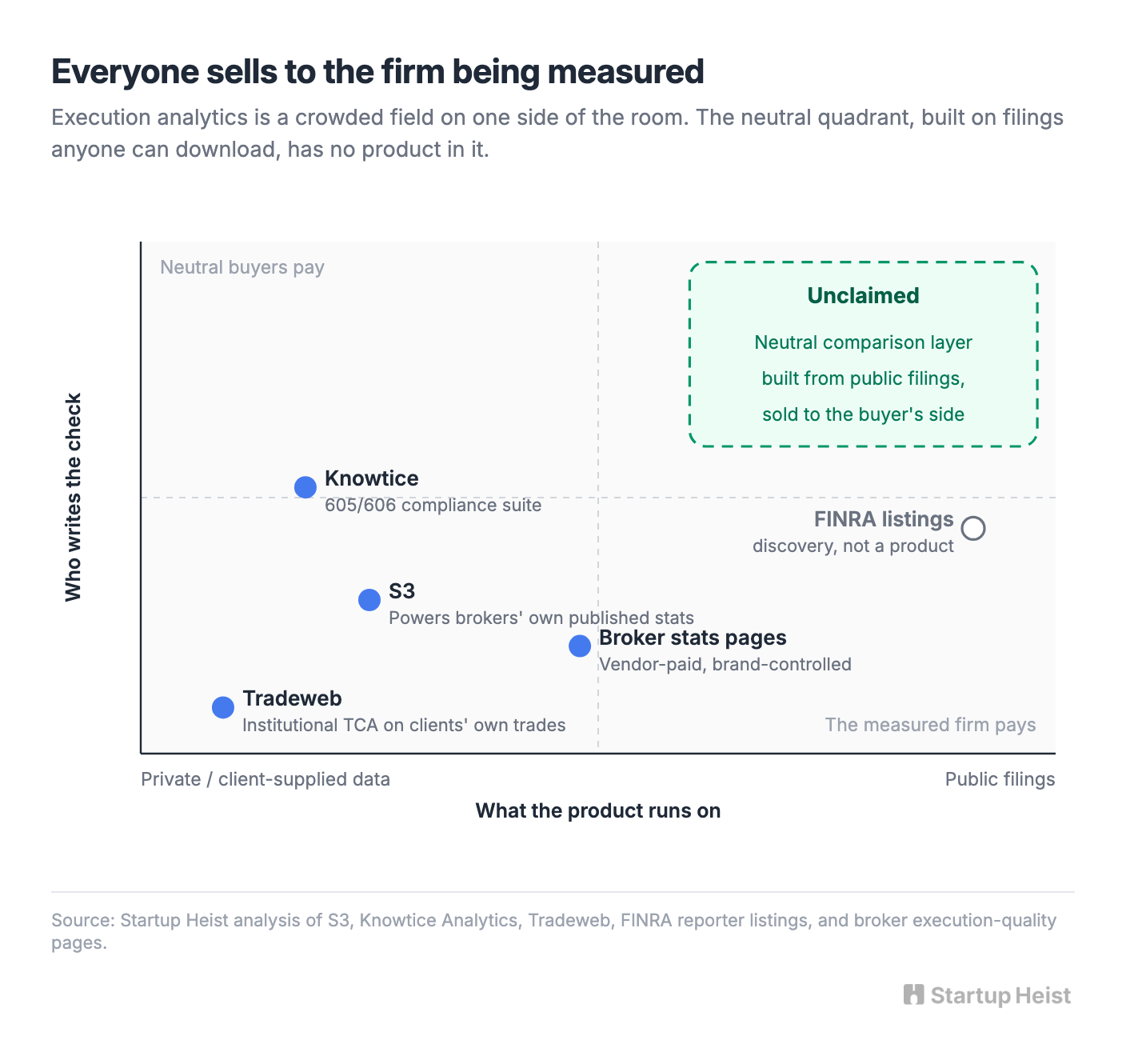
Every one of them sells to the firm that generates the data, and every one works with information the public can't see. Major brokers already publish execution speed and effective-over-quoted-spread figures on consumer-facing pages, sourced to third-party analytics vendors hired by the brokers being measured. Execution quality is already marketing material.
The neutral side is unclaimed. No one is selling publishers a white-label broker-comparison API built from public filings, and FINRA supplies discovery infrastructure without any interest in productizing anyone's comparison.
The real competitive threat comes from above. FINRA, the SEC, or an established analytics vendor could make the raw layer easier to reach, and you should assume one of them eventually will. A company whose only feature is "we collected the reports in one place" dies the week discovery improves. Everything defensible has to sit above that line.
What you actually build
Think of it as Bloomberg-lite for one small regulatory dataset. Three products sit in the same database, and they ship in this order.
Unlock the Vault.
Join founders who spot opportunities ahead of the crowd. Actionable insights. Zero fluff.
“Intelligent, bold, minus the pretense.”
“Like discovering the cheat codes of the startup world.”
“SH is off-Broadway for founders — weird, sharp, and ahead of the curve.”


