


The Booking Path Nobody Checks: A Monitoring Business Hiding Between Salon Websites and Square
Every salon website has a booking button. Almost nobody tests whether the journey behind it still works. Build the service that catches broken booking paths before customers quietly book somewhere else.
A neighborhood salon has four stylists, a good-looking website, a 4.8-star Google rating, and a Square Appointments account. A new customer finds it on her phone at 10:40 p.m., taps "Book Appointment," and lands on a booking page that loads fine. The stylist her friend recommended is missing from the menu. She tries a second service, sees no open times for three weeks, and books at the salon two blocks over.
Nobody gets an alert. Square's calendar is running, the website is up, and Google Analytics logs the click on the booking button as engagement. The owner finds out months later, if ever, when a regular mentions she "couldn't get in online."
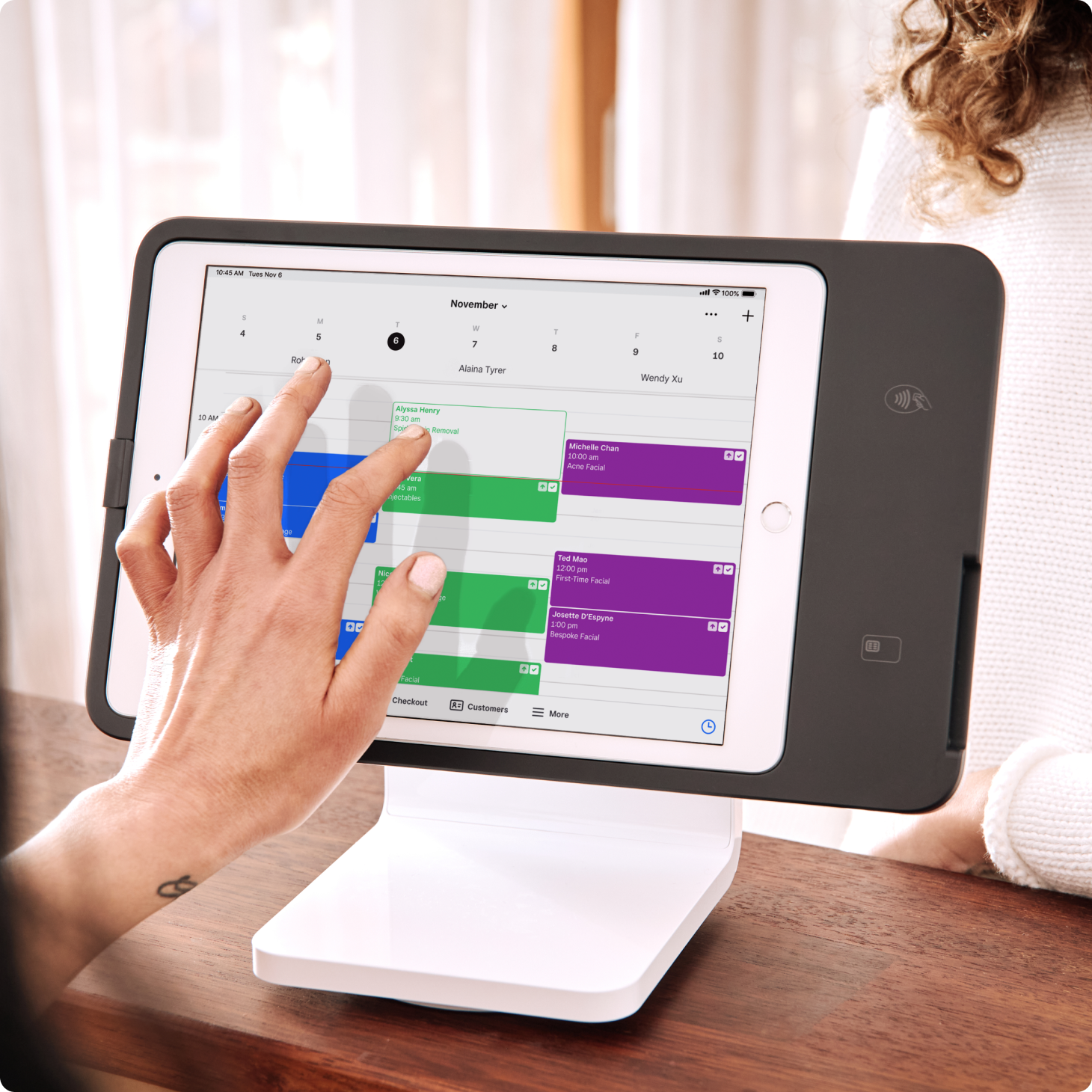
A salon can have a working website and a working booking system while the path between them is broken. The web agency watches whether the site is online, Square handles availability, and the owner manages staff. Nobody walks the path the way a customer does, every day, to prove it still ends at a bookable time slot. Whoever takes on that job has an open lane:
The money: 300 locations at $39 wholesale is $11,700 MRR, reachable through about 30 agency partners averaging ten salon clients each.
Inside:
• Three-layer tester with Square API diagnostics
• Audit, monitoring, and repair priced apart
• Agency outreach email and pilot playbook
• Go/no-go gate and support-time math
Call the business BookPath: a white-label booking-health monitor that local web agencies install across their salon clients. Each day it acts as a synthetic customer. It opens the salon's site, finds the booking entry point, follows the journey into Square, and confirms that the services and staff the salon wants to sell are reachable. When a step fails, it captures evidence, names the likely cause, and alerts whoever can fix it.
BookPath leaves Square and the calendar alone and promises no new customers. Its job is protecting a conversion path the salon already paid to build.
The Demand Is Proven, and Nobody Measures the Channel
Salon clients have told vendors plainly that booking friction costs bookings. In a survey of more than 1,000 U.S. salon and spa-goers published on November 7, 2025, the salon software company Zenoti found that 71% of salon regulars had decided not to book because it was too hard to reach someone or book online. Thirty-five percent said they already need to manage appointments outside business hours, and 48% said they'd be much more likely to return to a salon that let them book or change appointments at any time.
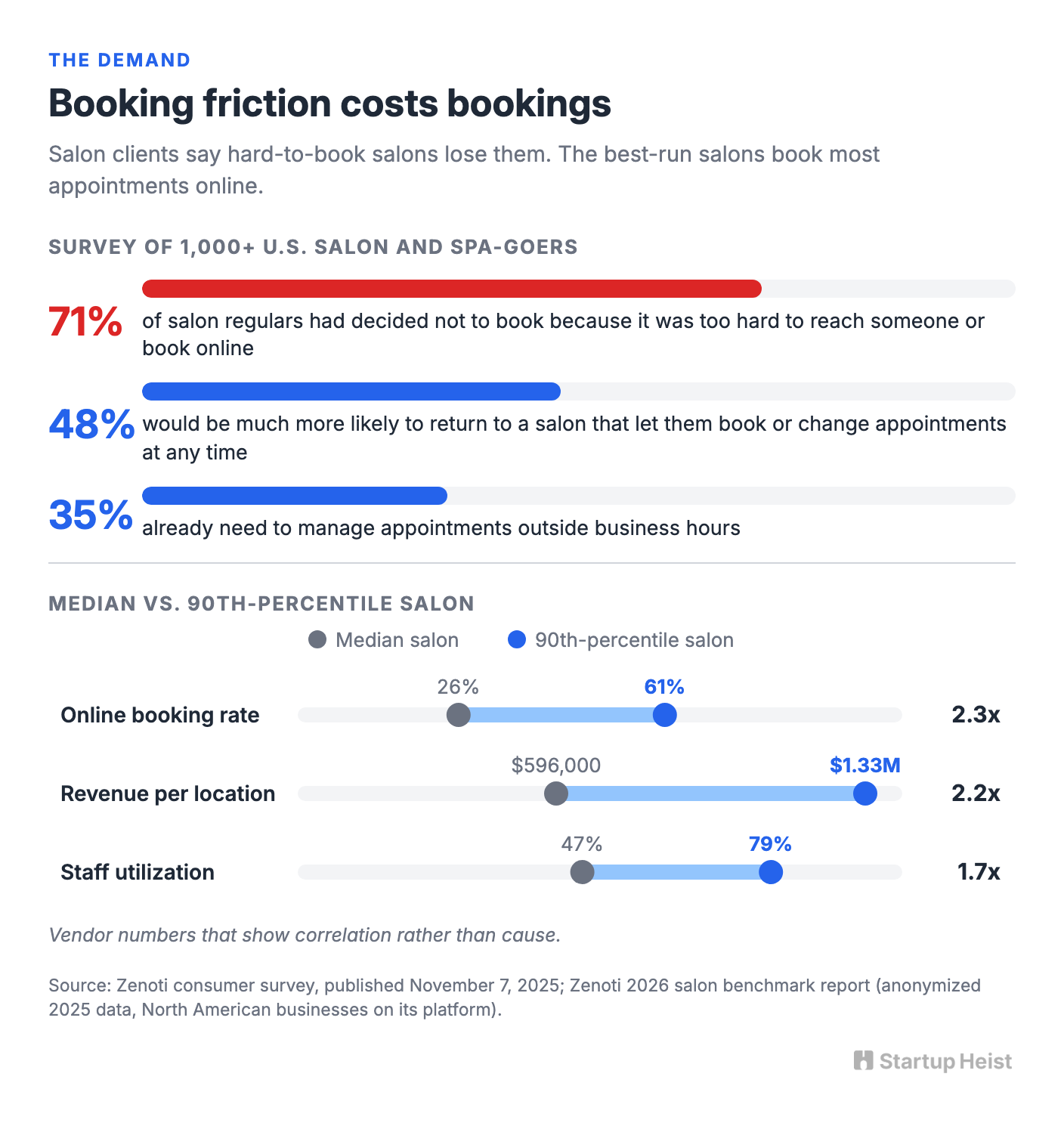
Zenoti's 2026 salon benchmark report, built from anonymized 2025 data on North American businesses running its platform, shows what online booking looks like at the top of the market:
| Metric | Median salon | 90th-percentile salon |
|---|---|---|
| Online booking rate | 26% | 61% |
| Revenue per location | $596,000 | $1.33 million |
| Staff utilization | 47% | 79% |
These are vendor numbers from a different software ecosystem, and they show correlation rather than cause. They still settle one point: at the best-run salons, online booking is a primary revenue channel, and a salon that books 61% of appointments online runs most of its front desk through a web page. Yet a typical independent salon pays for booking software, a website, Google ads, and an Instagram presence without a single systematic test that the channel all that spend points to still works.
Where Booking Paths Actually Break
Square's own help documentation describes the first failure. Merchants can embed a booking button, link to a booking URL, or install "Advanced Widgets" that show only specific services or staff. Deleting a widget in the Square dashboard, the documentation says, "will not automatically delete embedded widgets on other websites," and if the old code stays on the site, "an error message will display in place of the widget." An agency retires a widget during a menu update, forgets one landing page, and that page fails for every visitor while the homepage looks fine.
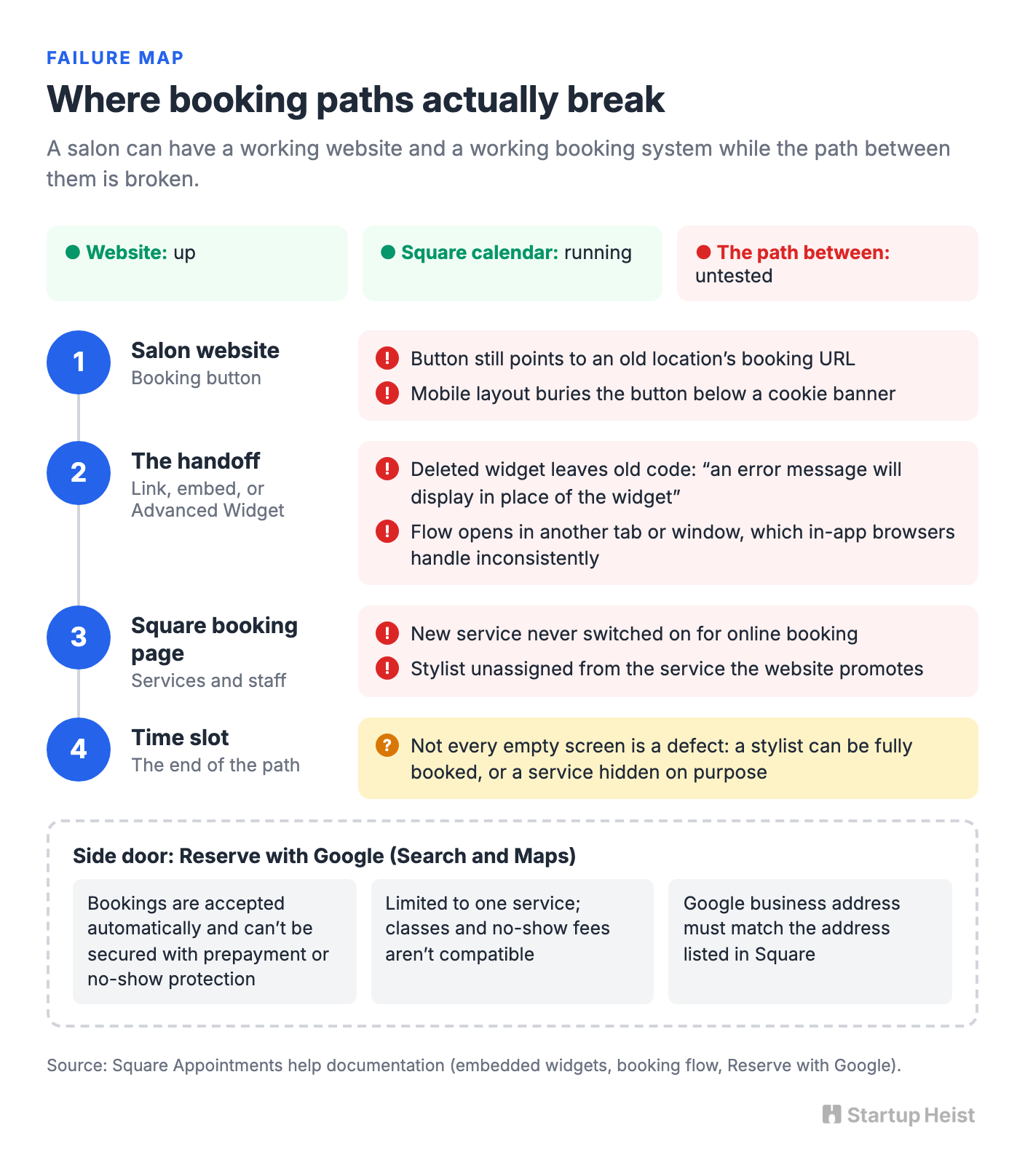
The same documentation notes that the embedded booking flow sends clients "to a flow in another tab or window," a handoff that mobile and in-app browsers (Instagram's, for one) handle inconsistently. A small business's everyday drift supplies the rest: a button still pointing to an old location's booking URL, a new service never switched on for online booking, a stylist unassigned from the service the website promotes, a mobile layout that buries the button below a cookie banner.
Google adds its own failure mode. Square merchants can turn on Reserve with Google so customers book straight from Search and Maps, and Square's help article spells out the limits. Classes and no-show fees aren't compatible with the integration. Google bookings are accepted automatically, limited to one service, and can't be secured with prepayment or no-show protection, so a salon that relies on deposits to prevent no-shows may never realize its Google bookings skip them. The Google business address must also match the address listed in Square, which makes an address edit on either side worth catching on the surface where many new customers start.
Not every empty screen is a defect. A stylist can be fully booked, or a service hidden on purpose. Telling the difference is the product's core technical job, and a generic uptime checker can't do it.
Why Now: The Web Is Closing to Automated Visitors
On October 6, 2026, TechCrunch reported that consumer AI agents were running into websites that won't let them in. Amazon had been blocking Meta's Muse shopping agent since late September. Yelp told TechCrunch it doesn't permit non-human traffic unless the agent pays for access to its data, so an agent trying to book or request a quote through Yelp needs a deal first. Zillow told TechCrunch its anti-scraping measures can occasionally block agents, and The Verge followed on October 17 with banks and airlines drawing the same line.
For salons, the near-term consequence is fragility: booking paths break more easily as bot protection and security layers stack up. The longer-term one is a new class of visitor, software acting on a customer's behalf, that will eventually try to book a haircut.
Treat that second development as the expansion and keep it there. A Feedvisor survey of 1,006 U.S. consumers, reported by Retail Brew on October 20, 2026, found that only 5% buy an AI-recommended product immediately and 62% say they'd never trust an AI agent to complete a transaction. Those are retail numbers, but they're enough to rule out agent booking as a paying market for now. The market is human customers booking from their phones. Sell reliability for today's customers; add agent compatibility once agents show up with real bookings.
The Wedge: Sell Through Local Web Agencies
Unlock the Vault.
Join founders who spot opportunities ahead of the crowd. Actionable insights. Zero fluff.
“Intelligent, bold, minus the pretense.”
“Like discovering the cheat codes of the startup world.”
“SH is off-Broadway for founders — weird, sharp, and ahead of the curve.”


