


The Reseller OS: A Back Office for the Depop Generation
Secondhand fashion has crossed the line from hobby to real commerce. The shift happened quietly, in bedrooms and storage units and Instagram DMs, while the rest of the e-commerce world argued about Shopify themes.
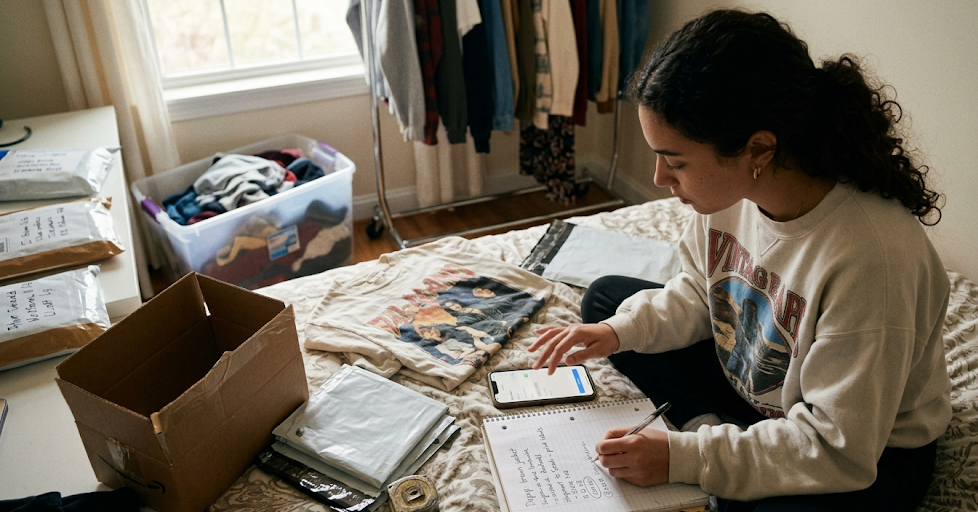
You already see the visible side. Gen Z buyers hunting Y2K cargos on Depop, streetwear on Grailed, designer bags on Poshmark, one-of-one vintage tees on Whatnot livestreams at 11pm on a Tuesday. What's harder to see is more interesting. Thousands of young sellers are running real retail businesses out of consumer apps and a single iPhone. They source at thrift bins, photograph on the floor by a window, cross-post to three platforms, answer DMs, send payment links, print labels at the post office, flag scammers, repost dead stock, and plan Friday drops. Almost all of it lives in Notes app entries, color-coded spreadsheets, marketplace dashboards, Venmo screenshots, and memory.

The play is a lightweight Reseller OS for Gen Z and millennial fashion sellers. Inventory manager, drop calendar, DM-to-invoice tool, shipping assistant, and buyer CRM in one app. A real operating system for people selling across Depop, Instagram, Whatnot, Poshmark, and eBay, built around how they actually work.
Here's the opportunity in one frame:
The money: 5,000 paying sellers at a $26 blended ARPU is $130K MRR. 10,000 at $30 is $300K MRR. Lifestyle floor, niche-leader ceiling.
Inside:
• 7-piece MVP scope, inventory-first
• Four-tier pricing from free to Pro
• Creator-led GTM with outreach templates
• Five-layer moat including benchmarks
The market is bigger than the headlines suggest
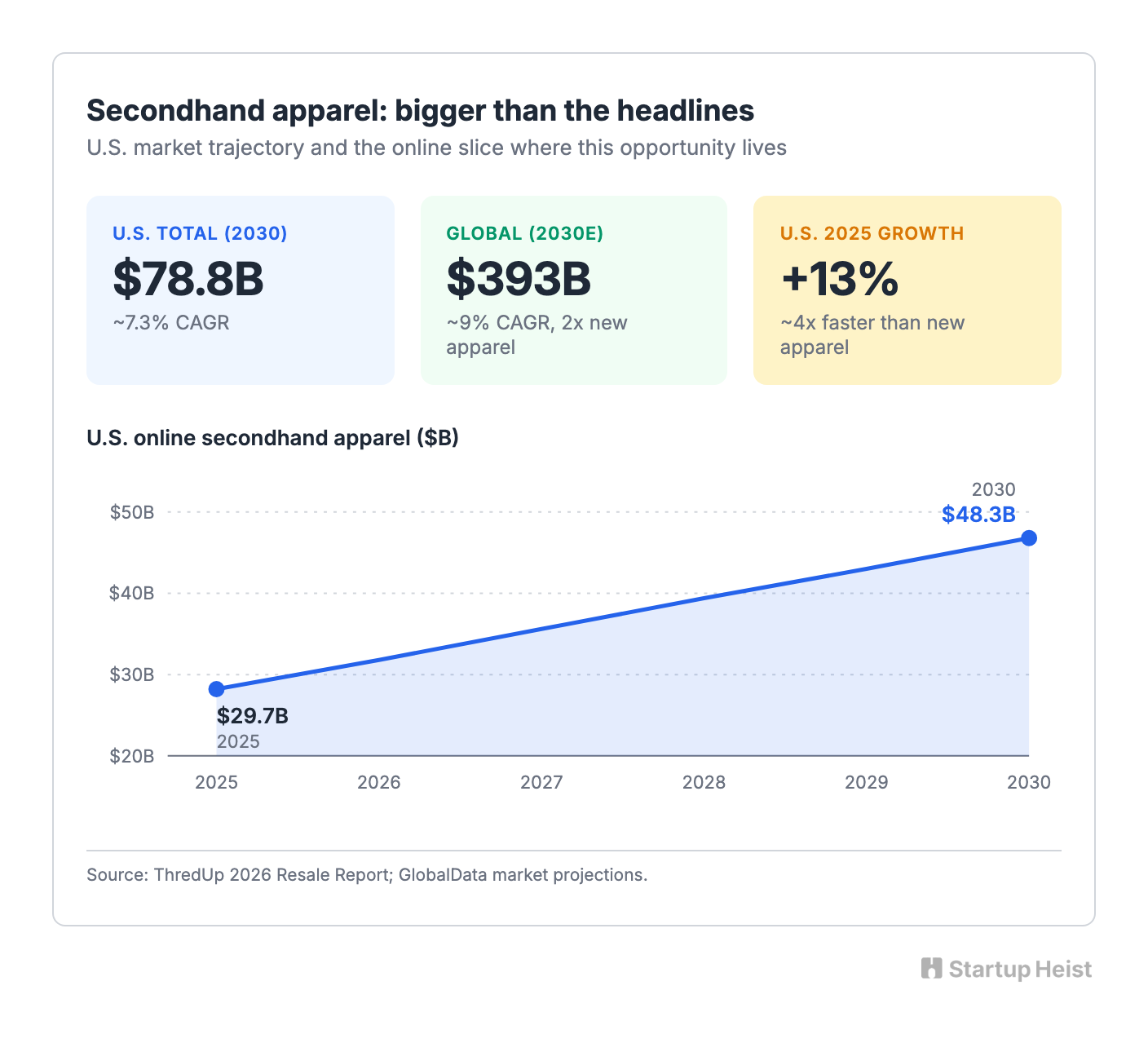
The U.S. secondhand apparel market is on track to hit $78.8 billion by 2030, growing roughly 7.3% a year. The global figure sits closer to $393 billion, expanding around 9% annually and outpacing new apparel two-to-one. In 2025, U.S. secondhand grew 13%, nearly 4x faster than the broader retail clothing market. The online slice, where this opportunity lives, climbs from $29.7 billion in 2025 to $48.3 billion by 2030.
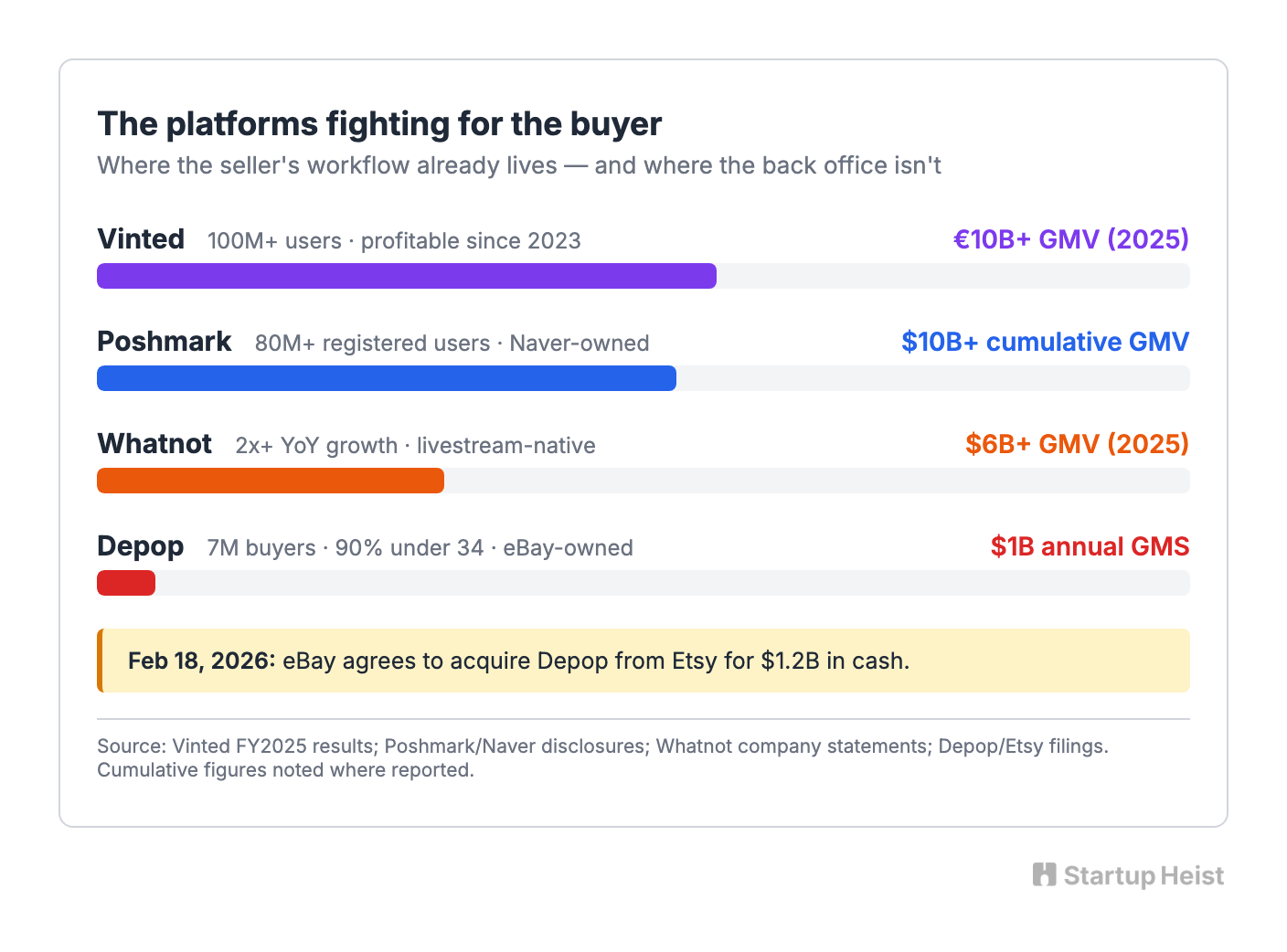
The buying side gets the press. The selling side gets the work, and the work is enormous. On February 18, 2026, eBay agreed to pay $1.2 billion in cash to acquire Depop from Etsy, a platform with roughly $1 billion in annual GMS, 60% U.S. growth, 7 million active buyers, 3 million active sellers, and nearly 90% of buyers under 34. Poshmark, now owned by Naver, carries 80+ million registered users and cumulative GMV north of $10 billion. Whatnot did more than $6 billion in GMV in 2025, more than doubling year-over-year, with women's fashion among its fastest-growing categories. And then there's Vinted. The zero-fee Lithuanian giant ran a NYC pilot in November 2025 and pushed a major U.S. expansion in January 2026 with tens of millions in marketing spend. Vinted carries 100M+ users globally, posted €10B+ GMV in 2025, and has been profitable since 2023. The zero-seller-fee model isn't a promo. It's a structural attack on Depop and Poshmark's economics.
Gen Z and millennials are projected to drive 71% of resale growth through 2030. eBay paid a ten-figure premium to access that cohort. The infrastructure underneath the cohort is wide open.
The wedge
The first instinct would be to build "Shopify for resellers." Too broad, too expensive, too abstract. Sellers don't wake up thinking they need commerce infrastructure. They think:
"I have 140 items in a bin and I don't remember what's listed where."
"Someone DMed me about the brown jacket but I'm not sure if it sold on Depop already."
"I need to relist the dead stock before the algorithm buries it."
"I lost a buyer because I didn't send a payment link fast enough."
"I shipped the wrong size to Sarah and now she's leaving a review."
"I want to do a Friday drop, but I'm scheduling it manually in Notes."
The wedge is turning messy resale workflows into clean, repeatable seller operations. The first product shouldn't try to replace Depop, Poshmark, Whatnot, or Instagram. It should sit underneath them as the seller's private back office, helping a part-time reseller manage inventory, drops, orders, DMs, buyers, and shipping without graduating into enterprise e-commerce software.
India is a few years ahead of the U.S. on social-native resale, and the pattern is instructive. A generation of young sellers, mostly 18 to 24, mostly female, runs micro-thrift shops with 5,000 to 50,000 Instagram followers out of hostels in Delhi, Bangalore, and Mumbai. A reel goes live. A drop happens at 8pm. The first commenter on each item gets it. The seller DMs a UPI QR. The buyer pays. By 11pm she's done forty transactions and is triaging refunds in three different DM threads.
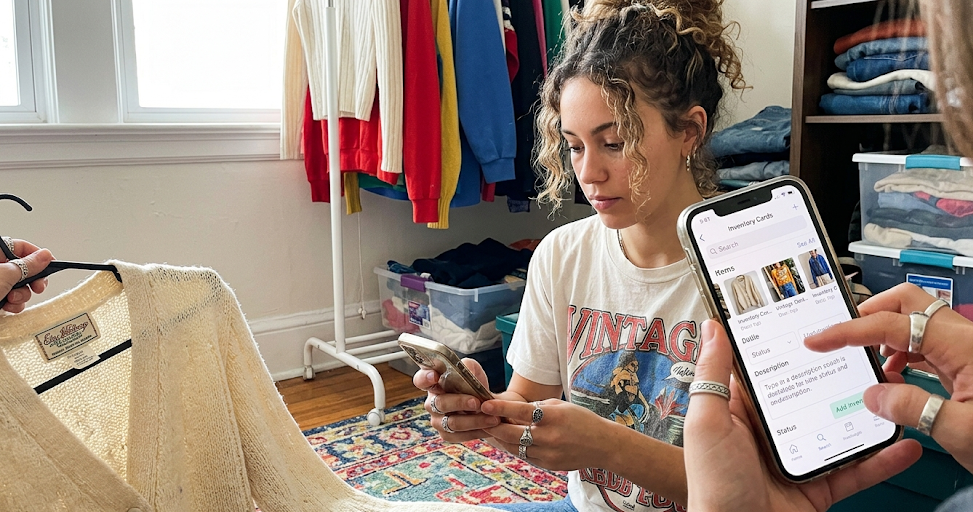
U.S. sellers run the same operation across Depop, Poshmark, Instagram, Whatnot, and eBay instead of Instagram and WhatsApp alone, but the operational pain is identical. The seller is the merchandiser, photographer, marketer, support rep, fraud department, and warehouse manager, and almost nothing in the software stack respects that workflow. The roadmap is hiding in plain sight: drop scheduling, inventory cards, size and condition templates, buyer history, bad-buyer notes, DM-to-payment flows, dead-stock tracking, simple income dashboards.
The competitive landscape is crowded but unsolved
Four categories of tools exist, with meaningful gaps between every one of them. Crosslisters like Vendoo, List Perfectly, and Crosslist publish the same listing across eBay, Poshmark, Mercari, Depop, Whatnot, Grailed, and a dozen others, but none are built around buyer conversations, drop calendars, scammer flags, or social-native selling. Shipping tools like Pirate Ship and Shippo generate labels but assume the order already exists. ManyChat automates DM responses but doesn't understand inventory. My Reseller Genie covers bookkeeping but falls flat as a daily operating tool. Poshmark's Smart List AI is genuinely useful, but it lives inside one platform.
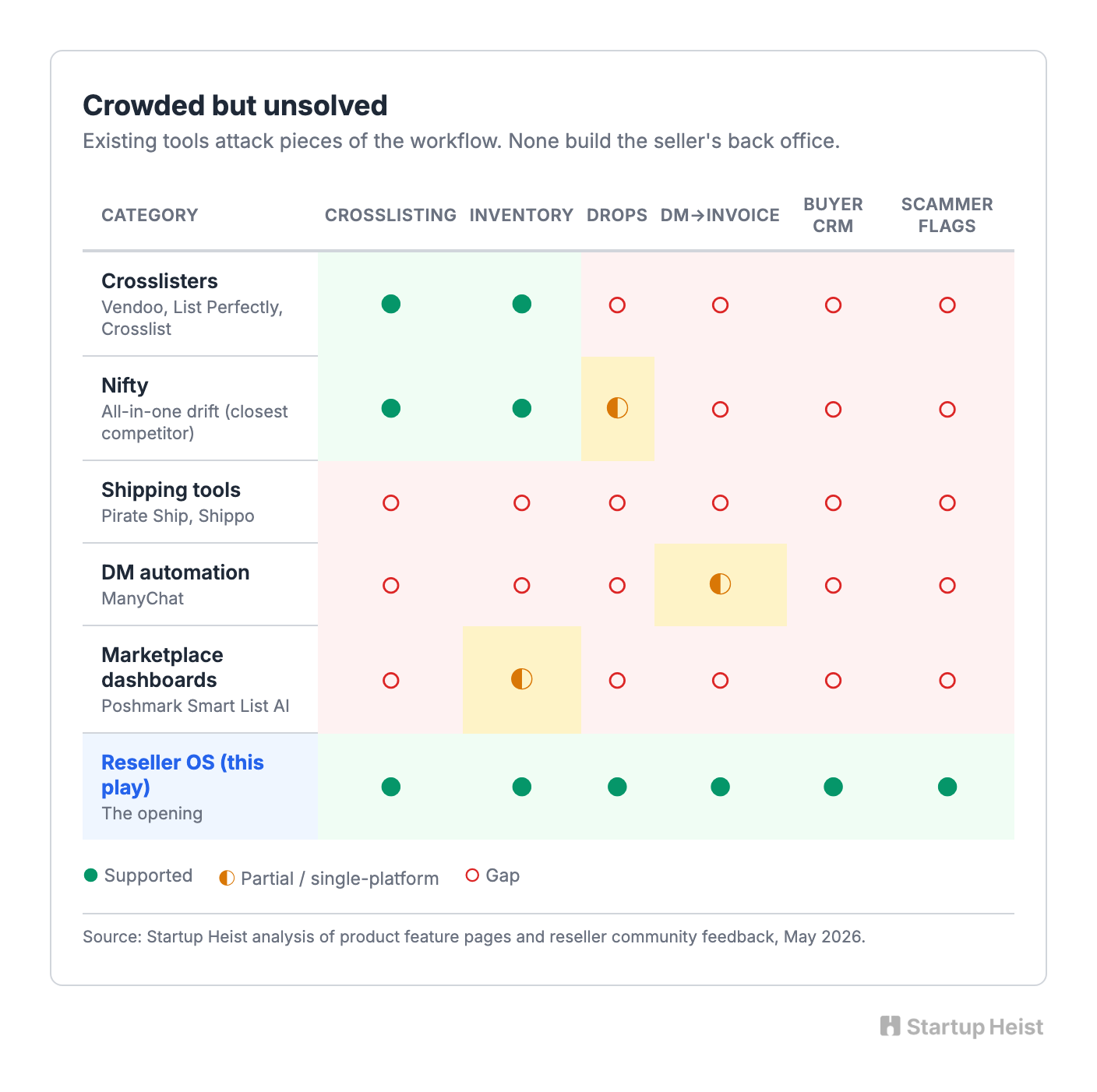
Nifty is the one to watch. It's evolved past pure crosslisting toward an all-in-one posture: cloud automation for sharing cycles and relisting, AI listing from photos, inventory management with auto-delisting on cross-platform sale, scheduled drafts that function as informal drops, and label filters for inventory segmentation. The trajectory is real. The core gap still holds. No buyer CRM. No DM-to-invoice. No drop calendar UI. No private scammer flags. A small cluster of AI-listing tools like Underpriced AI is entering the same lane, all of them attacking the listing step, none building the seller's back office. Building another crosslister is too late. The opening is the back office for social-native sellers operating across marketplaces and DMs, the ones already past hobbyist but not yet ready for a heavyweight e-commerce stack.
The customer
Skip the casual seller offloading three old sweaters. The target is the semi-serious reseller doing $1,000 to $10,000 a month in gross sales, working alone or with one helper. College students. Young creatives. Stay-at-home parents. Vintage pickers. Streetwear flippers. Y2K curators. Plus-size thrift specialists. Sneaker resellers. Weekend flea-market hunters who post to Instagram every Friday.
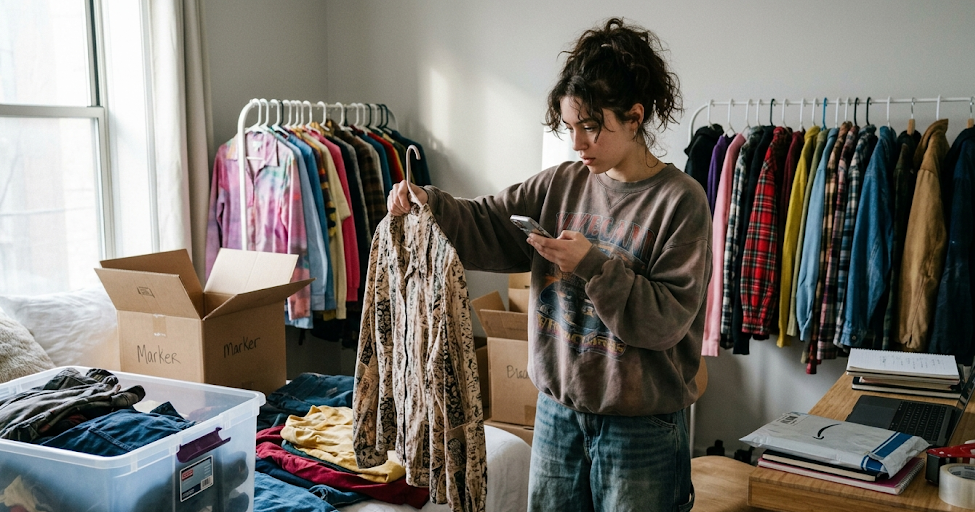
The cohort is real and tool-receptive. A serious tier of Depop and Poshmark sellers treats this as part-time or full-time work, clearing meaningful monthly income from sales rather than hobby flips. Over half of Gen Zers report having a side hustle, more than double older generations. ThredUp's 2026 report notes 48% of secondhand shoppers now use AI tools in their shopping journey and 63% are comfortable with agentic AI buying on their behalf. Nearly half discover items through social media and creators, not search. The buyers are tech-forward. The sellers serving them are even more so. At 20 items, Instagram DMs and memory work fine. At 100 items, things start breaking. At 500 items, the seller has a real business trapped inside consumer apps.
MVP: build the boring thing first
The temptation is to start with AI fashion descriptions. Don't. Poshmark Smart List AI already does that, and the cohort that needs operating help isn't constrained by description quality. They're constrained by the fact that nothing knows what they own, what's listed where, and who paid for what.
The MVP scope, kept tight on purpose:
This one's free.
This playbook is unlocked for members. Grab a free account — no card, ten seconds — and keep reading. You'll also get one free briefing every weekday morning.


