


Per-scan pricing at $299–$500 per document, with firm subscriptions at $999–$2,500/month. Path to $150K/month and ~$1.8M in annual revenue at early traction, without needing a massive user base. No one has claimed this category yet.
In recent years, thousands of founders draft their own patent applications with AI. They paste an invention description into ChatGPT, get back something that reads like a real filing, and submit it. Buried inside is often a sentence that quietly hands their competition a weapon.
The sentence might say "conventional systems typically use X architecture." Or "as is well known in the art, Z is standard practice." These phrases feel like good patent writing. Under U.S. patent law, they can function as Applicant Admitted Prior Art (AAPA)—statements the patent office treats as concessions that your invention is obvious, unoriginal, or both.
Not every mention of existing technology triggers AAPA. Context matters—the doctrine focuses on statements that specifically identify another's work as prior art, not generic technical descriptions. But AI writing tools produce exactly the kind of sweeping, authoritative-sounding background language that crosses that line without the writer realizing it. And with patent attorney fees running $2,000–$6,000 for provisionals and $10,000–$20,000 for non-provisionals against a $65 micro-entity filing fee, the economics push founders toward drafting first and asking counsel later.
The startup idea: build the AI tool that catches these drafting landmines before they cost someone their patent—a micro SaaS for patent risk review that slots into the gap between DIY filing and formal legal counsel.
Why This Problem Is Getting Worse
The USPTO's patent backlog has swelled past 800,000 unexamined applications, with total pending applications exceeding 1.2 million. Average time to first office action is running around 22.5 months. The system is crowded and unforgiving of sloppy work.
The Patent Office is also deploying AI on its own side. In October 2025, the USPTO launched the ASAP! pilot—an internal AI system that analyzes specifications, claims, and abstracts to surface prior art before substantive examination begins. It's a limited pilot for now, not universal deployment. But the agency called it "the first of many planned AI pilots." Machine reading of your application language is the trajectory.
Meanwhile, founders keep drafting more patent text with AI before counsel sees it. That cost spread between a $65 provisional filing and a $6,000+ attorney engagement pushes people toward the shortcut—and the shortcut seeds dangerous language into filings that sit unexamined for nearly two years.
What AAPA Actually Is (and Why AI Makes It Worse)
Most patent applications include a "background" section discussing the state of the art. This is where founders get hurt.
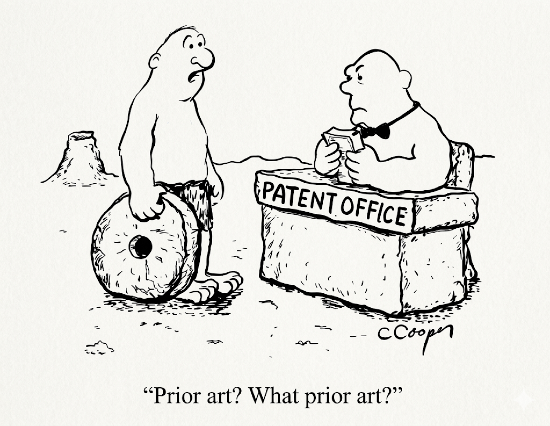
The MPEP (§ 2129) is explicit: when an applicant describes someone else's work in their specification as "prior art," that characterization can be treated as an admission. The examiner can rely on those admissions to reject your claims for anticipation or obviousness. You don't have to cite a specific reference. You don't have to intend it as a legal admission. If your language characterizes existing technology as prior art, the Patent Office can use your own words against you. Jepson-style claim structure—where the preamble recites known elements—creates implied admissions as well, though that implication can be rebutted in some circumstances.
This matters in post-grant proceedings too. The Federal Circuit spent much of 2025 defining AAPA's boundaries. In Qualcomm v. Apple (April 2025), the court confirmed AAPA cannot itself form the statutory basis of an IPR invalidity ground, because those grounds must rest on patents or printed publications. In Shockwave Medical v. Cardiovascular Systems (July 2025), the court ruled AAPA can still be treated as background knowledge and used to supply missing claim limitations in an obviousness analysis. Your own admissions can still be used against you—just through different procedural channels.
The USPTO responded with a July 2025 memo tightening how the PTAB handles AAPA evidence. The net effect: a more technical, more confusing environment for filers. Non-specialists will misread these rules, and that gap is where the product lives.
Why "AI Patent Drafter" Is the Wrong Product
The AI patent drafting market is already crowded with well-funded players. Solve Intelligence closed a $40M Series B in December 2025. Patlytics has raised roughly $18.5M across seed and Series A rounds, backed by Google's Gradient Ventures. DeepIP integrates into Microsoft Word. Edge, Patentext, and others occupy adjacent niches. Going head-on as a general patent AI product is volunteering to lose.
The better play is to sell defensive review, not authorship.
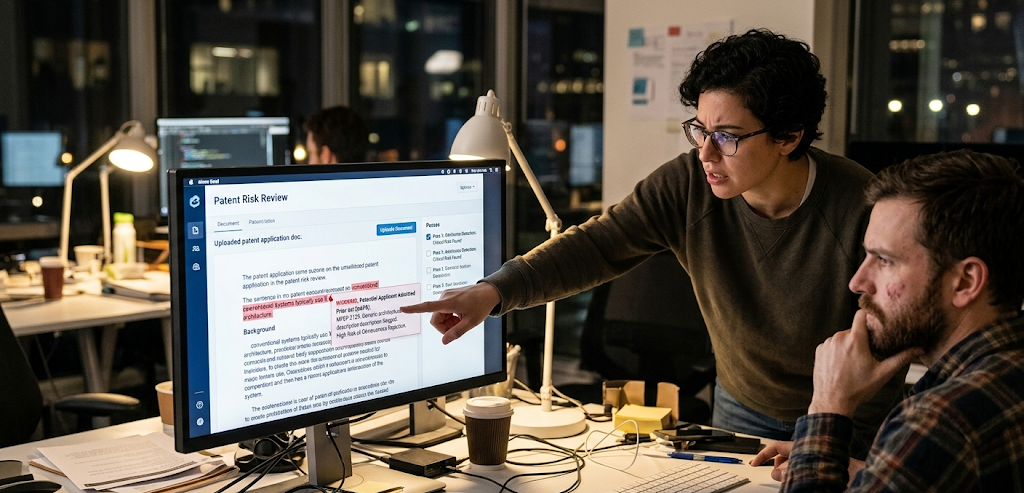
You are not the machine that writes the patent. You are the machine that says: "This sentence may be an admission. This framing weakens novelty. This background section is doing legal damage. Escalate to counsel before filing."
That promise is tighter, more believable, and easier to trust. It also fits within the ABA's Formal Opinion 512 (July 2024), which established that lawyers using generative AI must account for duties of competence, confidentiality, and client protection. A product positioned as a QC layer for attorney workflows has a more natural regulatory fit than one pretending to replace judgment—though you'd still need careful disclaimer and product design to stay clear of unauthorized-practice concerns.
Start with AAPA detection as the initial hook. The real company you're building is pre-filing patent risk intelligence for non-expert filers and the lawyers who clean up after them.
How the Product Works
Keep the initial build tight:
Unlock the Vault.
Join founders who spot opportunities ahead of the crowd. Actionable insights. Zero fluff.
“Intelligent, bold, minus the pretense.”
“Like discovering the cheat codes of the startup world.”
“SH is off-Broadway for founders — weird, sharp, and ahead of the curve.”


