


The Missing Prompt: Build the Analytics Layer After the AI Shopping Click
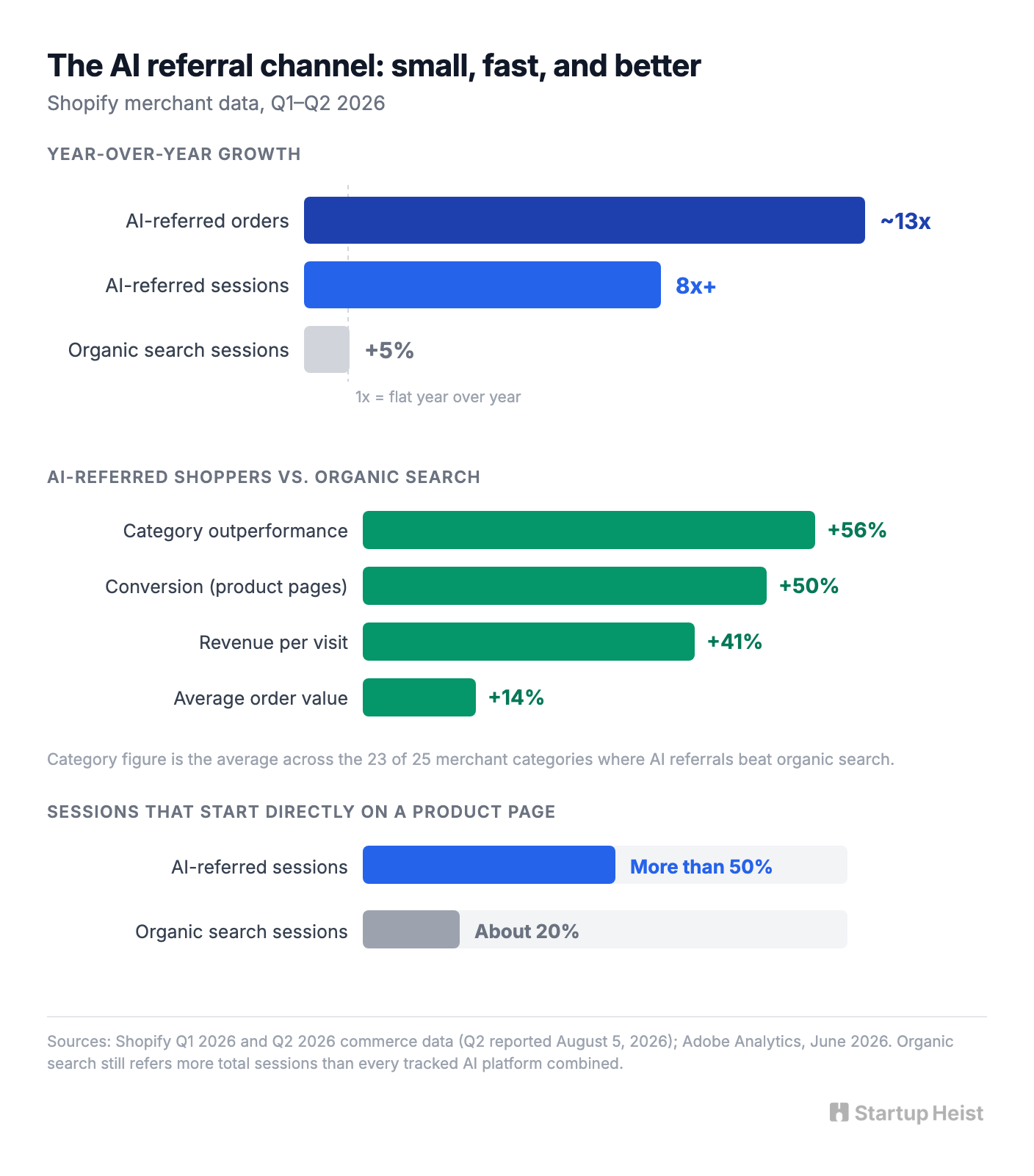
Shopify's Q1 2026 data described a channel that barely existed a year earlier. Referral sessions from AI chatbots (ChatGPT, Perplexity, Gemini, Copilot, Claude, Grok) grew more than 8x year over year. Orders from those sessions grew nearly 13x. Organic search sessions grew about 5% over the same window. In Q2, reported on August 5, 2026, Shopify said AI-driven traffic and AI-driven orders had each tripled year over year, and that new-buyer orders from AI channels were arriving at nearly twice the rate of other channels.

The absolute volume is still modest. Organic search refers more sessions to Shopify merchants than every tracked AI platform combined. What makes the channel interesting is the quality of the visitor. AI-referred shoppers convert at nearly 50% higher rates than organic search on product pages, carry 14% higher average order values, and outperform organic in 23 of 25 merchant categories by an average of 56%. Adobe found the same shape across retail: 41% of U.S. consumers used generative AI for online shopping in June 2026, and AI-referred visitors produced 41% higher revenue per visit than traditional channels. Ulta Beauty says shoppers arriving from Gemini and ChatGPT show roughly double the conversion and intent. Juniper Research expects $8 billion in retail spending this year to follow AI agent recommendations.
Merchants now have a small, fast-growing source of AI referral traffic that outperforms everything else on the site, and almost no information about it.
Here is the entire record a merchant gets when one of these shoppers lands:
Referrer: chatgpt.com
Landing page: /products/barrier-repair-moisturizer
What happened in the five minutes before that click was a conversation in which the shopper described her skin type, her budget, the three products that broke her out, and the result she wanted. The model weighed ingredient lists, read reviews, narrowed ten thousand options to one, and handed her over. All of that reasoning stayed inside someone else's product.
The transcript is gone and should stay gone. The job behind it is recoverable, and recovering it is the whole business.
Here's the shape of the opportunity:
The money: 300 stores at $149 a month is $44,700 MRR. Shopify says AI-driven orders tripled year over year in Q2 2026.
Inside:
• Four-table schema and the cartToken join
• Widget rules that protect conversion
• Four pricing tiers from $79 to $499
• Agency-led GTM with the outreach email
The intent leak that funded Google just closed
Google built an advertising empire on a structural accident: commercial searches leak intent. "Best running shoes for flat feet" tells you the buyer, the constraint, and the category in six words. That leak funded keyword targeting, landing page tests, merchandising decisions, ad creative, and entire product roadmaps.
AI shopping closes the leak. The query becomes a conversation, the conversation happens inside a chat window you don't own, and what arrives at your storefront is a pre-qualified stranger.
Shopify has a name for the underlying behavior: journey compression. More than half of AI-referred sessions in its Q1 data started directly on a product page, against roughly 20% for organic search. Discovery and consideration already happened somewhere else. A conventional shopper wanders through search results, an article, a homepage, a collection, two product pages, and a review section before buying three days later. An AI shopper arrives at the end of that process holding a decision.
The obvious version of this product is already dead
The gap is easy to see, which is why most of the people who see it will build the wrong thing.
Shopify itself now walks merchants through filtering any analytics report by Referrer Channel to isolate AI answer engines, with a separate Referrer Host filter for Gemini. Shopify Catalog syndicates merchant product data to ChatGPT, Perplexity, and Google AI Mode automatically. The platform is absorbing basic AI referral tracking the way it absorbs every commodity feature, which means a startup whose pitch is "we show you how much traffic comes from ChatGPT" is building on ground that's actively moving.
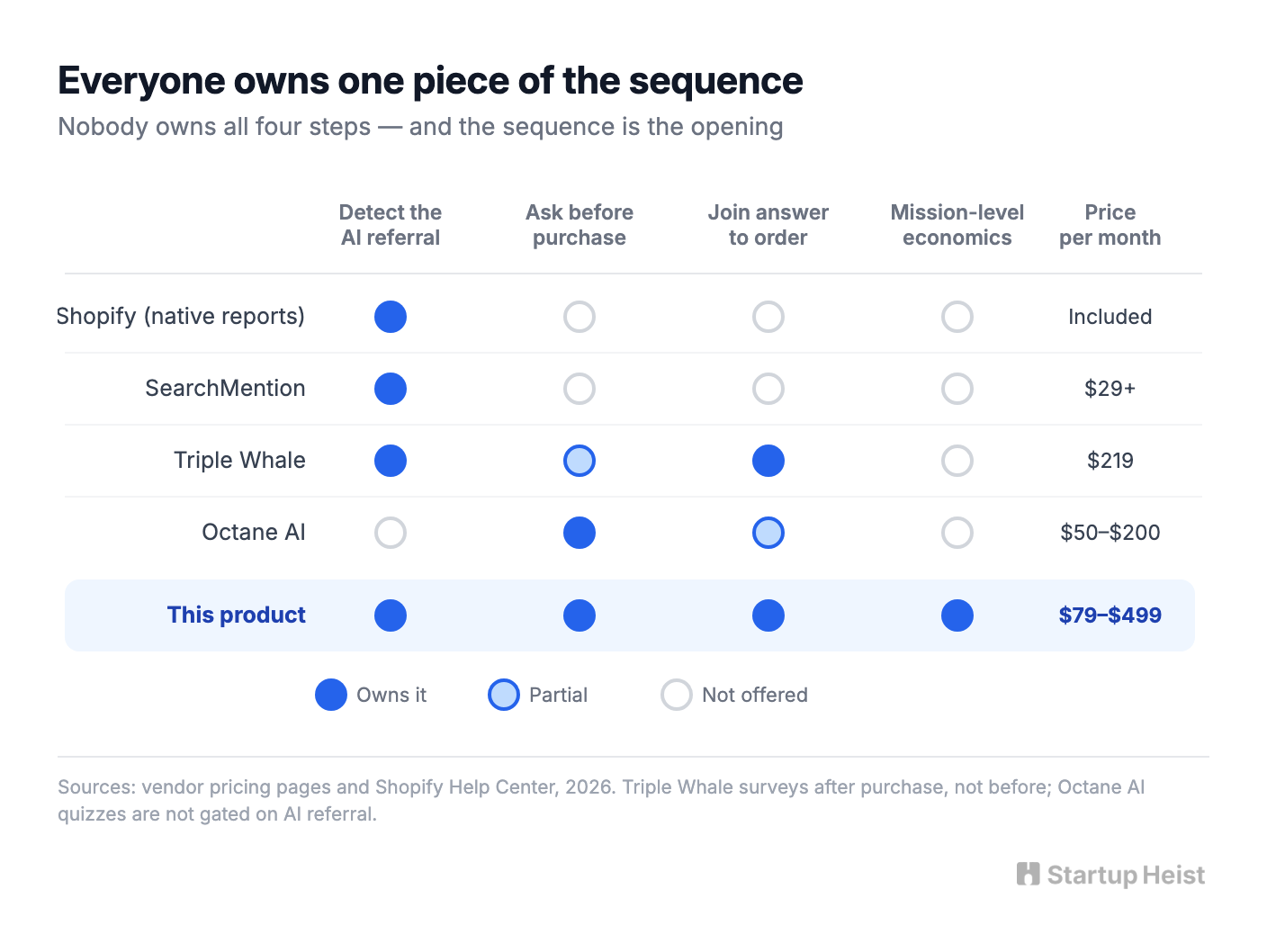
The adjacent tooling is already dense, and most of it points upstream at answer engine optimization: getting recommended by the model in the first place. SearchMention sells Shopify merchants AI visibility monitoring and referral tracking from $29 a month. Triple Whale bundles multi-touch attribution, AI visibility, and post-purchase surveys, with its Foundation plan at $219 a month and a free tier that includes standard post-purchase surveys. Octane AI sells quizzes, zero-party data capture, and Shopify plus Klaviyo sync starting at $50, with unlimited quizzes and A/B testing at $200. Each of these owns one piece of what's described here. None of them owns the sequence, and the sequence is the opening.
So ask the shopper
No legitimate product reconstructs a private ChatGPT conversation. What you actually have is an anonymous visitor and a detectable referrer, and that's enough to work with.
So ask. When a detected AI-referred visitor lands, show one small, optional, tappable question.
What brought you here today?
Sensitive skin · Comparing brands · Under $50 · Buying a gift · Something else
One tap, no quiz, no email gate, nothing fabricated. Store the answer against the anonymous session and connect it to whatever happens next.
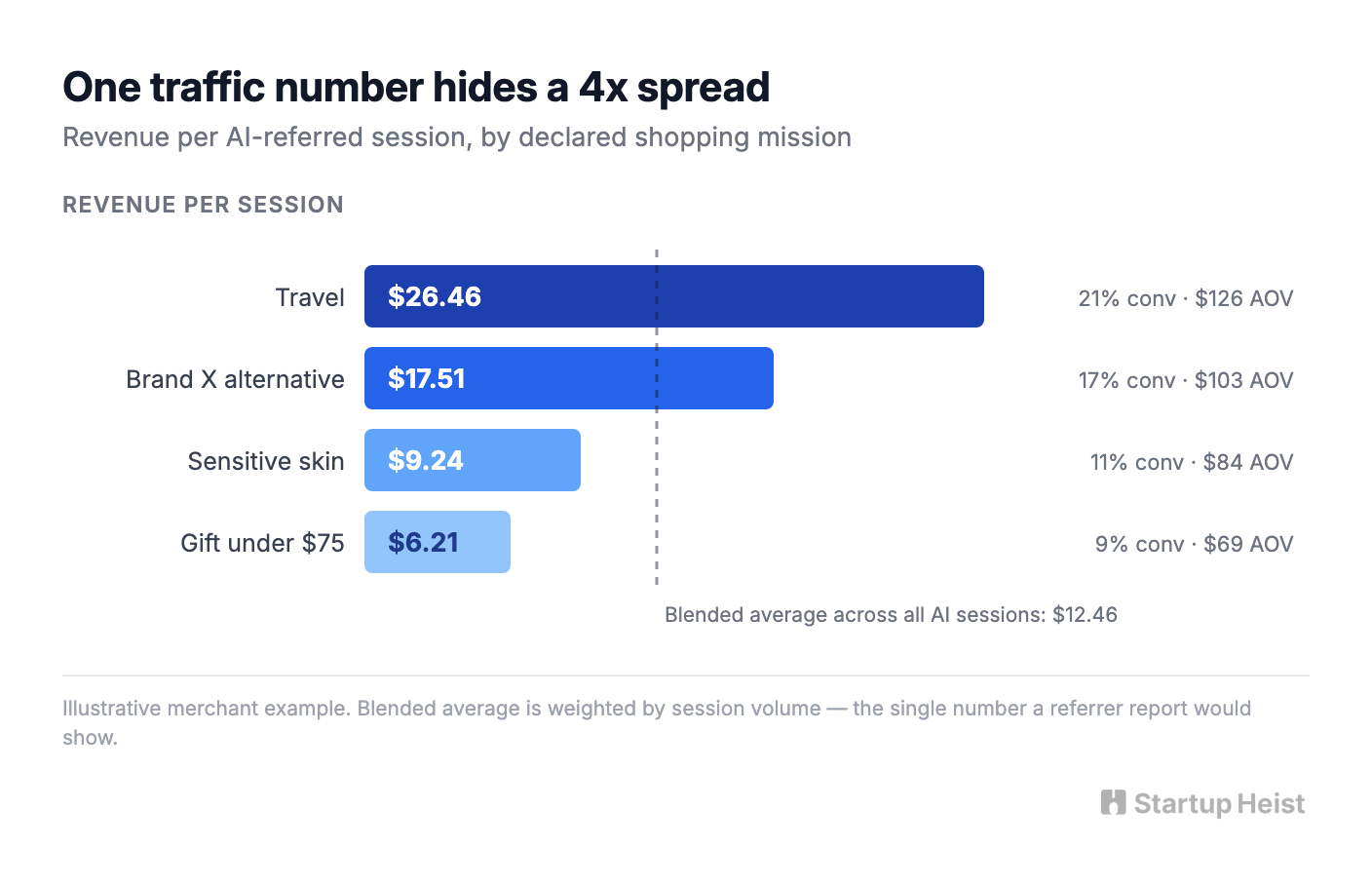
The merchant's view stops being a traffic number and becomes a demand map:
| Shopping mission | AI sessions | Response rate | Add-to-cart | Conversion | AOV |
|---|---|---|---|---|---|
| Sensitive skin | 184 | 31% | 22% | 11% | $84 |
| Brand X alternative | 96 | 28% | 31% | 17% | $103 |
| Gift under $75 | 142 | 36% | 18% | 9% | $69 |
| Travel | 71 | 24% | 38% | 21% | $126 |
A table like that is worth considerably more than "ChatGPT generated $9,420 last month."
Why not ask on the thank-you page, where post-purchase surveys routinely hit 40% to 80% completion and carry zero conversion risk? Because the thank-you page only surveys people who bought. You learn what your buyers wanted and nothing about the missions that arrived, browsed, and left. Mission-level conversion rates require a denominator, and the denominator only exists if you ask before the outcome is known. Triple Whale's post-purchase survey answers "which channel gets credit." A pre-purchase mission capture answers "which demand converts." Two different products built on the same widget, and the difference is the whole business.
Call the category what it is: AI shopping-mission analytics. Detect the AI-referred session, capture a declared intent, join it to the order.
Why merchants will care more every quarter
The reason this holds up past 2026 is the direction the platforms are already moving.
The agentic commerce story of 2025 was that the chatbot would own the checkout. OpenAI launched Instant Checkout on September 29, 2025 and pulled back on March 4, 2026, telling merchants they could use their own checkout experiences while OpenAI focused on product discovery. Shopify's president Harley Finkelstein put the adoption number at roughly a dozen merchants, out of millions on the platform.
Walmart is the clearest read on why. Reuters reported on August 7, 2026 that Walmart built its own assistant, Sparky, and embedded it inside ChatGPT and Gemini, then found that conversion through ChatGPT's Instant Checkout ran at about a third the rate of walmart.com. So Walmart uses the chatbots for discovery and steers the shopper back to its own site to buy. Every large retailer is running the same calculation: be recommended by the model, keep the transaction and the behavioral data on property you own.
The equilibrium forming is discover in AI, buy on site. AI takes more of the discovery journey every quarter while the merchant keeps the transaction, the relationship, and the data. The handoff between those two halves is now the most valuable and least instrumented moment in the entire funnel, and nobody is standing there with a clipboard.
The MVP
None of this requires frontier AI. It requires competent Shopify engineering and disciplined event modeling, which means a solo founder or a two-person team can have a convincing private beta running in two weeks.
Unlock the Vault.
Join founders who spot opportunities ahead of the crowd. Actionable insights. Zero fluff.
“Intelligent, bold, minus the pretense.”
“Like discovering the cheat codes of the startup world.”
“SH is off-Broadway for founders — weird, sharp, and ahead of the curve.”


