


The Flare File
A man with Long COVID sits in a parking lot ten minutes before his appointment, scrolling backward through text messages to his sister, trying to reconstruct how many bad days he had in June.
He owns a fitness tracker and a mood app, and he started a spreadsheet in April that he abandoned in May. None of it answers the only question that matters in the next twenty minutes: what has actually been happening to his body?

That gap is a business. Venture funds won't chase it. A single founder can build it in about six weeks, charge a price that respects the work, and extend it into a family of products no large health platform wants to touch. The product is a privacy-first symptom journal built for one fluctuating condition at a time. Log a flare in fifteen seconds, and walk into an appointment with a clean 30-day account of what happened.
Here's what that looks like as a business:
The money: At $39 a year, 1,540 subscribers is $5,000 MRR and 6,150 is $20,000. Visible reached 250,000 users in this community.
Inside:
• Three-layer logging built for a bad day
• The one-page report clinicians will read
• Six-week build plan for a solo founder
• Pricing at $39 a year and four real moats
The code is the easy part. The heist is stealing one job away from bloated health platforms:
Help me explain what has been happening to my body.
The Market Is Enormous. The Job Is Narrow.
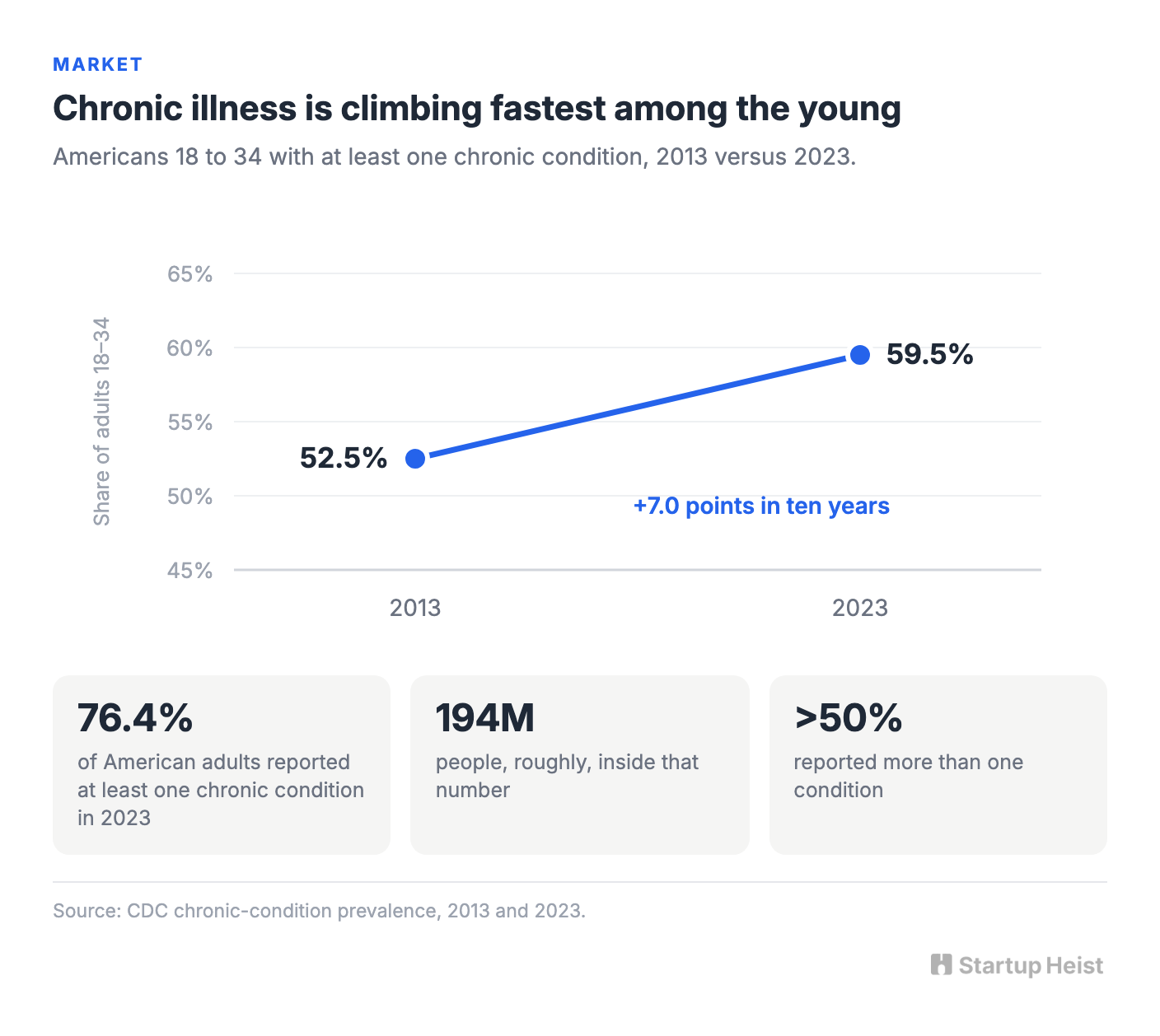
In 2023, 76.4% of American adults reported at least one chronic condition. That's roughly 194 million people. More than half reported multiple conditions. The trend among young adults is the part that should get your attention: among Americans ages 18 to 34, the share with at least one chronic condition climbed from 52.5% in 2013 to 59.5% in 2023.
Those numbers describe a market. They say nothing about what to build.
A generic chronic condition tracker has no customer. Diabetes management, tinnitus, chronic pelvic pain, vestibular migraine, POTS, and Long COVID produce completely different logging behaviors, vocabularies, clinical questions, and emotional loads. A symptom tracking app that covers all of them is useful to nobody.
The useful definition is narrower: people with one fluctuating condition who repeatedly fail to reconstruct their own recent history in a medical appointment. Nobody wakes up wanting to track health data. They wake up wanting to know why yesterday collapsed, whether the same thing happened two weeks ago, and how to avoid being reduced to "I feel bad a lot" in front of a clinician with twenty minutes and a full waiting room.
Why This Window Is Open Now
Two things changed between June 2025 and January 2026, and they push the same way.
The specialty infrastructure is collapsing. In 2022, more than 400 U.S. hospitals and clinics claimed to offer Long COVID care. Most are gone. The University of North Carolina closed its Long COVID clinic in June 2025 after treating more than 3,500 patients from over 20 states. Honolulu's Post-COVID Care Clinic shut on June 30, 2025. In San Antonio, wait times at a surviving center doubled from roughly two months to four as Houston and Dallas clinics folded. Patients land back in primary care, where nobody has a specialist's mental model of post-exertional malaise and nobody has an hour. Every closure converts a patient with a specialist into a patient who has to explain themselves from scratch.
The second shift is regulatory. On January 6, 2026, the FDA published revised final guidance on its General Wellness Policy for Low Risk Devices and on Clinical Decision Support Software, replacing the 2019 and 2022 versions. The revision expands what counts as a low-risk general wellness product that doesn't need premarket review, explicitly including sensor-based wearables that avoid disease, diagnostic, and clinical management claims, and it carves out enforcement discretion for certain lower-risk decision support software.
A journal that records what a patient observed and hands it back to them sits comfortably inside that lane. A product that tells them what it means doesn't. The line is sharper than it was before that revision, which helps anyone willing to stay on the right side of it.
Meanwhile the clinical reality hasn't moved. There's still no validated lab test for Long COVID. The NIH RECOVER study examined 25 routine clinical lab values across nearly 10,000 adults and found no reliable biomarker. Diagnosis and management still depend on detailed patient history. The patient's own account is the primary evidence, and it's being collected on the back of receipts.
The Field Is Crowded and Still Missing the Point
There's no empty space here, which is the first sign the demand is real.
Symptrac sells fast logging, heat maps, on-device pattern detection, and doctor-ready PDFs at $6.99 monthly or $49.99 a year on iOS. Trace is free, local-first, account-free, with 60+ symptoms and PDF reports. Bearable spans symptoms, mood, pain, sleep, medication, habits, and cycles at $6.99 monthly or $34.99 a year. Guava goes wider still, pulling in patient-portal records, lab imports, family profiles, and AI visit prep for $78 a year. The pattern across all of them is expansion: more inputs, more dashboard.
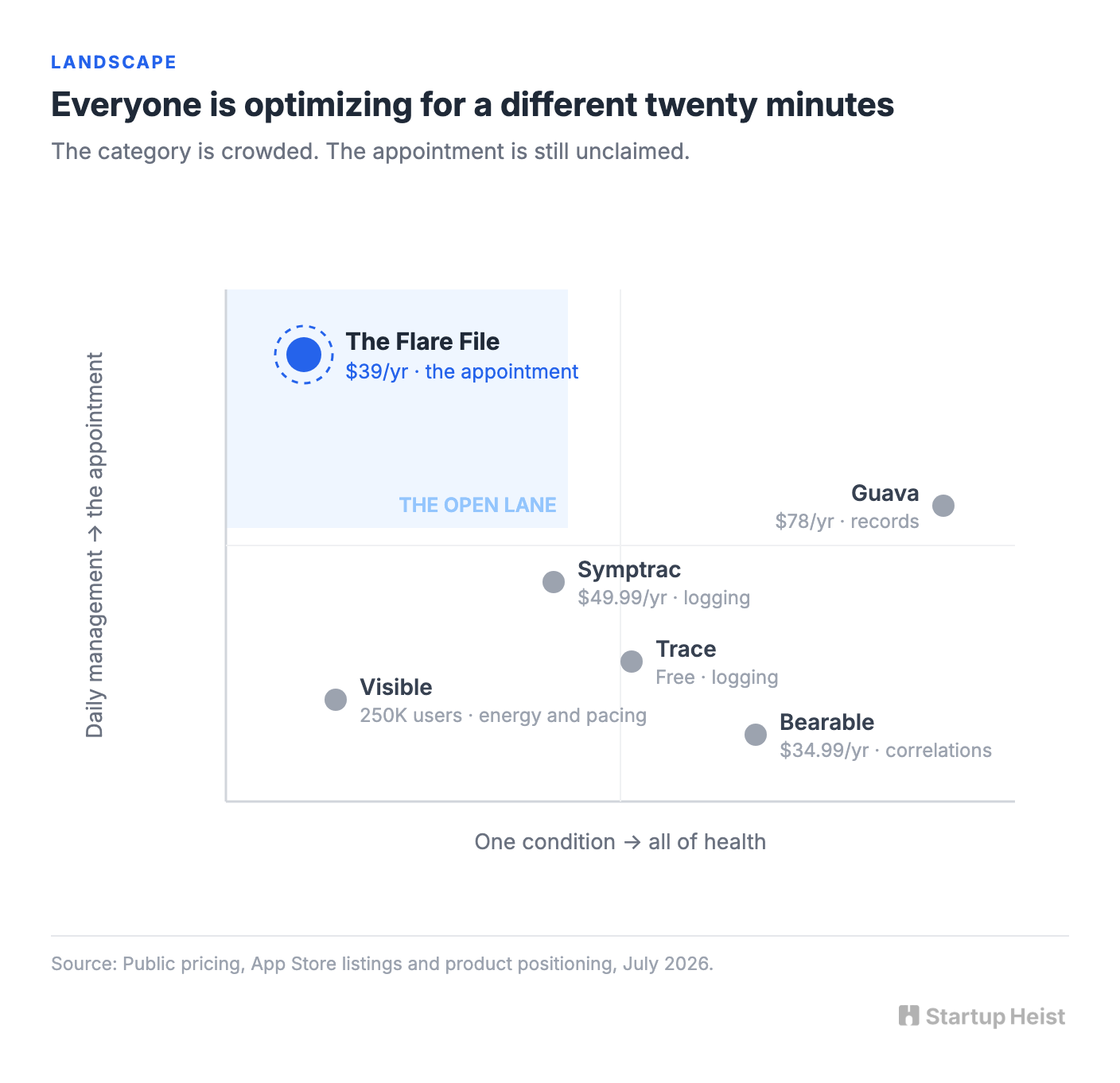
Visible is the sharpest comparison. Built specifically for Long COVID, ME/CFS, POTS, and fibromyalgia, it combines symptom logging with pacing, camera-based heart-rate variability readings, an optional wearable band, and research participation. More than 250,000 people use it, and its App Store listing carries 4.8 stars across about 3,400 ratings. Visible proves this community adopts software built specifically for them. It also marks the turf you shouldn't fight on: pacing, biometrics, hardware, all-day monitoring.
Look at what each product optimizes for and the hole appears. Visible manages energy, Guava consolidates records, Bearable surfaces correlations, and Symptrac and Trace log symptoms. Nobody is optimizing for the twenty minutes when a patient has to make a stranger in a white coat understand a year of invisible illness. Everywhere else the report is an export feature. Here it carries the whole value.
Build a One-Button Experience
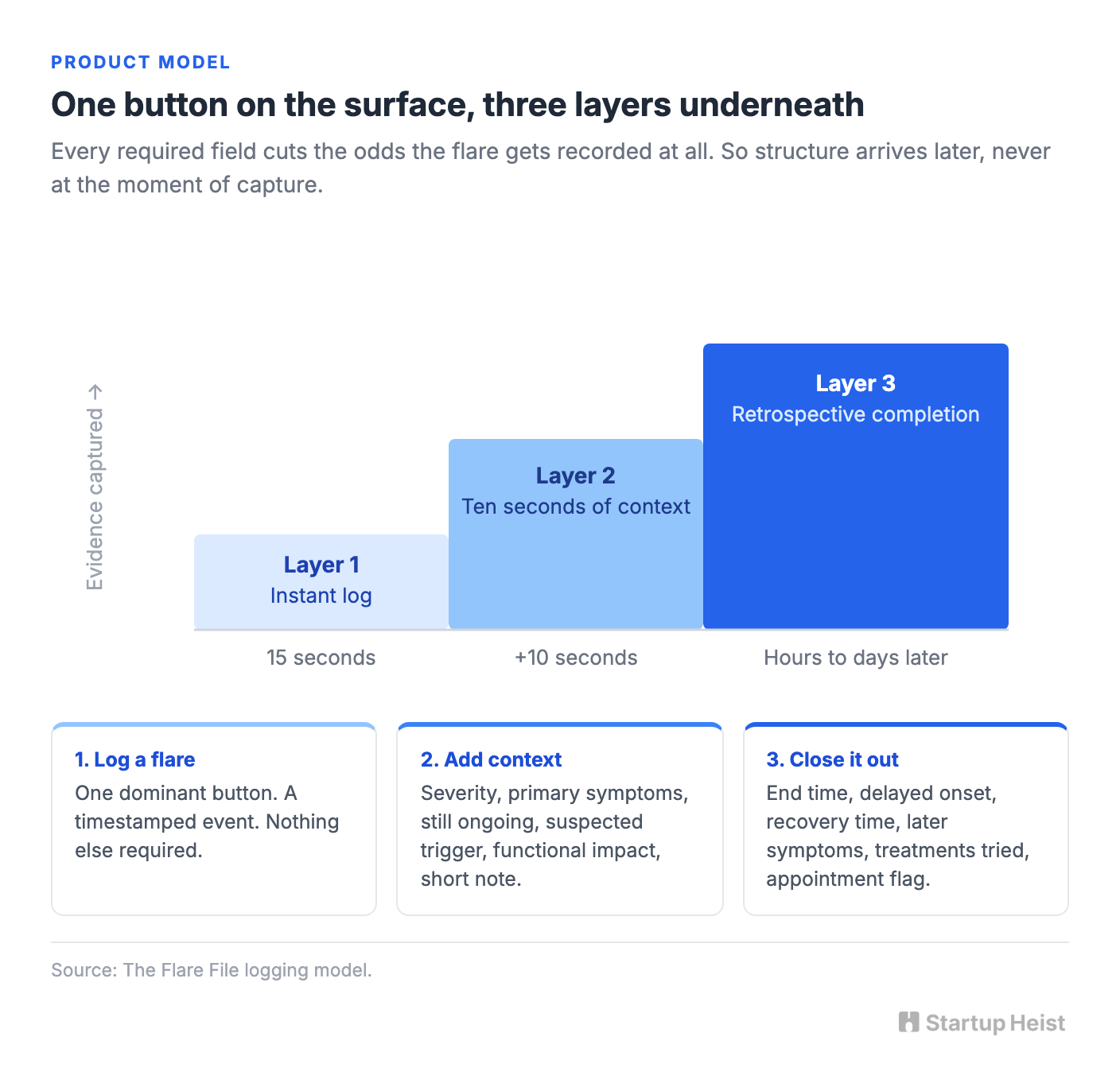
A literal one-button tracker is trivial to build and impossible to charge for. "Flare happened" plus a blank note field is Apple Notes with worse search. The interface should feel like one button while the record underneath carries enough structure to produce something a clinician will read.
That takes three layers.
Unlock the Vault.
Join founders who spot opportunities ahead of the crowd. Actionable insights. Zero fluff.
“Intelligent, bold, minus the pretense.”
“Like discovering the cheat codes of the startup world.”
“SH is off-Broadway for founders — weird, sharp, and ahead of the curve.”


