


The Film Lab OS: A Boring Vertical SaaS Hiding Inside the Analog Boom
Film photography is supposed to be slow. That's part of the appeal.
There's a difference between slow as a creative ritual and slow because a lab is buried under paper envelopes, Instagram DMs, Dropbox links, handwritten order forms, and "hey, just checking on my scans" emails. That gap is the opportunity.
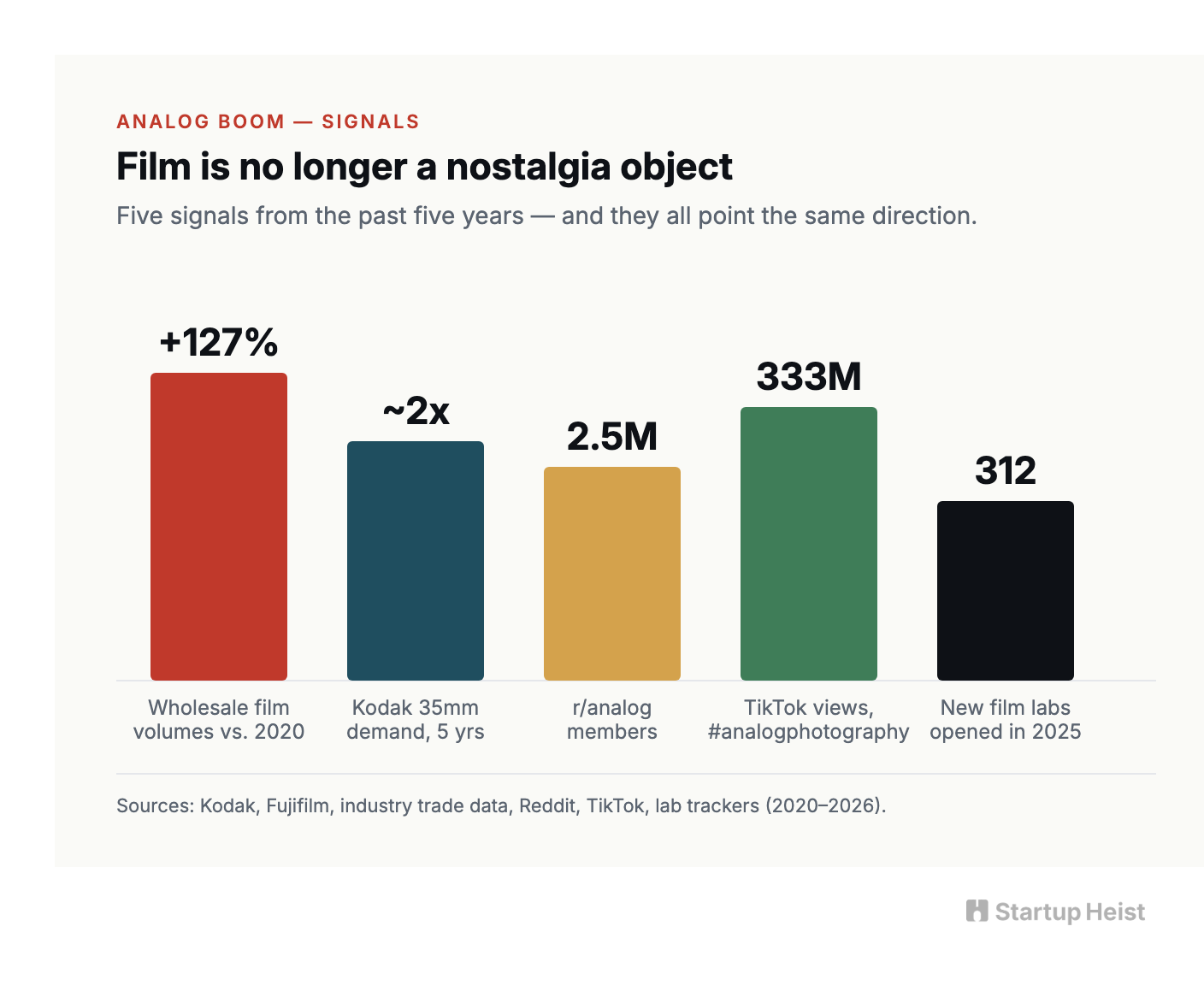
Film has quietly moved from nostalgia object to live consumer behavior. Kodak has poured tens of millions into expanding its Rochester film plant, including a major equipment overhaul completed in late 2024. Fujifilm has invested roughly $74 million across multiple rounds since 2022 to expand Instax production at its Ashigara factory, with capacity now 40–50% above pre-expansion levels. Kodak has said 35mm demand has roughly doubled over the past five years. On TikTok, #analogphotography crossed 333 million views. Reddit's r/analog holds more than 2.5 million members. Close to half of new film camera buyers in developed markets are 18 to 34.
Here's the wedge worth stealing:
The money: 100 paying labs at $200–$350 a month is $240K–$420K ARR for a solo founder. Toast proved the same software-plus-payments mechanic at far larger scale.
Inside:
• 6-surface MVP scope for film lab ops
• Three-tier pricing with embedded payments
• Founder-led GTM with outreach template
• Four moat layers worth compounding
Why Now: The Bottleneck Isn't Desire
A modern film customer can discover a camera on TikTok, buy a roll of Portra from an online shop, shoot it at a wedding, and then hit a wall: where do I send this, did the lab receive it, when are my scans ready, can I reorder prints, where is the download link.
On the other side is the indie film lab owner. No VC-backed operation with a product team here. It's a chemically regulated, labor-intensive, semi-retail, semi-mail-order business where every roll has to be received, labeled, developed, scanned, uploaded, invoiced, and returned. Film processing also carries real operational burden. Photo processors generate hazardous waste under EPA rules, and silver-bearing fixer and wastewater require recovery, recycling, or careful disposal.
The wedge is the operating system for indie film labs. No photo-editing tool. No Lightroom plugin. No gallery app for photographers. A vertical SaaS product for film lab operations: online order intake, QR-coded roll tracking, scan delivery, payments, notifications, reprint sales, customer history, and eventually lab analytics.
Sell shovels to the analog gold rush.
The Market Is Small, But the Pain Is Concentrated
This isn't a billion-dollar software category hiding in plain sight. It's probably never going to be the next Toast. But it has Toast-shaped mechanics at niche scale.
The numbers point in one direction. The global film developing service market was valued near $1.2 billion in 2024 and is projected to reach $1.8 billion by 2033. Wholesale film volumes are up roughly 127% since 2020. Industry trackers count more than 2,400 verified film processing labs operating worldwide, with an estimated 312 new labs opening globally in 2025, a number that would have been unthinkable a decade earlier. A wave of new indie labs has opened across North America, with new operations in cities like Toronto and Austin.
The exact market-size figure matters less than the shape of the pain. Film labs sit at the intersection of five forces.
- Repeat consumer behavior. Film shooters come back. A casual customer may shoot one roll a month. A traveler may drop off five rolls after a trip. A wedding photographer may submit dozens in a single season.
- High-anxiety order status. Each roll is irreplaceable. Customers want reassurance that their negatives haven't vanished.
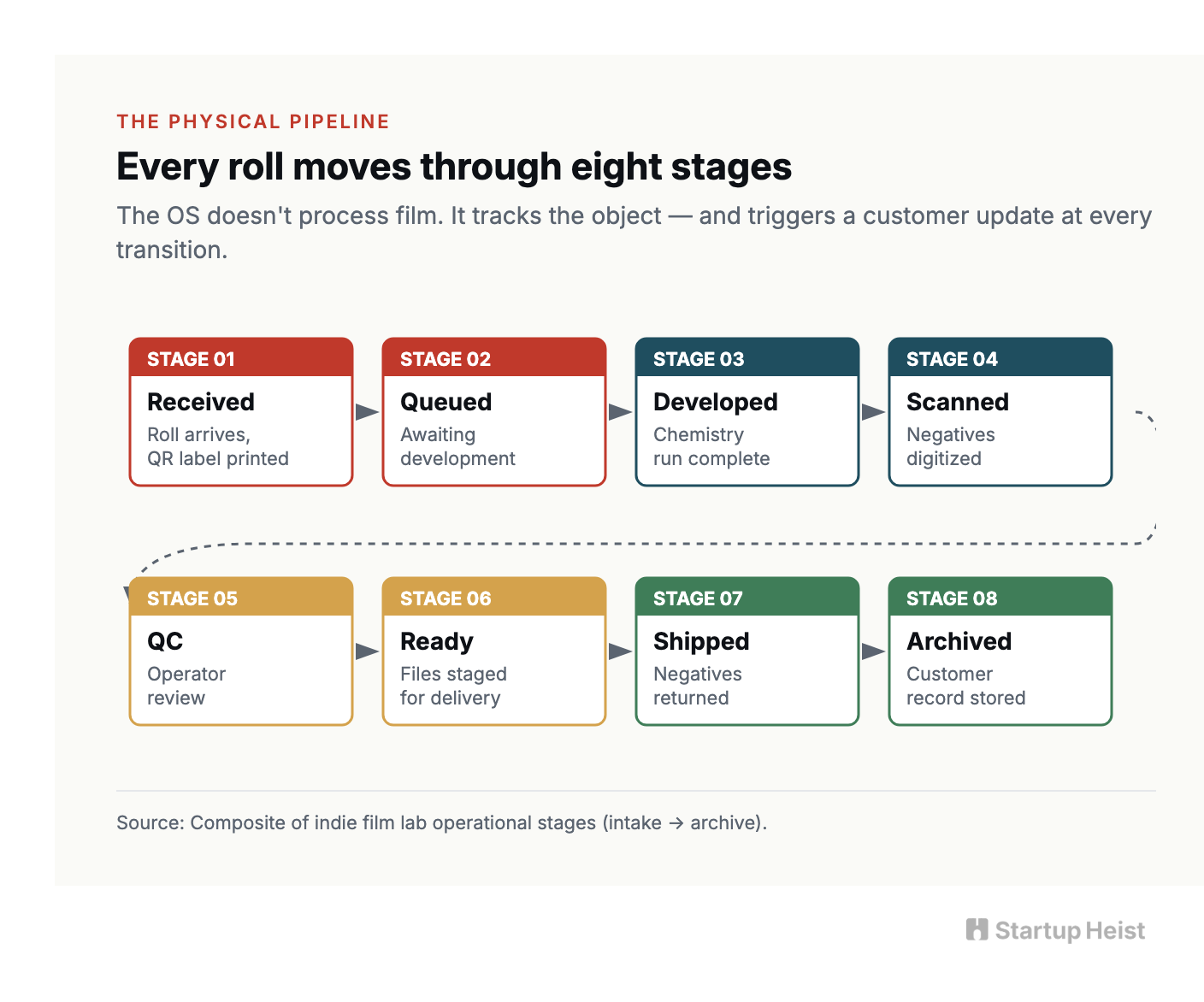
- Manual internal workflow. A lab moves physical objects through stages: received, queued, developed, scanned, QC'd, uploaded, shipped, archived.
- Digital delivery expectations. Customers expect online payment, email and SMS updates, clean download pages, and mobile-friendly galleries.
- Fragmented supply. The market has a long tail of indie labs, local labs, artist-run labs, camera shops, darkrooms, and mail-in specialists.
The best SaaS opportunities are rarely "big market, obvious software." They're "small market, painful clipboard." Every indie lab in the world is running on some version of that clipboard right now.
What Exists Today
The competitor landscape is deceptive because photo software is crowded. Most of it points the wrong direction.
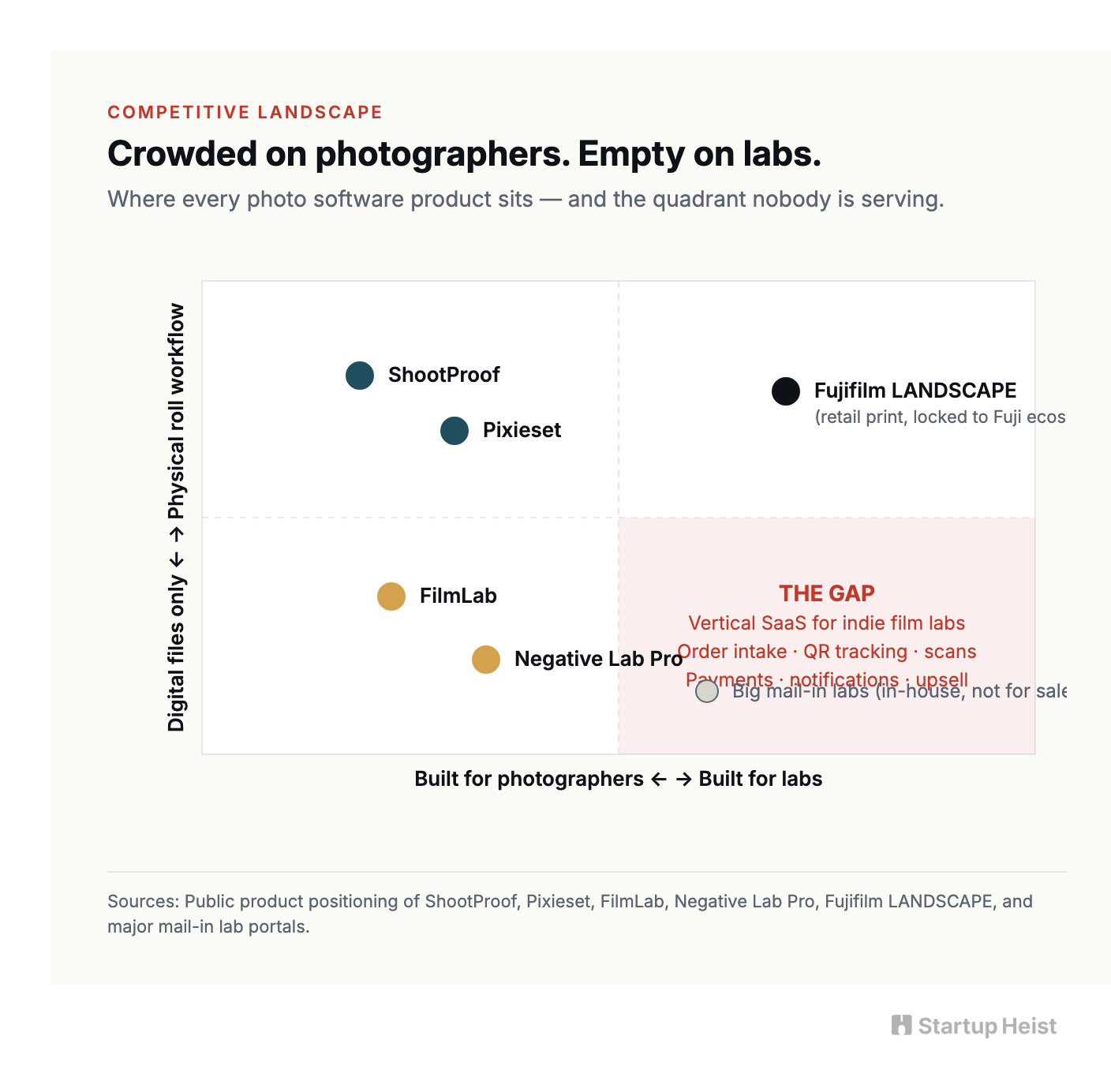
There are mature tools for photographers, with ShootProof and Pixieset being the names that come up. They help photographers deliver galleries, sell prints, sign contracts, send invoices, and fulfill orders through partner print labs. Both are excellent at what they do, which is everything that happens after a photographer already has digital files. Neither runs a film lab. Tools like FilmLab and Negative Lab Pro help individual photographers convert scanned negatives into positive images, useful for hobbyists but not lab operations. Fujifilm's LANDSCAPE handles retail photo lab workflow but is tied to Fujifilm's broader print ecosystem. The big mail-in labs like The Darkroom, Richard Photo Lab, and theFINDlab have built their own portals to handle online ordering and scan delivery. The successful labs all have software. None of them sell it.
The gap is a Shopify-for-film-labs product that a small lab can install without becoming a software company.
The Product: A Film Lab Operating System
The MVP shouldn't try to process images, color-correct scans, or replace lab equipment. That's the trap.
The lab already has scanners, chemistry, printers, Dropbox folders, Google Drive links, WeTransfer, Stripe, Square, spreadsheets, and muscle memory. The first product should sit around the workflow, not inside the chemistry. Six surfaces.
1. Branded Online Order Intake
Each lab gets a branded order page. Customers pick:
- Film type: 35mm, 120, 220, 110, disposable, sheet film
- Process: C-41, B&W, E-6, ECN-2, push/pull options
- Scan quality: standard, enhanced, TIFF, JPEG, flat, corrected
- Add-ons: prints, contact sheet, rush service, return negatives, sleeve options
- Shipping or drop-off method
- Payment at checkout
- Customer notes
This alone is valuable because many labs still make customers download a PDF, fill out a form, write on a bag, or explain everything in an email. The order form should be opinionated. Labs shouldn't need to configure 500 settings. Ship templates for the common lab archetypes: local drop-off lab, mail-in lab, wedding and pro photographer lab, B&W specialty lab, student and community darkroom.
2. QR-Coded Roll Tracking
Every order generates a printable QR label. The lab prints the label or writes a short code on the envelope. Staff scan the code at each stage:
- Received
- In development queue
- Developed
- Scanned
- QC needed
- Ready for delivery
- Negatives returned or shipped
- Problem or order exception
This is the psychological killer feature. Customers don't need to see every internal detail. A clean "we received your roll" and "your scans are now in scanning" update reduces inbound support. For a lab owner, fewer "any update?" messages is real labor savings.
3. Staff Dashboard
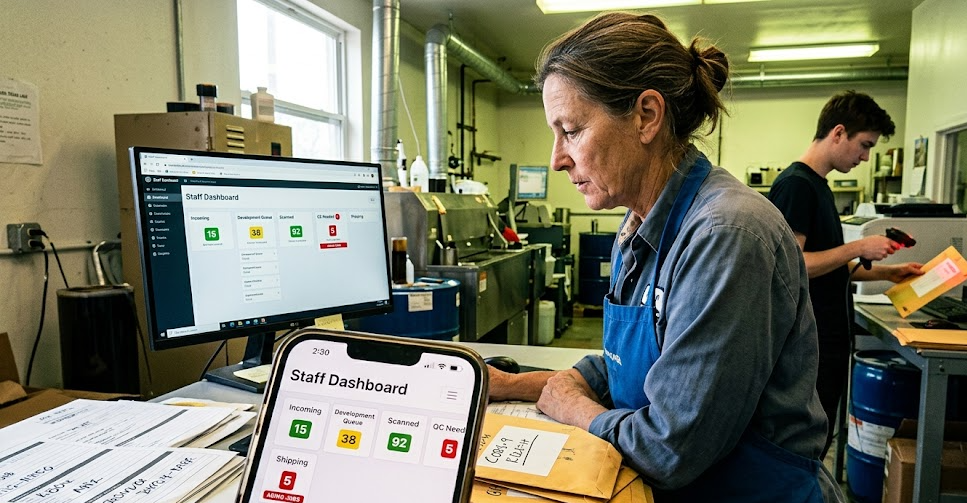
The admin dashboard should feel like a production board: today's incoming orders, rolls by status, rush jobs, aging jobs, problem orders, orders missing payment, orders missing customer choice, batches ready for scan upload, shipping queue. The dashboard should answer one question: what needs attention now. Build the lab owner's morning cockpit, not a generic task manager.
4. Scan Delivery Portal
When scans are ready, the customer gets a branded gallery and download page. Download all scans, view gallery, reorder prints, buy higher-resolution scans, order a photo book or contact sheet, request rescans or support, save order history. Storage starts simple with S3-compatible object storage. The product shouldn't touch image processing. It should deliver files cleanly and track customer activity.
5. Payments and Upsells
Use Stripe or Stripe Connect. Labs can collect payment upfront, hold card on file, or invoice on completion. Support card payment, Apple Pay and Google Pay, rush fees, shipping fees, reprint orders, refunds, store credit, promo codes, prepaid roll bundles, memberships.
This is where the business model gets interesting. If the SaaS owns checkout, it can charge subscription, transaction fees, or both. That two-lever structure is what made Toast work: financial technology now produces about 82% of Toast's revenue, while software subscriptions account for roughly 14%.
6. Notifications
Automated SMS and email triggers: order received, roll received, processing started, scans ready, payment needed, negatives shipped, reprint offer, "it's been 30 days, want prints?" This is part of the labor replacement. The lab owner isn't paying for software. They're paying to stop answering the same five questions 40 times a week.
MVP Scope
A real MVP can be built in 8 to 12 weeks by one strong full-stack founder or a small two-person team. Keep it brutally narrow:
Unlock the Vault.
Join founders who spot opportunities ahead of the crowd. Actionable insights. Zero fluff.
“Intelligent, bold, minus the pretense.”
“Like discovering the cheat codes of the startup world.”
“SH is off-Broadway for founders — weird, sharp, and ahead of the curve.”


