


Turn a Customer List Into a Creative Supply Chain
A consumer brand that keeps hunting for the right influencer is usually solving the wrong problem. What it actually runs out of is footage.
The paid-social team needs a steady supply of fresh video: new hooks, new faces, new use cases, new demonstrations. An agency makes polished work slowly and expensively. An influencer marketplace supplies people, but every campaign restarts the same cycle of discovery, negotiation, briefing, and contracting. Meanwhile the brand is sitting on 50,000 past customers, a few hundred of whom like the product enough to talk about it on camera for a $75 gift card.
The opportunity is a lightweight operating system that turns those customers into repeat contributors and converts their output into a searchable library of rights-cleared paid-social creative. The pieces are already in the building, just filed under the wrong names. The customer list is a talent pool. Weekly missions are a production schedule. Product samples and store credit are the budget, rights management is what turns a casual post into a reusable asset, and performance data decides who gets the next brief.
Build that loop well and a mid-sized Shopify brand operates something that behaves like a hundred-person creative studio without hiring anyone.
The money: Twenty brands at $1,250 a month is $25,000 MRR before managed retainers. Roster already clears $725 a month for less.
Inside:
• Full MVP scope for the mission-to-library loop
• Four-tier pricing from $750 to $6,000 a month
• Cold email and the pre-pitch creative audit
• The 45-day pilot model and its real numbers
Target Already Validated the Thesis
On May 6, 2026, Target launched Club Target, a gamified program for what it calls its biggest fans and everyday creators. Members complete weekly Instagram and TikTok challenges, earn points for engagement and affiliate revenue, and climb tiers toward gift cards, features on Target's own channels, exclusive events, and eventually commissions. The entry requirement is 500 followers on Instagram or TikTok. Target leaned on research from creator platform GRIN, which found that 74% of U.S. consumers have bought something because of creator content.
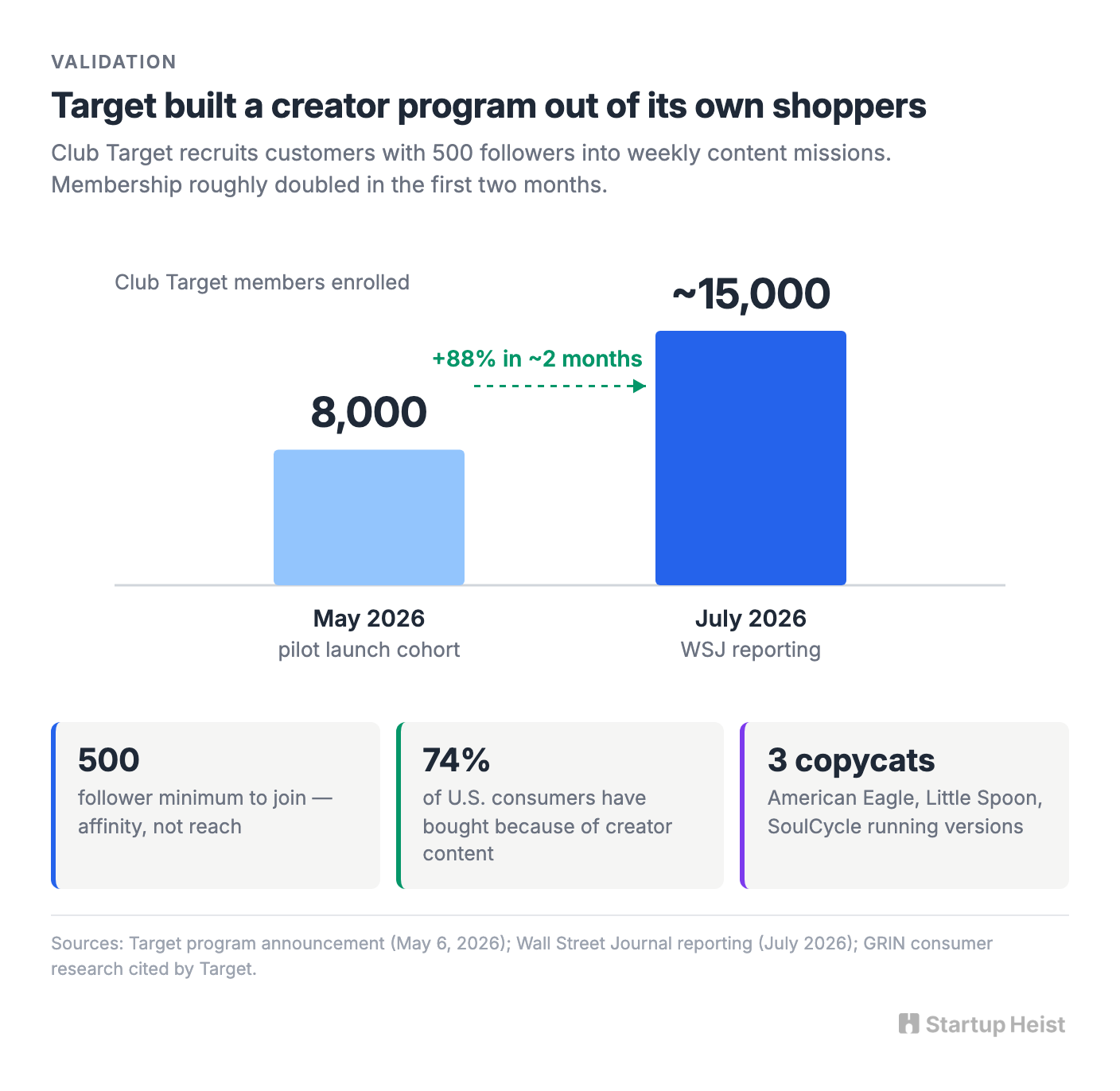
The May pilot signed up roughly 8,000 creators. By July 2026, Wall Street Journal reporting put membership near 15,000 and noted that American Eagle, Little Spoon, and SoulCycle are running versions of the same play.
Five hundred followers isn't an audience, which is exactly what makes the program worth studying.
The old influencer marketing playbook started with reach: find someone with distribution, pay for access to it, ask them to feature the product, count impressions. Club Target starts somewhere else. It begins with affinity. Someone who already bought the thing gets a specific brief and a reward for the work, the footage gets reused everywhere, and the reliable contributors get invited back.
Target runs the other motion too. Its Ambassadors program, operated through LTK, courts established influencers with real audiences. Club Target is the second track, and the split is the tell. A customer with 700 followers won't move inventory organically. That same customer can shoot a twenty-second demonstration that becomes the highest-performing ad in a Meta account. Distribution and production have quietly separated, and almost nobody is selling software to the production side of the split.
The Creative Deficit Is Arithmetic Now
This is a business rather than a nice idea because the ad platforms turned creative volume into a hard requirement.
Meta's guidance for Advantage+ campaigns now runs to dozens of differentiated assets per ad set. The working floor most practitioners cite is 20, and Meta's own recommendation for shopping campaigns goes far higher. Creative diversity replaced audience targeting as the primary performance lever. TikTok is more brutal. Its guidance is to refresh creative at least every seven days, shipping three to five meaningfully different videos per ad group every week to ten days.
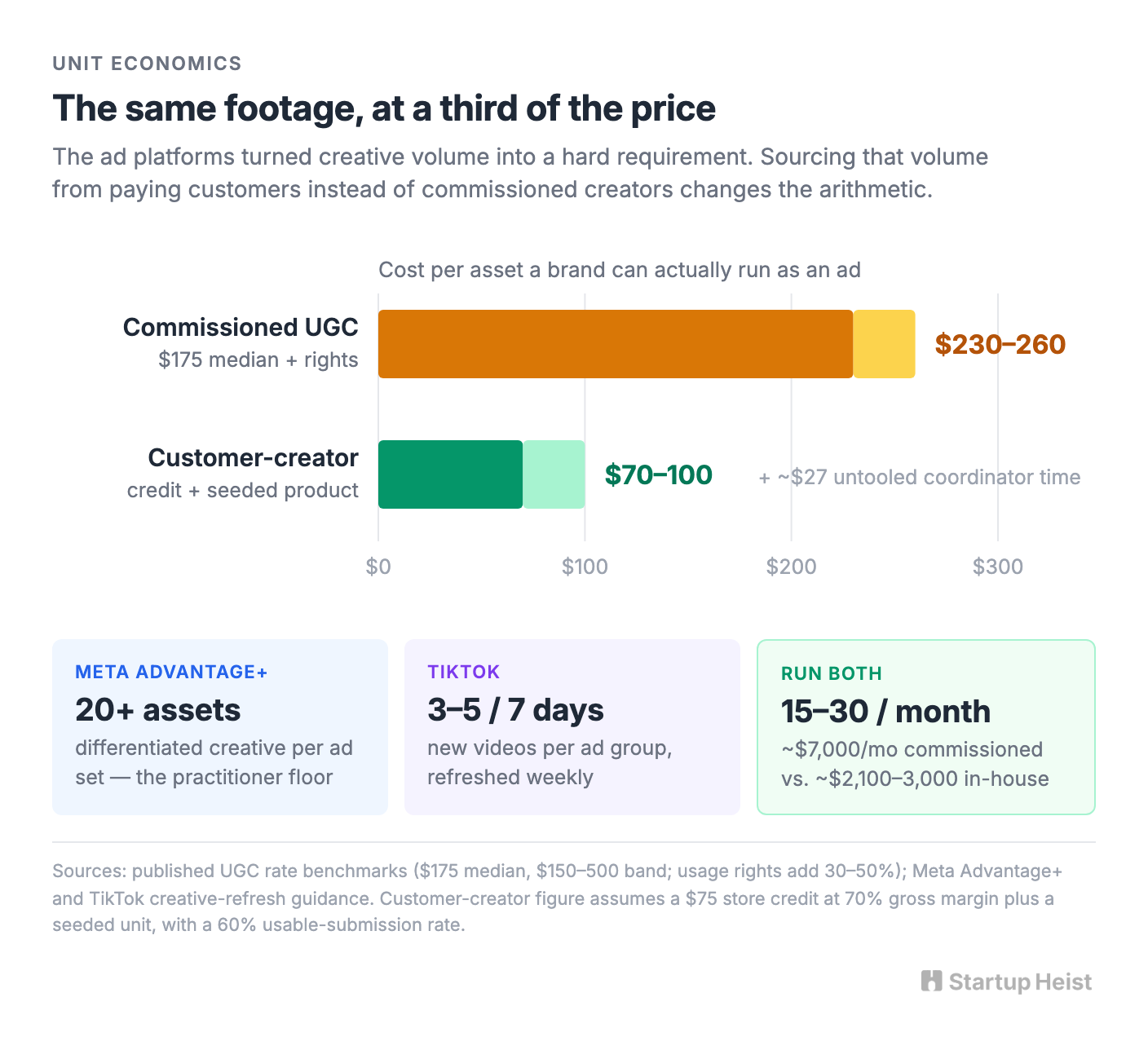
Run both channels seriously and the brand needs somewhere between fifteen and thirty genuinely new assets every month, forever.
Now price that. The going market rate for a commissioned UGC video sits around a $175 median, with the broad band running $150 to $500 depending on complexity. Usage rights add another 30% to 50% on top. Call it $230 to $260 for a single video a brand can actually run as an ad. Thirty of those is roughly $7,000 a month in creator fees alone, before anyone manages the process.
Against that, a customer-creator program pays in store credit and product. A $75 credit on a product carrying 70% gross margin costs the brand about $23 in real COGS. Add a seeded unit and the all-in cost per contributor lands near $40 to $60. Even if only 60% of submissions are usable, the cost per approved asset comes in around $70 to $100.
That's a two-to-three-times improvement on the same output, and it's the rare pitch that survives contact with a CFO.
The catch is labor. Somebody has to pick the cohort, write the brief, chase the deadline, review the footage, capture the rights, and send the gift card. Twenty hours a month of a coordinator's time is another $800 or so, which quietly adds $27 to every asset and climbs fast without tooling. The software exists to drive that number down, and the metric it lives or dies on is operator hours per approved asset.
The Field Is Crowded, and That Is Fine
There's no honest way to pitch this as an empty category.
LTK moves more than $5 billion in annual retail sales across 9,000-plus retailers and 400,000-plus creators, supporting over 55,000 creator-brand collaborations a year. Bazaarvoice sits on 13,000-plus brand and retail sites and can point to results like Molton Brown's 54% lift in revenue per visitor and 43% lift in conversion when shoppers engage with reviews. Duel raised a $16 million Series A in September 2025 to sell advocacy programs to Lush, ELEMIS, Victoria's Secret, and Abercrombie & Fitch. Roster sells ambassador management through Shopify starting at $725 a month and $1,450 for the next tier. Brandbassador ships 200-plus prebuilt mission templates and lists free on the Shopify App Store. Kale runs the opposite motion entirely, giving brands access to a pool of everyday creators with no follower minimum who get paid within 48 hours of posting. Its 2023 OLIPOP campaign, where customers poured soda into wine glasses, is still the case study the industry cites: hundreds of posts and a genuine trend.
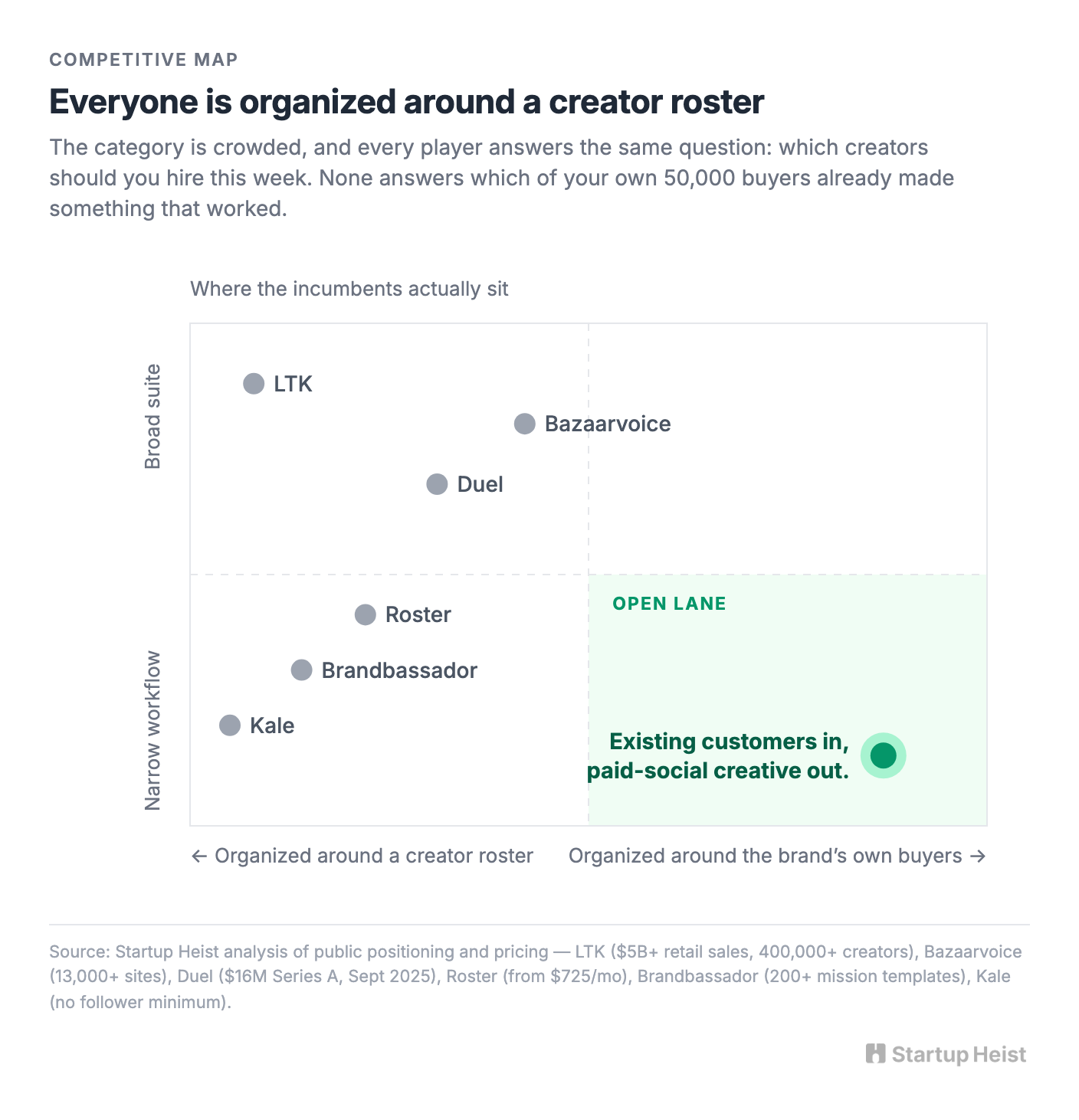
The pattern in that list matters more than its length. Every player is optimized around a creator roster: who they are, what they reach, how to pay them. Almost none are optimized around a specific brand's own buyers and what those buyers have already produced.
LTK's Quick Collabs, launched in March 2026, is the honest complication. It lets brands spin up flat-fee campaigns in minutes with creators paid inside 48 to 72 hours, which is precisely the low-friction mechanic a new entrant would want to claim as its wedge. The gap is narrower than it was a year ago. It's still the right gap, because Quick Collabs points a brand at LTK's roster. It answers which creators to hire this week. It does not answer which of your own 50,000 buyers already made something that worked.
The incumbents are broad because their enterprise accounts demand breadth. A new entrant gets to be narrow, because the customer it wants needs speed more than it needs surface area.
So the discipline is subtraction. No public creator marketplace, no affiliate network, no referral or commission engine as the lead, no enterprise social listening, no full loyalty platform, no integration arms race. The moment the pitch becomes "all-in-one creator marketing suite," the deal turns into a feature bake-off against companies with twenty times the engineering budget. One sentence has to survive all of it: existing customers in, paid-social creative out.
Who Actually Buys This
A small store with 300 buyers is the wrong first customer. Not enough volume, not enough staff, no ad budget to feed.
Unlock the Vault.
Join founders who spot opportunities ahead of the crowd. Actionable insights. Zero fluff.
“Intelligent, bold, minus the pretense.”
“Like discovering the cheat codes of the startup world.”
“SH is off-Broadway for founders — weird, sharp, and ahead of the curve.”


