


There is a real business hiding inside those spammy "start a faceless finance YouTube channel" trend. Most people will copy the shallow version — AI voiceovers, whiteboard animations, generic tax explainers — and wonder why it flatlines. The real opportunity is narrower, stickier, and far more valuable.
The play: build the tax-and-compliance media layer for one specific income tribe. Creators, Airbnb hosts, Etsy sellers, freelance consultants, truckers, real estate agents, cross-border freelancers, gig workers. These people search with urgency, not curiosity. They are trying to avoid penalties, save money, and make a decision this week. That urgency is what separates this niche from the content graveyard — and it's what makes this one of the better solo business ideas hiding in plain sight.
Clone the engine into two or three adjacent tribes and you're running a six-figure monthly media business off an audience most creators would consider "boring." If you've been hunting for a content-led micro SaaS idea or a side business with real unit economics, this is the unsexy cousin that actually prints money.
Why This Works Now
U.S. creator-economy ad spend is projected to reach about $37 billion in 2025, up roughly 26% year-over-year — about 4x faster than overall media industry growth. Nearly half of ad buyers now consider creators a "must buy." YouTube still explicitly rewards advertiser-friendly, brand-safe content, and finance consistently commands the platform's highest CPM rates. Benchmark data places personal finance and tax education in the $15–$40+ CPM range for U.S. audiences, while entertainment and gaming sit at $2–$8. The gap is structural: a single credit card customer is worth $500–$2,000 in lifetime revenue to the issuing bank, so financial advertisers can justify paying $15–$50 CPM to reach the right viewer. (Treat exact CPM figures as directional. The relative ranking is consistent across every benchmark source available.)
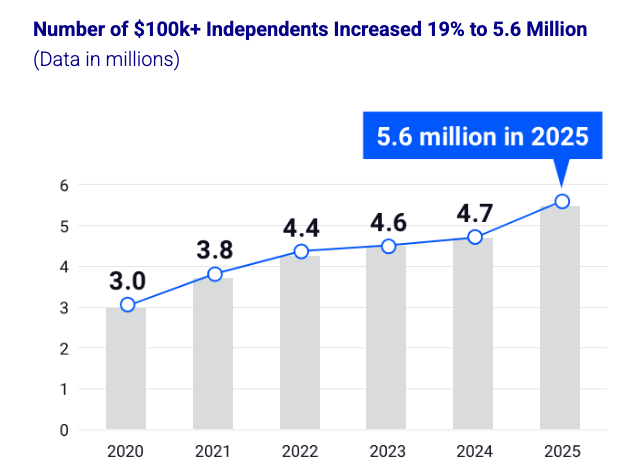
Meanwhile, roughly 72.9 million Americans now work independently — and a meaningful share earn over $100K, which means a large, economically valuable pool of "income tribes" that need tax clarity yesterday. The IRS explicitly warns that self-employment tax rules kick in at just $400 of net earnings, even if income is not fully reported on a 1099. Millions of people are earning internet-native income while feeling functionally illiterate about the tax rules surrounding it.
And the regulatory complexity machine just got louder. The One Big Beautiful Bill Act, signed July 4, 2025, made the 20% Qualified Business Income deduction permanent for pass-through entities and sole proprietors — but also introduced new phase-in ranges, minimum deduction floors, higher phaseout thresholds, and entity-structure considerations that need translating. Starting in 2026, the reporting threshold for Form 1099-NEC rises to $2,000 (up from $600, with inflation indexing going forward), the 1099-K threshold reverts to $20,000 and 200 transactions, and the self-employment tax rate remains 15.3% with the Social Security wage base climbing to $184,500. Each one of those changes is a content opportunity. Each creates confusion that needs a clear interpreter. And the IRS tax calendar — filing season, quarterly estimated payments, annual rule changes — resets this editorial engine every single year. That's the kind of recurring demand that makes this more durable content business idea than trend-chasing.
H&R Block launched a dedicated "Creator Suite" in February 2026, a tax platform built specifically for content creators. Their own survey found that 70% of creators find managing finances difficult and nearly 25% reported costly tax mistakes. That a $4 billion public company felt the need to build a dedicated creator tax product tells you the gap is real and acknowledged by incumbents. H&R Block can build software. What they cannot easily build is the trust, distribution, and niche-specific voice that a focused media property earns over time. They validated the category. The lane they left open is yours.
The Insight
Do not build a "tax channel." Build the operating manual for one economically valuable identity.
"Tax for creators." "Tax for Airbnb hosts." "Tax for Etsy sellers." "Tax for independent consultants." "US tax for new immigrants and expats." "Tax for real estate agents."
That single decision changes everything downstream. Click-through improves because the viewer feels seen. Retention improves because the examples match their world. Sponsor fit tightens because the audience is commercially coherent. Search performance sharpens because the keyword cloud becomes specific instead of generic — people search "Airbnb bonus depreciation 2026," not "what is Section 179." Over time, you start building something defensible. Generic finance channels are broad libraries. Yours becomes a trusted specialist.
The mistake amateurs will make is explaining tax law. Your actual job is translating fear into action.
Here is what that looks like in practice:
| Weak Content (Library Mode) | Strong Content (Money Mode) |
|---|---|
| "What is Section 179?" | "Can Airbnb hosts still use bonus depreciation in 2026?" |
| "Estimated taxes explained" | "You made $120K freelancing in Q1. Here's what to do before the next deadline." |
| "LLC vs. S-Corp overview" | "When a solo creator should switch to S-Corp — with the break-even math" |
Library content educates. Money content drives decisions. The second kind earns trust, earns clicks, and earns affiliate commissions.
The Real Business Model
AdSense is the bait. The business is a four-layer revenue stack:
Layer 1: Search-driven video media. Long-form YouTube videos (7–12 minutes) capture intent-rich search and recommendation traffic. These are the workhorses. Shorts support distribution and awareness but are not the core money engine. Shorts RPMs average roughly $0.05–$0.30 per thousand views, compared to $10–$25 for long-form content targeting U.S. audiences. Long-form is where the CPM economics actually work.
Unlock the Vault.
Join founders who spot opportunities ahead of the crowd. Actionable insights. Zero fluff.
“Intelligent, bold, minus the pretense.”
“Like discovering the cheat codes of the startup world.”
“SH is off-Broadway for founders — weird, sharp, and ahead of the curve.”


