


The $1 Trillion Family-Care Economy Has a Paperwork Problem
South Korea has a name for an old family arrangement: the "full-time child." Adult children living at home treat chores and caregiving as a job, and their parents pay them for it. On September 28, 2026, the Korea JoongAng Daily profiled Shin Suh-ji, a 22-year-old who earns 600,000 won a month, about $450, for cleaning the bathroom, sorting recyclables, and folding laundry. A 29-year-old named Kim receives 200,000 won a month to make lunch for her father, help him dress, and wash his face.

America runs the same arrangement at far greater scale, mostly without a name for it. Millions of adults drive a parent to appointments, manage prescriptions, pay the bills, cook, clean, and help with bathing, sometimes for as many hours as a part-time job. A growing number of their parents pay them. Moving the money is easy; Venmo solved that years ago. The hard part arrives five years later, when a Medicaid caseworker, a sibling, or a probate attorney asks what the money was for.
Your opening is the Caregiver Compensation Record: a white-label system sold through elder-law firms that do Medicaid planning. It sets up a prospective caregiver agreement (often called a personal care agreement), documents a defensible pay rate, logs duties and hours, captures approvals and payments, gives siblings visibility, and exports an attorney-ready file the day the family needs it. You leave payroll to the specialists and own the paper trail, which is the boring part of the problem and the part with the margin. Here's the opportunity in brief:
The money: 25 firms at $499 a month is about $12,500 MRR. At 100 firms, platform fees alone reach about $50,000 MRR, before per-matter overages.
Inside:
• Eight-module MVP and a strict do-not-build list
• Firm pricing: $249 pilot to $999 Practice Plus
• Cold email and pilot plan for the first 10 firms
• Four-layer moat built on three years of records
America's Invisible Workforce Got Very Big
AARP and the National Alliance for Caregiving count 63 million Americans, nearly one in four adults, providing ongoing family care in 2025, up 20 million from 2015. About 59 million care for adults. For the first time, the survey also counted 11 million family caregivers receiving some compensation through Medicaid, the VA, or other state programs.
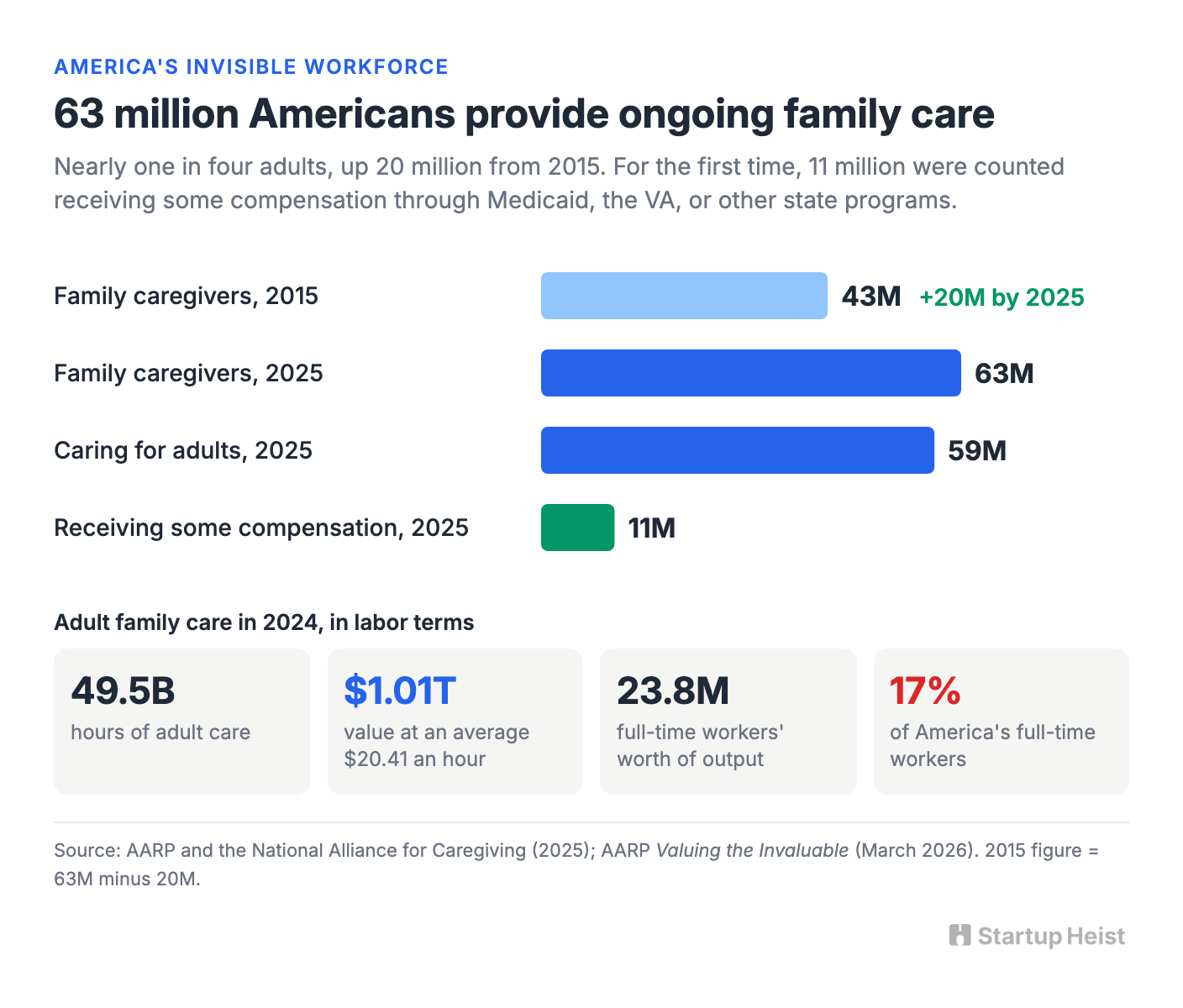
AARP's March 2026 Valuing the Invaluable update puts the output in labor terms: 49.5 billion hours of adult care in 2024, worth $1.01 trillion at an average $20.41 an hour. The hours match the output of 23.8 million full-time workers, and the dollar value exceeds what the country spent on Medicaid that year.
Resist the urge to call that a $1 trillion TAM. Most of that care is unpaid, and most families will never hire an elder-law attorney. What the number does show is that a labor force equal to 17% of America's full-time workers runs almost entirely outside the paperwork we use for ordinary employment. Once money starts moving inside a family, that gap becomes somebody's problem.
What $72,000 of Checks Looks Like Three Years Later
Take a hypothetical widowed mother in Pennsylvania who pays her daughter $2,000 a month. Everyone in the family understands the deal. The daughter cut back at work, comes over four days a week, handles appointments, meals, groceries, and medications, and stays overnight when Mom has a bad week. Mom writes checks.
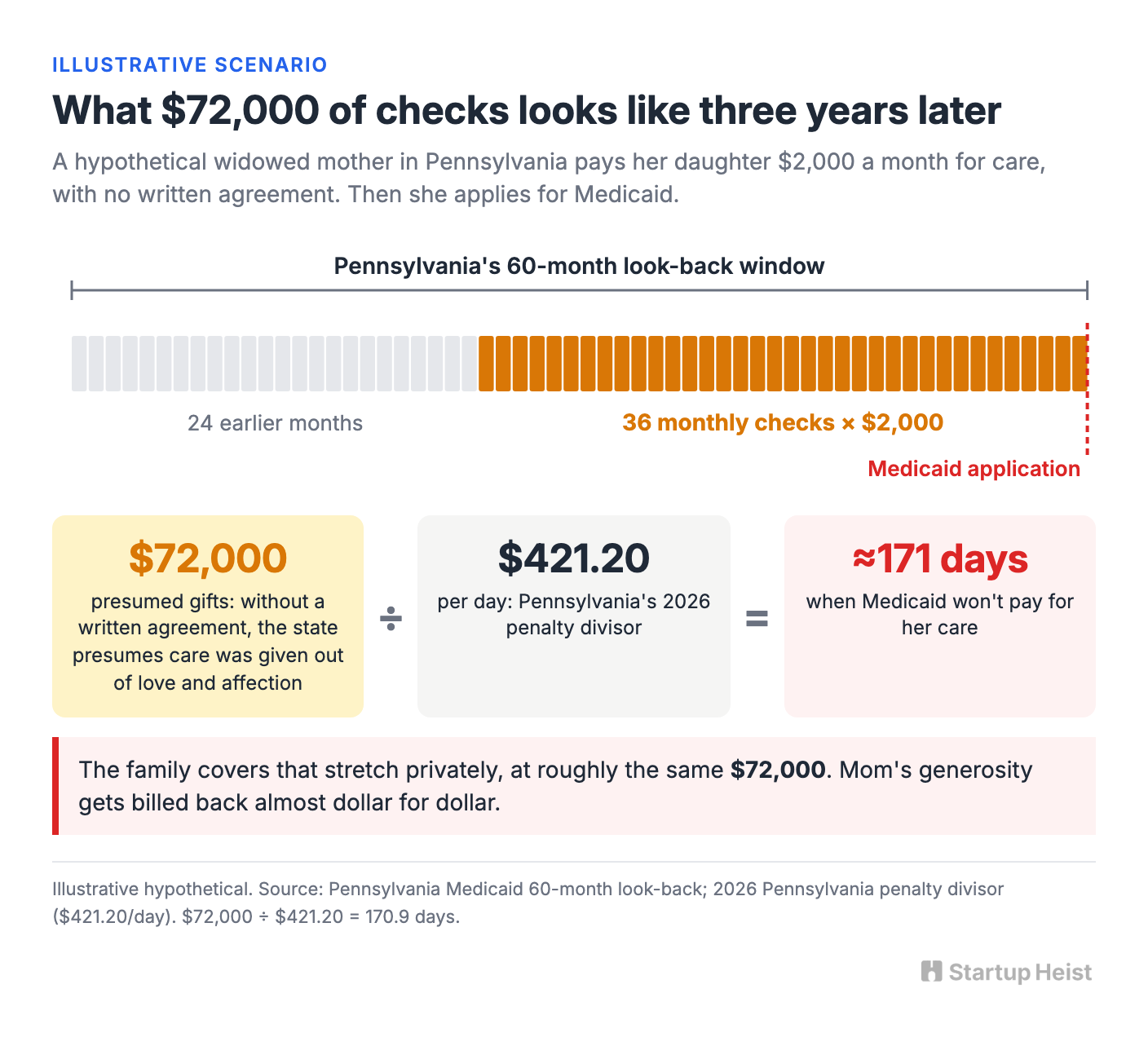
Three years later, Mom needs a nursing home and applies for Medicaid. Pennsylvania's Medicaid look-back reviews every transfer from the prior 60 months, and local elder-law attorneys describe the default bluntly: without a written agreement, the state presumes a child cared for a parent out of love and affection. Those 36 checks now look like $72,000 of gifts. Pennsylvania divides uncompensated transfers by a 2026 penalty divisor of $421.20 a day, which works out to roughly 171 days when Medicaid won't pay for her care. The family covers that stretch privately, at roughly the same $72,000, so Mom's generosity gets billed back almost dollar for dollar.
The daughter may have earned every cent, and she still has to prove it. Someone now has to reconstruct whether an agreement existed before the work, who set the rate and on what basis, what hours were worked, who authorized payments under the power of attorney, whether Mom had capacity, whether the daughter reported the income, and whether her siblings knew. A polished contract drafted after the fact proves none of it.
Provenance Is the Product
What families need is evidence with a timestamp: when the agreement was signed, which version, what changed, who approved each timesheet, which payment matched which hours, and whether an attorney can reproduce that history on demand. The startup's job is to make that record exist before anyone desperately needs it.
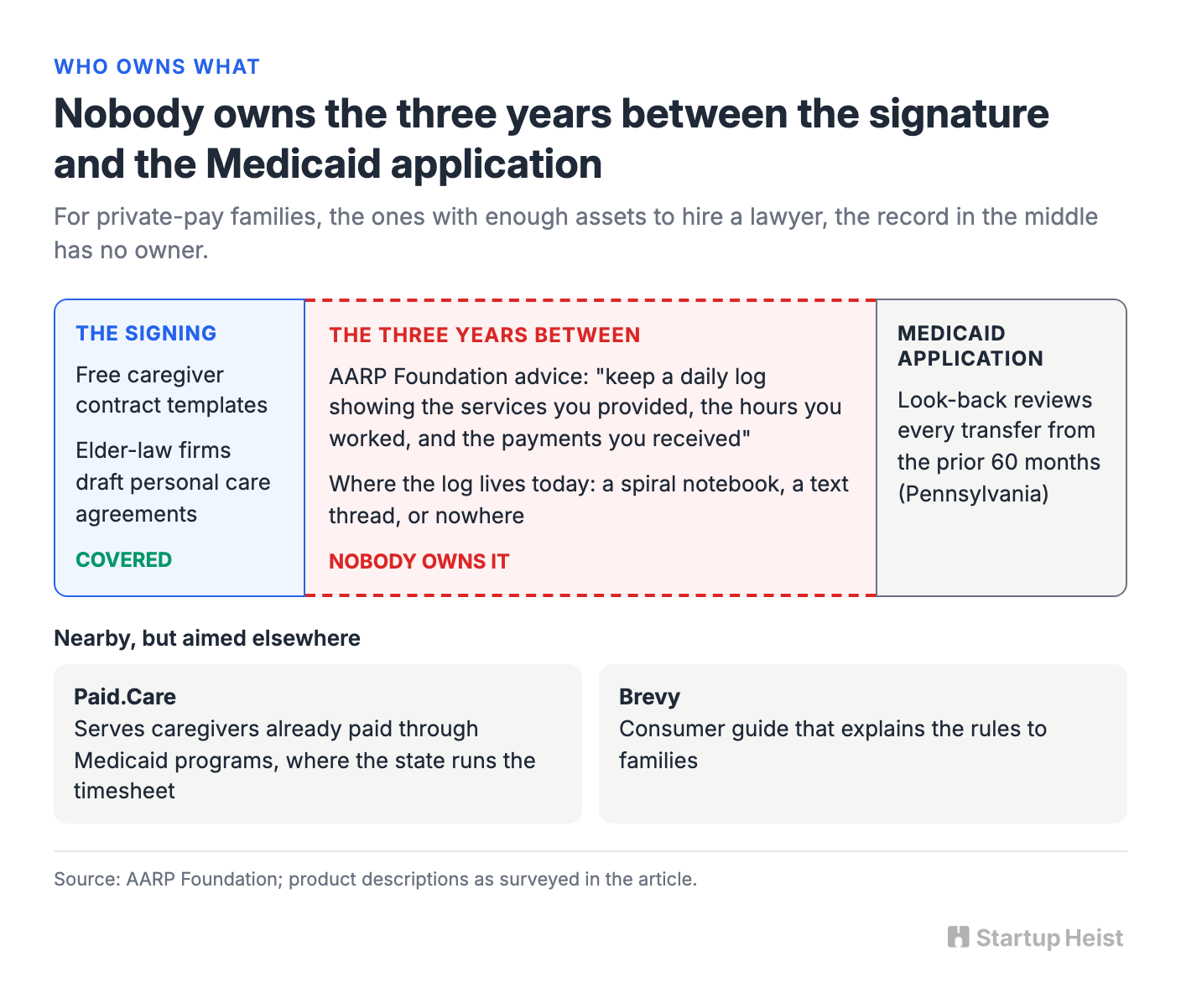
The advice already exists. The AARP Foundation tells paid family caregivers to "keep a daily log showing the services you provided, the hours you worked, and the payments you received, just in case Medicaid asks for one." Elder-law firms draft personal care agreements all the time. Then the family goes home, and the log lives in a spiral notebook, a text thread, or nowhere.
Survey what already sells around this problem and the hole is obvious. Free caregiver contract templates cover the signing. Apps like Paid.Care serve caregivers already paid through Medicaid programs, where the state runs the timesheet. Consumer guides like Brevy explain the rules to families. Nobody owns the three years between the signature and the Medicaid application for private-pay families, the ones with enough assets to hire a lawyer in the first place.
Don't Build Family Payroll
The obvious product is "Gusto for paying Mom's caregiver." Skip it. Household payroll is a mature, cheap category. Poppins Payroll charges $49 a month for one employee and handles tax registrations, payments, quarterly filings, W-2s, W-3s, and Schedule H. Care.com HomePay traces back to Breedlove & Associates, founded in 1992, and already runs referral and wholesale programs with a dashboard for accountants, advisors, and fiduciaries. Treat both as future integration partners.
Unlock the Vault.
Join founders who spot opportunities ahead of the crowd. Actionable insights. Zero fluff.
“Intelligent, bold, minus the pretense.”
“Like discovering the cheat codes of the startup world.”
“SH is off-Broadway for founders — weird, sharp, and ahead of the curve.”


