


Charge $19–$99 per use. Gross margins on AI compute exceed 99%. The median profitable micro-SaaS pulls $4,200/month; the top 1% clear $50K+ MRR with teams of one to three. If you're hunting for AI startup ideas, micro-SaaS ideas, or a solo AI business you can vibe-code and ship in a weekend — this is the fastest path from prompt to real revenue right now. And it works because you're selling clarity in a moment of panic, not "artificial intelligence."
There is a real business here, but not for the reason Twitter thinks.
The lazy version: wrap a clever prompt in a landing page, connect Stripe, post a demo, collect impulse purchases. That can work for a minute. The better version: identify a narrow moment of panic, shame, or confusion, then sell instant clarity. The prompt is just the engine. The business is emotional specificity and distribution.
Building a functional AI app from a prompt is table stakes. Prompt-to-app tools like Replit, Lovable, and Bolt.new now explicitly market this workflow to non-technical builders. Lovable hit a $6.6 billion valuation and roughly $100M ARR in under a year. Replit went from about $10M ARR at the end of 2024 to $100M+ by mid-2025 on the back of Replit Agent. Gartner-aligned forecasts project that low-code tools will account for 75% of new enterprise application development by 2026. The technical barrier has collapsed — which means "I built an AI app" is no longer a competitive statement.
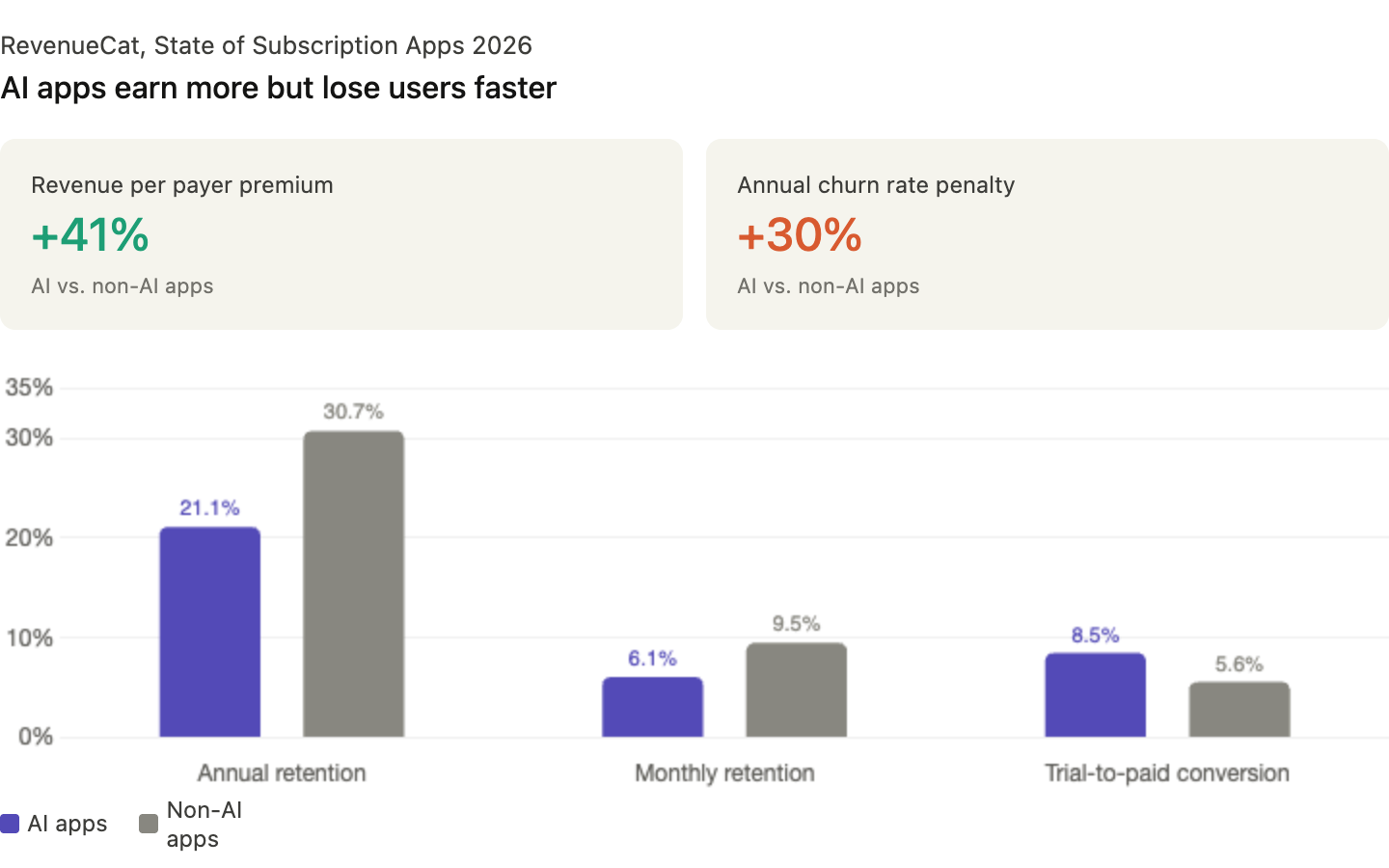
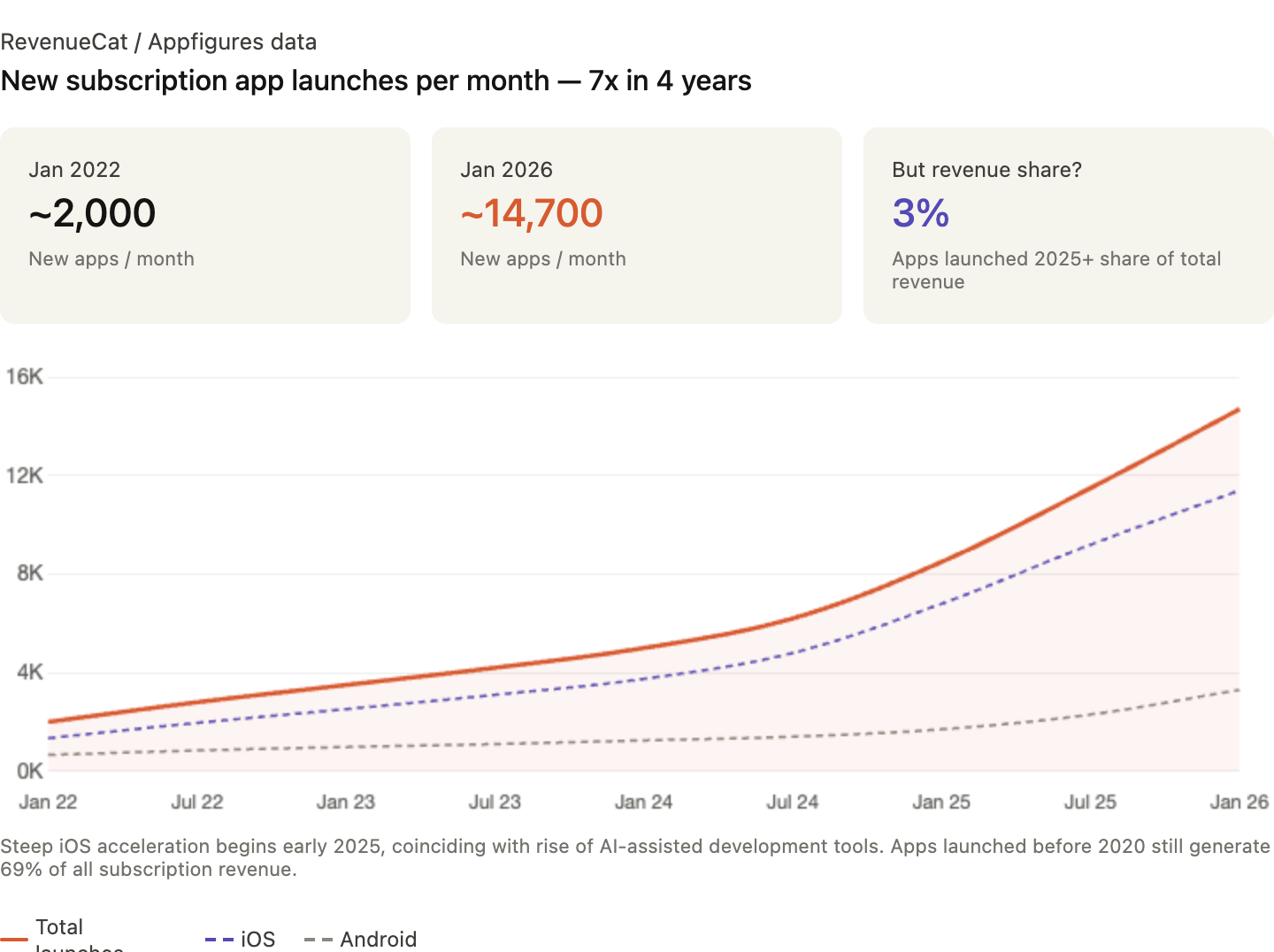
Consumer AI monetization, meanwhile, is real but uneven. RevenueCat's 2026 State of Subscription Apps report, based on 115,000+ apps and $16 billion in revenue, found that AI-powered apps generate 41% more revenue per payer than non-AI peers but churn 30–36% faster. New subscription app launches have grown 7x since 2022, yet apps launched in 2025 or later account for just 3% of all subscription revenue. People will try AI products, and sometimes pay for them, but most generic AI products are forgettable.
The opportunity isn't "sell AI." It's selling resolution.
The Setup
A certain class of AI product is quietly proving out: single-purpose tools that take one ugly, emotionally charged input and return one clean, relieving output. A solopreneur business idea with a sentence-length promise:
- "Upload your ER bill. We'll tell you what it means and what to do next."
- "Paste your Hinge profile. We'll tell you what your photos and prompts signal."
- "Drop in your job offer. We'll tell you if you're being lowballed."
- "Forward your landlord's email. We'll translate the threat level."
The user isn't buying software. They're buying immediate compression of uncertainty.
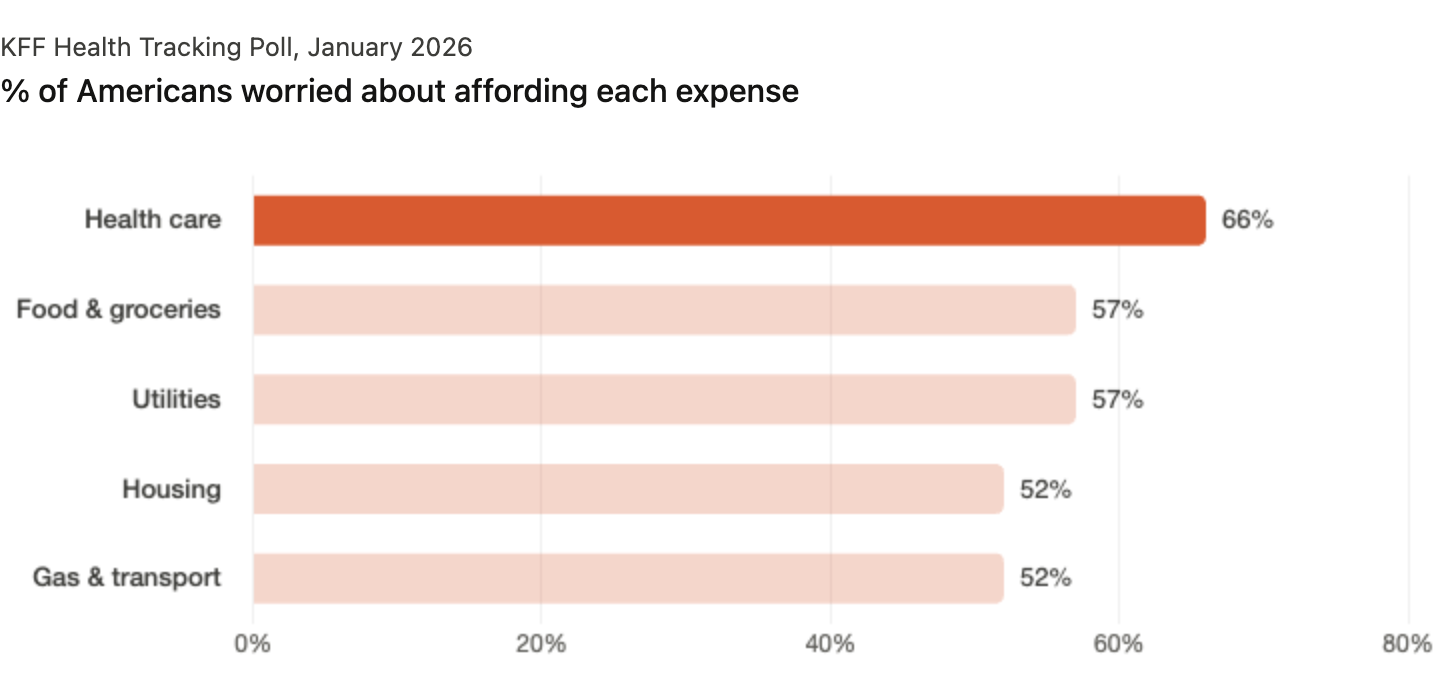
The best niches are moments where people feel outmatched by a system, a document, or another person. KFF's January 2026 tracking poll found that two-thirds of Americans are worried about affording health care costs — ranking it above food, utilities, housing, and transportation. About half of U.S. adults couldn't cover an unexpected $500 medical bill out of pocket. A West Health-Gallup survey found that roughly one-third of U.S. adults — over 82 million people — have made at least one trade-off with daily living expenses to pay for medical care: borrowing money, stretching prescriptions, skipping treatments.
The same logic applies to job offers, lease clauses, insurance denials, divorce paperwork, and immigration notices. Any system that communicates in jargon, to a person who didn't ask for jargon, creates a gap. AI is now cheap enough and capable enough to sit inside that gap and sell relief.
Most builders will copy the surface mechanics: prompt + form + Stripe + social demo. The actual moat is a four-part system. A painful input where the user arrives with something messy and emotionally loaded. A sharp promise framed as a specific emotional outcome — not "AI analysis." An output that reduces action paralysis through interpretation, prioritization, and next steps. And a distribution surface that makes the product legible in 15 seconds, usually short-form video demos showing before/after transformations. The format doubles as the ad.
Fast Heist or Real Company?
It can be either, and that flexibility is what makes it interesting.
The fast-heist version is a one-product, one-page, high-impulse business. You build quickly with vibe coding tools, test on TikTok and Reddit, and see if you can get a narrow funnel to convert. If it works, you collect cash. If it stalls, you kill it.
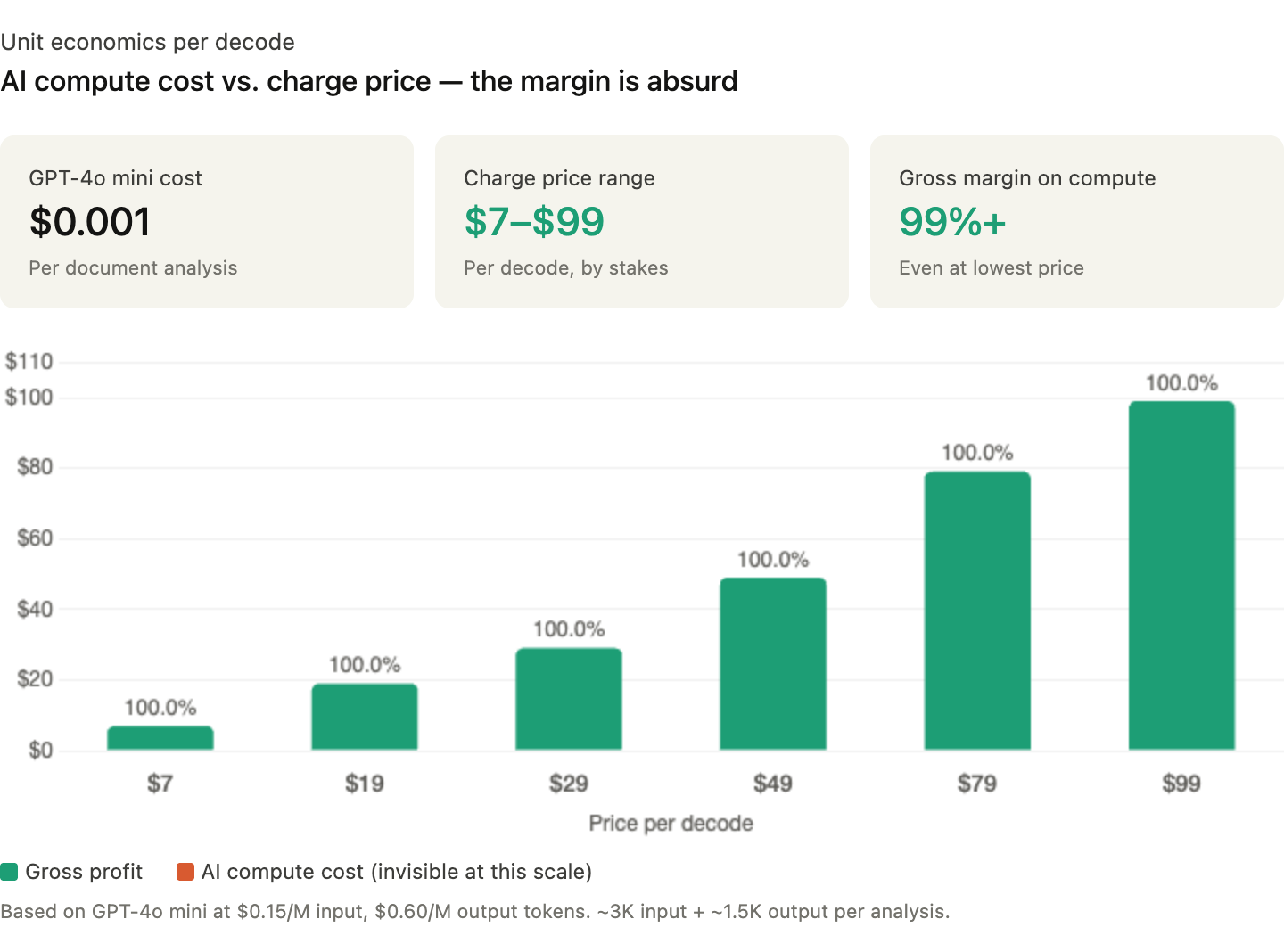
This mode is viable because AI costs have cratered. GPT-4o mini runs at $0.15 per million input tokens and $0.60 per million output tokens. A single document analysis might consume 2,000–4,000 tokens of input and 1,000–2,000 of output. Fractions of a penny. Even a stronger model like GPT-4.1 ($2.00/$8.00 per million tokens) costs well under a cent per structured analysis. If you're charging $7–$29 per decode, your gross margins on AI compute alone are 99%+.
The smarter move is to treat the first product as a wedge into a broader category: consumer-side translation infrastructure. Start with one narrow niche, then build a repeatable system for more of them. Medical bills, job offers, lease clauses, insurance denials, school paperwork, HOA notices, creator brand audits, dating profiles, visa letters, tuition aid letters. Same engine, different wrapper, different traffic source, different copy.
The long-term business isn't "we have a great prompt." It's "we own the trust layer between normal people and intimidating systems." Much bigger category.
Where the Real Money Is
Three business models here, and they stack.
1. Single-Use Payments
The cleanest starting point. Charge $7 to $29 for one analysis, depending on stakes. Low-friction, no subscription anxiety, easy creator demos, easy gifting, easy virality. This works especially well when the user has a one-time object to analyze: a bill, a letter, a profile, a contract excerpt. You're selling a transaction, not a relationship.
2. Packs and Credits
Once the niche proves demand, sell bundles: 3 analyses for $19, 10 for $49, a family pack, a job hunt pack, a dating profile + opener pack.
RevenueCat's 2026 data supports this approach. About a third of top apps now mix subscriptions with consumables or lifetime purchases, and AI apps in particular benefit from credit-based models. A credit model lets you monetize intent without pretending every user wants a monthly relationship — which matters because AI apps churn 30–36% faster than the baseline.
3. Assisted Premium Upsells
This is where the business gets serious. The AI does the first-pass interpretation. Then you upsell: human review, template appeal letters, negotiation scripts, call prep, expert escalation, affiliate referrals.
- "Want a human bill advocate to review this? $49."
- "Want us to draft the exact email to send? $9."
- "Want a coach to rewrite your entire Hinge profile and photo order? $39."
That upsell layer is how a toy becomes a margin-rich workflow. The AI handles the commodity layer (interpretation), and the premium layer — action templates, human review, escalation — captures the real willingness to pay. This is the same structure winning in adjacent categories like consumer legal-tech and AI tax tools: cheap AI on the front end, high-margin human and template services on the back end.
The Angle Most People Will Miss
The best opportunities here aren't the funniest ones. They're the ones where the user feels slightly ashamed they don't understand what they're looking at.
That shame is commercially useful. Consumers don't want a new dashboard for these moments. They want a calm, competent translator.
Look at the medical-bill angle. Industry estimates suggest that the majority of medical bills contain errors — some advocacy groups put the figure as high as 80%. Most patients report being confused by their bills. Very few know how to appeal a billing error, and fewer still actually do: patient appeal rates on marketplace claims remain vanishingly low despite high denial rates. Bills over $10,000 are widely estimated to contain over $1,000 in errors.
These numbers are hard to pin to a single pristine study because the billing system itself is opaque — which is exactly the point. The confusion is the product opportunity.
Medical bill decoding is stronger than dream interpretation. Dream interpretation may go viral; medical bill decoding has pain, urgency, savings potential, and referral logic baked in. The same applies to job offers, performance reviews, insurance letters, financial-aid packages, divorce paperwork, and immigration notices. The highest-value "1-prompt" products are anti-bureaucracy products.

And here's the structural gap: incumbents are building AI for the institution, not the consumer. In health care, most AI billing tools are designed to help providers collect payments or reduce support load. The consumer still receives a confusing bill and a 14-page Explanation of Benefits written in what appears to be a dead language. Wide-open white space on the consumer side.
Build AI that works for the person on the receiving end of institutional complexity. That's the real heist.
The Moat
A lot of founders will say there's no moat because prompts are copyable. Half true. A naked prompt is copyable. A narrow trust product is harder to replicate than people think.
Your moat comes from five layers.
Layer 1: Domain heuristics. The first version may be a prompt. The second version becomes a rules engine plus a prompt. For medical bills, that means detecting itemization gaps, duplicate charges, common appeal triggers, out-of-network patterns. For job offers, it means compensation benchmark logic and clause detection. The heuristics make the outputs feel grounded rather than generic.
Layer 2: Corpus. If users upload real documents, you accumulate a proprietary library of edge cases, language patterns, recurring traps, and successful outputs. That data improves the product and makes generic clones worse over time. (Handle this data carefully. More on compliance below.)
Layer 3: Trust brand. People don't want "some random AI." They want "the site that decodes hospital bills" or "the one that tells founders whether their recruiter is bluffing." Narrow trust compounds. In a world where incumbent apps still generate 69% of all subscription revenue despite a flood of new entrants, brand separates the survivors from the noise.
Layer 4: Distribution loops. If creators, communities, patient advocates, tenant groups, coaches, or job-search influencers start using your product in content and referrals, that channel advantage becomes difficult to clone. MicroConf's 2025 survey of nearly 700 founders found that 47% say integrations, partnerships, communities, and forums became a more dependable source of growth than paid ads.
Layer 5: Portfolio economics. One product can be cloned. Ten niche products on shared infrastructure start to look like a defensible company. The smartest founder here doesn't build one lucky micro-tool. They build a studio of tiny trust products.
What to Build First
Not a dream interpreter. Not a journaling analyzer. Not another generic "AI therapist" clone.
Three strong starting points, ranked by the balance of urgency, monetization, and manageable risk:
Unlock the Vault.
Join founders who spot opportunities ahead of the crowd. Actionable insights. Zero fluff.
“Intelligent, bold, minus the pretense.”
“Like discovering the cheat codes of the startup world.”
“SH is off-Broadway for founders — weird, sharp, and ahead of the curve.”


