


Restock or Discover? The Shopify Question Nobody Bothers to Ask
A customer visits the same skincare store twice in one week.
Monday, she's out of moisturizer. She wants the shortest possible path from homepage to checkout. Anything between her and that reorder button is friction.
Saturday, she has ten minutes and no agenda. She might buy the same moisturizer. She might also leave with a serum, a travel size, and a brand she'd never heard of before she opened the tab.
Same customer, same order history, same segment in every personalization tool the merchant is paying for. Two entirely different shopping trips.
Almost every ecommerce personalization product on Shopify is built around who the customer is: past purchases, predicted affinities, loyalty tier, geography, device, browsing history. There's a cheaper variable sitting one layer above all of that.
Why is this person here right now?
Almost nobody asks. The shopper would tell you if you did.
The gap between those two trips is where the business sits.
The money: 50 beauty merchants at $99 a month is $5,000 MRR. 250 at $199 approaches $50,000. Flat SaaS, buildable solo.
Inside:
• Three-component MVP inside Shopify's limits
• The traffic math that decides who to refuse
• Pricing tiers plus a $500 setup fee
• Cold email that sells the experiment
The signal
In August 2026, the Journal of Retailing and Consumer Services published a receipt-based field study by Sait Durgun, Berrak Deniz Çetinkaya, and Hakan Koç. They worked through 323 shoppers and coded 3,819 individual items, one purchase at a time, testing the piece of folk wisdom everyone repeats: don't shop hungry.
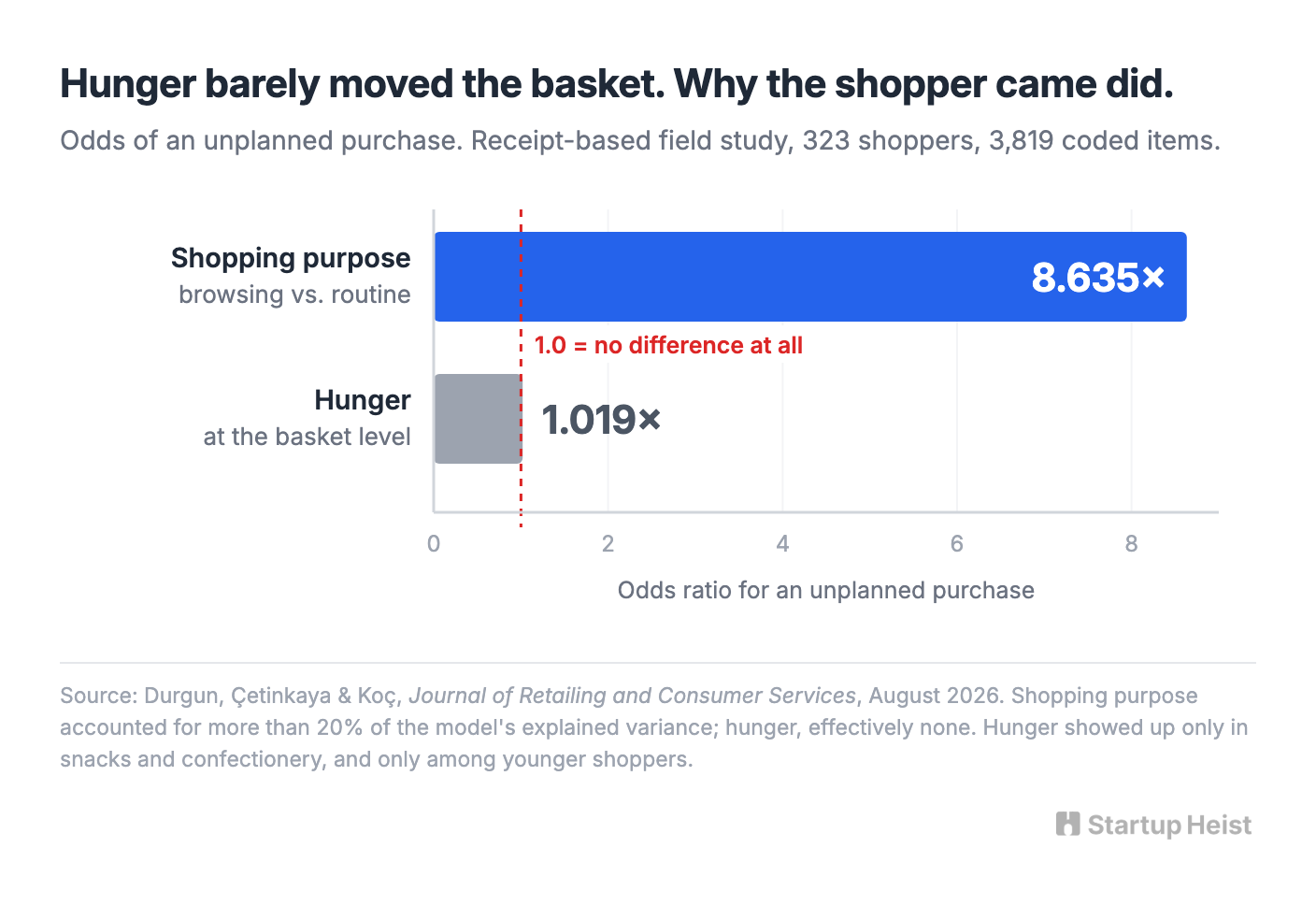
Hunger mostly didn't matter. At the basket level, the association between hunger and unplanned purchasing was statistically indistinguishable from zero. It showed up in one narrow place, snacks and confectionery, and only among younger shoppers.
Shopping purpose dominated by a wide margin. Shoppers coded as browsing showed 8.635 times the odds of an unplanned purchase compared with routine shoppers, and purpose accounted for more than twenty percent of the explained variance in the model. Hunger accounted for effectively none.
Two honest caveats before anyone builds a landing page around this. The study ran in physical grocery retail, not ecommerce, and one field study is not a law of nature. The same paper's clustering analysis also found three distinct shopper profiles, which is the first hint that a binary switch is a simplification.
What survives all of that is still valuable: a shopper completing a known task and a shopper open to discovery behave like two different customers behind one login. That's a merchandising hypothesis, and it's testable in a week. Earlier work reached the same place from a different direction, identifying distinct "shopping missions" across four million supermarket baskets and finding them useful for targeting.
So you sell merchants a controlled test of a specific hypothesis about their own store, rather than a scientific fact about shoppers in general. The whole business lives in that distinction.
The heist
Build a Shopify app with one customer-facing interaction.
What brings you here today? `I know what I need` · `Show me something good`
Then change what the shopper sees.
Restock shoppers get previous purchases, reorder buttons, replenishment collections, subscription and refill offers, search near the top, and a compressed path to checkout.
Discovery shoppers get new arrivals, staff picks, limited releases, an under-$25 shelf, complementary categories, bestsellers they've never bought, and bundles.
The interface has to be almost insultingly simple. The entire point is to be the opposite of the eight-question quiz that asks a shopper's age, skin type, goals, and concerns before it will show her a face cream.
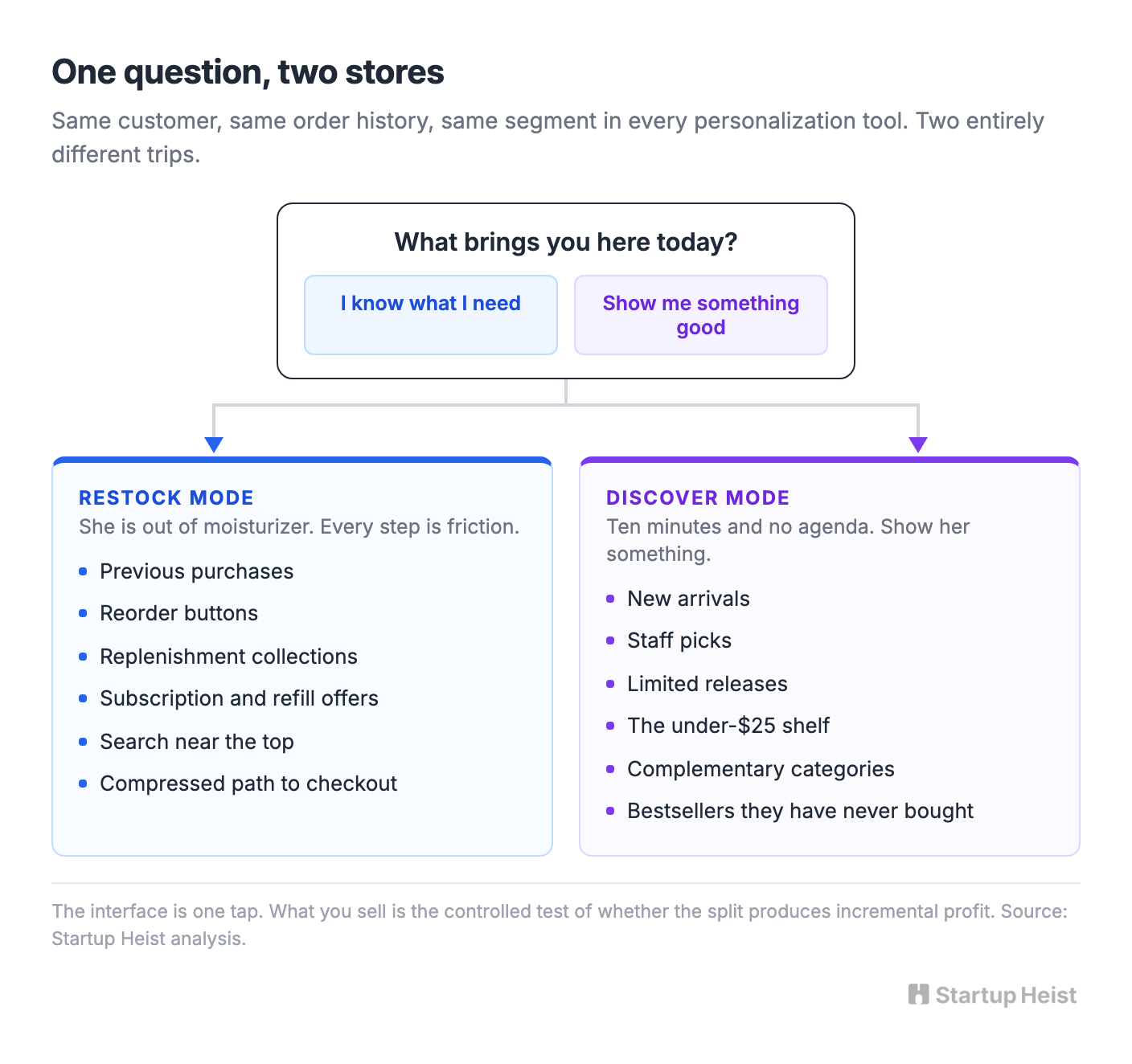
One question, and the store on the other side of it changes.
Call it Mission Mode or Shopper Mode or nothing at all. What you actually sell is this: we run a controlled test to determine whether merchandising your store differently for restocking and discovery shoppers produces incremental profit. Much harder to file under "another popup app."
Why the buttons are not the product
Say it wrong and you walk straight into a category full of well-funded incumbents. Rebuy sells AI recommendations, cart and checkout upsells, post-purchase offers, search, and A/B testing, starting around $25 a month and scaling with order volume, across roughly 800 reviews. LimeSpot sells bundles, cross-sells, and personalization from $9.99, with nearly 400 reviews. Visual Quiz Builder sells quizzes, an AI shopping agent, and segmentation between $30 and $100 a month. Wisepops sells popups, targeting, recommendations, and A/B testing, and its listed plan runs $299 a month for up to 500,000 pageviews.
Any of those teams could ship two buttons in a sprint, and several already have the surface area to bolt it on. Meanwhile the Shopify App Store holds north of 17,000 apps, and the average merchant already runs about six of them. Nobody is waiting for a seventh with a nicer toggle. What's defensible sits behind the interface: the experiment design, the merchandising workflow, and the measurement layer wrapped around them.
| What exists | What it answers | What you answer |
|---|---|---|
| Recommendation engines | Which product should this customer see? | Which store should this session see? |
| Product quizzes | Which product fits this person? | Is this person executing or exploring? |
| Popup tools | What message should we show? | What should change after they answer? |
| Generic A/B testing | Did B beat A? | Does declared intent create incremental profit? |
| AI shopping assistants | Can an agent guide the purchase? | Can one question outperform the whole conversation? |
Don't fight those companies on features. Run the one experiment none of them has packaged cleanly.
The platform underneath is both the reason to build and the reason to be careful. In Q2 2026, merchants pushed $115.6 billion in GMV through Shopify, up 32% year over year. Shopify's own revenue hit $3.58 billion, up 34%, with merchant solutions accounting for $2.78 billion of it. The transaction surface under any merchandising tool is enormous and compounding.
Shopify is also absorbing generic experimentation into the core product. On June 5, 2026, Rollouts gained the ability to schedule, gradually publish, and A/B test entire themes along with checkout and customer account configurations. Merchants can now run a real split test between two storefronts from the admin, free. One version of this startup just died. Don't build "A/B testing for Shopify." A platform feature that ships free isn't a market.
Build the opinionated experiment instead. Shopify supplies the laboratory; your job is the hypothesis worth testing, the storefront components required to run it, and the reading of what the result means. When a platform commoditizes the infrastructure, the money moves one level up, from the test engine to the answer to what should I test next?
Who this actually works for
This is wrong for most Shopify merchants, and picking the wrong ten will convince you the idea failed when it only met the wrong customers.
The right merchant satisfies two conditions at once. Customers come back for known products, and the catalog holds enough adjacent inventory to make discovery worth a click. Beauty and skincare fit best: consumables on real replenishment cycles, deep adjacent catalogs, high gross margins that make every attached item count, and merchants who already spend money on conversion. Coffee and tea, craft and hobby, stationery, specialty snacks, and pet all share the shape.
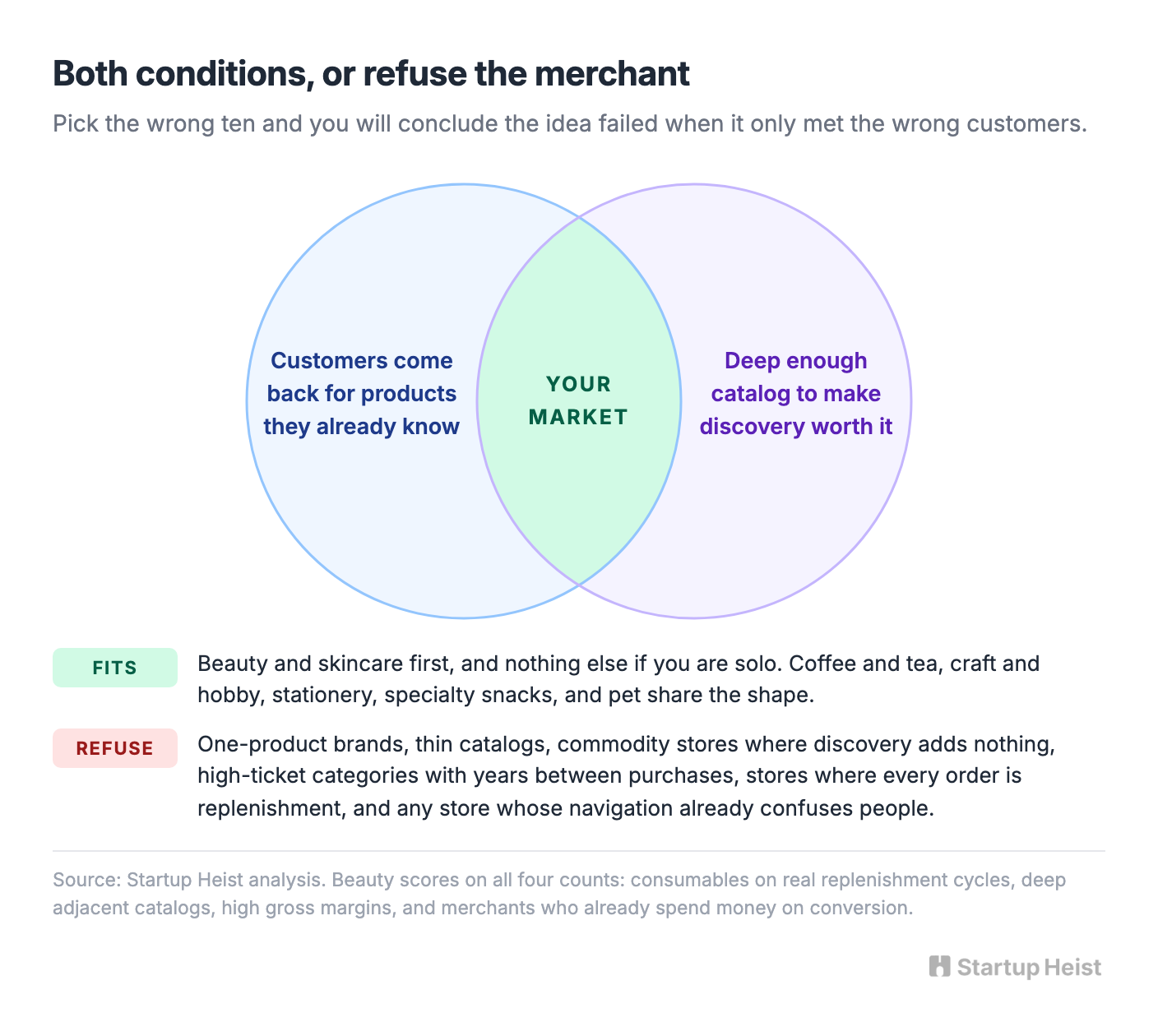
The inverse tells you who to refuse: one-product brands, thin catalogs, commodity stores where discovery adds nothing, high-ticket categories with years between purchases, and stores where every order is replenishment. Add any store whose navigation already confuses people, because you'd be handing them one more decision on top of the ones they can't handle.
If you're solo, don't launch across six verticals. Launch into skincare and nothing else. The split explains itself in one sentence, the catalogs are large enough to merchandise two ways, and cross-category attachment is worth real margin. Your landing page shouldn't say "intent-based personalization for modern brands." It should say: find out whether your repeat skincare customers spend more when they tell you they're restocking or exploring.
Specificity is what sells here. Once five beauty merchants have the result, you have something no competitor's feature list can answer.
The MVP
None of this needs machine learning, an AI concierge, or intent inferred from 47 behavioral signals. The customer will label it for you in one tap.
Unlock the Vault.
Join founders who spot opportunities ahead of the crowd. Actionable insights. Zero fluff.
“Intelligent, bold, minus the pretense.”
“Like discovering the cheat codes of the startup world.”
“SH is off-Broadway for founders — weird, sharp, and ahead of the curve.”


