


Ghost Cart: The Checkout That Buys Nothing
For twenty-five years, e-commerce has been optimized around a single goal: delete the pause.
Saved cards. Stored addresses. One-click checkout, Shop Pay, free two-day delivery, low-stock warnings, countdown timers. Every one of those improvements shortens the distance between wanting something and owning it.
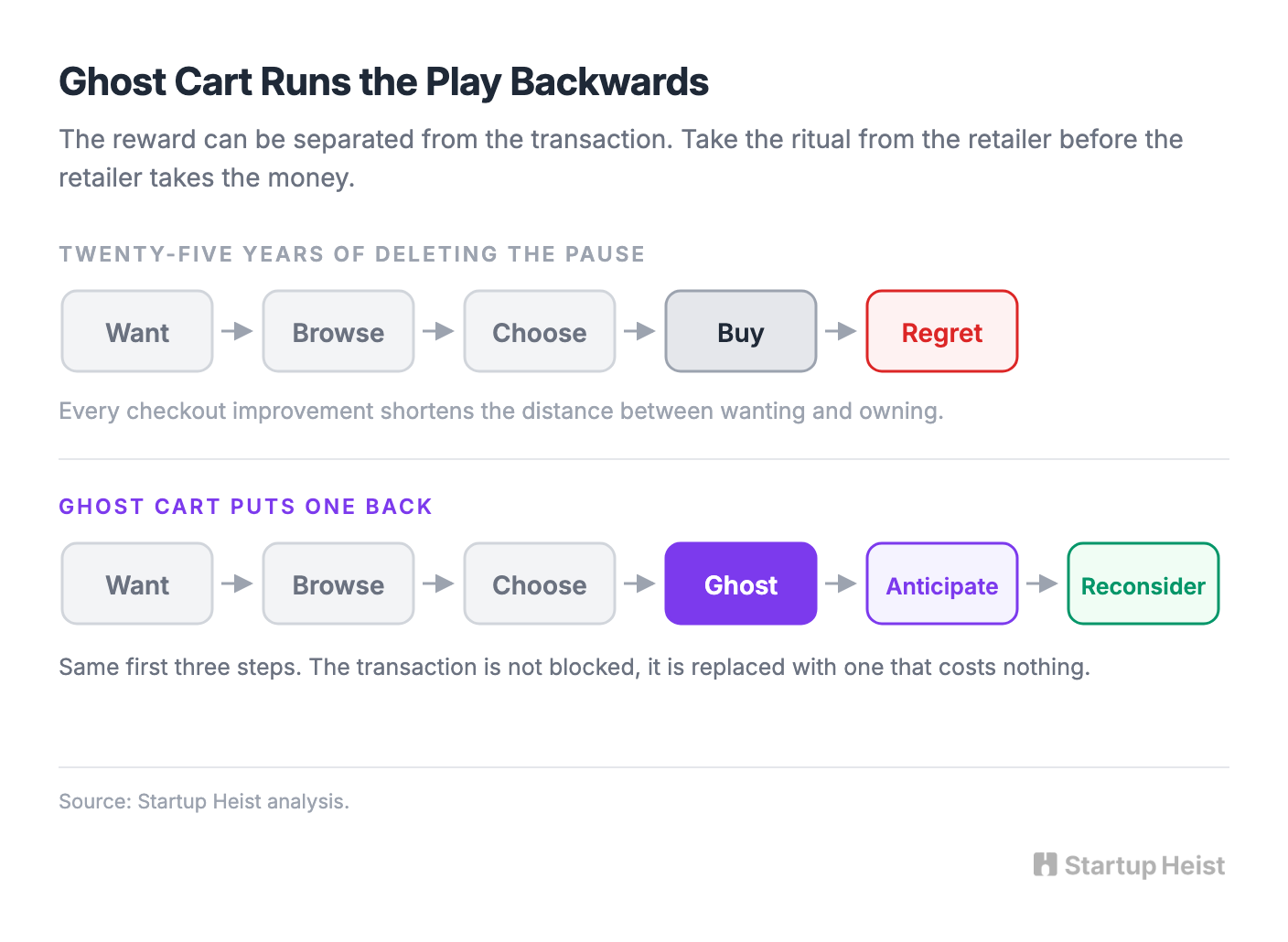
Ghost Cart runs the play backwards.
You find a $260 pair of sneakers you suddenly need. Instead of adding them to your real cart, you click Ghost It. The Chrome extension captures the item, generates a clearly fictional No-Buy Receipt, and starts a cooling period you choose: 24, 48, or 72 hours. You get the satisfying thunk of a completed action without handing Nike or Amazon or Sephora your money.
Two days later the sneakers come back. If you still want them, buy them. If the urge died, archive them, and the $260 moves from "deferred" to a running tally of things you decided against.
Strip the gag away and here's the business:
The money: 50,000 installs converting at 5% to a $29 a year plan is about $6,000 MRR. CartPause already charges $19.99 a year for the same behavior.
Inside:
• The eight-item MVP and what to leave out
• Why affiliate links would kill the product
• Creator no-buy challenges plus outreach copy
• Kill criteria for the novelty risk
That sounds like a gimmick, and it probably is one. The interesting question is whether a gimmick can harden into a ritual, and there's fresh evidence from an unexpected place that it can.
Korea Built the Weird Version First
In South Korea, a category of websites has emerged around what local media calls "dopamine sites." They simulate shopping, food delivery, and other consumer experiences where the transaction never actually happens.

The best-known was built by Park Seo-hyun, a 27-year-old developer, and launched in late March 2026. Her site is designed to resemble Baedal Minjok and Coupang Eats, and it looks almost too convincing. You browse menus for pizza, malatang, takoyaki, even bingsu, fill a cart, enter an address, place an order, and watch a virtual rider make the trip. Then nothing arrives, no money changes hands, and the site tells you what you avoided consuming. By mid-June 2026, roughly 30,000 people a week were using it to pretend to order food.
Park's account of why she built it is the useful part. "I used to order delivery all the time, like 10 times a week," she told the Korea JoongAng Daily. "I'm the type of person who gets addicted easily. One day I joked with my friends that I wished I could order food without it ever arriving. They told me to just make a website like that, so I did."
It has company. Sajasaja sells imaginary goods from the manga Doraemon, including a moonlight mortar for 120,000 won and tape that repairs a broken friendship for 50,000. DopamineCart mimics Amazon. FoodNeverComes runs the delivery gag in English across Indian, Mexican, and Brazilian menus. The category took off as Gen Z consumers, squeezed by rising living costs and burnout, went looking for a way to enjoy shopping without the receipt.
Traditional budgeting apps and personal finance software never touch any of this. They treat spending as an accounting problem: you spent $260, now categorize it, update the budget, feel bad. Every intervention arrives after the money is gone.
The Korean sites intervene earlier, and they demonstrate something worth stealing. Part of the reward can be separated from the transaction. Take the ritual from the retailer before the retailer takes the money.
The Market Is Narrower Than the TAM Math
The temptation here is dumb TAM math.
U.S. retail e-commerce hit $326.7 billion in the first quarter of 2026, 16.9% of all retail sales, growing 9.8% year over year against 3.9% for retail overall. So if Ghost Cart captures 0.001% of online purchases, then...
None of that is the market. Ghost Cart doesn't monetize commerce volume. Its defining feature is preventing some commerce from happening.
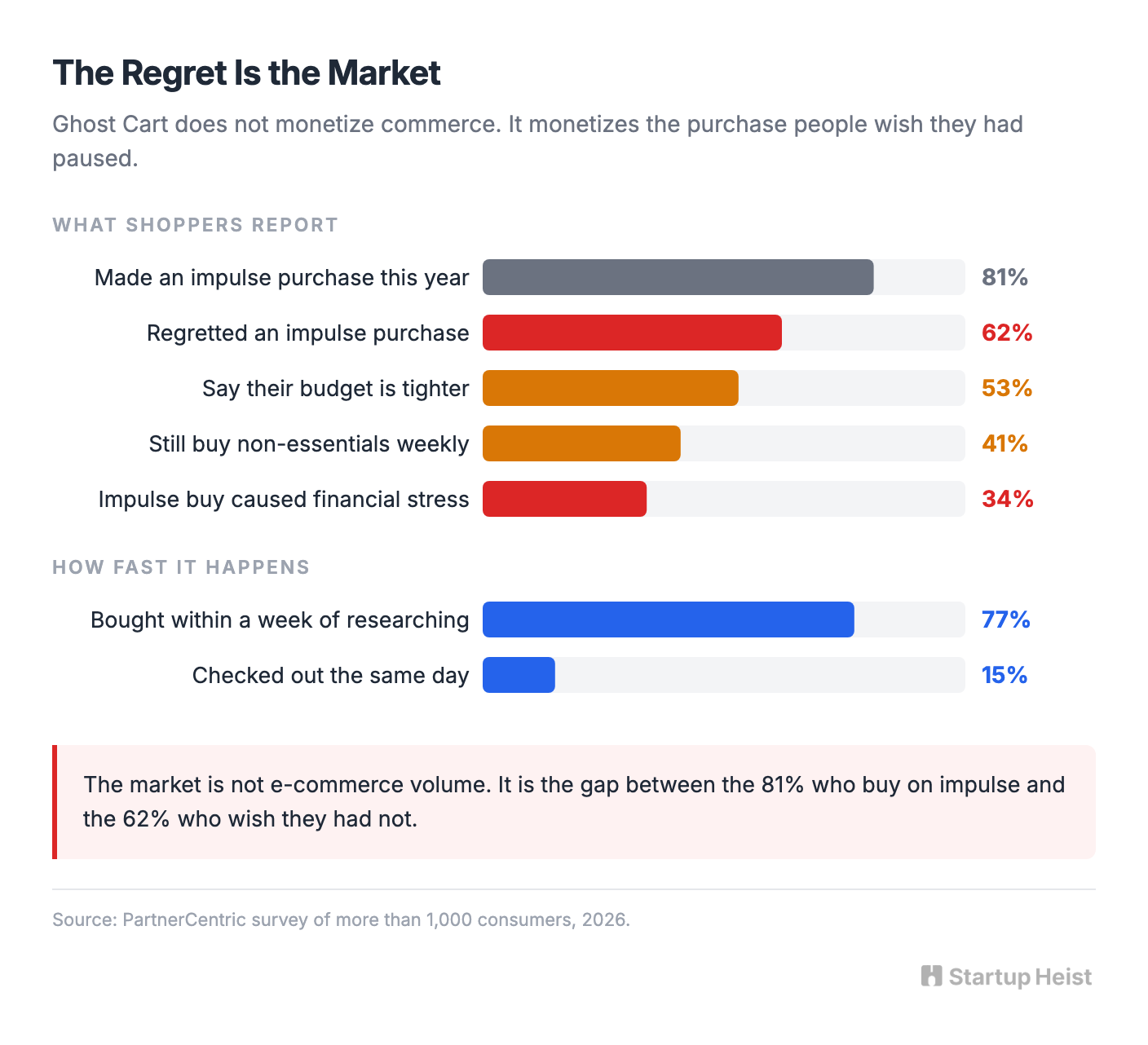
The signal that matters is regretted impulse buying, and it's large and well documented. A 2026 PartnerCentric survey of more than 1,000 consumers found 81% had made an impulse purchase that year, 62% regretted one, and 34% said an impulse purchase caused financial stress. The speed data is sharper still: 77% bought within a week of starting their research, and 15% checked out the same day. Meanwhile 53% described their budgets as tighter, and 41% were still buying non-essentials at least weekly. An older Bankrate survey from August 2023 put a dollar figure on the social-media slice specifically: $71 billion over twelve months, with 48% of social media users admitting an impulse buy they saw on a feed and 68% of those regretting at least one.
The cultural shift on the other side of influencer commerce matters more than any of those numbers. People are turning not buying things into content: no-buy months, low-buy years, deinfluencing, Project Pan, anti-hauls. Underconsumption core, which surfaced on TikTok in the summer of 2024 and drew tens of millions of posts, inverts haul culture entirely, with creators showing restraint, repair, and contentment with what they already own instead of showing acquisition.
That audience is Ghost Cart's actual customer, and naming it rules out the adjacent groups: people with real money problems, the general population of online shoppers, and above all anyone with a shopping compulsion, which is a clinical condition no browser extension has any business claiming to treat. What's left is people who already identify with intentional consumption and still enjoy shopping. That distinction is what gives the product permission to be fun.
The Graveyard Is Full of Better-Built Versions
The Chrome Web Store already contains a small crowd of impulse-delay extensions, and almost all of them are ghost towns. Less adds a three-hour delay before checkout, is backed by a master's thesis that analyzed over two million Reddit comments on anti-consumption, holds a perfect rating, and had 49 users when checked in August 2026. Budget Angel goes further, with a pixel-art angel that intercepts your Buy Now button, holds items for 15 to 30 days, and converts delayed purchases into collectibles. It had one user. Piggy Pause is free, runs entirely on-device, collects nothing, and locks shopping sites after five visits in a day: 19 users. Nope It converts prices into hours of work and syncs to a companion app: 8 users. Usure asks your mood at checkout, offers a sleep-on-it timer, and charges $12.99 a month for its analytics tier. It has no ratings at all.
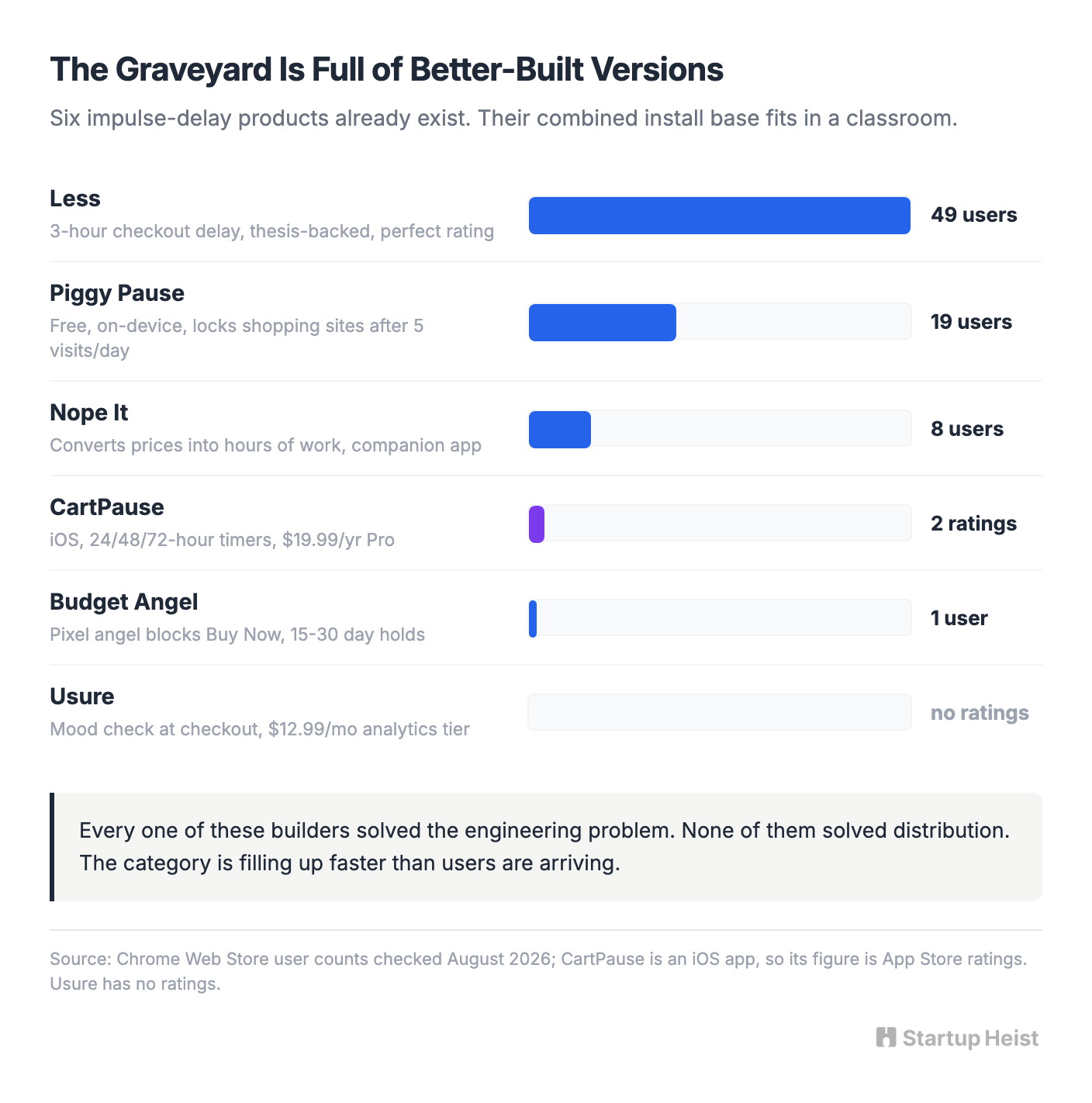
Mobile is taken too, which the obvious roadmap for this idea assumes it isn't. CartPause is an iOS app where you share any item from any shopping app, set a 24-, 48-, or 72-hour timer, get a push notification when it expires, and decide. It extracts product name, price, and image automatically. It charges $19.99 a year for Pro. It has two ratings.
That list doesn't describe an empty category. It describes one filling up faster than users are arriving. The behavioral idea is obvious enough that a dozen people built it independently, the code is a weekend of work, and the technical feature carries no moat whatsoever. Every one of those builders solved the engineering problem. None of them solved distribution.
Another mindful-spending extension is dead on arrival. What's unclaimed is the behavior itself, and the language for it: don't resist the purchase, ghost it.
The Moat Is a Verb
If a user describes this thing as "an impulse-control browser extension," the product has already lost the only protection available to it. The version that works is the one where they say "I ghosted it."
That's the whole brand opportunity, and it's the one asset a competitor can't copy over a weekend. Someone posts a handbag; a friend replies "ghost it for 72 hours." A creator titles a video "everything I ghosted this month." A user closes out January with "I ghosted $1,420 of stuff and ended up buying $170 of it."
Call it what it is: a soft moat. There's no proprietary model, no exclusive dataset, no marketplace liquidity, and nothing technical to hide behind. What defensibility exists compounds from four places. The ritual gives ghosting its own emotional payoff. The archive, after six months, becomes a personal museum of things you almost bought (shoes, air fryers, serums, a vegetable chopper), most of which you forgot and some of which you bought anyway. The challenge layer turns the extension from a utility into the execution engine for No-Buy August and the 48-hour rule and the beauty freeze that people already attempt with spreadsheets. Creator distribution is the only channel where these customers are already assembled and already performing the behavior for an audience.
Distribution is the bottleneck. The graveyard proves it, which is why the build has to stay small enough to leave room for the marketing.
What You Actually Build
A competent extension developer ships the first credible version in about a month. Don't turn this into a twelve-month fintech roadmap.
Unlock the Vault.
Join founders who spot opportunities ahead of the crowd. Actionable insights. Zero fluff.
“Intelligent, bold, minus the pretense.”
“Like discovering the cheat codes of the startup world.”
“SH is off-Broadway for founders — weird, sharp, and ahead of the curve.”


