


YouTube Shorts now averages over 200 billion daily views — a 186% jump from 70 billion just fifteen months earlier. The platform's interface is optimized for compulsion. And a growing revolt against it is turning into one of the sharpest micro SaaS ideas in the digital wellness space.
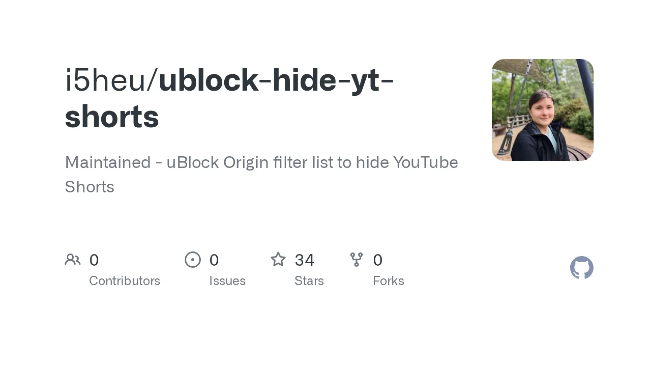
A tiny GitHub project — a uBlock Origin filter list that hides all traces of YouTube Shorts — surfaced on Hacker News and triggered a confessional: thousands of people don't just dislike Shorts. They hate being farmed for attention. The obvious play is to ship a "Shorts blocker." The higher-leverage play is to productize the behavioral boundary underneath it — portable Focus Profiles that travel with you across browsers, devices, and contexts.
Freedom and Opal already prove consumers pay $40–$100/year for digital self-control tools. You're selling something more specific — and the incumbents haven't built it yet.
You're not early on the problem. You're early on the infrastructure-shaped solution. And that's the part worth building.
The Signal
The backlash goes deeper than "ads are annoying." People are saying the format itself is corrosive to how they think.
A 2025 meta-analysis in Psychological Bulletin (Nguyen et al.), reviewing 71 studies with nearly 100,000 participants, found heavy short-form video consumption associated with reduced attention, weaker impulse control, and increased anxiety and depression symptoms. Critically, the research shows that compulsive usage patterns — not raw screen time — are the stronger predictors of harm. That distinction matters: it validates content shaping and friction interventions over blunt domain blocking. A separate EEG study at Zhejiang University found that short-form video addiction correlates with lower theta brainwave activity in the prefrontal cortex, the region governing executive control. Oxford University Press named "brain rot" its 2024 word of the year. The mainstream press and the research literature are converging on the same story, which means consumers are already primed to see this as a real problem rather than niche productivity neurosis.
And the demand is operational. On Hacker News, users shared redirect scripts that convert youtube.com/shorts/... URLs into normal watch?v=... pages, killing the infinite swipe loop entirely. The uBlock filter list has active community maintenance and multiple forks. That pattern — grassroots hacks that later become products — is consistent with how browser extension businesses have launched before. The tools people wish existed are being assembled in public. They just haven't been packaged into a product yet.
The Gap
The current landscape of focus and productivity tools is fragmented and feature-thin.
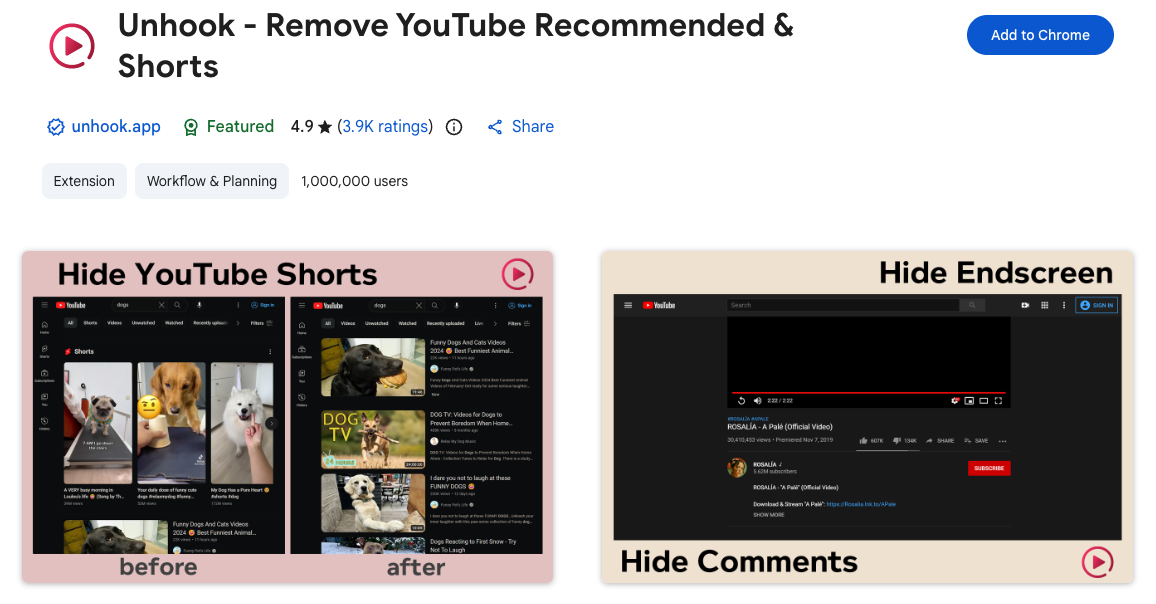
Unhook (600,000+ active users, 4.9 stars) lets you toggle off Shorts, recommendations, and comments — but it's a single-purpose toggle stuck inside one browser. Freedom (3+ million users, ~$40/year) syncs blocking sessions across devices but operates purely as a timer-and-blocklist with no content shaping, no shareability, no identity layer. one sec takes the friction approach with a breathing exercise before you open an app, and published research with the Max-Planck Institute showed it reduces app opens by roughly 57%. Smart design, but no daily time limits once you're past the pause. Then there's a long tail of Chrome extensions that are powerful individually but fragmented and non-portable.
Each tool solves a slice. None of them solve the whole problem. People don't want to block the internet. They want the internet to behave like they meant to open it — and no startup idea in the attention economy has cleanly productized that intent yet.
The Product: Focus Profiles (Attention Infrastructure)
A "blocker" is a feature. A Focus Profile is a product layer — a portable, shareable ruleset that reshapes your digital environment across three dimensions.

Unlock the Vault.
Join founders who spot opportunities ahead of the crowd. Actionable insights. Zero fluff.
“Intelligent, bold, minus the pretense.”
“Like discovering the cheat codes of the startup world.”
“SH is off-Broadway for founders — weird, sharp, and ahead of the curve.”


