


It's a micro SaaS idea built for the AI-assisted solopreneur or small team, targeting a digital sales room market growing at roughly 20% CAGR — with a realistic path to $30K–$50K MRR within 12–18 months selling to SMB and mid-market SaaS teams that live and die by post-demo follow-through.
There is a real business hiding inside one of the most common fake-next-steps in B2B sales: "Looks great — send me the deck."
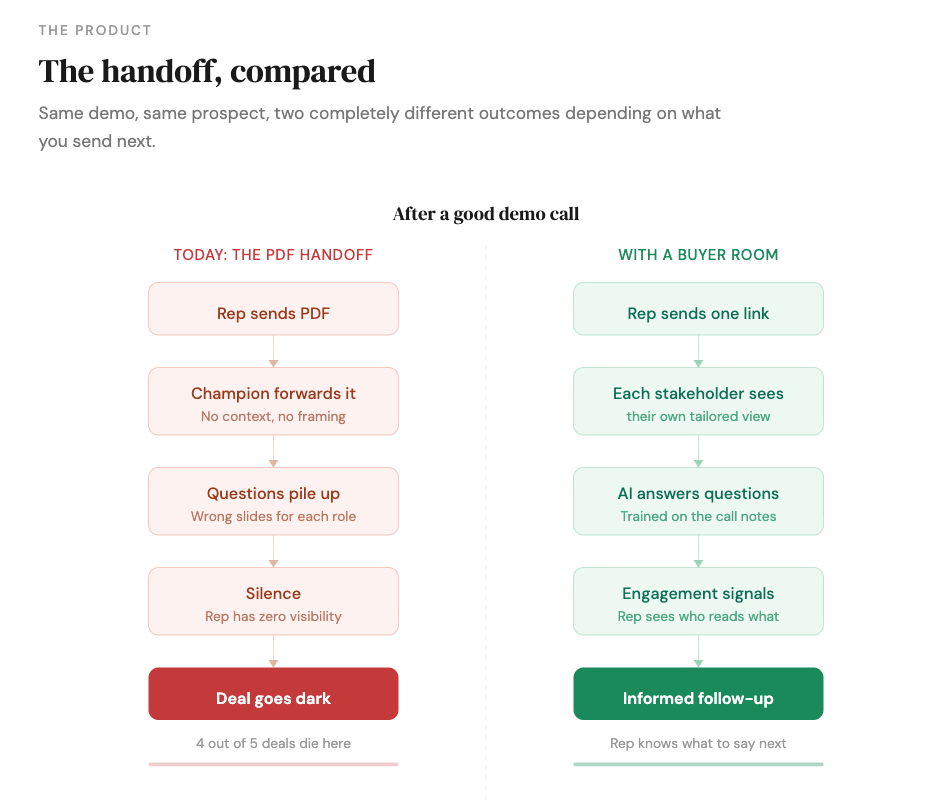
You already know what happens next. The call feels warm. The prospect sounds engaged. Then the PDF disappears into a committee, gets forwarded without context, and the deal goes dark.
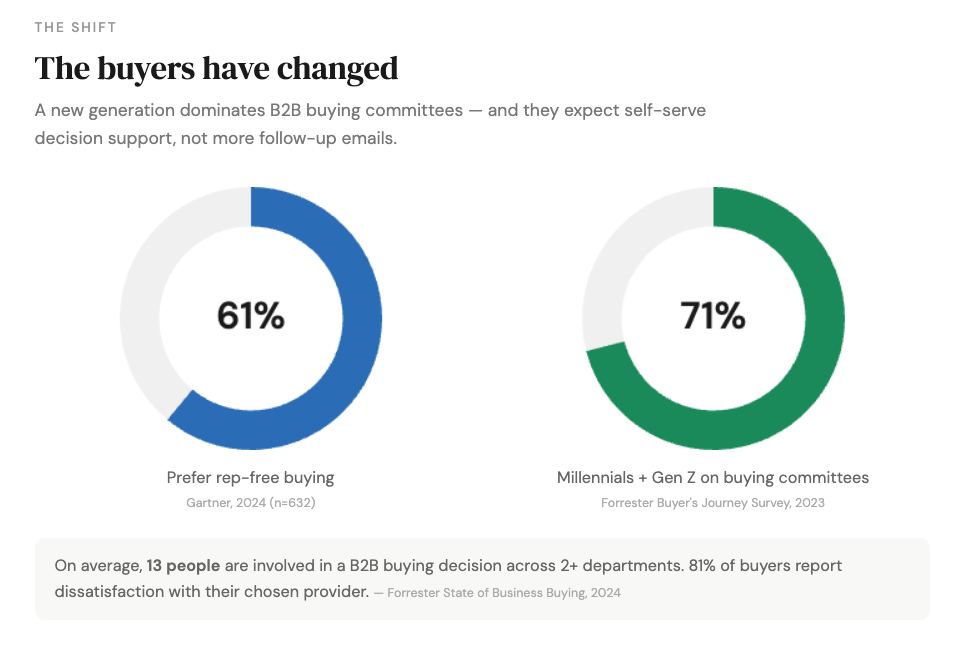
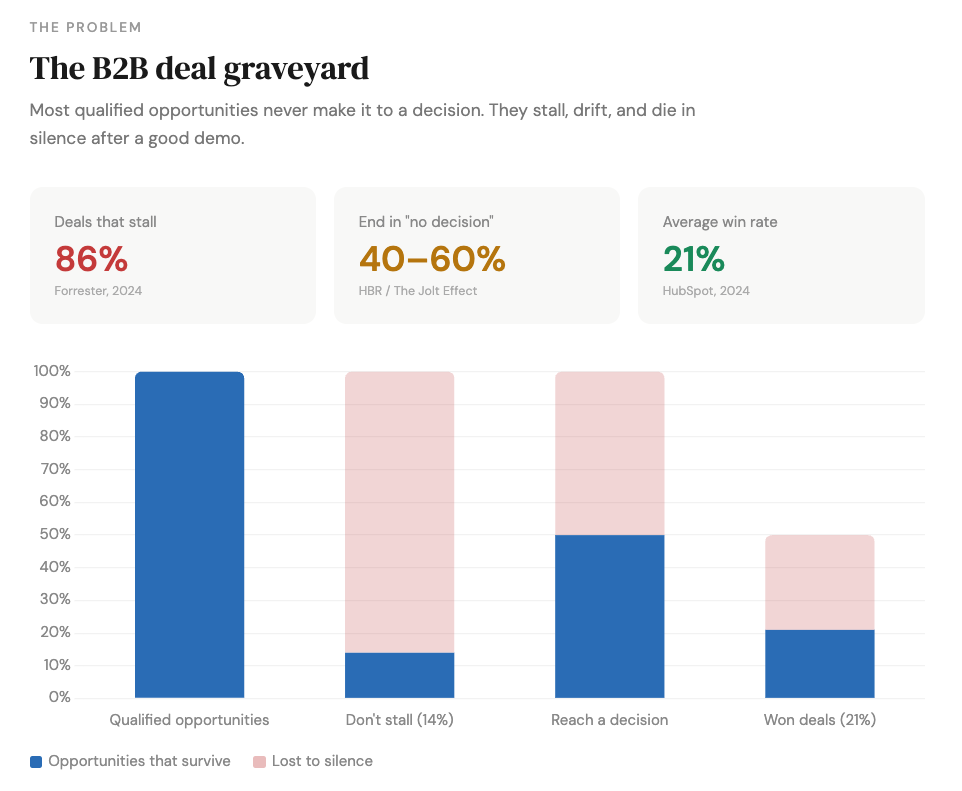
Around 61% of B2B buyers now prefer a rep-free buying experience — a number that climbs higher among millennials and Gen Z, who together make up 71% of B2B buying committees. Meanwhile, 40% to 60% of B2B deals end in "no decision" according to a Harvard Business Review study of 2.5 million sales conversations, and Forrester reports that 86% of B2B purchases stall at some point during the buying process. These deals aren't lost to a competitor. They're lost to silence — to a PDF that couldn't carry the conversation forward when the rep wasn't in the room.
The incumbents in this space — Trumpet, Flowla, Storylane, GetAccept — are all chasing enterprise budgets and full-lifecycle revenue platforms. The wedge for a focused, lightweight B2B SaaS tool built around one painful moment is wide open.
The Deck Is Overloaded
A static deck carries the weight of an entire buying process. It's supposed to summarize the pitch, travel across the buying committee, answer objections, justify ROI, calm security concerns, and help an internal champion retell your story when you're not in the room. No single document can do all of that.
The typical B2B purchase now involves 10 or more stakeholders across IT, finance, operations, and end users. A CFO wants ROI projections and risk analysis. A security lead wants compliance certifications. A department head wants proof of adoption at companies like theirs. The internal champion — the person actually selling for you when you leave the room — needs a story simple enough to repeat. When you send a PDF, you're asking that champion to do all of the translation work manually. They rarely can. The deal stalls. The average B2B win rate hovers around 21%, meaning four out of five qualified opportunities die somewhere between interest and decision.
Recent buyer research from Adience adds another layer: nearly a third of buyers say vendors waste their time with repetitive questions, irrelevant decks, and what amounts to "discovery theatre." Buyers don't want more follow-up. They want better self-serve decision support.
The market has started to respond. Storylane's Buyer Hub positions itself as a single destination for demos, videos, pricing PDFs, and supporting assets. Trumpet builds AI-powered digital sales rooms that personalize content for each buyer and surface engagement signals. Consensus sells automated demos and buyer-led product experiences. Flowla builds collaborative deal rooms with mutual action plans and engagement analytics. The category exists. Buyer behavior has been trained. But there is still a wedge worth owning.
The Category Is Big. The Wedge Is Specific.
The global digital sales room market sits in the low single-digit billions and is projected to grow at a mid-teens to 20% CAGR through the early 2030s. Gartner predicts 30% of all B2B sales cycles will be managed through digital sales rooms by 2026.
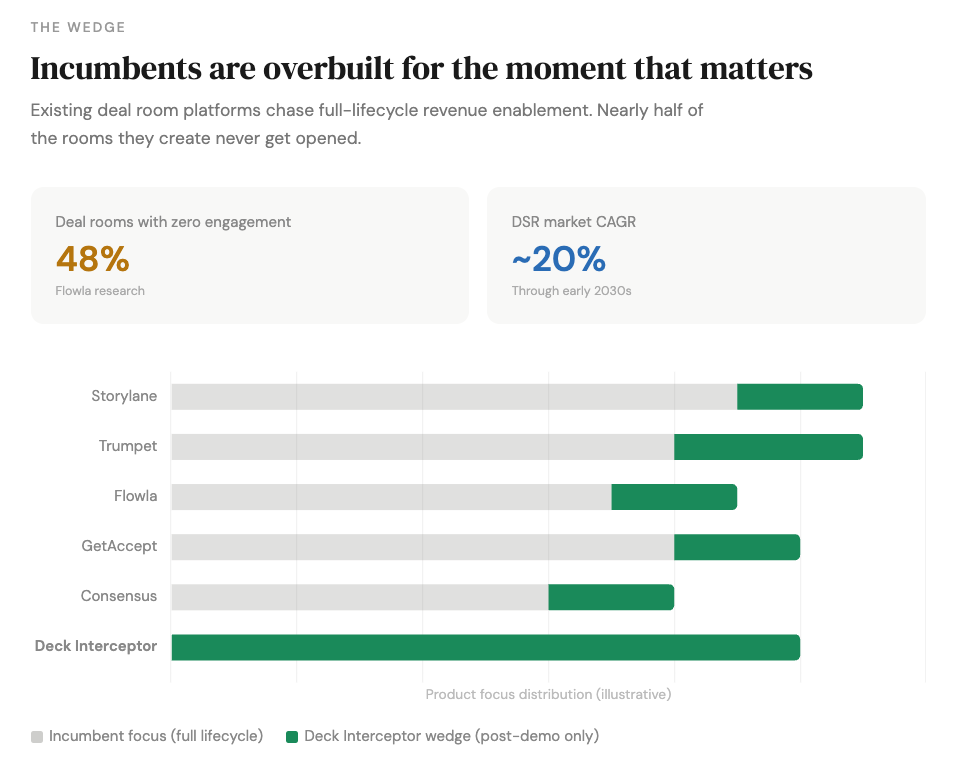
Most existing tools are sold as broad demo automation platforms, enablement infrastructure, or full-lifecycle revenue rooms. They serve enterprise GTM teams with dozens of reps, long implementation timelines, and big budgets. Storylane's public plans run from free to $1,200 per month, with Buyer Hub gated behind higher tiers. DocSend starts at $10–$45 per user per month. GetAccept starts around £45 per user per month with a five-user minimum. Seismic, Highspot, and DealHub serve the enterprise end with custom pricing.
Here's the interesting part: despite all this growth, Flowla's own research shows that roughly 48% of deal rooms created never get any engagement at all. Many sit untouched for a week or more after creation. The primary complaint across sales communities is added complexity. Teams struggle to teach champions how to use the platform, and those champions then have to educate their entire buying committee. The rooms are introduced too late in the process and built too heavy for the moment they're supposed to serve.
That failure rate points to the wedge. Existing tools try to be everything: document hosting, proposals, mutual action plans, contracts, onboarding flows, room collaboration, templates, coaching dashboards. They optimize for the full revenue lifecycle. That ambition is exactly what makes them heavy. And heaviness kills adoption at the one moment that matters most — the five minutes after a demo when a rep decides what to send.
The opportunity is a product aimed at one acute moment: post-demo deal slippage. Interest is highest, context is freshest, and the default action (attaching a PDF to an email) kills the deal's momentum.
The pitch difference matters. An incumbent says: "We are a next-generation AI-powered buyer enablement platform." You say: "When prospects say 'send the deck,' your reps send a live buyer link that keeps deals moving and shows where they stall." One of those sentences makes a sales leader stop scrolling.
What Deck Interceptor Actually Is
The smart version of this business is not "DocSend with AI chat." Too small, too easy to copy, too close to tools buyers already know.
Unlock the Vault.
Join founders who spot opportunities ahead of the crowd. Actionable insights. Zero fluff.
“Intelligent, bold, minus the pretense.”
“Like discovering the cheat codes of the startup world.”
“SH is off-Broadway for founders — weird, sharp, and ahead of the curve.”


