


The $49 Kit That Gives Married Co-Founders a Closing Time
Hundreds of thousands of American businesses are co-owned and co-run by spouses. Their project tools track the work. Nothing they own tells them when the workday ends, who gets the final call, or where a 9 p.m. client problem should go. A narrow Notion kit can sell that missing operating layer.
A husband-and-wife team runs a small marketing agency out of their house. She owns sales and client relationships. He runs production, contractors, and delivery. They share the bank account, the payroll worry, and most of the big decisions.
At 8:30 p.m., she remembers a client needs a revised proposal by morning. She mentions it over dinner. He has been on calls since seven and answers sharply. Ten minutes later they are arguing about who carries more of the load, and the proposal is the least important thing at the table.
The fight had little to do with the proposal. The business has no closing time, no clear decision rights, and no place to put an operational thought that doesn't require starting a conversation.

A normal company has those boundaries built in. Job descriptions say who owns what, managers have defined authority, and meetings exist so problems get raised at a scheduled time. A two-person business run by spouses can skip all of it, and early on that's a feature: decisions happen in the kitchen, nobody writes memos, and both partners always know what's going on. As the business gets heavier, the same informality starts leaking. One spouse assumes the other sent the invoice. A client request lands during family time. A hiring decision stalls for weeks because neither partner has the final say.
The couple already has project management. What they lack is a set of operating rules for being business partners and spouses at the same address.
You can sell them those rules as a $49 Business Boundaries Kit for Married Co-Founders, a ready-to-use Notion template that walks a couple through a written operating agreement, a responsibility map, a weekly business meeting, an after-hours issue inbox, a decision log, and a protocol for deadlocks. The build needs no code and no funding, only a clear method and a founder willing to sell it couple by couple.
The opportunity at a glance:
The money: A hundred couples a month plus ten $149 setup calls is $6,390 in monthly revenue before fees. Premium Notion systems already sell at $79.
Inside:
• Six modules, from issue inbox to deadlock rule
• Guided 30-minute setup and four-week sequence
• Founder-led outreach email for couples
• Four-week launch plan with pilot targets
The Market Is Real, and Smaller Than the Headline
The headline number looks big. A Pew Research Center analysis of Census Bureau data, published April 22, 2024, found that in 2021, 10% of U.S. small employer businesses were jointly owned and operated equally by spouses. Another 11% were jointly owned by spouses but separately operated. Applied to the roughly 6 million small businesses with employees, the co-run group alone comes to roughly 600,000 firms, as a back-of-envelope estimate. Nearly half of those 6 million employers (49%) have one to four workers, which means management falls straight onto the owners.
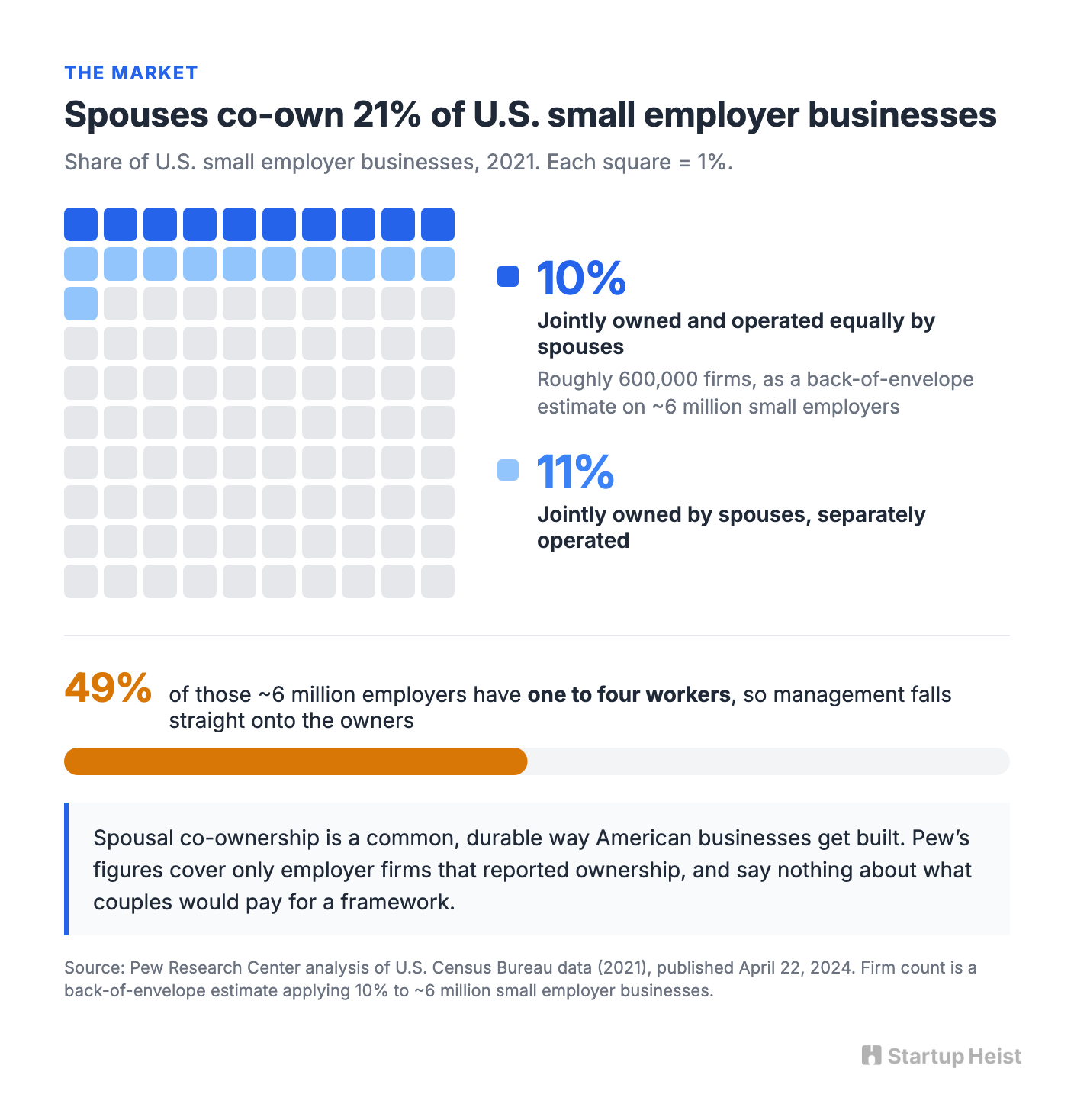
Resist multiplying 21% by the 33 million total U.S. small businesses. Pew's ownership figures cover only employer firms that reported the information, and they say nothing about how many couples run digital agencies or what they'd pay for a framework. The useful takeaway is narrower: spousal co-ownership is a common, durable way American businesses get built.
Researchers have studied this group for decades under the name copreneurs. A 2012 study in the Journal of Family Business Strategy by Patricia Hedberg and Sharon Danes found that couples who treat each other as equal partners and make decisions collaboratively form more productive business decision teams. A 2023 Journal of Business Venturing study, "Not So Silent Partners," interviewed 18 spousal pairs and traced how spouses' business roles shift as a venture grows. Neither paper proves demand for a template, though together they show the problem has a recognizable shape, and recognizable problems can be productized.
Your first customer is a married couple where both spouses actively operate a small service business: marketing agencies, web and design studios, video production shops, boutique consultancies. These businesses have recurring clients, deadlines that spill into evenings, and a clean split between "the one who sells" and "the one who delivers." A typical buyer might be a couple running a $200,000-a-year creative studio on Google Workspace and some mix of Notion, Asana, or Trello. They have plenty of places to store tasks and no settled answers to five questions: Who can commit the business to a new project? When must the other partner be consulted? What counts as an after-hours emergency? How do we raise a workload complaint without it becoming a fight? What happens when we disagree about a hire?
Each of those questions can be answered with a repeatable workflow, and nobody has packaged the set at a price a two-person shop will pay on impulse.
The Gap Between Two Crowded Shelves
On the business shelf, Asana gives two users task ownership, deadlines, and status tracking free on its Personal plan, and Starter runs $10.99 per user per month on annual billing. Premium Notion systems prove that operators will pay for structure: Easlo sells Freelance OS and Content OS at $79 each. On the relationship shelf, Notion's marketplace carries free-to-cheap couple dashboards for shared goals, calendars, and household budgets, and Paired, a guided-conversation app for couples, lists at $79.99 per couple per year. At the top end, coaching outfits such as Couplepreneurs, run by Kyle and Ariel Tresch, sell year-long mentorship programs to established entrepreneurial couples.
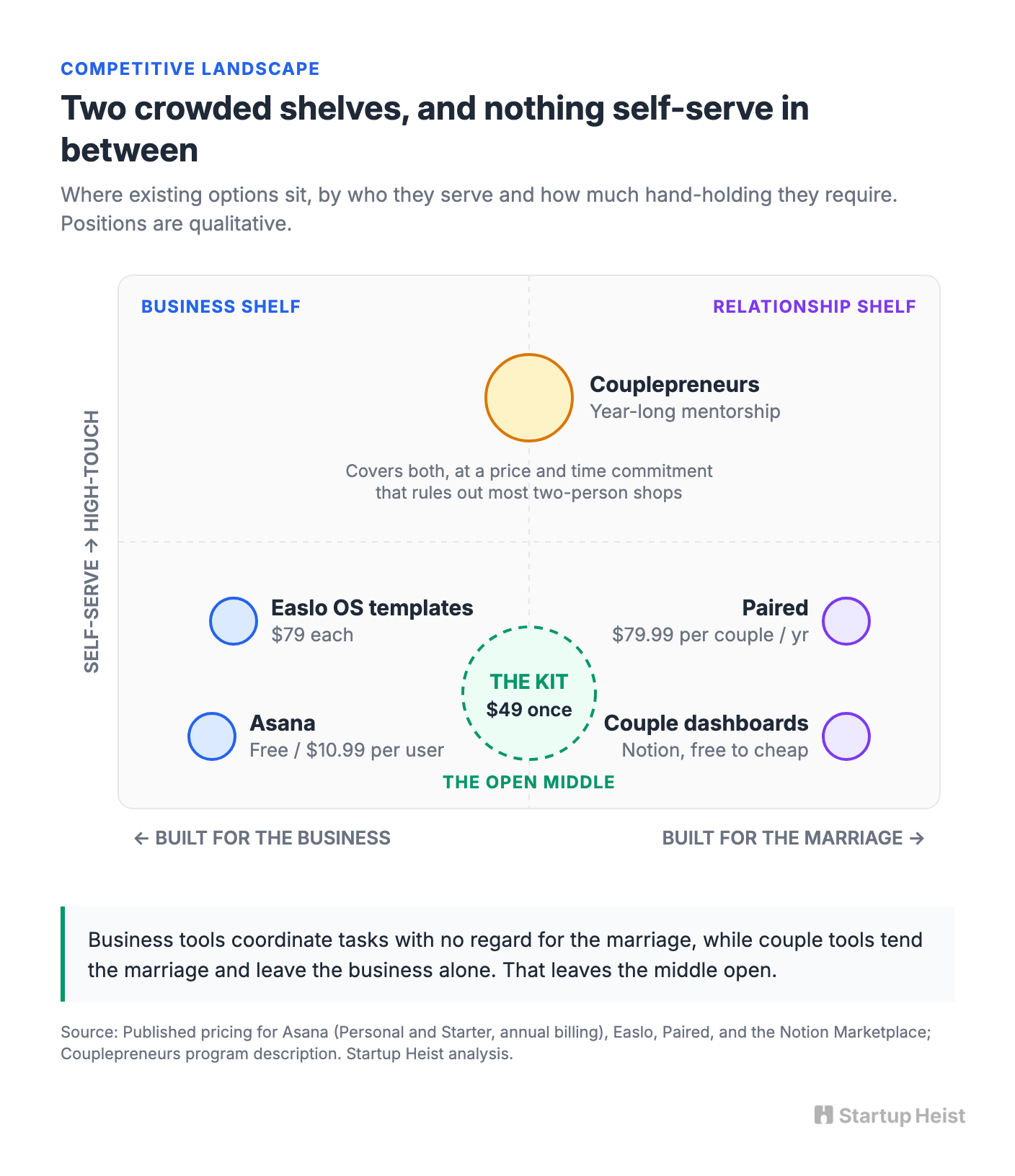
Business tools coordinate tasks with no regard for the marriage, while couple tools tend the marriage and leave the business alone. Coaching covers both, at a price and time commitment that rules out most two-person shops. That leaves the middle open: a self-serve operating method for spouses who run a company together.
| Category | What couples already get | What the kit adds |
|---|---|---|
| Project management | Tasks, owners, deadlines, status | Rules for when and how spouses discuss business |
| Business Notion templates | Dashboards, finances, projects, CRM | Decision authority and work-home boundary rituals |
| Couple planners and apps | Shared goals, calendars, guided conversations | Governance of an actively operated business |
| Copreneur coaching | Personalized strategy and accountability | A self-serve version at a fraction of the price |
There's also a borrowed precedent. Rocket Fuel, by Gino Wickman and Mark C. Winters and the companion book to the EOS operating system, prescribes a monthly "Same Page Meeting" for the two people at the top of a company, built on a running issues list and a standing agenda. Business owners already pay EOS implementers to install that structure, and nobody has adapted it for two leaders who also share a bedroom. A generic dashboard with two name fields has no pricing power. The product is the agreement the workspace helps a couple write and keep.
The Kit: Six Modules, One Agreement
Name it plainly: Business Boundaries Kit for Married Co-Founders. Promise three outcomes: clear ownership, fewer repeat arguments, and a predictable end to the workday.
Module 1: Responsibility Map. Every recurring responsibility gets one accountable owner, even when both spouses contribute. Ship it pre-filled with defaults the couple edits:
Unlock the Vault.
Join founders who spot opportunities ahead of the crowd. Actionable insights. Zero fluff.
“Intelligent, bold, minus the pretense.”
“Like discovering the cheat codes of the startup world.”
“SH is off-Broadway for founders — weird, sharp, and ahead of the curve.”


