


ClipAudit: The Missing Paper Trail in the Clipping Economy
On June 26, 2026, the National Association of Consumer Advocates sued Polymarket in D.C. Superior Court. Buried in the complaint is a screenshot of a campaign page on Whop, the marketplace where brands pay independent editors to cut and repost short clips. The terms were plain: $1 per 1,000 views, at least 60% U.S. viewers, and a line telling clippers, "Do NOT make the videos feel like ads or promotions." One of those campaigns, the complaint says, paid out $8,892 across 4,700 submissions that drew 9.1 million views.
These are allegations, and Polymarket hasn't been found liable for anything. But the filing shows something every brand buying clips should notice. A campaign with thousands of submissions from thousands of strangers leaves behind a record, and somebody is responsible for what that record says.
Clipping already has payment rails, marketplaces, and fraud filters. It still has no paper trail. The opening is a review and evidence layer for the agencies that run paid clipping campaigns, a credible micro-SaaS with a service-assisted start and a narrow class of buyers. Call it ClipAudit. Here's the opportunity at a glance:
The money: 30 agencies at $299/month is $8,970 MRR, about $108,000 a year. For scale, one streamer says he paid 303 clippers $1.4 million over five weeks.
Inside:
• The pre-payout review desk, field by field
• A 12-week MVP build and evidence model
• Volume-based pricing from $299 to $799 a month
• Outreach email and 30-day pilot plan
How the clipping machine works
In a clipping campaign, a brand skips the big influencer fees and offers hundreds of independent editors a small payment for every thousand views they generate. The editors take existing footage (podcasts, livestreams, interviews, music videos), cut it into TikToks, Reels, and Shorts, and post it on their own accounts. A $5,000 budget at a $2 CPM buys up to 2.5 million views before fees, with no production budget or retainers attached.
The numbers get large quickly. In July 2026, ListenFirst reported that streamer Rangesh "N3on" Mutama said he paid $1.4 million to 303 clippers over five weeks, and that Whop averages over 100 million views a day through clipping. On October 25, 2026, Whop's Content Rewards listings included A24 at $3,000 and a $1 CPM, Pop Mart's SKULLPANDA at $3,000 and a $6 CPM, and The Iced Coffee Hour podcast at $9,000 and a $0.75 CPM. Content Rewards Inc., which runs its own clipping platform at contentrewards.com, says 200 agencies run campaigns on it. The broader U.S. creator ad market hit $29.5 billion in 2024 and was projected at $37 billion for 2025, per the IAB. Nobody has sized the clipping slice, let alone what agencies would spend to supervise it.
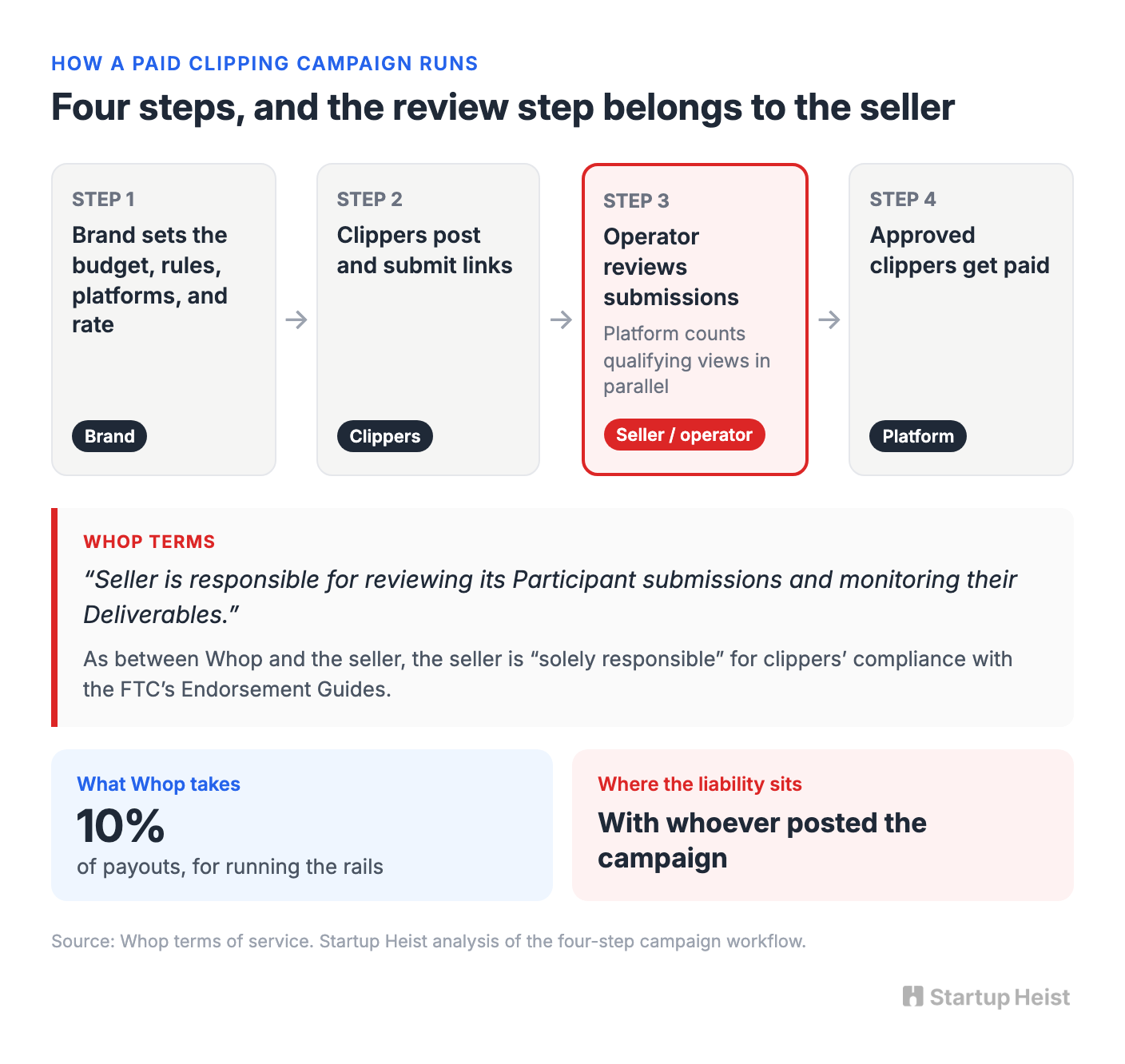
The workflow runs in four steps: a brand sets the budget, rules, platforms, and rate; clippers post and submit links; the operator reviews submissions while the platform counts qualifying views; approved clippers get paid. Whop's terms say who owns the third step. "Seller is responsible for reviewing its Participant submissions and monitoring their Deliverables," and as between Whop and the seller, the seller is "solely responsible" for clippers' compliance with the FTC's Endorsement Guides. Whop takes 10% of payouts for running the rails, while the liability stays with whoever posted the campaign.
The disclosure problem nobody can see
The FTC's Endorsement Guides, revised in 2023, require clear disclosure of a material connection when it would affect how consumers weigh the content. The FTC also expects advertisers to train and monitor the people promoting them and to act on the problems they find. Where practical, it wants paid posts pre-approved, and it warns that a platform's built-in "paid partnership" label may not be enough on its own. Responsibility reaches advertisers, endorsers, and intermediaries alike, so handing a campaign to an agency doesn't hand off the obligation.
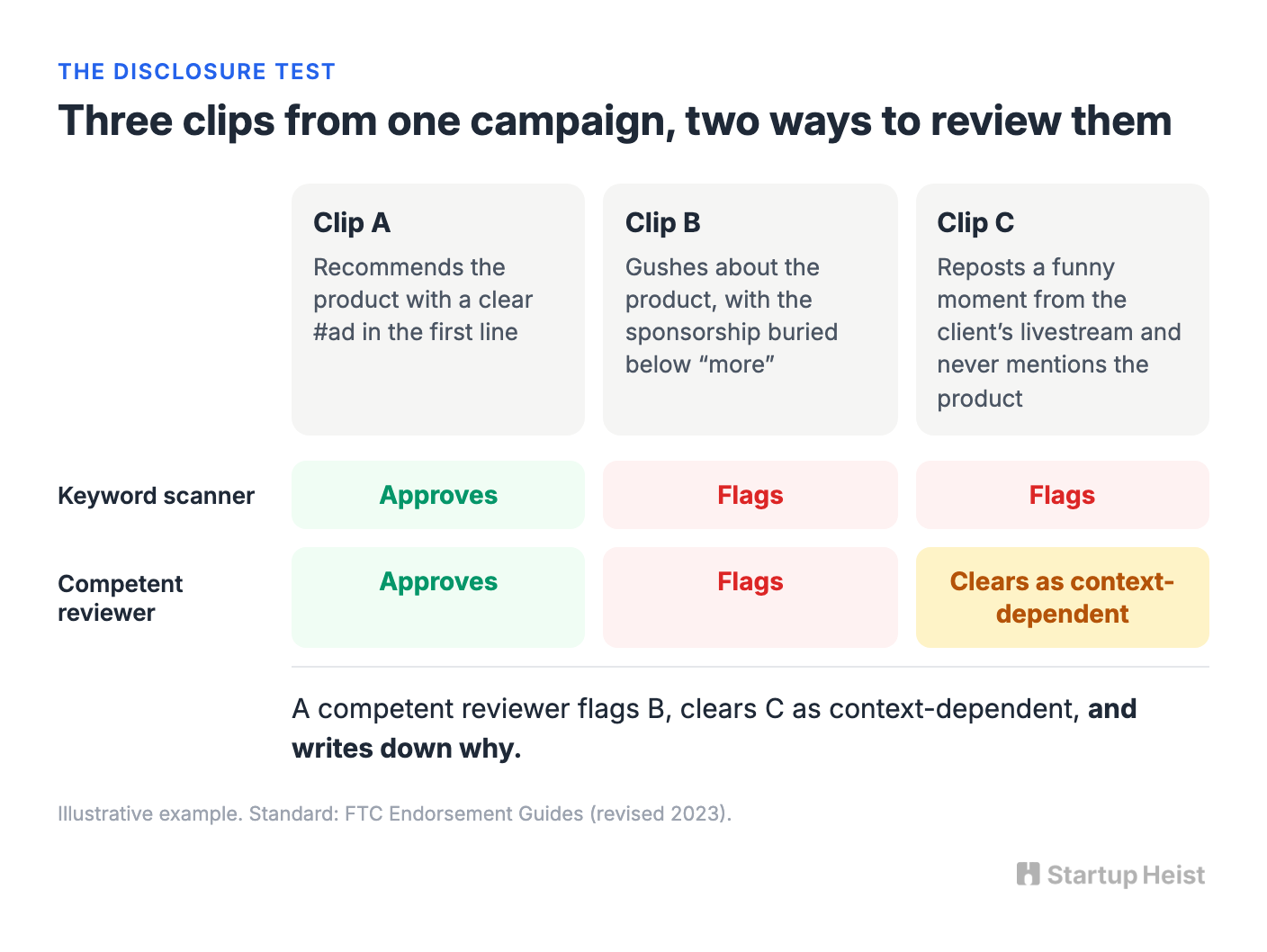
Clipping makes this hard because the content doesn't always look like an endorsement. Take three clips from one campaign. Clip A recommends the product with a clear #ad in the first line. Clip B gushes about the product, with the sponsorship buried below "more." Clip C reposts a funny moment from the client's livestream and never mentions the product. A keyword scanner approves A and flags both B and C. A competent reviewer flags B, clears C as context-dependent, and writes down why.
Three months later, the client's general counsel calls: "Did you review the paid posts? Which ones were missing disclosures? What happened after you found them?" If the agency ran its review through Slack threads and spreadsheets, it has nothing to show. A timestamped review log answers all three questions, and that log is what ClipAudit sells. It proves a process existed and was followed, though it offers no legal shield.
Everyone grades their own homework
The incumbents already cover a lot. Whop handles submissions, approvals, legitimate-view determinations, and payouts. Content Rewards gives agencies client sub-accounts, a bot-likelihood score on every submission, held payouts for flagged clips, CSV exports, and an outside view-verification beta with select agencies. Clipster checks each post against the brief on submission and keeps rechecking while it's live, routing unclear cases to a moderator. Clipping networks such as FindClout publish comparison pages attacking rivals over whose views are "actually verified." In traditional influencer marketing, Modash covers creator tracking and missing-disclosure alerts, and HypeAuditor covers audience authenticity and fraud vetting.
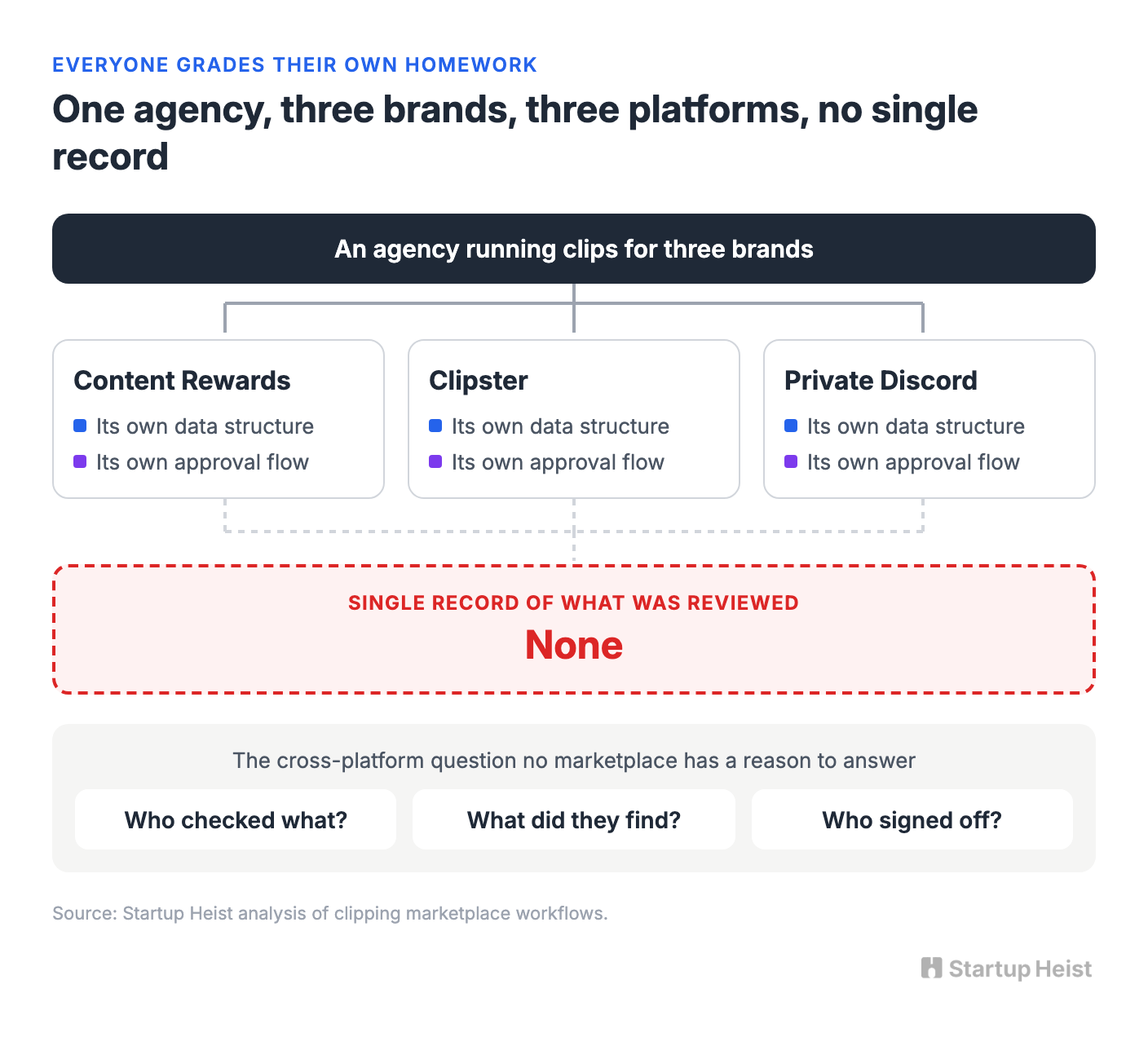
Every one of these vendors checks its own work. The marketplace that counts the views is the one that gets paid on them, and its fraud score is a vendor claim nobody outside can audit. An agency running clips for three brands across Content Rewards, Clipster, and a private Discord has three data structures, three approval flows, and no single record of what was reviewed. A small founder won't out-detect bots against platforms with first-party data and shouldn't try. The opening is the cross-platform question no marketplace has a reason to answer: who checked what, what did they find, and who signed off.
That's a hypothesis, and it could be wrong. If an agency lives entirely inside one marketplace and trusts its tools, ClipAudit adds little. The whole business depends on finding agencies whose operations have outgrown a single dashboard.
The buyer is the person who signs off
The smallest campaign operators make poor customers. A podcaster spending $1,000 won't add a $299 software bill. Someone paying five clippers directly can check links by hand. A growth marketer whose pitch rests on the biggest view count may see scrutiny as a threat.
The ideal buyer is the owner or operations lead of a clipping agency running recurring campaigns for several paying clients, with multiple reviewers and clients who expect proof of oversight. That includes clipping-native agencies, creator-marketing shops that added clipping as a service line, and entertainment marketers coordinating third-party publishers. A second buyer is worth testing: the in-house marketer at a brand spending $10,000 or more a month across several clipping networks, who has no neutral way to compare what each one delivered.
For the agency buyer, ClipAudit cuts the time reviewers spend hunting for missing information and reconstructing past decisions. It lets owners show clients what was checked alongside views and spend, and it gets new campaign managers applying the same written rules as veterans. Time savings alone won't justify $299 a month for a small shop, so the strongest qualifying signal is a formal payout-approval step. If nobody owns that decision, nobody pays for a tool that supports it.
The product: a pre-payout review desk
Unlock the Vault.
Join founders who spot opportunities ahead of the crowd. Actionable insights. Zero fluff.
“Intelligent, bold, minus the pretense.”
“Like discovering the cheat codes of the startup world.”
“SH is off-Broadway for founders — weird, sharp, and ahead of the curve.”


