


Every AI writing tool on the market is racing toward the same finish line: faster output. Paste your notes, get a polished draft, ship it. The global AI writing assistant market hit $2.3 billion in 2024 and is projected to reach $8.3 billion by 2030, with a mid-20% CAGR driven by content marketing and generative AI adoption. Real spending. Real adoption. And a crowded field of "write faster" tools — which creates room for a differentiated "think better" wedge.

The customer isn't a casual user. It's newsletter operators, B2B content strategists, solo consultants, and founder-marketers — people whose income depends on saying something their audience hasn't already read six times this week.
In January 2026, Professor Matthew Grimes at Cambridge Judge Business School unveiled Scholarly Ideas, an AI tool designed to surface genuine intellectual puzzles rather than locate gaps in existing research. The tool uses a Socratic framework, cross-compatible with multiple models, to push users toward questions grounded in real anomalies. That's an academic signal with a much larger commercial implication: the bottleneck for high-leverage writers has never been typing speed. It's angle quality. And the tools everyone relies on are making that bottleneck worse.
 Matthew Grimes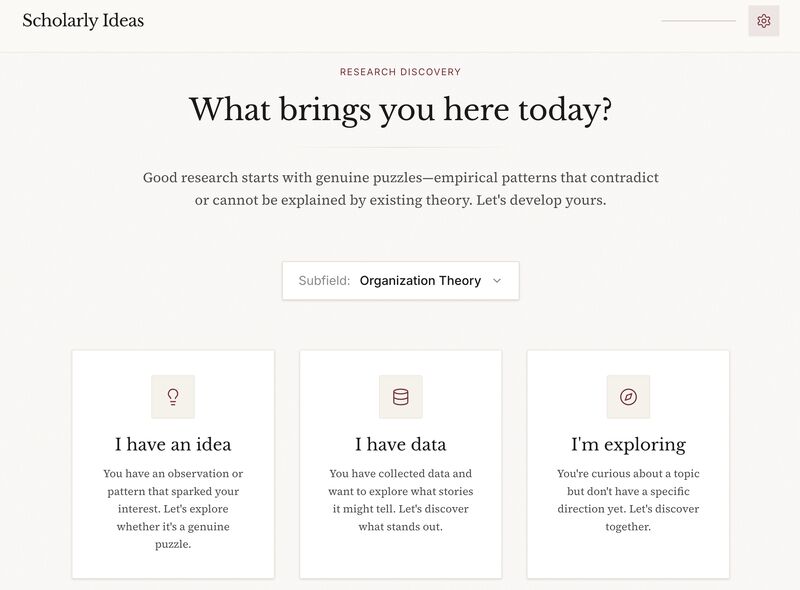
A Wharton study published in Nature Human Behaviour examined what happens when groups brainstorm with ChatGPT. Individual ideas got more creative. But across the group, the pool of ideas became dramatically less diverse. In one task — inventing toys using a brick and a fan — 94% of ChatGPT-assisted ideas shared overlapping concepts. Nine participants independently named their invention "Build-a-Breeze Castle." Among participants who brainstormed without AI, every single idea was unique. A 2024 study in Science Advances confirmed the same pattern in fiction writing: AI-assisted stories were rated higher in quality and enjoyment individually, especially among less-creative writers, whose work improved by as much as 26.6% in rated writing quality. But the AI-assisted stories were significantly more similar to each other. The researchers called it a social dilemma: each writer is individually better off, but collectively, the range of novel content shrinks.
A 2025 study on writer-AI interaction added the critical nuance. Auto-complete systems — the kind built into most writing tools — tend to hamper idea generation. Writers become less likely to develop original insights through the act of writing itself. Socratic AI systems, which pose probing questions instead of generating text, actually facilitate ideation.
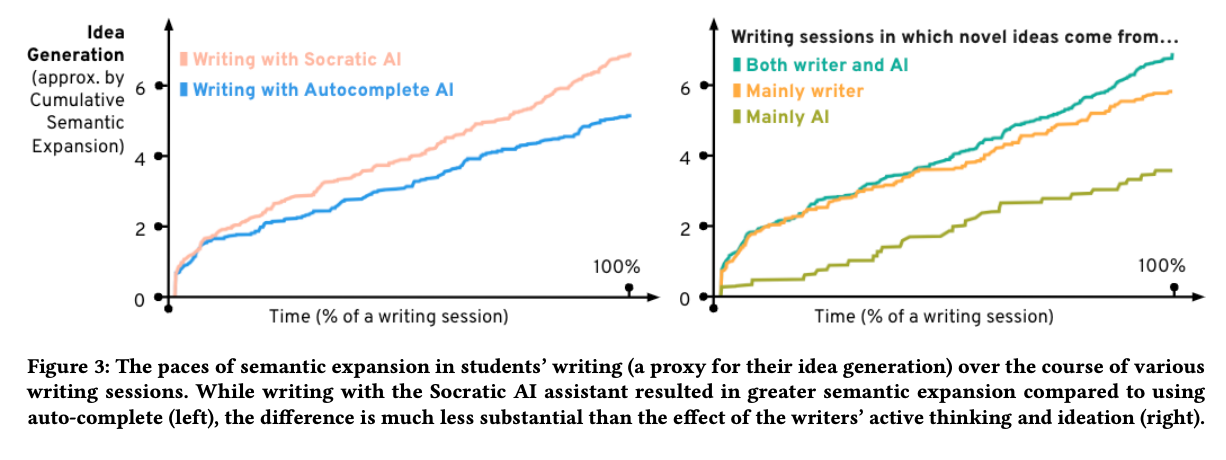
Give people finished text and they stop thinking. Give them better questions and they think harder. AI is making everyone's work better on average and more alike in aggregate. The more your niche adopts generic AI assistance, the more valuable a divergence engine becomes.
The Product: A Contrarian Socratic Editor
Picture a premium thinking tool — a SaaS workflow for consultants, strategists, and creators who publish under their own name. Users paste a draft, memo, thesis, newsletter outline, sales narrative, or market note. The product doesn't write for them. It pressure-tests them. It flags consensus language, spots hidden contradictions, proposes rabbit holes, and maps unasked questions while preserving the author's voice. No generated drafts unless you explicitly ask.

Closer to a sparring partner than a ghostwriter. And the part that matters commercially: if you ship "paste text, get 10 contrarian questions," you have a weekend project. It'll get copied by a prompt pack, a Chrome extension, and three indie hackers before lunch. The product has to be opinionated enough that users feel they're adopting a method. The positioning line worth internalizing: this tool doesn't write for you. It interrogates you.
The interface should be brutally simple. One screen. Paste your draft or notes on the left.
On the right, four analysis tabs, #2 and #3 are musts:
1) Consensus highlights clichés, overused narratives, and statements that are too clean to be interesting. If your draft says "AI is transforming every industry," Consensus flags it — because your reader has seen that sentence 400 times this month and will stop reading.
Unlock the Vault.
Join founders who spot opportunities ahead of the crowd. Actionable insights. Zero fluff.
“Intelligent, bold, minus the pretense.”
“Like discovering the cheat codes of the startup world.”
“SH is off-Broadway for founders — weird, sharp, and ahead of the curve.”


