


The Wedding Quote Auditor
Three caterers bid on the same wedding. The first sends an 11-page PDF quoting $7,800. The second replies to an email with $8,450. The third attaches a spreadsheet quoting $9,100.
The couple sorts them cheapest to priciest and opens negotiations with the first one. They have just made a five-figure decision using three numbers that describe three different weddings.
Caterer A's price sits on top of a 22% service charge, never mentions china or glassware, and adds $350 for delivery. Caterer B folds staffing, rentals, delivery, and service into one figure. Caterer C quoted for 125 guests when the couple is inviting 100. Level all three to the same scope and the cheapest headline becomes the most expensive contract by roughly $800.
Corporate America solved this problem decades ago. It's called bid leveling: take every subcontractor proposal, force it into one scope, surface the exclusions, compare the totals that actually govern the job. General contractors buy dedicated software for it. Beck Technology sells DESTINI Bid Day. PlanHub ships an integrated bid leveler. Buildr now sells AI bid leveling that reads proposals, pulls out scope and pricing, and flags what each bidder quietly left out.
The event industry already has its own version. GoodEvent sells software to professional planners, festival organizers, and corporate event buyers that pushes one tender out to multiple suppliers, pulls every quote into a single dashboard, and compares them side by side against the budget while surfacing the delivery, setup, and breakdown charges that inflate a headline price. It is sold business-to-business. Couples cannot buy it.
A couple spending $34,000 on the largest single purchase of their twenties gets Gmail and a Google Sheet.
The heist is straightforward: take the buyer-side procurement desk out of corporate America and hand it to couples for $59.
The money: 5,000 couples at $59 is $295,000 a year. Twenty thousand clears $1.1 million, against 2 million U.S. weddings averaging $34,000 each.
Inside:
• Six-part catering MVP with a receipts parser
• Flat pricing: free check, $49 compare, $79 pass
• Creator and planner GTM with outreach template
• Four moat layers and the four failure modes
Don't build the wedding tax product
There's a satisfying version of this idea that you should refuse to build.
The pitch goes: vendors hear the word "wedding" and triple the price, so help couples disguise the event and catch the gougers. It sells well on TikTok, and it poisons the product. Weddings genuinely do cost more to execute than a birthday party. Weekend inventory is scarce, staffing ratios are higher, venues impose insurance and vendor restrictions, and load-in windows are tight. Lie to a caterer about the event and you get an inaccurate quote and a hostile vendor, which is a terrible foundation for software whose entire value is accuracy.
The better promise is stronger anyway, and it doesn't require anyone to be a villain:
You don't need to prove your caterer is overcharging you. You need to know what you're actually buying.
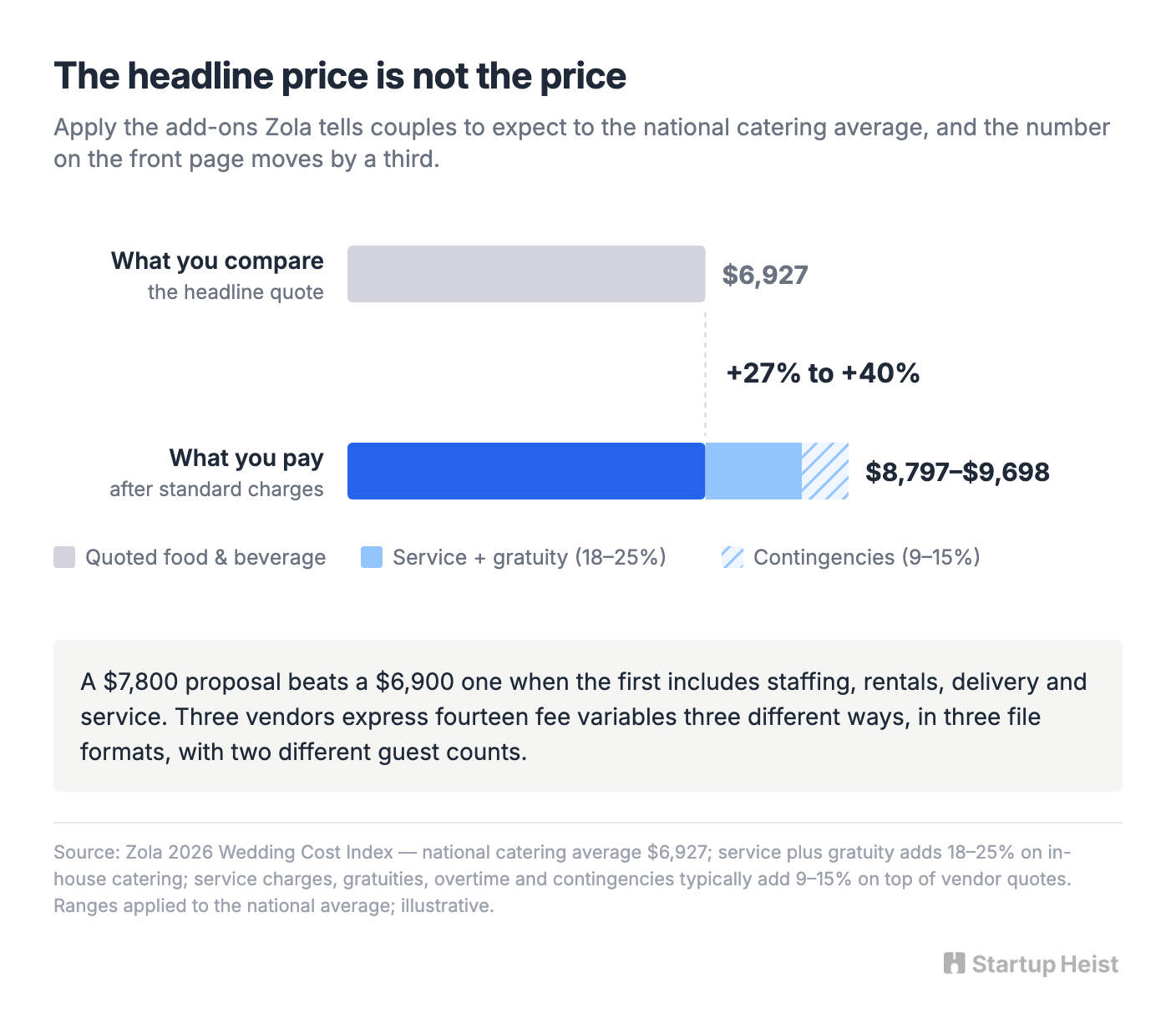
A $7,800 proposal can beat a $6,900 one when the first includes staffing, rentals, delivery, and service. Fleecing is rarely what's happening. Couples are being asked to compare heterogeneous products using headline prices, which is precisely the failure mode procurement departments exist to prevent.
Where the money actually sits
About 2 million American couples married in 2025. The Knot's 2026 Real Weddings Study, built on more than 10,000 U.S. couples, puts average spend at $34,000, or $292 per guest across an average guest list of 117. Zola's 2026 Wedding Cost Index lands at $36,000.
Concentration matters more than the top-line figure. Zola's national averages: venue $8,573, catering $6,927, flowers and décor $6,345, bar service $5,542, photography $4,400, planner $4,047. Couples hire roughly 13 vendors, and six of them absorb most of the budget. So the software only has to help someone get four or five $5,000-to-$15,000 decisions right. Thirty-vendor project management is somebody else's product.
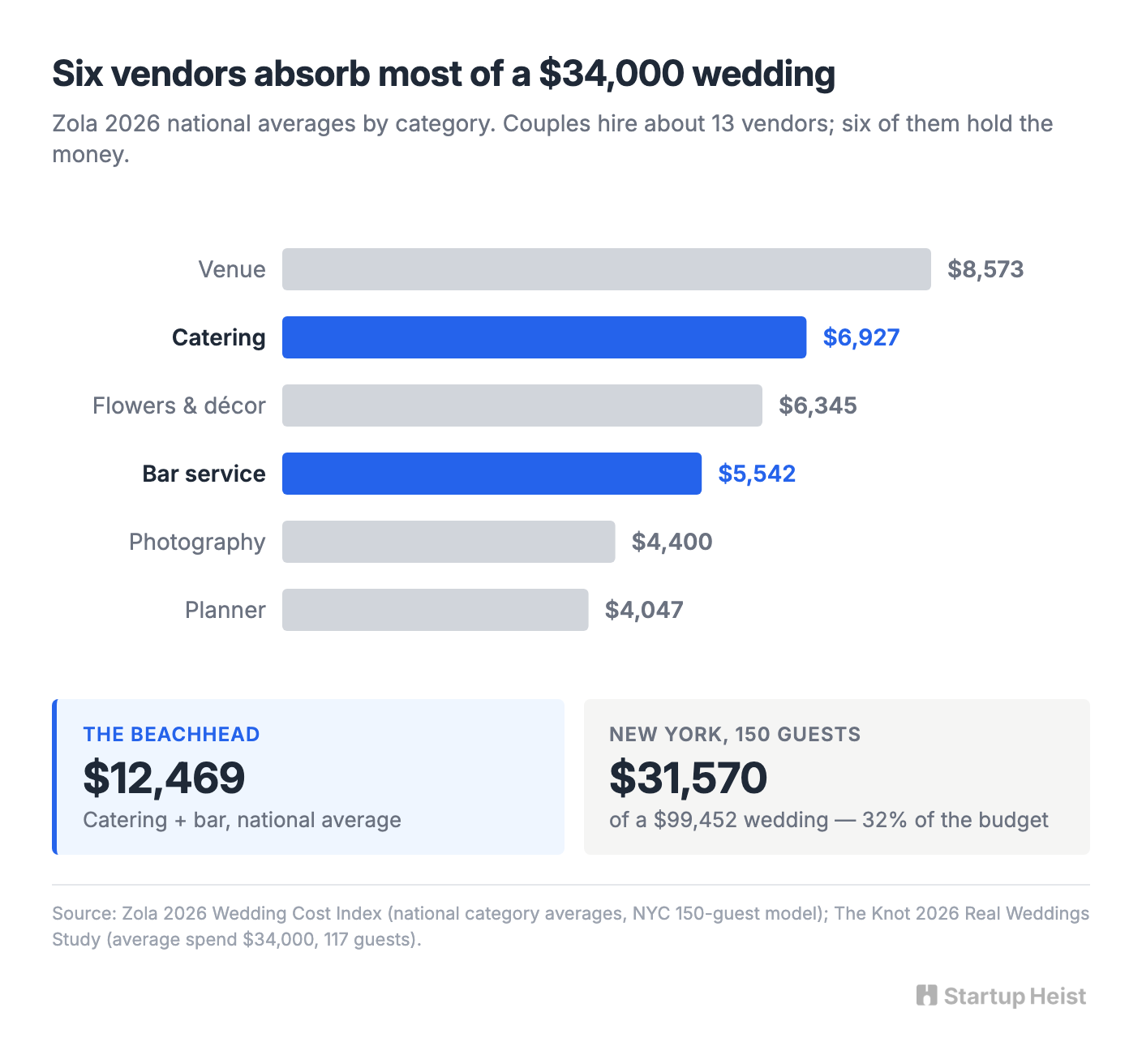
Start with catering and bar. Nationally that's about $12,500 of spend across two categories. In New York, Zola's 150-guest model runs $99,452 all in, with $17,539 going to catering and $14,031 to bar service. North of $31,000 rides on documents nobody in the transaction was trained to read.
These are also the categories where headline pricing misleads most. A single wedding catering proposal can carry food, beverage, staff, rentals, delivery, setup, breakdown, service charge, administrative fee, tax, gratuity, overtime, and minimum spend. Zola warns that service charges, gratuities, overtime, and contingencies typically add 9% to 15% on top of vendor quotes, and that service plus gratuity can add 18% to 25% on in-house catering. Zola is also explicit that a service charge usually goes to the business rather than the staff, so "22% service" tells a couple nothing about whether tipping is covered.
Three vendors will express those fourteen variables three different ways, in three different file formats, with two different guest counts. Nobody is solving that for couples.
The demo that closes the sale
The product has to prove itself in thirty seconds. A couple uploads three wedding catering quotes and gets this back:
Unlock the Vault.
Join founders who spot opportunities ahead of the crowd. Actionable insights. Zero fluff.
“Intelligent, bold, minus the pretense.”
“Like discovering the cheat codes of the startup world.”
“SH is off-Broadway for founders — weird, sharp, and ahead of the curve.”


