


Your Voice Has a Battery. Nobody Tracks It.
The opportunity: a privacy-first "vocal budget" wearable for people who earn a living with their voice.
The wearable boom has a pattern worth copying. The winners find an expensive human constraint that people can't see, measure it continuously and tell the user what to do before it turns into a problem.
Oura did it for sleep and WHOOP for training strain. Lumeria, a Y Combinator company from the Summer 2026 batch, is attempting it for skin: its Lumoscope clips onto a phone camera and uses multispectral imaging (RGB, UV and polarized light) to turn changes in hydration, redness and pigmentation into longitudinal data. The first batch sold out in under 24 hours, and the device now lists at $299 against a $329 regular price, shipping in fall 2026.
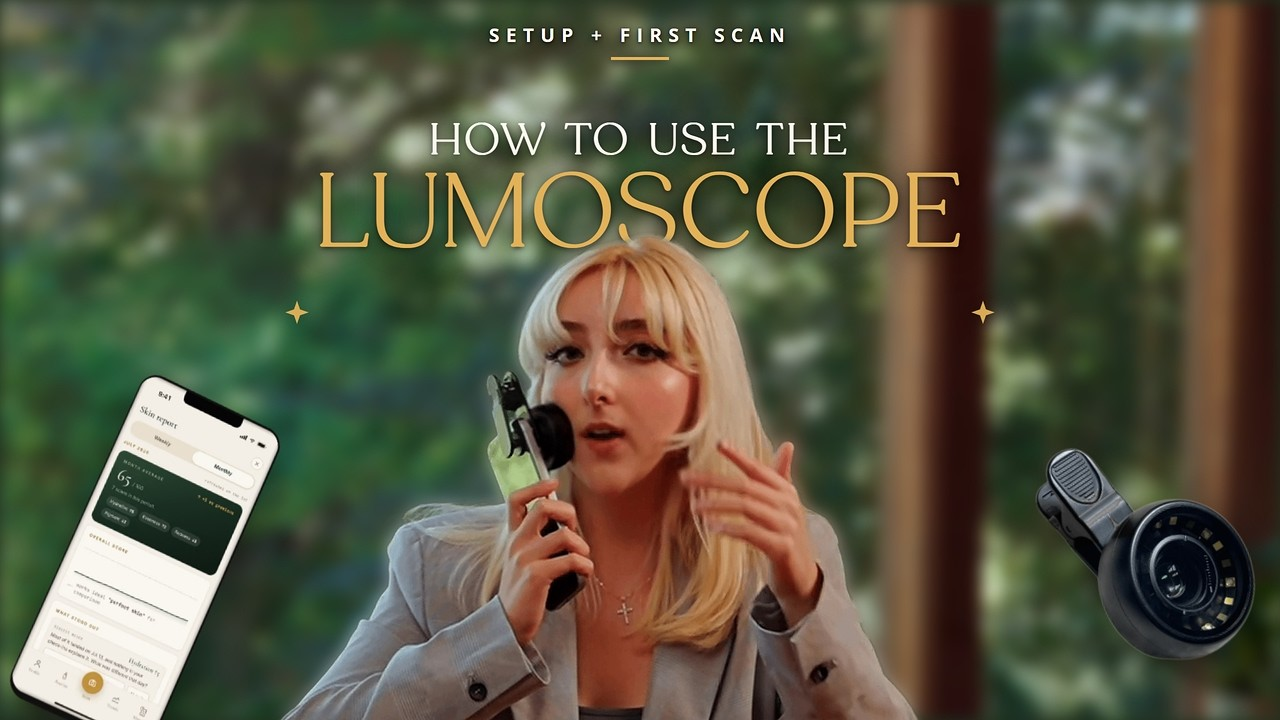
The lazy reading of that success is to order a $15 sensor from Alibaba, wrap it in an AI app and launch "the Oura for hydration." Hardware punishes founders who try it. The sharper play is narrower: a non-diagnostic vocal-load coach for singers, podcasters, teachers, voice actors, streamers and salespeople. It gives each user a daily vocal budget, tracks load continuously, fires break alerts and plans recovery around the sessions that matter.
Call it WHOOP for your voice, with a different headline number: how much voice do I have left today? Here's the shape of the business.
The money: 10,000 devices at $249 is about $2.5M upfront; 7,000 renewals at $79 a year add roughly $46K MRR. Oura expects 5.7M paid members for fiscal 2026, up 96%.
Inside:
• 90-day test ending in 100 paid deposits
• $249 device plus $79/year pricing ladder
• Coach-led distribution and outreach email
• Kill criteria and a five-part moat
The meter nobody can see
A podcast host with six interviews over two days can see her laptop battery, her sleep score, her calendar and her step count. She can't see whether she has already spent a big share of tomorrow's voice.
The same blind spot hits a teacher lecturing through five periods, a singer rehearsing before a weekend show and a rep running back-to-back demos. The signs of vocal strain arrive late: the throat tires, projection gets harder, the speaker compensates by pushing, and then a session gets cancelled or a weekend goes to silence.
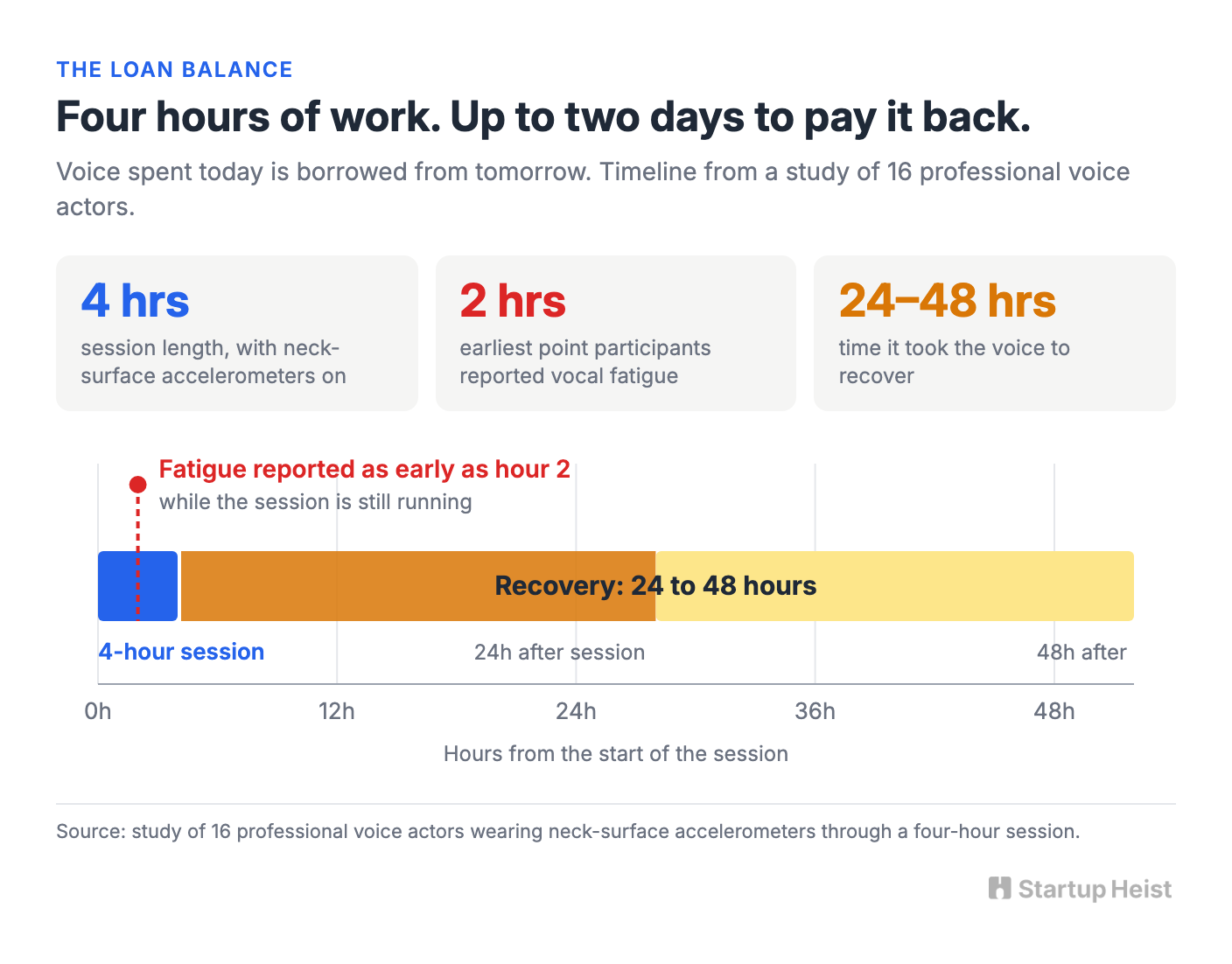
Research puts a clock on it. In a study of 16 professional voice actors wearing neck-surface accelerometers through a four-hour session, participants reported vocal fatigue as early as two hours in, and recovery took 24 to 48 hours. The business lives in that second number. Voice spent today is borrowed from tomorrow, and no mainstream wearable shows you the loan balance.
Millions of people bill by the spoken hour
The Bureau of Labor Statistics counted roughly 4.37 million U.S. teachers from preschool through high school (including special education and career and technical education) in May 2025, about 2.6 million customer service representatives and around 170,000 musicians and singers.
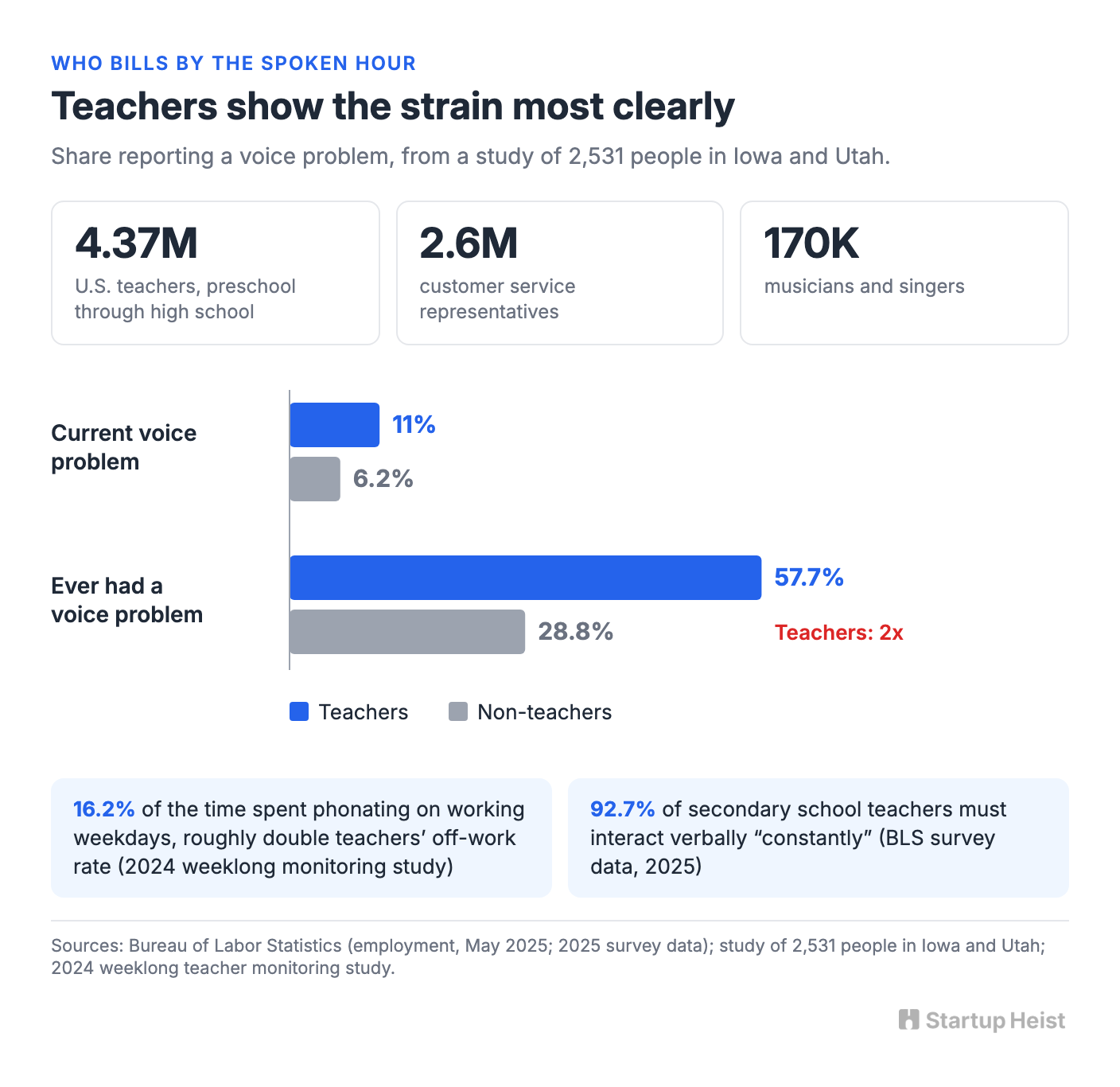
Teachers show the strain most clearly. A landmark study of 2,531 people in Iowa and Utah found 11% of teachers reporting a current voice problem versus 6.2% of non-teachers; lifetime prevalence was 57.7% versus 28.8%. A weeklong monitoring study published in 2024 found teachers phonating 16.2% of the time on working weekdays, roughly double their off-work rate, and BLS survey data for 2025 shows 92.7% of secondary school teachers must interact verbally "constantly."
Prevalence alone doesn't make a startup. The startup appears when that invisible workload becomes a number, and the science to produce the number now exists.
The sensing problem is already solved
In 2023, Northwestern researchers published a soft, postage-stamp-sized wireless device that sticks to the upper chest and reads the vibrations of speaking and singing. Machine-learning models separate the two activities, the app tallies cumulative use, and a haptic buzz fires as the wearer nears a personalized threshold. Because this wearable voice dosimeter senses vibration instead of recording audio, it sidesteps most of the privacy problem of an always-on microphone. In January 2026, Northwestern reported that the project was one of six backed by its new Querrey Simpson Institute for Translational Engineering, which exists to speed clinical validation and launch.
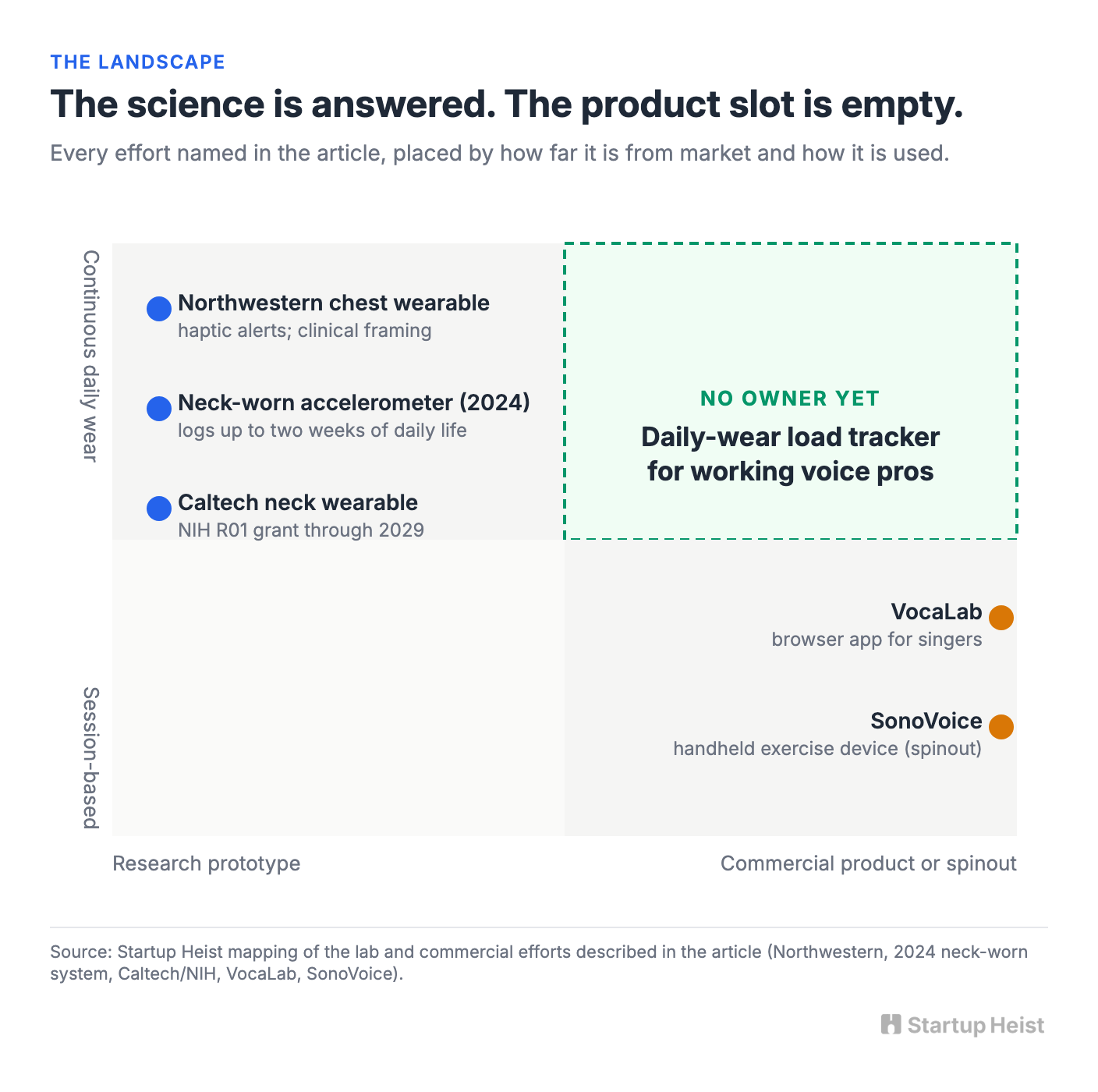
Other labs are converging. A 2024 paper described a low-power neck-worn accelerometer system that logs pitch, relative intensity and phonation time for up to two weeks in daily life. An NIH R01 grant running through 2029 funds Caltech researchers building a wireless, skin-conformable neck wearable that pairs accelerometry with muscle sensing. The commercial layer is thin. VocaLab sells singers a browser-based app with load tracking and fatigue warnings, and SonoVoice, a Duke and NC State spinout with an NSF grant, is building a handheld vocal-health device around voice exercises for clinicians and singers, a neighbor to load tracking more than a rival.
So the sensing thesis is real, and you're late to the paper. The closest efforts are research prototypes, a browser app and a handheld exercise device, and Northwestern's own framing leans clinical. None of them is a daily-wear load tracker built for working voice professionals. Closing that gap is an execution problem, and execution is something a small team can win.
Why hardware at all
Answer this before manufacturing anything, because "vocal health app" is already a crowded search result. A wearable earns its place only where a phone falls short.
Passive continuity. A phone analyzes the sessions you remember to record. The wearable captures everything in between: the three-hour dinner, the phone call after rehearsal, the hallway conversations between classes. Nobody has to log anything.
Privacy. An employer asking staff to keep microphones on all day has built a surveillance program. A vibration sensor that knows that you spoke without storing what you said is a different proposition, because the privacy lives in the architecture.
Signal ownership. If your product depends on Apple's microphone policies, background-execution rules or someone else's wearable API, your moat belongs to them. Owning the sensor gives you a unique dataset along with every hardware headache that comes with it. Take that trade with open eyes.
The product: a fuel gauge for your voice
Unlock the Vault.
Join founders who spot opportunities ahead of the crowd. Actionable insights. Zero fluff.
“Intelligent, bold, minus the pretense.”
“Like discovering the cheat codes of the startup world.”
“SH is off-Broadway for founders — weird, sharp, and ahead of the curve.”


