


The Town Joke That Sells: Building a Regional Souvenir Studio
Turn local folklore, neighborhood embarrassments, and inside jokes into illustrated merchandise that independent retailers reorder.
In September 2026, Taobao filled 1,200 square meters of exhibition space in Hangzhou with some of the strangest products on Chinese ecommerce: rhinestone cockroaches, frog-shaped utensils, toilet-inspired phone cases, and deliberately awkward plush toys. It was the second exhibition for Taobao's Uglies campaign, staged with the China Academy of Art. More than 500 products were on display, and organizers reported over 5,000 visitors a day, up from roughly 3,000 at the previous year's show.
Taobao says products tied to the campaign have generated more than 230 million yuan, about $34 million, in cumulative sales since 2020. The figure is a running total across several years, and the buying behavior behind it deserves more attention than the dollar amount. Hu Yu, who leads the Uglies program, says shoppers are buying the emotions, stories, and self-expression these objects carry. A lopsided frog sticks in the memory, and a jeweled cockroach starts the kind of conversation a tasteful brooch never would. In both cases the buyer is paying for personality.
Now walk into an independent souvenir shop in a small American coastal town. You'll find postcards, beach magnets, commemorative mugs, and a dozen versions of the town's name printed over stock artwork. The people who live there, meanwhile, have spent years joking about the seagulls that steal French fries, the bridge that has been under construction for as long as anyone can remember, or the creature from local folklore every kid has heard about. Those stories are specific and often genuinely funny, and they rarely make it onto a shelf.
The gap between those jokes and the souvenir rack is a business. Find a local joke, draw a character worth remembering, collect prepaid orders from several nearby gift shops, and print one shared batch. If it sells, print more; if it flops, you've spent hundreds of dollars learning that instead of thousands on inventory.
The money: A five-shop pilot contributes about $353 on its first run and banks 200 stickers for reorders. Thirty shops reordering quarterly is $12,000 a year in wholesale; the real income comes when proven characters move into new formats.
Inside:
• Pilot economics and reorder math
• The retailer pitch email, word for word
• A 90-day playbook with pass/fail metrics
• Four-stage path to a regional character studio
A $16 Billion Shelf With a Narrow Opening
The U.S. has roughly 22,000 gift, novelty, and souvenir stores generating about $16 billion a year, according to First Research. The category runs from Hallmark stores to Spencer's, so the number tells you how much shelf exists, which is a long way from how much of it you could reach. The travel backdrop is steady and unspectacular: the U.S. Travel Association's May 2026 forecast puts domestic leisure spending at $909 billion in 2026, up 0.9% after inflation. Retailers in a market this mature already have suppliers, price expectations, and limited counter space.
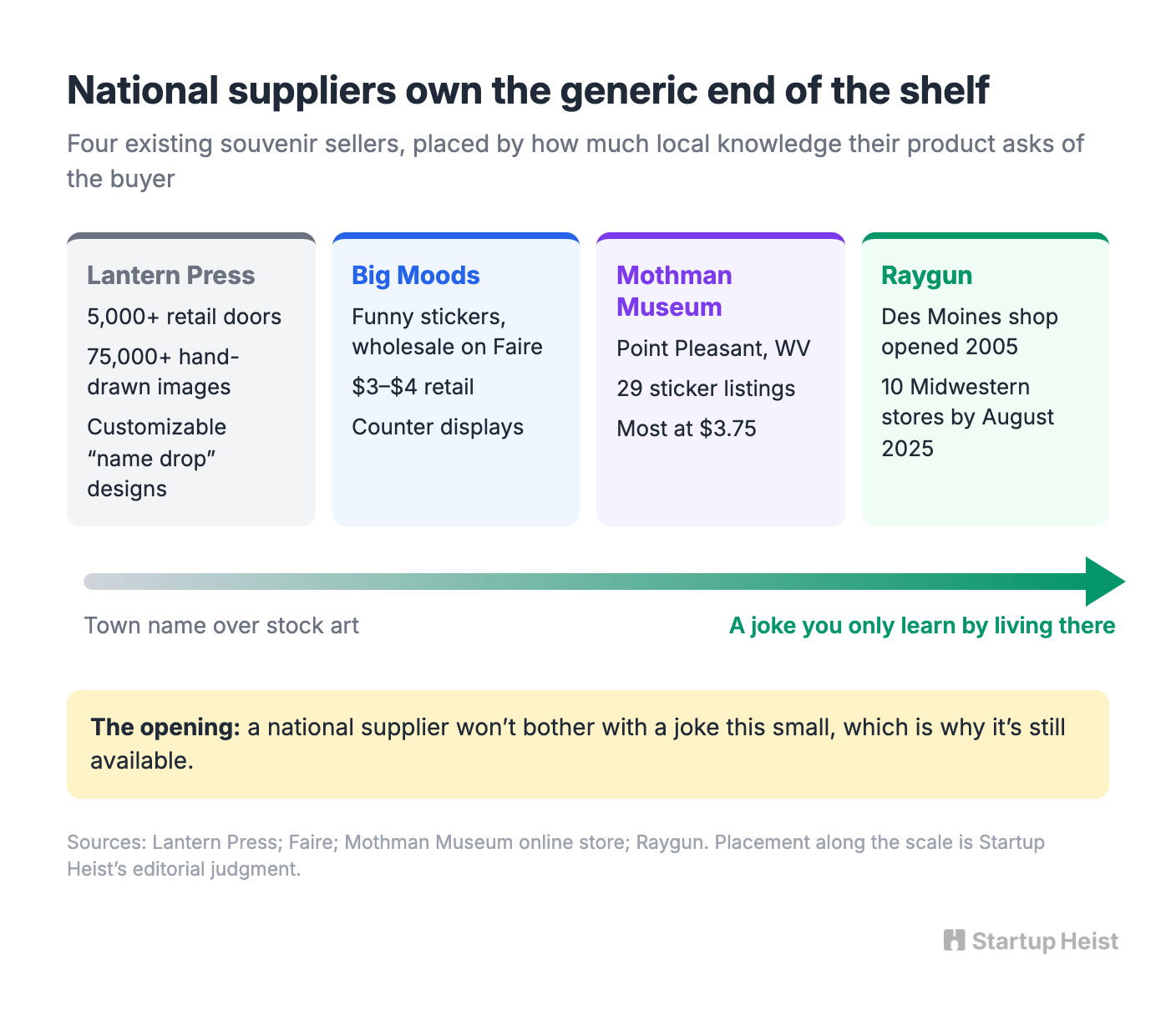
Souvenir wholesale is crowded, too. Lantern Press sells destination art into more than 5,000 retail doors from a catalog of over 75,000 hand-drawn images, with low minimums, customizable "name drop" designs, and printing done mostly in the U.S. Funny-sticker brands like Big Moods already wholesale on Faire, with stickers that retail for $3 to $4 and counter displays to match. A buyer can already get custom souvenirs and domestic printing from existing suppliers, so a new studio that leads with either is pitching something the shop already buys.
Local is the thing the big catalogs can't do. The Mothman Museum in Point Pleasant, West Virginia, has 29 sticker listings in its online store, most at $3.75, because a cryptid comes with a story people already want to be part of. In Des Moines, Mike Draper opened a T-shirt shop in 2005, ran it alone for two years, and grew Raygun into a chain with 10 Midwestern stores by August 2025, selling lines like "Des Moines: Let us exceed your already low expectations!" Both businesses sell the joke you only learn by living somewhere. A national supplier won't bother with a joke that small, which is why it's still available.
The Product Is a Local Story
A souvenir does three jobs at once. It marks where someone went, gives them a small story to tell, and works as a cheap gift or impulse buy. Most destination merchandise handles the first job and stops. Put two stickers side by side at a checkout counter: a sunset over the town's name, and a furious, badly groomed seagull gripping a stolen fry beside a phrase locals have repeated for years. The sunset records where someone went, while the seagull captures what it felt like to be there, and the gap between them is what you're testing.
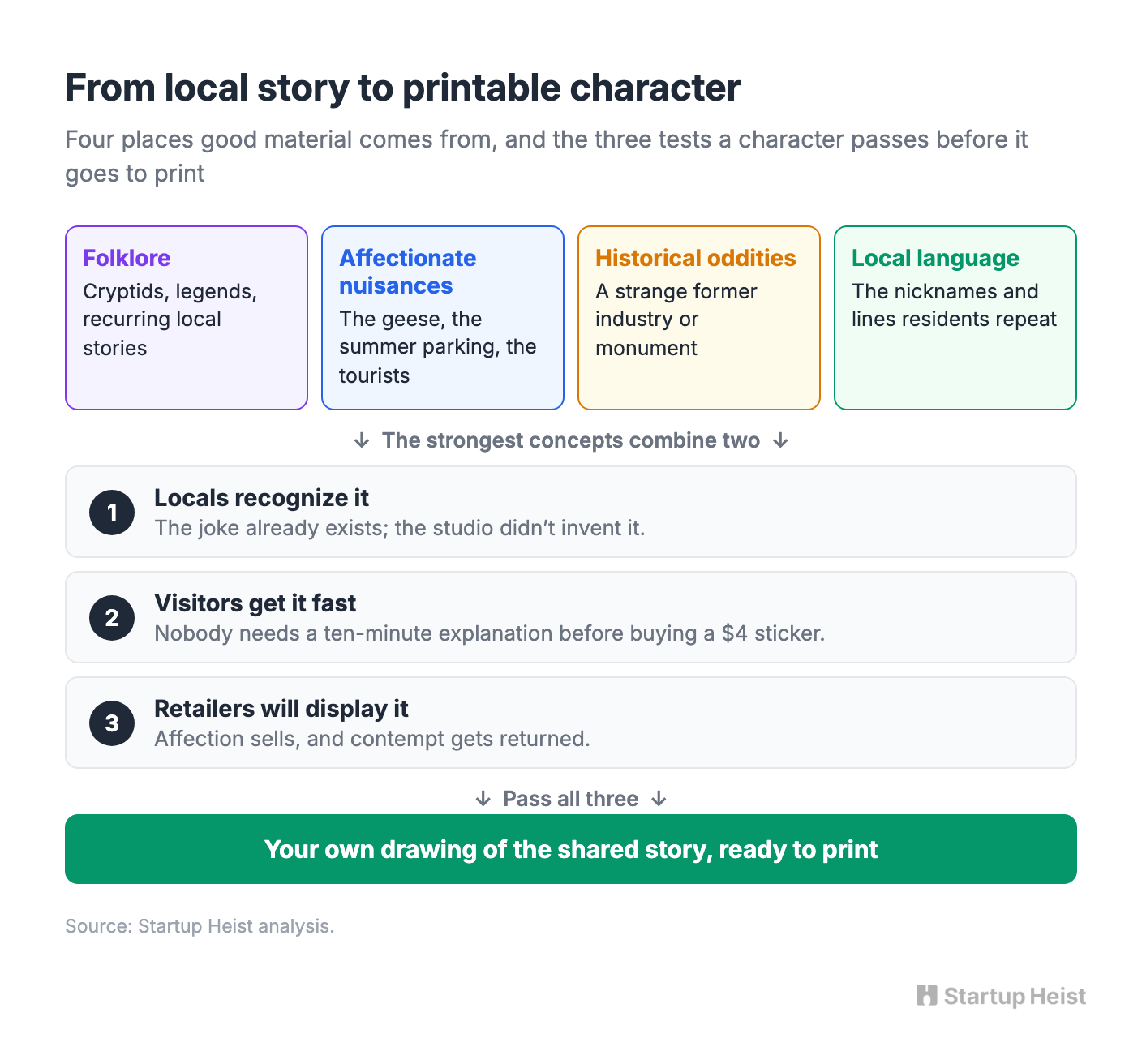
Anyone with an image model can generate a thousand cartoon potholes, and almost none will mean anything to a particular town. The work starts with research, down to the nickname residents use for the worst gull or the line shopkeepers repeat about guarding boardwalk food. Good material for local merchandise tends to come from four places: folklore (cryptids, legends, recurring local stories), affectionate nuisances (the geese, the summer parking, the tourists), historical oddities (a strange former industry or monument), and local language. The strongest concepts combine two of them. Before you print a character, it should pass three tests:
- Locals recognize it. The joke already exists; the studio didn't invent it.
- Visitors get it fast. Nobody needs a ten-minute explanation before buying a $4 sticker.
- Retailers will display it. A miserable traffic cone may delight a neighborhood bookstore and make a municipal visitor center nervous. Affection sells, and contempt gets returned.
One caution before you sketch: a famous legend isn't free intellectual property. Nobody owns the Mothman story, but specific logos, illustrations, photographs, and branded mascots built around it can belong to someone. Your character has to be your own drawing of the shared story. Making that drawing pay for itself means you stop selling it one shop at a time.
Pool the Orders Before You Print
Unlock the Vault.
Join founders who spot opportunities ahead of the crowd. Actionable insights. Zero fluff.
“Intelligent, bold, minus the pretense.”
“Like discovering the cheat codes of the startup world.”
“SH is off-Broadway for founders — weird, sharp, and ahead of the curve.”


