


The $8 Sticker Is the Bait. The Swap Night Is the Business.
Japanese adults are packing cafés to trade puffy stickers. The U.S. opportunity is to import the ritual, and let the sticker come along for the ride.
In an Osaka café built for sticker trading, grown women spread albums across the tables and negotiate swaps. "We're packed on some days and have many regulars," the manager, Mika Kawano, told reporters.
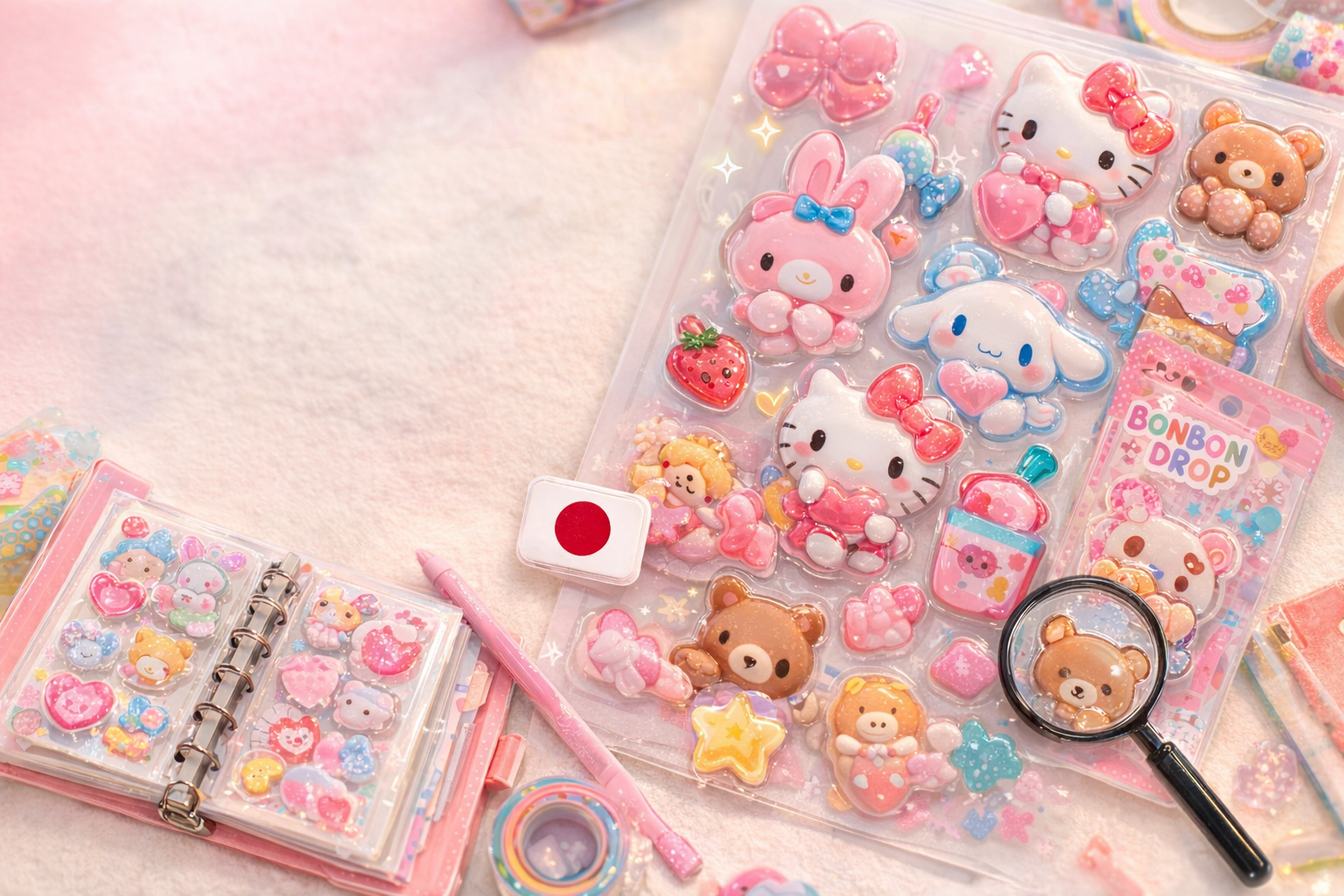
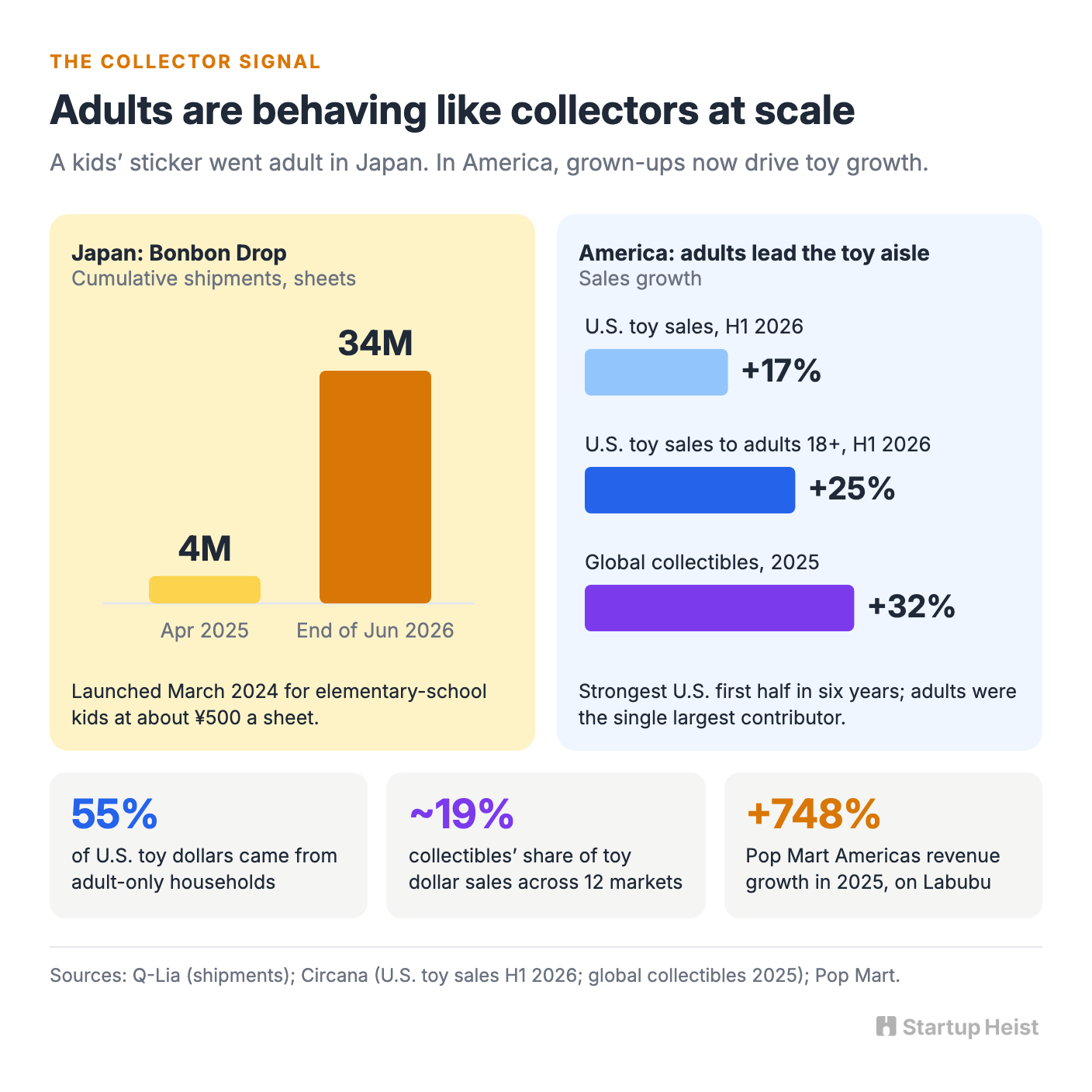
The object in their hands is Bonbon Drop, a line of glossy, raised puffy stickers from Osaka stationery maker Q-Lia. It launched in March 2024 as a product for elementary-school kids and sells for about ¥500 a sheet. Around spring 2025, adults started posting photos of Bonbon Drops on phone cases and cosmetic containers. Women in their late 20s and 30s, the generation that traded stickers in the schoolyard during Japan's Heisei era, came back to the sticker craze with adult paychecks. Q-Lia says cumulative shipments rose from roughly 4 million sheets in April 2025 to 34 million by the end of June 2026.
A growth curve like that makes a founder want to call a factory, and that instinct is worth resisting. Bonbon Drop lookalikes already show up on U.S. TikTok Shop, and Japanese police are making counterfeit arrests. The sticker is the easiest part of this story to copy and the least valuable part to own.
What's worth stealing is everything that happened around the sticker. A cheap stationery product became something people collect, display, hunt for, carry to a café, trade with strangers, and film. Build that in America: an original collectible-sticker brand for adults with commissioned art, small numbered seasons, collaborating illustrators who bring their own audiences, and recurring swap nights at cafés, bookstores, and maker spaces. The product gets someone through the door, and the ritual is what brings them back the following month.
Here's the opportunity at a glance:
The money: 5,000 active collectors spending $100 a year is $500K in annual sales, with starter sets carrying about a 56% contribution margin.
Inside:
• Season Zero lineup and set pricing
• Trade mechanics that skip fake rarity
• Venue pitch script for your first swap nights
• 12-week MVP with seven kill criteria
Be clear-eyed about what this is. Bonbon Drop's surge began in December 2024 after character collaborations with Chiikawa and Sanrio. An original brand starts without that licensed pull, so your illustrators and your swap nights have to carry the weight. Puffy stickers are also easy to source and easy to copy, so you won't win on manufacturing. What you can build is a small consumer brand with a community moat, run like one.
Why the ritual can cross the Pacific
Nobody should expect America to buy 34 million sheets of puffy stickers. The stronger signal is that American adults have started behaving like collectors at scale.
U.S. toy sales grew 17% in the first half of 2026, the strongest first half in six years, according to Circana. Sales to adults 18 and older grew 25%, making them the single largest contributor, and adult-only households accounted for 55% of toy dollars. Circana put the shift plainly: toys "increasingly function as hobbies, fandom ecosystems, and social experiences rather than traditional children's products." Globally, collectibles grew 32% in 2025 and now make up almost 19% of toy dollar sales across the 12 markets Circana tracks. Pop Mart's Americas revenue rose 748% in 2025 on the back of Labubu.
Adults are also putting their collections on display. Pinterest's 2026 Hobbies Trend Report, published August 25, 2026, names a behavior it calls Curated Clutter, where small collections become "styled identity statements." Searches for "trinket shelf ideas" rose 852%. "Travel sticker collection display ideas" rose 74%, and "kpop photocard binder" rose 54%. A sticker fits this environment unusually well: it's cheap, tactile, visual, easy to ship, and made to be photographed.
The 2026 World Cup then gave Americans a mass tutorial in swapping. Panini's album, with 980 stickers to complete, sent collectors to rooftop swap brunches in Brooklyn, library swap meets in Miami-Dade, and QR-code trading inside Panini's own app. Few of those soccer fans will buy your stickers. What the World Cup left behind is a public that no longer needs a five-minute explanation of what a sticker swap is.
The mistake everyone will make
The obvious play is to sell cute stickers, and the category is already crowded with them. Pipsticks sells a $5.95 "Puffy Sticker Club" sheet whose listing invites buyers to "collect and trade with other sticker lovers," and nothing on the page says where or when that trading happens. Marketplaces are full of generic squishy stickers, and custom puffy manufacturing is available to anyone with a credit card and an illustration file.
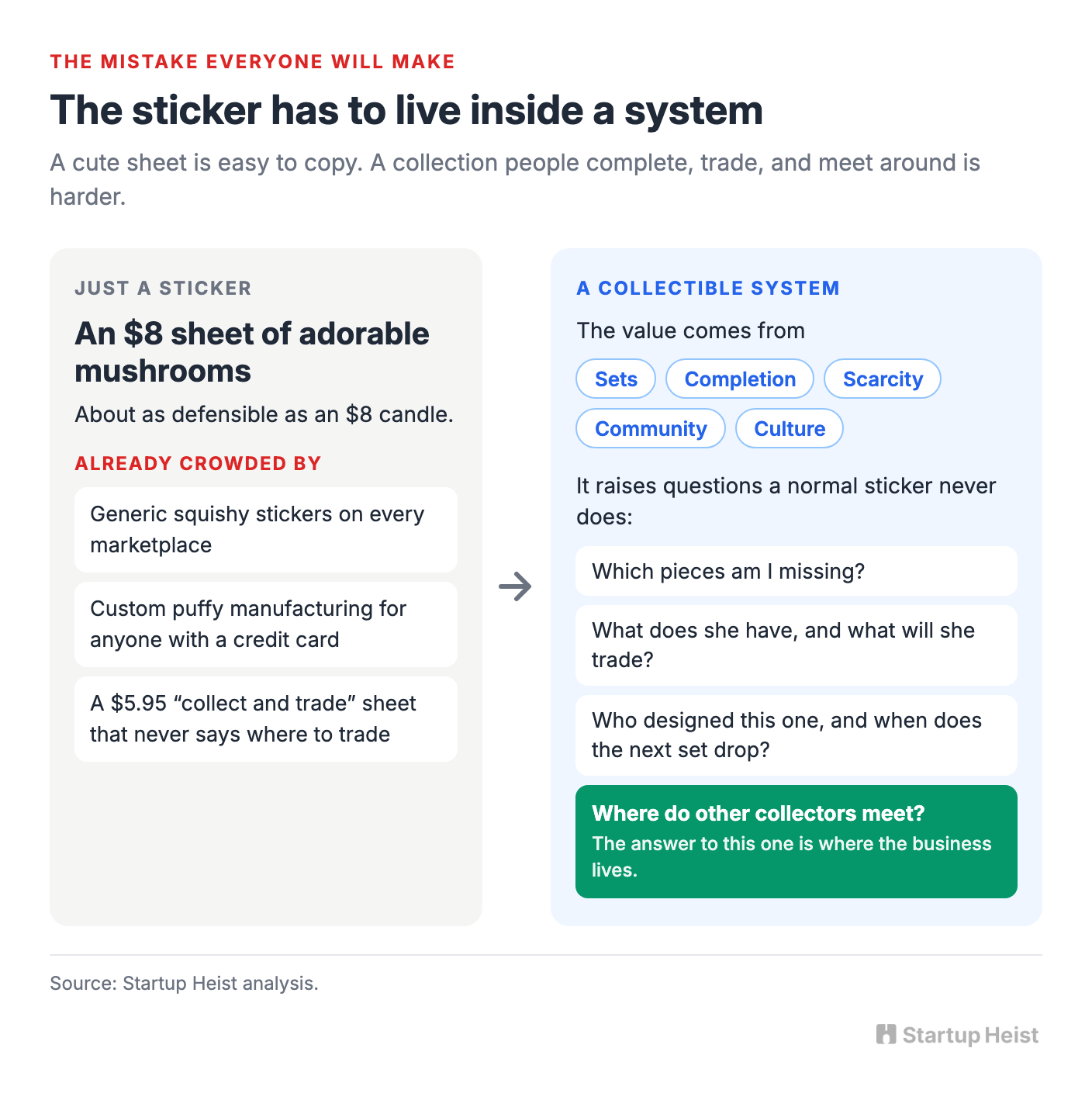
A new $8 sheet of adorable mushrooms is about as defensible as an $8 candle. People might like it, and TikTok might like it, right up until someone makes another one.
The sticker has to live inside a system. A Pikachu printed on cardboard is worth pennies as an industrial object; the value comes from sets, completion, scarcity, community, and decades of culture. You won't rebuild Pokémon. But the principle works at miniature scale, because a collectible creates questions a normal sticker never raises:
- Which pieces am I missing?
- What does she have, and what will she trade?
- Who designed this one, and when does the next set drop?
- Where do other collectors meet?
A collectible system gives customers an answer to every one of those, and the answer to the last one is where the business lives.
Position it as a club with inventory
The positioning line: limited, artist-designed puffy sticker collections made to collect, display, and swap in public.
Treat it as a small adult hobby, and keep it well clear of children's toys, stationery supply, and anything that smells like an "investment collectible." The emotional territory sits between journaling, Sonny Angels, enamel pins, zines, K-pop photocards, and the small objects people clip to bags and phones. You're selling tiny pieces of art that give people an excuse to meet.
Every product decision follows from that. The art should be good enough that a 31-year-old designer would put it on her AirPods case without feeling like she wandered into a kindergarten aisle. Packaging should read as an indie print drop. Artist names, season numbers, and continuity between releases all matter. And the brand should never tell customers a sticker is "worth" more because you printed ULTRA RARE on the pack.
Engineer reasons to trade
The tempting launch mechanic is common, rare, ultra-rare, and you should skip it. Printing "rare" on a sticker only announces what the manufacturer wants customers to value. Real trading starts when one collector has something another collector wants, and you can engineer that condition cleanly:
Unlock the Vault.
Join founders who spot opportunities ahead of the crowd. Actionable insights. Zero fluff.
“Intelligent, bold, minus the pretense.”
“Like discovering the cheat codes of the startup world.”
“SH is off-Broadway for founders — weird, sharp, and ahead of the curve.”


